Architecture
Victorian loft conversion by A Small Studio creates “relaxation oasis”
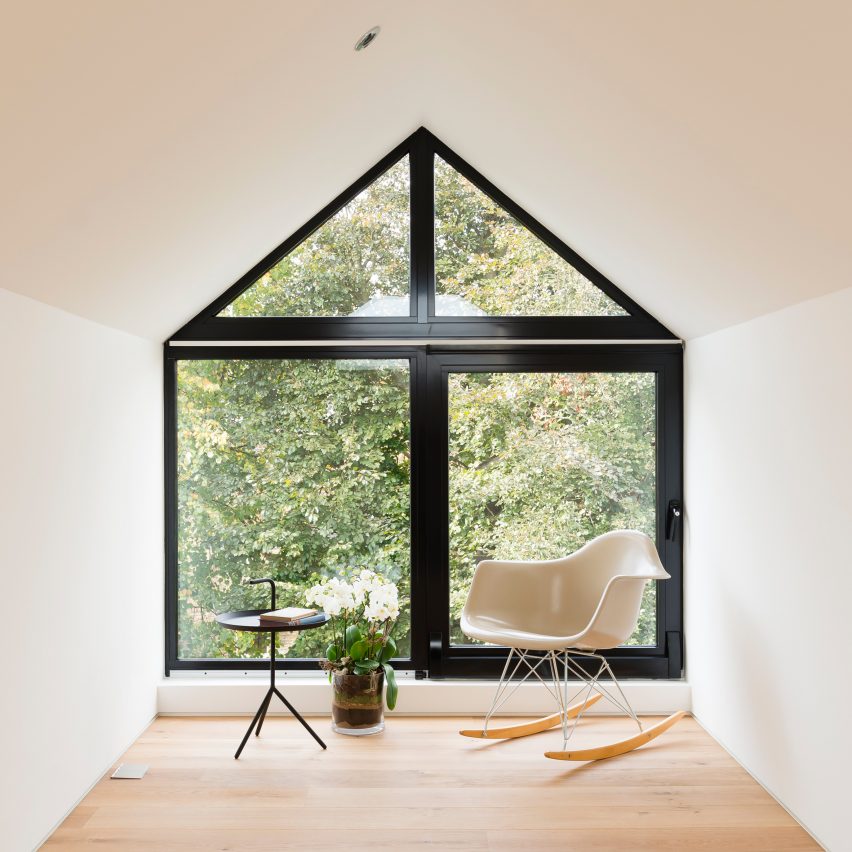
A dormer window with a thick black frame offers views of the garden from this reading room, which is one of three new loft spaces created for a home in south-east London by A Small Studio. Read more
Zaha Hadid-Designed Statuettes to be Presented at BRIT Awards 2017

BRIT statue concept sketch by Zaha Hadid Design. Image Courtesy of Zaha Hadid Architects
The BRIT Awards has announced that the statuettes that will be given during their 2017 awards ceremony have been designed by the late Zaha Hadid.
Hadid had accepted the project in January of this year and developed concepts for the design before her sudden passing in March of this year. The work has since been led by Zaha Hadid Design Director Maha Kutay and the BRIT Awards Niamh Byrne.
“Zaha was truly excited to be doing this,” recalled Kutay. “Her vision was, being an architect, to focus our efforts more on the 3D element, as the statue had previously been used as a canvas for artists to paint on for the last few years. Our design expresses Zaha’s unwavering belief in progress and optimism for the future and a break from the norm. The biggest challenge was to create something different within certain guidelines, yet achieving a result recognisable to the public. You have to respect the existing to create something new.”
The final designs will consist of a family of 5 interrelated statuettes representing diversity, and will be revealed in full later this year.
“The family is connected by a wave of transition, they are different yet connected,” explains Kutay.
Explaining his reasons for approaching Hadid, BRITs Chairman Jason Iley remarked, “Zaha’s work is innovative, original and recognises diversity in culture. It has much in common with music. She was the perfect choice for progressing the Award into the future.”
A self-proclaimed huge fan of music, Hadid took part in an interview with BBC’s Desert Island Discs, in which she listed a range of artists including Drake, Bryan Ferry, The Beatles, Sam Smith and Adele amongst her favorites.
In 2015, Hadid collaborated with artist and producer Pharrell Williams to create a pair of sneakers for the Adidas Originals line. About the collaboration Williams said, “I’m a huge fan of Zaha’s. I would venture to say that she’s one of the most talented architects of our time, and of history in my opinion.”
The BRIT Awards 2017 will take place at London’s O2 Arena on Wednesday February 22nd.
News via Zaha Hadid Architects.
Alfonso Ideas Design a Contemporary Private Residence in Taipei City

Blossom is a residential project designed by Alfonso Ideas. It is located in Taipei City, Taiwan. Photos courtesy of Alfonso Ideas
Dunalastair School Gymnasium / Patricio Schmidt + Alejandro Dumay

© Aryeh Kornfeld
- Architects: Patricio Schmidt , Alejandro Dumay
- Location: Av. Quilín, Penalolen, Peñalolén, Región Metropolitana, Chile
- Area: 2070.0 sqm
- Project Year: 2013
- Photographs: Aryeh Kornfeld
- Collaborators: María Pía Salas O, Manuel Gumucio P, Cristián Tello S.
© Aryeh Kornfeld
From the architect. The building is part of a complex which englobes the Dunalastair School (Colegio Dunalastair), located in the Community of Peñalolén, which is characterized for being a traditional, slightly urbanized rural area.
© Aryeh Kornfeld
The working plan consists in designing/developing a building dedicated mainly to indoors sport activities but also suitable for cultural events such as concerts and stage plays.The whole project, totaling an extension of 2070 m2,will consider a multi activity field with bleachers for 300 spectators, dressing rooms, storage rooms plus an infirmary.
Plan
The gymnasium will be built in a piece of land with a 7% slope which, considering the size of the construction, will result in a considerable difference in level. For this reason, it has been decided to sink the construction to certain extend so as to minimize the volumetric impact in relation with the surrounding landscape.
© Aryeh Kornfeld
The building consists of 2 concrete volumes (invested with bricks) at each end, making up the most hermetic space of the structure, holding the stage, toilets and storage rooms at one enf, and the dressing rooms at the other end. A more light structure in between, holding the playground and bleachers, is totally accessible from the school.
© Aryeh Kornfeld
Section
One of the main objectives is to allow natural light to infiltrate in all the premises, thus reducing to a minimum the energy consumption. This has been accomplished by different ceiling levels, using metal trusses 2 meter high by 28 meter in length as dormers. The resulting geometry of this structure improves the acoustic of the space and, at the same time, provides a greater spatial amplitude.
Detail
Due to the multiple purpose uses of the building it was necessary to improve the warmth and acoustics of the premises by using an interior finishing with MDF boards,veneered with natural wood, in 2 different formats: a) In the ceiling, through the original modulation of the manufacturer in 15 x 240 cm strips, 3 cm apart, lined with an acoustic insulation fabric in the inner side, in order to reduce resonance, and b) in the walls, 60×120 cm panels drilled with holes of different diameters, with the same acoustic objective but aimed to simulate an interior vegetal landscape, providing an atmosphere connected with nature.
© Aryeh Kornfeld
Tesla Unveils Fully-Integrated Solar Roof System

Elon Musk has revealed his company Tesla’s latest world-changing innovation: a solar roof system so fully integrated into a home’s architecture as to be indistinguishable from a traditional roof.
"Tuscan" Style. Image © Tesla. Via the Verge
At the unveiling event on Friday, Musk invited a crowd to the old Hollywood set of “Desperate Housewives,” the quintessential model of American suburbia. After an introduction about the imminent effects of climate change, he revealed the reason for the unique site.
“The interesting thing is that the houses you see around you are all solar houses,” said Musk. “Did you notice?”
"Smooth" Style. Image © Tesla. Via the Verge
As it turns out, nobody had. Musk had installed prototype versions of his new solar tiles onto the roofs of the surrounding houses, but their aesthetic nearly identical to that of traditional roof shingles. With many homeowners turned off by the appearance of other solar panel systems, this represents a possible breakthrough to full acceptance of solar technology.
"Slate" Style. Image © Tesla. Via the Verge
Made from textured glass, the tiles feature microscopic louvres that allow light to pass through while blocking views to the photovoltaic cell within. Tesla claims the tempered glass shingles would be “tough as steel,” with a “quasi-infinite lifetime,” and that heating elements could be added to melt snow in colder climates.
The solar roof will come in four different architectural styles: Tuscan, slate, smooth, and textured, and will be integrated into Tesla’s Powerwall 2 home solar battery, allowing most homes to produce all of the energy they would need for a typical day. Tesla is also in the process of further refining the louvre technology to bounce reflected light back onto the solar cell, potentially increasing the tiles’ efficiency.
"Textured" Style. Image © Tesla. Via the Verge
Pricing on the system has not yet been released, but Musk claims that the solar roof could cost less than than the installation of a traditional roof combined with the cost of electricity from the grid.
News via Tesla, The Verge, Bloomberg News.
New Casa Triângulo / Metro Arquitetos Associados

© Leonardo Finotti
- Architects: Metro Arquitetos Associados
- Location: R. Estados Unidos, 1324 – Jardim America, São Paulo – SP, 01427-001, Brazil
- Area: 450.0 sqm
- Project Year: 2016
- Photographs: Leonardo Finotti
- Team: Martin Corullon, Gustavo Cedroni, Helena Cavalheiro, Marina Ioshii, Renata Mori, Luis Tavares, Isadora Marchi, Rafael de Sousa, Juliana Ziebell, Gabriela Santana, Marina Pereira
- Structural Design : Inner Engenharia E Gerenciamento
- Structural Prospection: Marcondes Ferraz Engenharia
- Lightining Design : Fernanda Carvalho
- Mep : L2C ENGENHARIA
- Landscape Design : Bonsai Paisagismo
© Leonardo Finotti
From the architect. METRO began the project for a new Casa Triângulo by collaborating with their clients on an extensive search for a site suitable for one of Brazil’s most important contemporary art galleries, which has already been in operation for 28 years. This partnership ensured that that the property on Rua Estados Unidos (one of Sao Paulo’s most distinctive streets) was not simply chosen based on its physical location, but was also selected for the characteristics of an existing structure that would allow for a rapid conversion into a substantial exhibition space. The resultant gap between design and construction was just 11 months.
© Leonardo Finotti
The new building is conceived as a single large volume, housing two exhibition areas, the collection’s storage, administration and support areas totalling approximately 500sqm spread over three levels (ground, mezzanine and first floors). At almost 5m, the height of the main exhibition area is equivalent to that of the Sao Paulo’s Biennale Pavillion, making the new Casa Triângulo one of the few galleries in town with proportions of this scale.
© Leonardo Finotti
Section
© Leonardo Finotti
Regarding the external areas, the façade facing onto Rua Cristóvão Diniz – less exposed to flows of traffic than Estados Unidos – is defined by a courtyard demarcated by the extension of the concrete flooring of the gallery and at its lengeth by a pre-cast concrete bench. This helps suggest a public character conducive to both event days and the daily use of pedestrians. This is complemented by a second asphalt and gravel area which may be used for loading and unloading works of art, but also activated as additional external event space. The area fronting Rua Estados Unidos is reserved for general-access parking. Translucent polycarbonate panels form the entire perimeter of the gallery allowing for natural lighting and transparency during the day, whilst in reverse, transmitting it at night. Large pivoting openings found within these continuous panels, reinforce the permeability between interior and exterior.
© Leonardo Finotti
Materials have been selected for their efficiency at the detailing stage, either because they were prefabricated or did not require excessive finishing during construction. The polycarbonate and cement panels used on the external facade and in the lining of the main exhibition area, together with the expanded steel grills covering the ceiling, are examples of such materials.
© Leonardo Finotti
Ex of In House / Steven Holl Architects

© Paul Warchol
- Architects: Steven Holl Architects
- Location: Rhinebeck, NY, United States
- Architect In Charge: Steven Holl
- Design Architect, Project Architect: Dimitra Tsachrelia
- Project Team: Yuliya Savelyeva, Ruoyu
- Area: 918.0 ft2
- Project Year: 2016
- Photographs: Paul Warchol
- Structural Engineer: Robert Silman Associates
- Climate Engineers: Transsolar
- Contractor: JLP Home Improvement
© Paul Warchol
From the architect. The Ex of In House explores a language of space, aimed at inner spatial energy strongly bound to the ecology of the place – questioning current clichés of architectural language and commercial practice. The house is a built manifestation of the research and development project Explorations of “IN” under development at Steven Holl Architects since June 2014.
Sketch
SEVEN POINT MANIFESTO FOR EXPLORATIONS OF “IN”
-
TO STUDY ARCHITECTURE FREED FROM THE PURELY OBJECTIVE.
-
FROM ORIGINS OF ARCHITECTURE WE EXPLORE “IN”.
-
“IN”: ALL SPACE IS SACRED SPACE.
-
THE ARCHITECTURE OF “IN” DOMINATES SPACE VIA SPACE.
-
INTRINSIC “IN” IS AN ELEMENTAL FORCE OF SENSUAL BEAUTY.
-
“IN” IS USELESS, BUT IN THE FUTURE WILL BE USED. PURPOSE FINDS “IN”.
-
THE THING CONTAINING IS NOT THE THING CONTAINED.
© Paul Warchol
On twenty-eight acres of forested rock outcropping, the site named ‘T2 reserve’ has been established as an experimental topological landscape. Slated to be a subdivision with five suburban house plots, the site was joined into one natural preserved landscape.
© Paul Warchol
As a compressed form of 918 square feet on a site of twenty-eight preserved rural acres, the house serves as an alternative to modernist suburban houses that “sprawl in the landscape”. Instead, the Ex of In is a house of compression and inner voids.
Section
Section
The house’s geometry is formed from spherical spaces intersecting with tesseract trapezoids intended as a catalyst of volumetric inner space. The geometry of the spherical intersections begins to be felt at the entry porch; an orb of wood carved out of the house volume welcomes the entrant.
© Paul Warchol
The shift in section of the house alters internal space with vertical dynamic spatial overlap. Situated around one main volume, open to the second level, with the kitchen placed in the center, alternative use patterns are created. There are zero bedrooms, yet the house can sleep five.
Sketch
Instead of fossil fuel, the house is heated geothermally. Instead of grid power, the house has electricity from the sun. Thin film SoloPower photovoltaic cells are connected to a Sonnen battery energy storage system, allowing the house to be energy independent. All light fixtures are 3D printed in PLA cornstarch-based bioplastic. Glass and wood are locally sourced.
© Paul Warchol
The house was made almost entirely from raw materials by the builders, crafting solid mahogany window and door frames, a mahogany stair and birch plywood walls. There is no use of sheetrock. The spherical intersection space was also crafted in curved, thin wood layers. All natural oiled wood and plywood interior finishes are part of the arte povera materiality and economy of this place of wabi-sabi.
T3 Architecture Completes a Remodeling of a Duplex in Marseille

Duplex in Marseille is a residential project completed by T3 Architecture in 2016. The 1,076-square-foot home is located in Marseille, France. Photos by: David Giancatarina
7 Scary Architectural Elements That Wouldn’t Meet Building Code Requirements Today

The Skull Chapel in Czermna, Poland. Image© <a href='http://ift.tt/2ee69H2 user Merlin</a> licensed under <a href='http://ift.tt/2cVj3fA BY 3.0</a>
Architecture is often the backdrop, rather than the subject, of the scary. For example, The Shining owes much to the Overlook Hotel, “haunted” is often followed by “house,” and Victorian architecture has come to be associated with the creepy. In a less supernatural manner however, architectural elements themselves have proven over history to be scary in their own right. With the clarity that only retrospect can offer, it’s easy to look back on the following macabre materials, bleak utilities, and terrifying technologies in horror… but perhaps what is most scary is to consider which aspects of architecture we might blindly accept today that will also become glaringly frightening with time.
1. Paternoster Elevators
© <a href='http://ift.tt/2eea6M5 user kallerna</a> licensed under <a href='http://ift.tt/2d3FStB domain</a>
Unlike conventional elevators, paternosters have no doors and never stop. Working sort of like a completely vertical escalator or ski lift, a user steps into an open compartment looping in either the up or down direction, simply stepping off at their desired floor. The paternoster’s lack of adaptability for disability design and their safety issues–such as people staying in the compartments past their looping endpoint, or passenger changeovers gone wrong, with people falling in the shaft between compartments–mean that paternosters are now banned in most countries, though pre-existing ones can still be found scattered around Europe, sometimes repurposed to novel uses.
2. Lead Piping
© <a href='http://ift.tt/2ee7huw user KBreker</a> licensed under <a href='http://ift.tt/2aA6y58 BY 3.0</a>
Not only deadly to the likes of Colonel Mustard and Miss Scarlet, lead water piping was common up until the early 20th century before it was proven to be linked to lead poisoning. Before this knowledge, lead was favoured for its malleability, resistance to pinhole leaks, and longer lifetime compared to iron pipes.
3. Bones
The Skull Chapel in Czermna, Poland. Image© <a href='http://ift.tt/2ee69H2 user Merlin</a> licensed under <a href='http://ift.tt/2cVj3fA BY 3.0</a>
Although never a widespread practice, human bones are certainly unlikely to make it into a BIM database or drawing set schedule today. However, historic buildings such as the Sedlec Ossuary (decorated with over 40,000 human skeletons, including a chandelier made from every bone of the human body) and the Czerma Skull Chapel (with three thousand skulls making up its walls), show off a gratuitous use of tibia over timber.
4. Sky Boys
A worker on the Empire State Building. Image<a href='http://ift.tt/2ee4jX0 Wikimedia</a>. Image taken by Lewis Hine, used under <a href='http://ift.tt/2f8RRVS domain</a>
Immortalized in the (albeit staged) photograph “Lunch atop a Skyscraper,” the precarious working heights of ironworkers earned them the nicknames of “air-treaders” or “sky boys.” In the 1890s, American ironworkers had the highest accident and mortality rate of any trade, as they needed to traverse narrow steel beams all with the expectation that they would work ten-hour work days and disregard weather conditions. Today, ironworkers have greatly improved safety regulations, with nets, helmets, and harnesses, but the sheer heights remain the same, if not higher.
5. Cesspits
© <a href='http://ift.tt/2ee7aPs user Emillie via Wikimedia</a> licensed under <a href='http://ift.tt/2f8Tl2F BY 2.0</a>
Before indoor plumbing, early pit latrine-style toilets usually had a cesspool outside or underneath to collect excretion. Not only would this lead to terrible smelling neighborhoods, the “night-soil men” in charge of emptying them faced a dangerous and dirty job, with at least one recorded case of a night-soil collector who drowned after falling into one.
6. Asbestos
© <a href='http://ift.tt/2eecz9t user aramgutang</a> licensed under <a href='http://ift.tt/2d3FStB domain</a>
Once hailed as a “miracle material,” asbestos was desirable for its insulating properties, fire and heat resistance, and tensile strength. Less desirably, it was discovered to be carcinogenic when inhaled, though only after widespread international use in construction. Today, non-carcinogenic but materially similar fibreglass insulation is the most common substitute, while many older buildings throughout the world are riddled with a dangerous and difficult-to-remove reminder of our earlier ignorance.
7. Blood
© Wikimedia user Internet Archive Book Images licensed under public domain
The Phoenicians were amongst the first to use animal blood in their building methods [1]. Blood held symbolic value as a paint, but was also a powerful additive to clay used in the building of adobe bricks. On a molecular level, a tight layer of blood wraps around the clay crystals, increasing the material’s plasticity, strength and water repellence. Although this ancient technique of using mammal blood as a bio-adhesive may seem slightly grisly, as one architectural graduate sees it, revitalizing the art of blood bricks today could be a productive way of utilising waste cattle blood.
References:
- Winkler, Erhard M. “Stone: Properties, Durability in Man’s Environment.” Volume 4 of Applied Mineralogy Technische Mineralogie (2013).

