Life Science Centre of Vilnius University / Architektūros linija


© Tadas Černiauskas

© Tadas Černiauskas


© Martynas Slapšy


© Tadas Černiauskas


© Tadas Černiauskas


© Martynas Slapšy

  • Architects: Architektūros linija
  • Location: Saulėtekio al. 9, Vilnius 10221, Lithuania
  • Architects In Charge: Gintaras Čaikauskas, Miroslav Šejnicki, Virginija Venckūnienė, Vytenis Raugala
  • Area: 24084.0 sqm
  • Project Year: 2016
  • Photographs: Tadas Černiauskas, Martynas Slapšy
  • Engineers : Ekoprojektas, Viltekta
  • Clients : Vilnius University
  • Consultants: Statybos Inžinierių Konsultantų Biuras

© Martynas Slapšy

© Martynas Slapšy

The key idea of the Life Science Centre architecture are the science and teaching complex modules forming the public space layout and comprising the integral whole like different cells of the matter. Cube-shaped volumes in open spaces of Saulėtekis, reiterating the natural context and building a humanist, traditional urban structure characteristic of the city of Vilnius, resemble a feature of the historical Vilnius University ensemble – a cosy inner courtyard. The volumes comprising the square perimeter and the entrance to the building are moved out over the glass vestibule and the merging space unites the areas of the main lobby, the courtyard and the passage, seamlessly linking them with the environment. 


Diagram

Diagram

The monumental expression of the building architecture provides exceptionality and reflects the typological purpose, symbolises the austerity of science and creates a solid character of the new complex. Life is movement and growth. Notedly vibrant vertical lines of facades inspired by the impressive nature and the textural image of the adjacent trunks of the pine trees create a playful abundance of different points of view.


© Martynas Slapšy

© Martynas Slapšy

Indoor premises are planned universally, the ongoing research and training processes can be organised as needed – jointly or separately. Researchers will enjoy ultra-modern laboratories, quiet workrooms and open recreation areas. Student premises can function independently but during lectures scientists and students will meet in the audiences, teaching laboratories etc. General spaces are adapted for recreation and independent studies. 


© Tadas Černiauskas

© Tadas Černiauskas

Section

Section

© Tadas Černiauskas

© Tadas Černiauskas

The lecture auditorium complex is individualised and has a separate entrance. It can be used as an independent conference centre. 


© Martynas Slapšy

© Martynas Slapšy

http://ift.tt/2ef5qEr

Manon Bélanger Designs a Snazzy Loft in Old Montreal

Loft Vieux Montreal by Manon Bélanger (1)

Loft Vieux-Montréal is a private home located in Montreal, Canada. Completed in 2015, it was designed by Manon Bélanger. Loft Vieux-Montréal by Manon Bélanger: “This apartment is located in the Old Montreal, with a spectacular view from the terrace on the St-Lawrence River and the port. The building uses to be a fire station and was converted to condos. When the new owner bought it, the apartment hasn’t been renovated..

More…

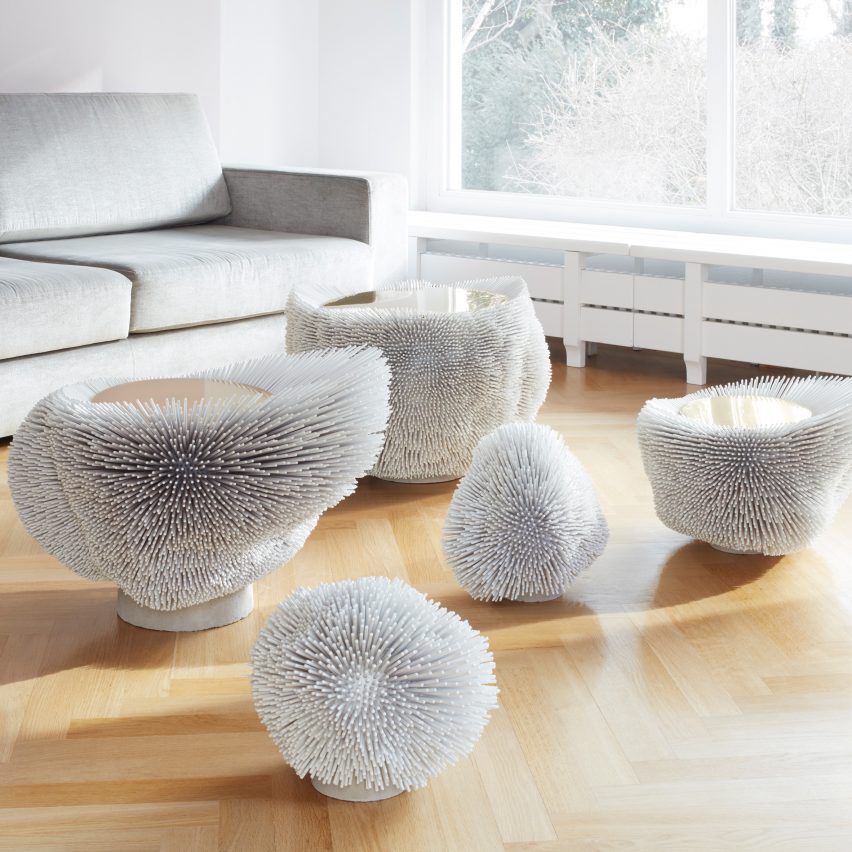
Beech rods turned into spiky furniture by Pia Maria Raeder

pia-maria-raeder-beech-reed-furniture-for-galerie-bsl-design_dezeen_sq-c

German designer Pia Maria Raeder has combined thousands of beech rods to create spiny furniture that resembles sea anemones.  Read more

http://ift.tt/2ebP1Bp

Chi She / Archi-Union Architects


© Su Shengliang

© Su Shengliang


© Su Shengliang


© Su Shengliang


© Su Shengliang


© Su Shengliang

  • Architects: Archi-Union Architects
  • Location: Xuhui, Shanghai, China
  • Architect In Charge: Philip F. Yuan / Archi-Union Architects
  • Design Team: Alex Han, Xiangping Kong, Tianrui Zhu, Qinrong Liu
  • Area: 200.0 sqm
  • Project Year: 2016
  • Photographs: Su Shengliang, Bian Lin
  • Structural Engineer: Rui Wang, Junchao Shen, Xiaofeng Zhang, Jin Wang
  • Interior Designer: Xuwei Wang, Xiaoming Chen Construction Equipment
  • Construction Equipment: Yong Liu, Changying Jiang, Xi Li
  • Fabrication Company: Fab-Union Intelligent Engineering Co. Ltd.
  • Fabrication Team: Philip F. Yuan, Yuchen Hu, Liming Zhang, Wen Zhang.

© Bian Lin

© Bian Lin

Chi She is an artistic group founded by ZHANG Peili, GENG Jiangyi, whose exhibition space in West Bund Art Exhibition Area characterizes an altitude towards realism, that is, chasing the spatial appeal, harmonizing with integral environment, as well as realizing formal representation corresponding with the artistic mission embedded inside. It is hoped that the building can provide a delicate and abundant compound art space, where contains various artistic events, such as curiosities exhibition, creative workshop and unpremeditated communication.


© Su Shengliang

© Su Shengliang

Elevations

Elevations

We retained the initial exterior walls, followed by the elementary performance enhancement and structure reinforcement, in order to provide a maximum exhibition space. Therefore, under the condition of maintaining the space perception of the whole artistic park, part of the roof has been elevated in order to create an interlayer space, where people could enjoy the intact sky view. Furthermore, the roof structure has been replaced by a lightweight and more efficient tensioning string wood structure, and part of them is lifted to obtain the skylight indicating the climate change, which presents a sense of harmony. On the other hand, the grey green bricks coordinated with this ancient building have been applied on the exterior part located on the main interface towards the park. When the wall in the entrance is curled up a lit bit, this generated wrinkle wall texture becomes the impressive part of the form manipulation, which represents the architectural expressions as well, that is, a status that embodies current cultural trends based on tradition. 


© Su Shengliang

© Su Shengliang

Diagaram

Diagaram

In order to complete such a masonry process that cannot be precisely achieved by traditional technology, we applied the robotic masonry fabrication technique by Fab-Union, which accomplishes the first endeavor to utilize the advanced digital fabrication technology to construct on site. The external walls of Chi She were built by the recycled grey green bricks from the old building and constructed with the help of the advanced technology of mechanical arm, which generates a cambered surface morphology, showing the vitality of Chi She.


© Su Shengliang

© Su Shengliang

The precise positioning of the integrated equipment of robotic masonry fabrication technique and the construction elaborately to the mortar and bricks by the craftsmen makes this ancient material, brick, be able to meet the requirements in the new era, and realizes the presentation of the design model consummately. The dilapidation of these old bricks coordinated with the stretch display of the curving walls are narrating a connection between people and bricks, machines and construction, design and culture, which will be spread permanently in the shadow of external walls under the setting sun.


Sections

Sections

http://ift.tt/2ehAPKb

MPavilion 2016 / Bijoy Jain of Studio Mumbai


© John Gollings

© John Gollings


© John Gollings


© John Gollings


© John Gollings


© John Gollings

  • Other Participants: Arup and Kane Construction

© John Gollings

© John Gollings

MPavilion 2016 is part of an international movement in handmade architecture and uses 7km of bamboo, 50t of stone and 26km of rope to create an extraordinary 16.8m square summer pavilion for Melbourne. Encapsulating Jain’s ongoing interest in traditional craftsmanship and human connectedness, the pavilion sits on a bluestone floor sourced from a quarry in Port Fairy, Victoria. Bamboo poles imported from India especially for the MPavilion are pegged together with 5,000 wooden pins and lashed together with rope. Slatted panels that form the MPavilion roof are constructed from sticks from the Karvi plant woven together by craftspeople in India over four months. 


Plans

Plans

MPavilion’s design features an opening at the centre of the roof that Bijoy Jain sees as connecting earth to sky and below sits a golden well symbolising the importance of water to place and community. An elaborate ‘tazia’ entrance tower, as used in Indian ceremonies, sits next to the pavilion as a welcoming gesture. 


© John Gollings

© John Gollings

MPavilion features lighting design by Ben Cobham of Bluebottle. Activated at twilight every night, the pavilion will be lit in-synch with a specially commissioned nightly soundscape by artists Geoff Nees and J David Franzke.


Elevation + Section

Elevation + Section

The MPavilion is an annual architecture commission and design event conceived and created by the Naomi Milgrom Foundation.  Every year, a new temporary summer pavilion designed by a leading international architect, is erected in Melbourne’s historic Queen Victoria Gardens.  From October through February, the MPavilion becomes a ‘cultural laboratory’ and home to a series of talks, workshops, performances and installations.  It is then moved to a permanent new home within Melbourne’s CBD, creating an ongoing legacy in Melbourne’s increasingly sophisticated architectural landscape.


© John Gollings

© John Gollings

Indian architect Bijoy Jain of Studio Mumbai was selected to design MPavilion 2016. Australian architect Sean Godsell designed MPavilion 2014 and in 2015 it was designed by British architect Amanda Levete of AL_A.

http://ift.tt/2djkVxF

Hirano Clinic / TSC Architects


© Masato Kawano / Nacasa&Partners Inc.

© Masato Kawano / Nacasa&Partners Inc.


© Masato Kawano / Nacasa&Partners Inc.


© Masato Kawano / Nacasa&Partners Inc.


© Masato Kawano / Nacasa&Partners Inc.


© Masato Kawano / Nacasa&Partners Inc.


© Masato Kawano / Nacasa&Partners Inc.

© Masato Kawano / Nacasa&Partners Inc.

This building was planned as the clinic which supported a medical connection with the people from a local child to the elderly.


© Masato Kawano / Nacasa&Partners Inc.

© Masato Kawano / Nacasa&Partners Inc.

A client is the doctor who performed medical care to support an area as a family doctor for a long time in this ground. The front road of the site became the attending school road of the elementary school, and the building which had children feel friendly feeling was demanded.


Plan - Section

Plan – Section

The shape that a wall assists makes a feeling of opening without giving the town a feeling of pressure and makes the memory of the town. In addition, the diagonal adjoining roof supports a building and the connection with the town. The house-shaped window of various size penetrated by the wall is each domestic symbol and watches local people warmly. We prepared the space with the warmth into the finish of the interior decoration using a variety of trees. We pray for becoming the place of the community of the people whom this building visits.


© Masato Kawano / Nacasa&Partners Inc.

© Masato Kawano / Nacasa&Partners Inc.

http://ift.tt/2dw5UXQ

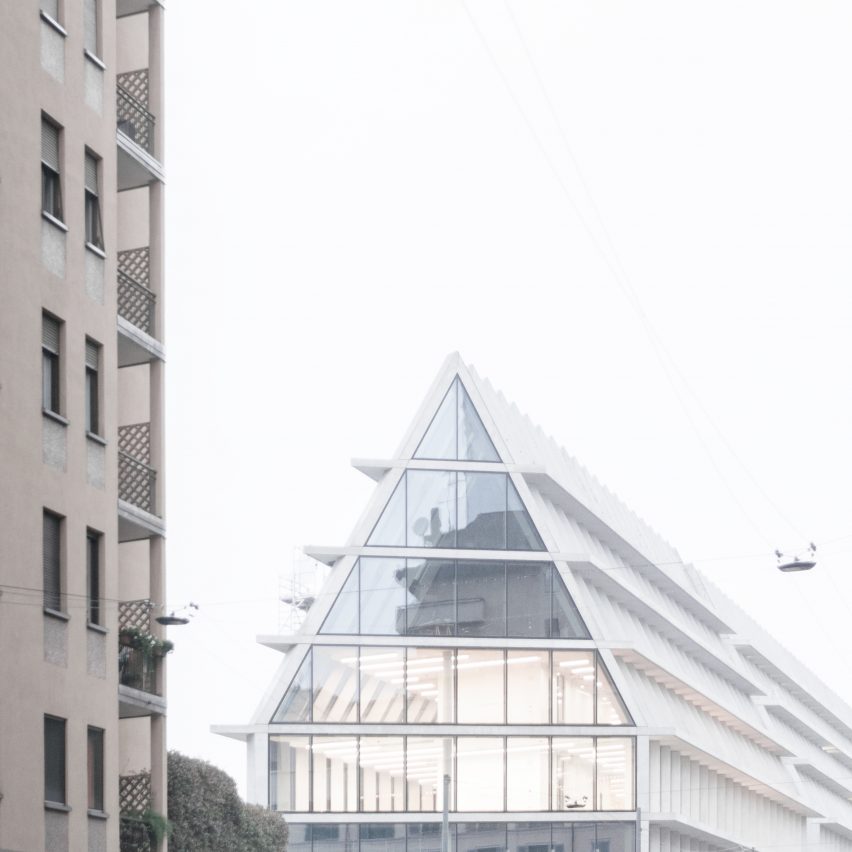
Herzog & de Meuron completes gabled Feltrinelli Porta Volta building in Milan

Feltrinelli Porta Volta by Herzog de Meuron

A grid of glazing covers the long, gabled form of this Milan building designed by Swiss firm Herzog & de Meuron to host a research centre and offices. Read more

http://ift.tt/2dX054Y

DESCENTE BLANC Marunouchi / Schemata Architects


© Kenta Hasegawa


© Kenta Hasegawa


© Kenta Hasegawa


© Kenta Hasegawa

  • Project Team: Ryosuke Yamamoto, Ou Ueno, Shun Sato
  • Construction: TANK

© Kenta Hasegawa

© Kenta Hasegawa

From the architect. This is the fourth shop we designed for the apparel brand DESCENTE BLANC in Japan, located in Shin Marunouchi Building, and its second in-shop after their shop at Expo City in Osaka. The characteristic difference from the Osaka shop is that the entire design of Shin Marunouchi Building is very authentic.


© Kenta Hasegawa

© Kenta Hasegawa

© Kenta Hasegawa

© Kenta Hasegawa

Our design concept for the DESCENTE BLANC series is to redesign the movement of shop staff to go to get stocks and incorporate automatic lifting stock stock-display systems in the ceiling. After the existing ceiling was removed, the ceiling plenum was exposed and the existing finishes above and below the removed ceiling created a sharp contrast, implying an “imaginary” ceiling plane there.


Section

Section

In order to highlight this distinctive feature, we designed the overhead stock space in the plenum space where clothes are stored closely under the ceiling, resembling an aircraft hangar. Hanger pipes are leveled so that hems of the clothes align with the “imaginary” ceiling plane, and the ceiling lights are also installed at the same level to emphasize the effect. 


© Kenta Hasegawa

© Kenta Hasegawa

http://ift.tt/2en2NPm

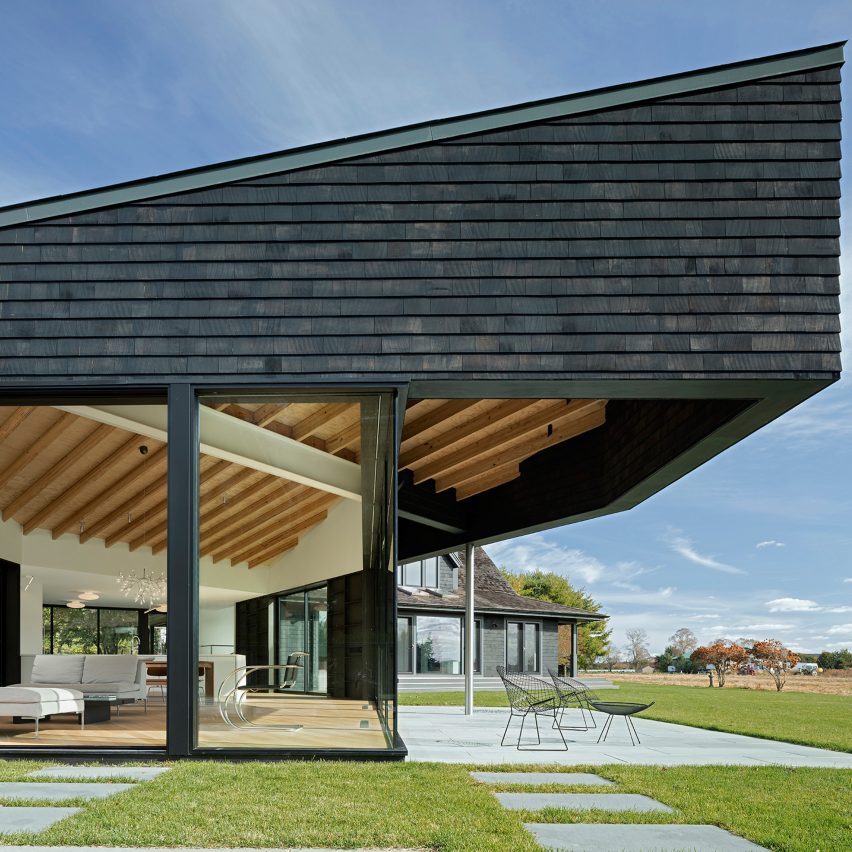
Desai Chia adds pointy extension to cedar-clad cottage in the Hamptons

Watermill House by Desai Chia Architecture

US studio Desai Chia Architecture has overhauled a country home in Long Island, New York, and created an extension that is meant to be an “expressive counterpoint” to the main dwelling. Read more

http://ift.tt/2eaQ2tH

California College of the Arts Selects 3 Firms to Compete for New Campus Design


Front of the campus "Skyline". Image © Dave Fenton

Front of the campus "Skyline". Image © Dave Fenton

The California College of the Arts (CCA) has selected 3 top firms as finalists in a competition to design “a new, ground-breaking art school that will redefine 21st century arts education.” Chosen from an original pool of 75 architects, the three firms will now submit proposals for a new campus design that aims to unify the college’s Oakland and San Francisco campuses into one vibrant Bay Area institution.

The winning firm will work together with the school over the next five years to create a plan that will bring together 2,000 students, 600 faculty members, 250 staff members, and 34 academic programs to a consolidated campus located at the intersection of the city’s innovation corridor, the new DoReMi (Dogpatch, Potrero Hill, Mission) arts district, and Mission Bay. The primary project site will be a 2.4-acre lot that borders the college’s existing San Francisco campus buildings. The campus will house all of CCA’s programs, including art, crafts, design, architecture and writing, fostering interaction between the different disciplines.


The 2.4-Acre primary project site. Image © Jim Norrena

The 2.4-Acre primary project site. Image © Jim Norrena

The three finalists are:

The campus design will follow the strategic planning framework outlined by Gensler and MKThink and further developed by local firm Jensen Architects. The plan will be held to high sustainability standards, stipulating advanced strategies for water and energy generation, usage, and conservation; healthy air quality; and environmentally safe artmaking materials and practices. Student housing will also be a priority for the campus, as the college hopes to double the number of on-campus beds to 1,000 by 2025.


CCA Site Plan. Image Courtesy of California College of the Arts

CCA Site Plan. Image Courtesy of California College of the Arts

Later this month, the three finalists will give presentations to the CCA community and public, with a winner expected to be selected in November 2016.

For more information, visit the CCA website, here.

News via CCA.

http://ift.tt/2eaO10G