The TED conference series has enabled leading thinkers, including architects, to share their ideas with the world for over 30 years. Dezeen contributing editor Jenna M McKnight has chosen some of the best presentations about the built environment from the past three decades. Read more
Frederick Fisher and Partners was selected to design the new Science Education & Research Facility for the Crossroads School for Arts & Sciences in Santa Monica. As the first new building to be constructed at the school’s main campus in nearly 20 years, the Science Education & Research Facility is 25,000 sf and serves the school’s Upper and Middle School students as their primary science facility. Its location and relationship to the urban campus and freeway create opportunities as both a promotional beacon and destination.
FFP led the design effort, which was a community effort that involved Crossroads alumni, students, faculty, staff and administrators every step of the way. FFP also worked closely with Morley Builders to manage this project so that construction schedule coincided with the school’s summer break to minimize disturbance of the regular school functions. The facility includes seven Upper School science classrooms, five Middle School science classrooms, three faculty prep rooms, one student study area, a fume hood room and a Projects Pavilion that features two project classrooms and one outdoor living laboratory. Exterior hallways and public terraces featuring slate blackboards extend the learning environment outside the classrooms. To the north of the building, a new plaza serves as an all-school gathering place for events and recreation. The plaza features a solar clock and a butterfly garden by Landscape Architect Pamela Burton. Atop the Pavilion rests a hyperbolic paraboloid sculpture by esteemed environmental artist Ned Kahn, who created the piece as a visual reminder of the hidden interplay between wind and gravity. In addition to meeting Crossroads’ strict sustainability guidelines, the facility also features energy-generating photovoltaic panels embedded into the glass curtain wall, recycled denim insulation throughout, LED light fixtures and ample natural light, a storm-water filtration system and energy-efficient plumbing and a roof garden.
To coincide with the opening of Agnes Martin’s retrospective at the Guggenheim Museum in New York, fashion brand COS has created a collection based on the artist‘s works. Read more
Homerton College, a constituent college of the University of Cambridge, announced today the five firms shortlisted in the competition to design a emblematic £7 million ($8.5 million USD) centrepiece building to house a 300-person dining hall for the school. The finalists were selected from an original pool of 155 architects, from which 24 were selected for the longlist.
The competition, organized by Malcolm Reading Consultants, is a part of the College’s wider plan to improve and expand school facilities. Homerton boasts one of the largest student communities at Cambridge, and is one of a few of the University’s colleges capable of housing all undergraduate students in on-site facilities for all four years. To be located on an attractive wooded site, the commission has the potential to determine the character of the school for years to come.
‘What made the difference between reaching the long-list and the shortlist? It came down to an understanding of, and empathy with, the client as an institution, a genuine focus on working in collaboration and an initial response that emphasised both the inspirational and the practical,’ said David Hamilton, Director of Projects at Malcolm Reading Consultants.
Courtesy of Malcolm Reading Consultants
The five finalists will now progress on to the concept development stage of the competition. This stage will challenge architects to develop more detailed designs for the 1,400 square meter (15,000 square foot) building, which will contain a 300 person dining hall, kitchen, administrative areas and supporting facilities. Key design themes for the firms to focus on will include land use and landscape, access and movement, integration of uses, infrastructure and services, and outstanding environmental performance.
Courtesy of Malcolm Reading Consultants
The five concept designs will be exhibited at Homerton College from December 2016 to early next year. The winning team is expected to be announced in late January 2017.
Construction on the dining hall is anticipated to begin in the second quarter of 2018.
Older buildings are often poorly adapted to the demands of modern life in terms of functionality and comfort. The staircase is too steep, the house too dark and the floor plan incompatible with new requirements. In addition, such buildings are often listed and must be handled with extra care.The solution can be an extension that houses spaces and functions that are difficult to fit in the older building, such as new wet rooms or a more convenient vertical communication. When adding a new building to an old one, the architect has to answer some fundamental questions: Is an affinity with the existing house necessary when designing an extension? If so, what makes one recognise an affinity? What level of abstraction can be used without losing the bond between the two buildings?Is the contrast maybe just as important as the affinity? Contrast creates legibility and definition. It highlights the qualities of both the original building and the addition. Strict formal guidelines from the planning authorities were the basis for many of the decisions in the Bestemorstua project.
Model
The extension was obliged to have a pitched roof at the same angle as the roof of the older building and had to be situated well behind the original house.
This restriction led to the idea of making a non identical twin with its own strong character, placed side by side with the old house. Like yin and yang, the new and the old part of the house complement each other, both practically and visually. The slate extension sits like a rock next to its’ twin. It anchors its brother firmly to the ground and protects him from the strong sea wind.
The choice of both shape and material of the extension simultaneously create an affinity and a contrast. The height restrictions from the planning authorities resulted in a split-level floor plan to provide natural light to all rooms in the extension. This solution made the vertical division between floors less prominent and movement through the house effortless. The visual contact between floors, as well as between the building and the landscape outside, enhances the feeling of openness in the house.
Section
In order to minimise the physical engagement with the old façade, the extension had to be freestanding, only joined together with the old building by a narrow connection. In spite of its moderate width and its role as a divider between the old and new parts of the house, it was important that the connecting volume and the rest of the extension together formed one single shape. An oblique surface was therefore added that tied the new pitched roof volume to the connection.
The end product is an extension that combines exciting spatial experiences with the practical requirements of modern family life, whilst meeting the demands of the planning authorities.
Product Description. When designing Bestemorstua it was important to create an affinity between the new extension and the old house. Choosing a material that related to the existing building was one way to achieve that. The original roof material of the old house is Alta slate so it was natural to also use that for the extension. By letting the slate cover not only the roof but also the wall on the extension, it simultaneously creates an affinity and a contrast to the old house.
The use of Alta slate forges a bond between a 400-year-old vernacular tradition and new contemporary architecture and between building and the Norwegian archipelago landscape.
Alta slate, as a material, was crucial to the project’s success, not only visually but also practically. Its strength made it ideal for the harsh coastal weather.
Alta slate is essentially indestructible and unchangeable. It is also sustainable and maintenance free. Due to the fact that it is a natural material, each slate is unique. At the same time it is just the same as it was 100 or 200 years ago, which means it is perfect for extensions where you want to relate to an original building that uses this material.
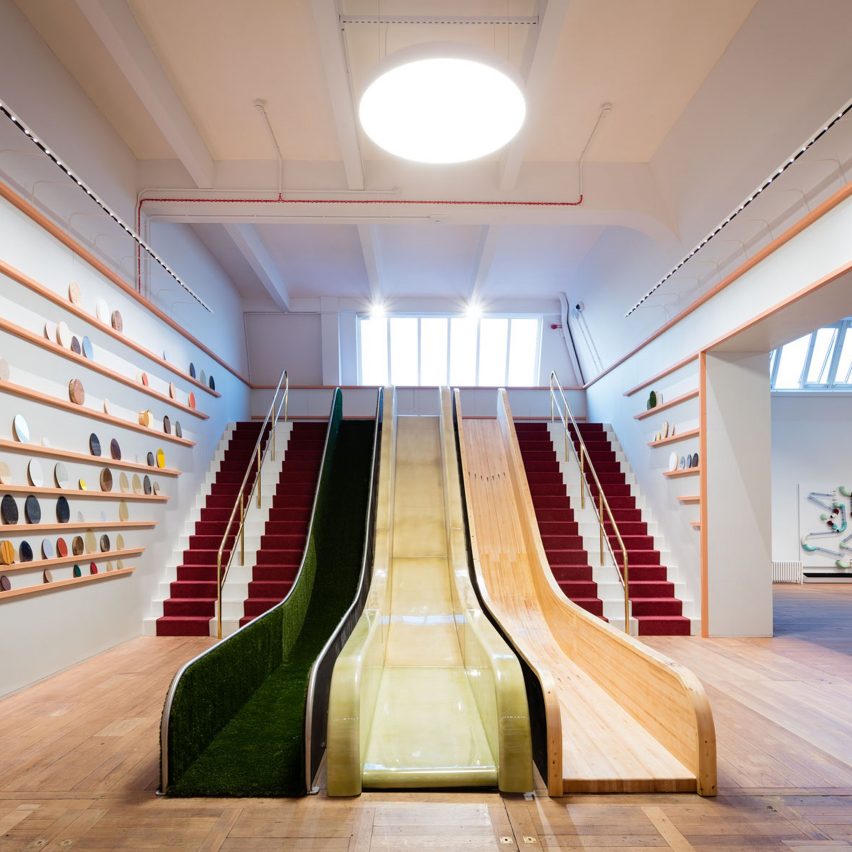
Architecture studio Muf has created a new interactive gallery at London’s Science Museum, featuring playground slides, a quilted theatre and a huge model of the solar system. Read more
At the ground breaking ceremony this week, officials including His Highness Sheikh Mohammed bin Rashid Al Maktoum, UAE Vice President and Prime Minister and Ruler of Dubai, His Excellency Mohammad Al Gergawi, Chairman of Dubai Holding, and Mohamed Alabbar, Chairman of Emaar Properties, and Micael Calatrava, CEO of Calatrava International announced that upon its completion in 2020, the landmark observation tower will measure in at a height slightly taller than Dubai’s own Burj Khalifa, making it the tallest tower in the world.
“The design and architectural features of The Tower demand unique engineering approaches that are currently being implemented on site. Extensive studies were undertaken in preparation for the groundbreaking, and the learning that we have gained from the experience will add to the knowledge base of mankind,” said Santiago Calatrava.
The design of the tower integrates “traditional Islamic architecture with cutting-edge design, engineering and sustainability elements.” The tower will contain three public observation decks, a cafe and numerous events spaces, as well as dynamic balconies that will rotate out from the facade of the tower. The structure will be topped by “The Pinnacle Room,” an observation space featuring 360-degree views of the city and several VIP Observation Garden Decks.
During the day, the tower will be recognizable for its slender form and array of stay cables, while at night, it will be lit with dynamic illumination and movement lighting. The building will feature a highly-efficient cooling system with a water collection system, which will be utilized to clean the building’s facade. Vegetation and an integrated shading system along the tower will encourage solar protection and contribute to the building’s efficiency.
Envisioned as a new landmark public space, the tower’s ground level Central Plaza will serve as the hub of a neighborhood masterplan containing world-class retail, a museum, educational facilities, and an indoor auditorium. Several green corridors will provide pedestrian access and clear connections to the Dubai Creek Harbor.
With a scheduled completion date set for 2020, the tower will support the goals of the Dubai Plan 2021, which is aimed at establishing the city as a global hub for business and leisure.