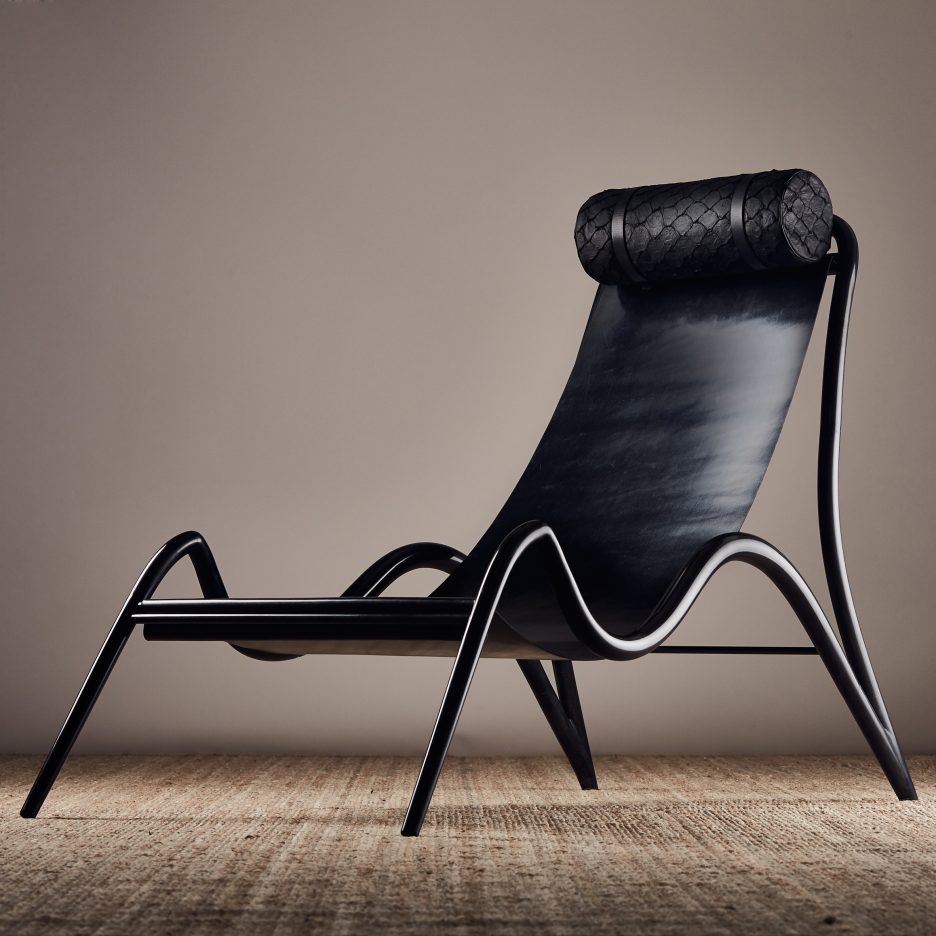
London Design Festival 2016: Studio Swine used very hard rubber to craft this black furniture collection, designed for American industrialist Henry Ford’s failed utopian city (+ slideshow). (more…)
London Design Festival 2016: Studio Swine used very hard rubber to craft this black furniture collection, designed for American industrialist Henry Ford’s failed utopian city (+ slideshow). (more…)

LeanToo is a private residence designed by Nick Deaver Architect. It is located in Austin, Texas, USA and was completed in 2015. LeanToo by Nick Deaver Architect: “LeanToo is the addition to an existing cottage situated in vibrant Austin neighborhood. The site had the original home set back from the street and bracketed by two large heritage oak trees, an active city drainage line that cut through the property, and..

In the neighbour’s garden
Densification can also be possible in built up settlement areas of one family houses. The property of House D is located in the middle of a block of buildings, which are surrounded by the local streets, and each building is part of the formation of a big wonderful garden right in the heart of the block. The generous building regulation allows us to build on all properties up to at least a quarter of the whole property area and thereby creates possibilities to divide properties and the densification of the green spaces.
That’s how in the middle of an existing green space a lot the size of 433 m² was developed which cannot be seen from the streets. Due to the ground water situation coming from the Donau and the slight subsidence of the property to the street level, it was clear that the goal would be to build as high as possible.
Family life is happening in the middle of living and cooking on the ground floor and sleeping and relaxing on the first floor. An additional multifunctional room in the attic is extending with an all around view over the neighbour’s buildings. Three differently shaped and stacked volumes, which were arranged next to each other, are reflecting the various areas of use of the yet still 3 member family. To create as much connection as possible to the outdoor space, the transparent volume of the living room on the ground floor is mostly all over and up to the ceiling made of glass. Connecting with the transparent surface, the needed side rooms are partly only exposed through slits. It seems as though the more introverted appearing box with bed rooms on the first floor and balconies, is floating above the living area. Because the multifunctional room in the attic, which was built a bit further back and also appears to be a closed box, can hardly be seen from the garden. That’s how it creates intimacy and a retreat.
The design on the ground floor consists of concrete or exposed concrete and a light wood construction on the first floor. The vertically arranged battens of the facade are made of grey fir wood which was formerly impregnated. On the one hand to prevent decomposition and to frame it more homogenous. On the other hand it is supposed to let the three volumes appear as one. The battens are partly creating a natural sunscreen and privacy shield on the vitrification.
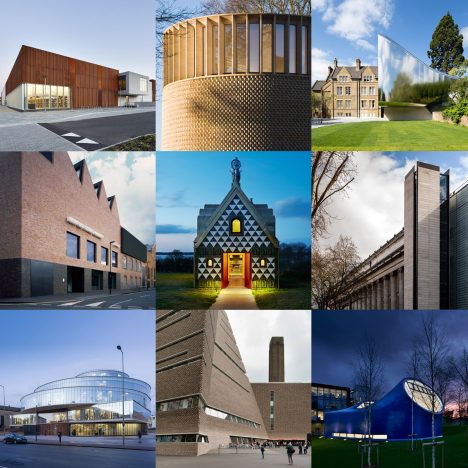
This week saw the Caruso St John-designed gallery for Damien Hirst win this year’s RIBA Stirling Prize, as the UK’s best new building. To mark the occasion, we’ve scoured our archives to find more examples of Britain’s finest contemporary architecture and pinned them to a new Pinterest board.
Follow Dezeen on Pinterest | See more examples of UK projects in our archive

The renovation of the Bank of Slovenia’s central lobby was designed at a student workshop at Ljubljana’s Faculty of architecture. The project was executed by SADAR+VUGA in close collaboration with the initial student design team.
Bank of Slovenia’s headquarters are located on Slovenska Boulevard. The portal of the 1920s building is adorned by two mighty Atlants. Behind this impressive entrance is the central lobby of the Bank of Slovenia.
Before the reconstruction it had the character of a publicly accessible, monofunctional bank hall: it hosted cashier desks and a mailroom. Despite its central location and formidable size, it was in no condition to host protocolar events.
A complex programmatic and spatial reconstruction made the lobby an interactive space, intended mainly for the Bank’s employees. Here they can meet, work, socialise or greet their guests. The flexible design envisions both formal and informal usage, which is why the lobby becomes a strong identification point for its daily users as well as for the institution of the Bank of Slovenia.
The space is designed to provide the employees with a more relaxed, diverse and interactive work environment and at the same time create a protocolar space for Bank’s official events. Combining the two created a space which offers strong identification for the employees as well as for the institution.
The monofunctional space became a frame within which several ambients and programs were layered. The new programmatic sections, incorporated in the niches, intertwine in a club-like ambient without strict programmatic boundaries. A soft curtain, that allows the users to regulate the level of intimacy, is the only physical boundary of the space.
Library is placed next to the south openings; adjacent to it is a small self-service bar. Both are separated from the main area by a glass wall. Library’s program is complemented by the reading room, and café extends into a lounge area.
Three meeting rooms are placed on the opposite side of the lobby. Closing the curtain separates them from the main space and thus ensures privacy for informal meetings and workshops. Service spaces are placed at the back of the lobby, their walls upholstered with rich blue textile that gives depth to the space.
The lobby is furnished with a comfortable armchair Triglav, developed for this project.
The new areas intentionally recreate a living room-like environment, where the employees can feel comfortalbe and at ease. Warm and soft materials, like textile (curtains, flooring, upholstery) and wood (celiling lamellas), are chosen. The area is ambientally lit. Blue, green and golden tones are complemented by neutral furniture in dark matte and reflective tones.
The central, triple height area, is in contrast with the warm and ambiental surroundings. Its classical architecture is accentuated with stone cladding and a monochromatic palette, which makes it a perfect setting for protocolar events. The central space can be separated from other programes by enclosing the curtains around its perimeter.
The lobby’s main feature is a mighty chandelier, which – with its circular form and silver and gold materiality – simbolizes a coin as a representative image of the national bank. The ‘levitating coin’ is made of aluminium truss, lined with satinated tin in two shades, suspended from steel cables and mounted into the walls. The chandelier centers the programmatically mixed lobby and creates a solemn atmosphere appropriate for the events it holds.

Manila Architecture Workshop (MAAW) was just awarded one of six outstanding entries to the recently completed Metrobank Art and Design Excellence (MADE) programs for Architecture and Interior Design. In partnership with the United Architects of the Philippines and BluPrint Magazine, MADE encourages architects to design inventive buildings that address public, economic, and environmental issues.
Per the competition’s instructions, design entries were required to relate to their chosen site or inhabitants. MAAW proposed a Civic Center — intended as an urban environment capable of supporting its community and wellbeing. The firm believes that a civic center can be responsible for improving the quality of life through cultural opportunities and exposure to knowledge.
This project was inspired by one of the Philippines’ noble traits which embodies close relationship with neighbors, and devotion to a community’s organization, “Bayanihan” which means “being in a bayan”, refers to the spirit of communal unity, work and cooperation to achieve a particular goal, states their proposal.
Within the civic center, spaces will be provided for a community library, a learning center, barangay and local government offices, a lecture auditorium, and a multi-purpose gallery. In addition to an urban farm deck where community members can produce their own food, a ground level plaza allows pedestrians to move freely through the space. Naturally, a farm-to-table concept will then enable produce from the community garden to be cooked at the canteen.
Inspired by “blinking eyes,” the proposal’s façade (or modular cells capable of eliminating pollution) wrap around the building and thereby cleanse the air. Its exterior is composed of a material that screens direct sunlight (helping cool the building), while photovoltaic cells line the roof deck. What more could this building need? A desalination tank that processes storm water is also located at basement level to be reserved for outdoor irrigation.
In MAAW’s statement for their proposal, they link the civic center to the Agora in ancient Greece, inviting the public to make transactions and engage in cultural pursuits. A key attribute of their project needs the continuity of public interest and commitment to the Civic Center.
MADE was created in 1984 with the intent to engage youth in positive challenges during the political turmoil in the Philippines at that time.
News Via: Manila Architecture Workshop

French studio Lacaton & Vassal and Chilean studio UMWELT have been revealed as the recipients of the 2016 Lisbon Architecture Triennale’s Lifetime Achievement Award and Début Award, respectively. An award ceremony will take place on the 15th November 2016 at the Centro Cultural de Belém (CCB), followed by a conference convened by Anne Lacaton and Jean-Philippe Vassal.
The Lisbon Architecture Triennial’s Millennium bcp Lifetime Achievement Award “distinguishes the individual or studio whose work and ideas have influenced and continue to have a great impact on current architectural practices and discourse.” Selected by an international jury of architects, writers and curators—including Andres Lepik, Bijoy Jain, Cecilia Puga, Jorge Figueira, Juan Herreros, and Niall Hobhouse—the practice will receive a specially commissioned artwork by José Pedro Croft, the artist representing Portugal at the 2017 Venice Art Biennale.
José Mateus, President of the Triennale, has said that “the work of Lacaton & Vassal has reached worldwide recognition for its relevance as well as uniqueness. From small projects marked by the questioning of typologies and materials used outside of their conventional field, to the clever re-invention of pre-existing architectures, their body of work is an extraordinary example of the capacity of transformation that architecture can achieve.”
Founded in Paris by Anne Lacaton and Jean-Philippe Vassal, the studio is internationally recognized for its sustainable reuse of existent resources and structures as well as for a series of careful rehabilitation schemes. Their most notable projects include the Palais de Tokyo in Paris, the School of Architecture in Nantes, and Cité Manifeste in Mulhouse. Previous Lifetime Achievement Awards have been bestowed upon Italian architect Vittorio Gregotti (2007), Portuguese architect Álvaro Siza Vieira (2010), and British theorist and historian Kenneth Frampton (2013).
The Millennium bcp Début Award, now in its second year (having been previously awarded in 2013 to American architect Jimenez Lai), aims to recognize the work and promote the career of new generations of architects and studios under the age of 35. The jury—including André Tavares (co-curator of the The Form of Form, the 2016 Triennale), Fernanda Bárbara, Luís Santiago Baptista, Margarita Jover, Mimi Zeiger, Tetsuo Kondo, and Tim Abrahams—evaluated more than 140 applications from across the world before reaching their decision.
For Tavares, “the body of work already done by this promising duo combines built projects with highly relevant research work. There are links to be found between their critical look at the landscape and territory, as well as a very strong connection between their conceptual thinking and the realization of their projects. Thought and rigor of construction drive the renovation of the formal imagery of architecture in their projects.” Founded in 2011 by Ignacio Garcia Partarrieu (1984) and Arturo Scheidegger (1983), the studio “develops research and design projects at different scales” and has exhibited widely. They will receive a prize of €5000.

Berkeley-based TLS Landscape Architecture has won the Lion Mountain Park Design competition in Suzhou, China, corresponding to the Chinese government’s new Urban Work Guidelines. The guidelines prioritize ecological and urban development, as well as rejuvenation of local character in public spaces. Lion Mountain Park will be the first large-scale public project to be constructed according to these values, envisioned as the core of a new urban ecosystem complex.
To that end, the park aims to revitalize the surrounding mountain, forest, and aquatic environment through natural processes in the traditional Chinese style of shanshui—unifying the adjacent Shishan (Lion) Mountain and Shishan Lake. Shishan Lake is planned to double in size and improve drastically in water quality as a result of a new sustainable watershed that harvests rainwater and naturally filters runoff from the development area.
Lion Mountain Park is also projected to become the featured amenity of the up-and-coming Suzhou High-Tech District. Developers hope the park’s spotlight on flourishing nature and an ancient geological landmark will produce a high-value focal point in its urban environment. At 74 hectares, the park will be built on the grounds of a former amusement park and pond, and will house a public art program emphasizing local cultural and artistic traditions. Park construction is scheduled to begin in March 2017.
News via: TLS Landscape Architecture