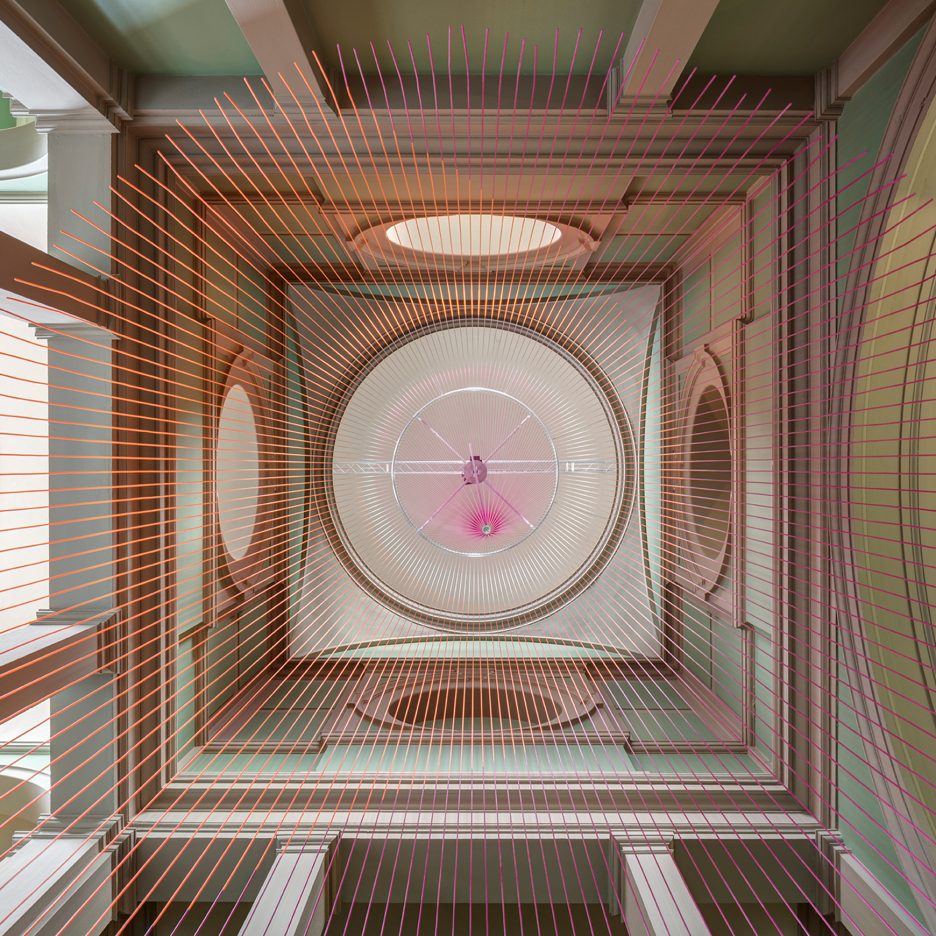
Exhibition: Chiharu Shiota “Uncertain Journey”


"Uncertain Journey" / Chiharu Shiota. Image © Laurian Ghinitoiu

"Uncertain Journey" / Chiharu Shiota. Image © Laurian Ghinitoiu

Text via Blain|Southern. For her first exhibition with Blain|Southern, Chiharu Shiota will create a new site-specific monumental installation in the Berlin gallery, eight years after she last exhibited in her home city.

Shiota is primarily known for her immersive installations, such as The Key in the Hand, with which she represented Japan at the Venice Biennale in 2015. Weaving intricate networks of yarn, the artist creates new visual planes as if she were painting in mid-air.

The installation Uncertain Journey fills the gallery’s vast central atrium with dense webs of red yarn – seemingly growing from above, reaching down towards the skeletal hulls of boats which rest on the gallery floor below. The colour of blood, the nexus of yarn is laden with symbolism, for the artist it alludes to the interior of the body and the complex network of neural connections in the brain. Enclosed by the canopy overhead, the boat carcasses raise existential questions of fate and belonging, evoking ideas that can be as complex as the tangled yarn itself.


"Uncertain Journey" / Chiharu Shiota. Image © Laurian Ghinitoiu


"Uncertain Journey" / Chiharu Shiota. Image © Laurian Ghinitoiu


"Uncertain Journey" / Chiharu Shiota. Image © Laurian Ghinitoiu


"Uncertain Journey" / Chiharu Shiota. Image © Laurian Ghinitoiu

The gallery’s second floor mezzanine offers an alternative perspective, a bird’s eye view, several steps removed from the psychological weight of the entanglement below. On this floor in the Long Gallery, new two dimensional thread-on-canvas works further explore the ideas used in the main space. Shiota studied painting early in her education but restricted by the use of canvas and paint, she proceeded to push against the definitions of the medium. At first using her own body in performance pieces, she later began to use thread as a mode for formal and conceptual expression; it allowed her to remove her physical presence yet still address the corporeal ideas that are central to her practice. Her canvases can be viewed as this journey coming full circle.

Her explorations of space, objects, material and scale continue with a series of new works where networks of yarn, thread and occasionally found objects, connect within frames reminiscent of scaled down buildings or doll’s houses. Shiota has been commissioned for set design and artistic direction for many opera and theatre productions. This includes several productions with Theater Kiel including forthcoming productions of Shakespeare’s, The Winter’s Tale in October 2016 and Wagner’s Siegfried in March 2017.

Photographs courtesy and copyright Laurian Ghinitoiu.

http://ift.tt/2d2eRtV

Basildon’s “Failed” New Town: What Happened When We Built Utopia?

We are all familiar with the “utopian” towns of the 20th Century. Basildon, Essex, was one of the largest of those New Towns. It was founded in 1949, when Lewis Silkin, the Minister of town and country planning at the time, ambitiously predicted that “Basildon will become a city which people from all over the world will want to visit. It will be a place where all classes of community can meet freely together on equal terms and enjoy common cultural recreational facilities.”[1] Nearly seventy years later, Basildon is left with a struggling local economy, splintered communities, and a fraction of the art and culture than what was originally hoped for. “New Town Utopia” is a documentary film that confronts this concrete reality with a question: “What happened when we built Utopia?”


Basildon Fire Station. Image © <a href='http://ift.tt/2cWC1xh user GaryReggae</a> licensed under <a href='http://ift.tt/2cNSQNM BY-SA 2.0</a>


BasildonTown Square. Image © <a href='http://ift.tt/2cWCNuh user Stephen McKay</a> licensed under <a href='http://ift.tt/2cNSQNM BY-SA 2.0</a>


Freedom House, Basildon. Image © <a href='http://ift.tt/2cNS3fZ user GaryReggae</a> licensed under <a href='http://ift.tt/2cNSQNM BY-SA 2.0</a>


Bell Tower, St. Martin's Church, Basildon. Image © <a href='http://ift.tt/2cNSAyr user Julieanne Savage</a> licensed under <a href='http://ift.tt/2cNSQNM BY-SA 2.0</a>

Twenty-two New Towns were built in Britain during the post-war period, and these towns are are currently home to about 2 million people.[2] Their most identifiable common feature? Brutalism. Brutalism’s concrete character was born at around the same time as the New Towns, when the Western world was determined to create a “rationally planned modernist future”[2] after the Second World War. Le Corbusier, not just a strong supporter of Brutalism, but also one of the frontrunners in realizing the vision through architecture, even went so far as to propose a city that would function as a machine. The dream was of course beautiful; one city housing people from all socioeconomic backgrounds; enormous green park areas for recreation and leisure; a large amount of sunlight entering the buildings through skylights; rooftop gardens and efficient public transport.[3] With cheap land and such a rational concept, why hasn’t it worked?


St. Martin's Church Garden, Basildon. Image © <a href='http://ift.tt/2cWCBLF user terry joyce</a> licensed under <a href='http://ift.tt/2cNSQNM BY-SA 2.0</a>

St. Martin's Church Garden, Basildon. Image © <a href='http://ift.tt/2cWCBLF user terry joyce</a> licensed under <a href='http://ift.tt/2cNSQNM BY-SA 2.0</a>

The documentary project, led by Essex-raised producer-director Christopher Ian Smith, aims to evaluate how and why the utopian dream has faded. The film explores how Thomas Moore’s original vision of “a new age of citizen, a healthy, self-respecting, dignified person with a sense of beauty, culture and civic pride”[4] has been affected by the architecture of New Towns. Not only does it provide an insight into the lives of people living in these environments, but also on the influence of the utopian experiments on their psyches. The documentary brings us to a fundamental question: “Do people make the place… or does a place make the people?”

http://ift.tt/2cEXywP

“New Town Utopia” has been in the making for four years, with over 100 hours of footage filmed. However, Smith and his executive producer Margaret Matheson couldn’t have launched this Kickstarter at a timelier moment: this year is the 500th anniversary since Thomas Moore’s initial vision of Utopia, and the 70th anniversary of the New Towns Act, yet the UK is still facing housing shortages as well as social, economic and cultural challenges, especially in places such as Basildon; places that were meant to be at the forefront of Utopia. “New Town Utopia” is encouraging us all to question these dreams, because they have not been left in the past; countries around the world are still facing many of the same problems that prompted the construction of New Towns. Appropriately, the Kickstarter campaign ends with a challenging question: “If we did it again – how can we make it work?” 

References:

  1. Cox, William. “Basildon History.” Basildon History Online. N.p., 2008 2005. Web. 16 Sept. 2016.
  2. Unknown author. “Britain’s New Towns: Paradise Lost.” News. The Economist. N.p., 8 Mar. 2013. Web. 16 Sept. 2016.
  3. Newitz, Annalee, and Emily Stamm. “10 Failed Utopian Cities That Influenced the Future.” io9. N.p., 29 Jan. 2014. Web. 16 Sept. 2016.
  4. Christopher Ian, Smith. “New Town Utopia.” Crowdfunding. Kickstarter. N.p., n.d. Web. 16 Sept. 2016.

http://ift.tt/2cEX9dQ

Glithero suspends highlighter-bright “abstract clock” above V&A stairwell


London Design Festival 2016: Taking inspiration from the passage of time, London design studio Glithero has created a kinetic installation that extends across six floors at the V&A museum. (more…)

http://ift.tt/2cHkpou

Duplex in Marseille / T3 Architecture


© David Giancatarina

© David Giancatarina


© David Giancatarina


© David Giancatarina


© David Giancatarina


© David Giancatarina

  • Architects: T3 Architecture
  • Location: Marseille, France
  • Architect In Charge: Luc Lacortiglia, Christophe Pinero
  • Area: 100.0 sqm
  • Project Year: 2016
  • Photographs: David Giancatarina
  • Collaborators: Anaïs Giraud, Cindy Lostys

© David Giancatarina

© David Giancatarina

Complete refurbishment of this duplex in the center of Marseille. The existing flat suffered from a significant lack of light and its main rooms were constrained by the central staircase.


© David Giancatarina

© David Giancatarina

The architects completely released the heart of the apartment by removing the stairs and most of the partitions. The entrance of the flat now enjoys a generous double height volume that offers a visual communication between the different spaces of the two storeys.


Section

Section

Glass floors and railings complement the effect of volume and allow a large penetration of daylight in the very center of the flat. In addition, a concrete wall reaffirms the verticality of the central volume and support the minimal metallic staircase.


© David Giancatarina

© David Giancatarina

The impressive traditional plaster ceiling in the main bedroom has been renovated and is a strong component that gives the flat its character. In order to make it visible from the livings rooms, the architects added a narrow glazed opening on the upper part of the concrete wall.


Floor Plan

Floor Plan

Floor Plan

Floor Plan

A small bathroom was added on the upper floor next to the second bedroom. Its triangle shaped leaves a free area that hosts a lounge space. This space is closed by a thin metallic glass partition that allows light to reach the entrance of the flat.


© David Giancatarina

© David Giancatarina

The living room and the kitchen are located at the bottom level and enjoy openings on the terrace and garden.


© David Giancatarina

© David Giancatarina

http://ift.tt/2cycXOT

Bezalel Academy of Art and Design Students Build Temporary Pavilion in Jerusalem


Image © Elad Sarig, Courtesy of The Architecture Department, Bezalel academy of Art and Design, Jerusalem

Image © Elad Sarig, Courtesy of The Architecture Department, Bezalel academy of Art and Design, Jerusalem

At a vibrant intersection in downtown JerusalemThe Architecture Department at the Bezalel Academy of Art and Design, in collaboration with the Israel Festival Jerusalem and EDEN—the Jerusalem development authority—created a temporary structure for the Israel Festival, which ran from the end of May to mid June of this year.

Located in Zion Square parallel to the tramway line, the pavilion creates a space to host art programs including lectures, concerts, dance performances, video screenings, and theater productions. The structure beautifully frames a dialogue between the urban routine and cultural experiences, giving users a new understanding of the Israel Festival, and of the potential of the spaces within their city.


Image © Yifat Zailer, Courtesy of The Architecture Department, Bezalel academy of Art and Design, Jerusalem


Image © Elad Sarig, Courtesy of The Architecture Department, Bezalel academy of Art and Design, Jerusalem


Image © Yifat Zailer, Courtesy of The Architecture Department, Bezalel academy of Art and Design, Jerusalem


Image © Elad Sarig, Courtesy of The Architecture Department, Bezalel academy of Art and Design, Jerusalem


Image © Yifat Zailer, Courtesy of The Architecture Department, Bezalel academy of Art and Design, Jerusalem

Image © Yifat Zailer, Courtesy of The Architecture Department, Bezalel academy of Art and Design, Jerusalem

Image © Elad Sarig, Courtesy of The Architecture Department, Bezalel academy of Art and Design, Jerusalem

Image © Elad Sarig, Courtesy of The Architecture Department, Bezalel academy of Art and Design, Jerusalem

At 24 meters long, three meters wide, and four meters high, the structure spans between two boxes: the “toolshed,” which encapsulates festival needs, and “the garden,” which acts as an intimate shaded space in the bustling square, featuring benches and enclosed by a curtain. This curtain can further be drawn over the entirety of the pavilion, connecting its two ends and creating a larger event space.


Courtesy of The Architecture Department, Bezalel academy of Art and Design, Jerusalem

Courtesy of The Architecture Department, Bezalel academy of Art and Design, Jerusalem

Courtesy of The Architecture Department, Bezalel academy of Art and Design, Jerusalem

Courtesy of The Architecture Department, Bezalel academy of Art and Design, Jerusalem

The place—beautiful, inspiring and optimistic at every moment of the day—is a great success at meeting all the goals of this project, said Eyal Sher, Director of the Israel Festival. The main one being bringing the joy of culture to many people of diverse backgrounds, who would not otherwise have the means or the opportunity to experience it – at a unique most pleasant casual and accessible urban yet intimate setting. Along is a sense of community that we don’t experience often as Jerusalem citizens. It’s truly heartwarming.


Image © Yifat Zailer, Courtesy of The Architecture Department, Bezalel academy of Art and Design, Jerusalem

Image © Yifat Zailer, Courtesy of The Architecture Department, Bezalel academy of Art and Design, Jerusalem

Image © Elad Sarig, Courtesy of The Architecture Department, Bezalel academy of Art and Design, Jerusalem

Image © Elad Sarig, Courtesy of The Architecture Department, Bezalel academy of Art and Design, Jerusalem

News via The Architecture Department, Bezalel academy of Art and Design, Jerusalem.

ArchDaily was introduced to this project thanks to the 2016 Vibe Israel Arch Tour. See more at #VibeArch.

http://ift.tt/2cEOk3K

OMA Reveals Their First Residential Tower in New York


© OMA

© OMA

OMA has unveiled its first residential tower for New York. Located at 121 East 22nd Street, the building sits at the intersection of two neighborhoods, with the busy Madison Square area to the North-West and the relative tranquility of Gramercy Park to the South. The building’s facade reflects this duality, with a striking “prismatic corner” of glass contrasting the rest of the building’s more conventional window layout. The corner element is designed to frame views, in some places directing users’ attention up towards the sky and in others along the busy streets below.

Filling an L-shaped site that faces 22nd Street on one side and the corner of 23rd Street and Lexington Avenue on the other, the building features ground-level retail units and a setback above its 12th floor to continue the roofline of its neighbors. “The design of the 133-unit residential block was driven by the duality of its context,” explained OMA’s New York Principle Shohei Shigematsu. “Punched windows echoing the façade of its pre-war neighbors seamlessly transition to contemporary, floor-to-ceiling glazed windows towards the corner, forming a gradient from historic to modern.”

http://ift.tt/2d85BDw

Split House by BKK Architects is made up of two angular wooden structures


Angular volumes clad in timber and metal step down the side of a sloping site to form this house near Melbourne with ocean views (+ slideshow). (more…)

http://ift.tt/2cEImji

PYO Arquitectos Remodel a Small and Colorful Home in Madrid, Spain

Casa MA by PYO Arquitectos (6)

Casa MA is a private home located in Madrid, Spain. The 861-square-foot home was designed by PYO Arquitectos in 2015. Casa MA by PYO Arquitectos: “Before its renovation, the apartment had a dark corridor and a dark entrance hall giving access to a sequence of small rooms. The main objective of the project is to provide natural light to the entrance hall and the corridor and to bring closer the..

More…

Classrooms in Linares Science and Technology Campus / García Torrente Arquitectos


© Fernando Alda

© Fernando Alda


© Fernando Alda


© Fernando Alda


© Fernando Alda


© Fernando Alda

  • Architects: García Torrente Arquitectos
  • Location: 23700 Linares, Jaén, Spain
  • Client: Fundación Campus Científico-Tecnológico de Linares
  • Collaborators: Isabel Mota Pernias, José Rincón Calderón, Curro Rodríguez Salvador López Cervantes, Esaú Vázquez Rodríguez
  • Project Year: 2008
  • Photographs: Fernando Alda
  • Construction Direction: Cristina Sanabria Rodríguez
  • Building Services Consultants: ASTER Consultores (Sevilla)
  • Structures Consultants: EDARTEC (Sevilla)
  • Security And Health: Baluarte Arquitectura y Seguridad
  • Construction: Acciona S.A.
  • Entidad De Control De Calidad: Entidad de control de calidad

© Fernando Alda

© Fernando Alda

During the financial crisis, the Science and Technology Campus of Linares Foundation decided in 2008 to cope with the various adjustments and industrial dismantling of the region, with a project that promoted research and innovation as well as economic development and the social revitalization this disadvantaged area. A project come true thanks to the continuous support of all social, economic and political agents.


© Fernando Alda

© Fernando Alda

As home of the University of Jaen in Linares, the campus has six main buildings, among which is the present classroom building for 2600 students. Located on a steep plot, its formalization responds to the need to resolve both the encounter between the different elevations as well as the program of needs, so that a spatial fluidity and permeability occurs from the different accesses; a fluidity that extends to the relationship with the other buildings and the large central area of the campus. The building thus becomes a kind of interior landscape that is shaped as one traverses it and according to the different levels, always in permanent physical and visual relationship with the exterior.


© Fernando Alda

© Fernando Alda

Functionally, the ground level of the central square is reserved for the lobby and concierge; below, between the enclosed patio and lawn are the examinations classrooms; the upper level is for the computer rooms and the top two floors for classrooms, workshops and seminars, in general. Thus projected, the building allows a compartmentalization in separate areas that make possible a more rational operation in special situations: exams days, uses outside of schedules, seminars, etc. so that, despite their openness and flexibility, it is possible to narrow particular areas both spatially and in the use of facilities.


Section

Section

Section

Section

Constructively the encounter with the ground is resolved with three large concrete supports from which the whole building is suspended, conceived as a bridge of almost 40 meters in span and two stories high, executed with metal frame in which most of the classrooms are located. The facade is made of an aluminum curtain wall and glass -Schüco system- which is protected, except for the north-facing sides, by a thin skin of aluminum microperforated sheet allowing the ventilation of the facade and reducing direct heat gain by 35%, while enabling direct views from the inside.


© Fernando Alda

© Fernando Alda

Spatial clarity, easy maintenance and durability, as well as energy efficiency have been the fundamental premises at the time of undertaking the project.


© Fernando Alda

© Fernando Alda

http://ift.tt/2cQTzMz

Yonder – Architektur Und Design Creates a Holiday Home for a Family of Seven in Weiler-Simmerberg

Haus P by Yonder – Architektur Und Design (2)

Haus P is a residential project completed by Yonder – Architektur Und Design. It is located in Weiler-Simmerberg, Germany. Haus P by Yonder – Architektur Und Design: “House P is a holiday home for a family of seven from Hamburg. The house takes ques from traditional Allgäu architecture, but results in a unique, contemporary building. House P’s geometry was generated by maximizing the property’s allowable building envelope, a classic Allgäu..

More…