
The Wolf House is a private home located in Victoria, Australia. Completed in 2012, it was designed by Wolf Architects. The Wolf House by Wolf Architects: “When you arrive at the house you enter via a formal pedestrian entry. Beyond that is a contemporary Chinese garden which in itself is a playful expression of east meeting west. A bridge over a dry riverbed directs you the office at the rear…
Villers Abbey Visitor Center / Binario Architectes

© François Lichtle
- Architects: Binario Architectes
- Location: 1495 Villers-la-Ville, Belgium
- Area: 420.0 sqm
- Project Year: 2016
- Photographs: François Lichtle
- Structure: JZH et partners
- Fluids: SECA benelux
- Lightning: Henriette Michaux
- Landscape: Du Paysage (Virginie Pigeon et Sébastien Ochej)
- Scenography: L'Escaut
© François Lichtle
© François Lichtle
The Villers abbey site is crossed and split by the N275 national road so it loses logic and unity. Architecture, through a common intervention in landscape and scenography fields, tries to reunite the full cistercian composition plan. The project leads to a truly sequence from the parking to the ruins and prepares the visitors. The new path goes by the mill (reception hall, scenographic spaces, models room), reaches the hill across the new footbridge, continues through the garden, crosses the second bridge over the national road and finally goes down into the ruins. The project highlights a common thread by means of sober materials (corten, wood, concrete) set up in various ways.
© François Lichtle
View
© François Lichtle
View
© François Lichtle
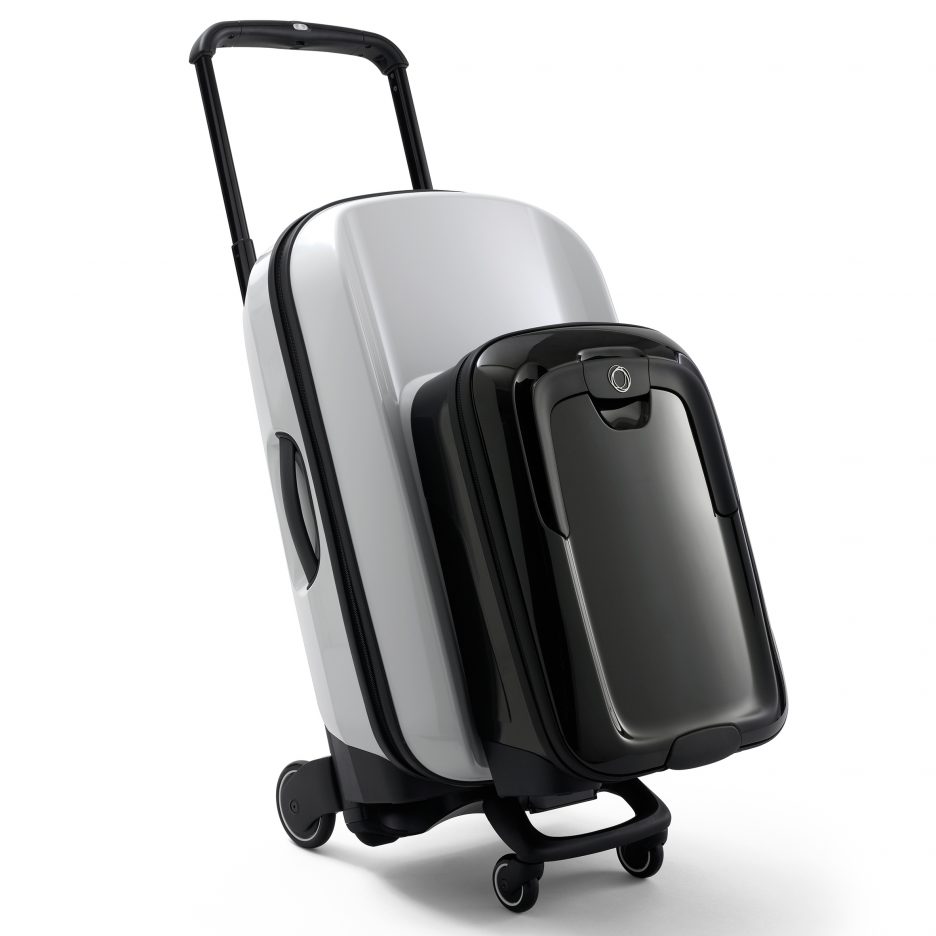
Bugaboo expands beyond pushchairs with first luggage collection
Mermerler Plaza / Ergün Architecture

© Cemal Emden
- Architects: Ergün Architecture
- Location: İçerenköy, Kozyatağı, Topçu İbrahim Sk., 34752 Ataşehir/İstanbul, Turkey
- Area: 32000.0 sqm
- Project Year: 2015
- Photographs: Cemal Emden
© Cemal Emden
It is no secret. Concrete structures sprawl Istanbul’s urban metropolis. For the past decade Istanbul has been an ever expanding construction site. The rise of this so called “concrete jungle” depicts a time of rapid change. Yet during these times, our core studio philosophy has remained the same. Ergün Architecture has long posited a balance between art and utility at the very centre of its’ practice. Mermerler Plaza is a testament to such an objective.
© Cemal Emden
This parent-child building duo is located in the Kozyatağı district of Istanbul. The tall wavy glass walls provide a playful contrast to its shorter aluminium enveloped counterpart. In order to preserve the southward looking façade from the sun, the design incorporates randomised tan colored sun blockers made from perforated aluminium sheets.
© Cemal Emden
The back façade is made of light grey pre-cast stone which provides a contrasting but balanced look against its neighbouring façades.
© Cemal Emden
Detail
© Cemal Emden
The individual floor balconies were designed as a green space that could showcase a variety of plants and flowers, but more importantly provide a pleasant, open-air socialising space for employees.
© Cemal Emden
The LEED Gold certified buildings sit between a major highway (called E-5) and several important roads that connect Istanbulites from all stretches of the city. Mermerler Plaza not only stands to provide office buildings, but its’ function extends to the public at large.
Section
The spacious, two-building structure provides a convenient public passage for pedestrians. Pedestrians in transit can now connect from the highway to a number of main roads by foot. This public access point was essential to creating an interconnected transit system in Kozyatağı. Accordingly, the dual functioning plaza mandated a well contrived night-time lighting scheme that ensures public safety.
© Cemal Emden
Mermerler Plaza is beautiful at night. The night-time lighting gives a day-time feeling. Blue waves are emphasised by cool hidden lights that pool in triangled shapes. Perforated mesh walls are illuminated with wall washer lighting producing a captivating soft warm glow that wraps around both buildings façades.
© Cemal Emden
The interior architecture boasts modern geometrical designs, often mimicking the same motifs from the building’s exterior. The interior finishes as such consist primarily of triangle shaped waves that are emphasised by hidden lights and aluminium perforated sheets used to drape the entrance ceiling. Contrast between the marble flooring and the glass walls enable the building to breathe without becoming a bore. An angularity ricochets down hallways, into restrooms, lighting fixtures, meeting rooms, and right back out the front foyer reminding us that the buildings interior run just as fluid at it’s wave encrusted exterior.
© Cemal Emden
Egue y Seta Remodel an Apartment in the Barcelona Neighborhood of Eixample

Suite for Ten is a private home located in Barcelona, Spain. Completed in 2016, it was designed by Egue y Seta. Suite for Ten by Egue y Seta: “There are those who travel to escape and those who do it to meet again. Those who gather with family for vacation thousands of kilometers away from home and those who like to host even when in a foreign country. For customers..
Moving walls open Stal Collectief’s charred timber workshop to the elements
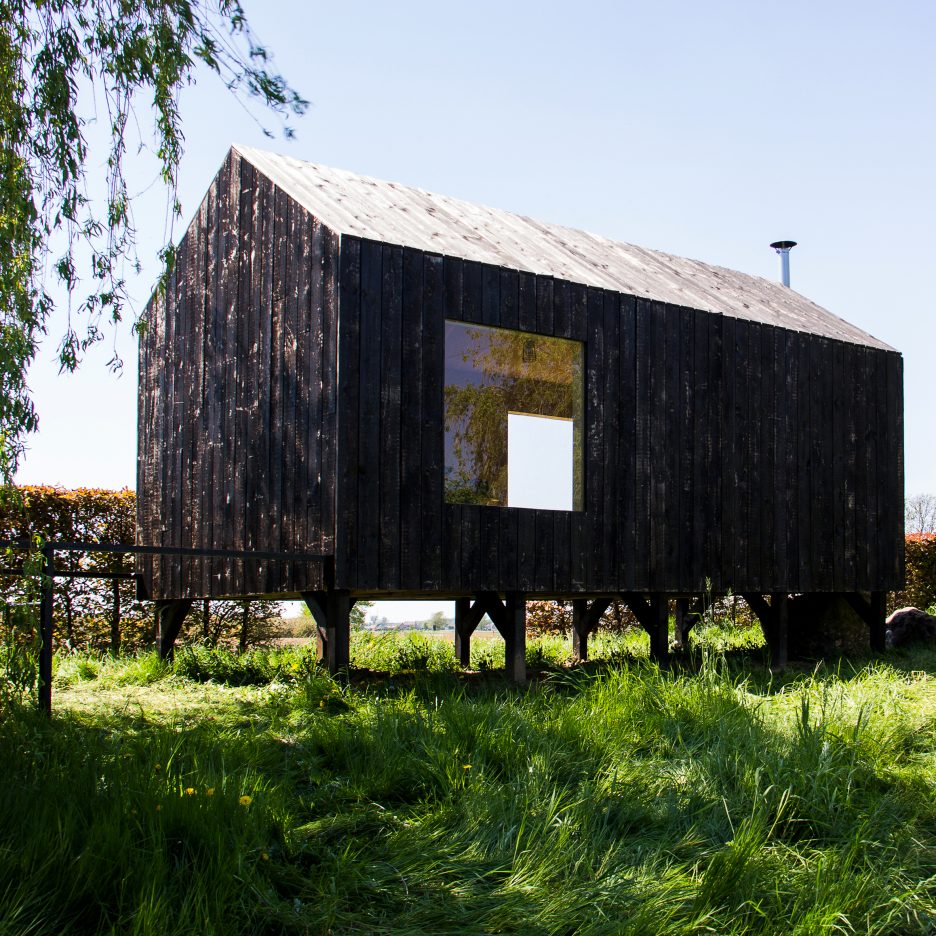
Raised on stilts above a field in northeast Belgium, Stal Collectief’s self-designed studio features charred timber walls that can be wheeled back to reveal the interior (+ movie). (more…)
The Treehouse / Wee Studio

© Sun Haiting – RoadsideAlien Studio
- Architects: Wee Studio
- Location: Garden Village, Xin Chengzi Town, Miyun District, Beijing, China
- Architect In Charge: Zhao Sheng
- Design Team: Dai Haifei, Zhang Yanping, Zhao Sheng
- Area: 8.0 sqm
- Project Year: 2016
- Photographs: Sun Haiting – RoadsideAlien Studio
© Sun Haiting – RoadsideAlien Studio
From the architect. The Treehouse is located in a little woods of poplar and hawthorn trees, where is at the foot of Mount Wuling in Miyun, Beijing. The cliff on the north with a stream meandering under it, and a mountain spring running in all seasons together create a quiet and peaceful environment for the Treehouse. There are two parts of the building, a deck and two separated polyhedrons the function of which are tearoom and bathroom. The inside of the tearoom is floored with Tatami, and the space is designed to serve as tea drinking in the daylight and sleeping as well as at night.
© Sun Haiting – RoadsideAlien Studio
The building of Treehouse is a practice of Wee Studio about the subtle relationship between nature and inhabitation, as well as an exploration about how to achieve the architecture in the era of internet now. At the end of 2015, we initiated a crowdfunding on the Internet which had a great response in a short time. More than just about building a Treehouse on our own, the practice is more about inviting more people with same interests into the process of design and construction and having fun with it.
© Sun Haiting – RoadsideAlien Studio
Going down through the steps from the door of a backyard, you would see the Treehouse floating in trees at the side of a stream. And then you have to climb onto a rock growing from the ground to achieve the deck.
© Sun Haiting – RoadsideAlien Studio
The full size glass to the floor brings the view of trees and cliff in the tearoom, where you can read, rest, drink and even encounter with squirrels sometimes.
You can enjoy the shadow of trees and leafs as well as the sky if lying down.
© Sun Haiting – RoadsideAlien Studio
The Treehouse is equipped with thermal insulating layer and heating system to ensure normal operation in winter, in which you can enjoy another different view of the beautiful mountain area.
Plan
While the north floor window brings the view in, a small window on the west side leads people to the small woods outside far away. The skylight at the end of the sloping ceiling introduces the light into the room, so that you can lying on Tatami and look to the nature with sky and trees outside which makes the small room felt bigger and higher. Through the study of window layout and human body size, we avoid the feeling of cramp in such a small interior space and make a conversation with the nature in a subtle way.
© Sun Haiting – RoadsideAlien Studio
The Treehouse is interlocking with five poplar trees and two hawthorn trees.
The Treehouse is a space where you can communicate with mountain, trees, the sky and stream.
© Sun Haiting – RoadsideAlien Studio
The main structure of the Treehouse is steel frame. We prefabricated all the structures in factory and transported them to be assemble on site to ensure the precision of the irregular form. The facade is installed with recycled wood panels in 60mm width, on which the trace of time makes the building blending into the environment.
Section
Nonhyeon 101-1 / Stocker Lee Architetti

© Simone Bossi
- Architects: Stocker Lee Architetti
- Location: Seoul, South Korea
- Area: 1033.0 sqm
- Project Year: 2016
- Photographs: Simone Bossi
- Civil Engineer: KyuSang Guak – Harmony Ing.
- Costruction Company: Jehyo
© Simone Bossi
The building site is situated in the Gangnam district, a commercial southern area of Seoul.
© Simone Bossi
Sketch
© Simone Bossi
The area was previously occupied by an existing anonymous construction which was completely demolished, leaving the space to a new volume.
© Simone Bossi
Section
© Simone Bossi
A concrete basement, shaped by the structure, generates a filter space between inside and outside, public and private. It identifies the main entrance and the ground floor cafè and it also structurally support a clear block of bricks on top.
© Simone Bossi
Here, there are other four floors, where offices and apartments are. Selected materials remark the strong contrast with the context and recreate a new order in this high density area of the city.
© Simone Bossi
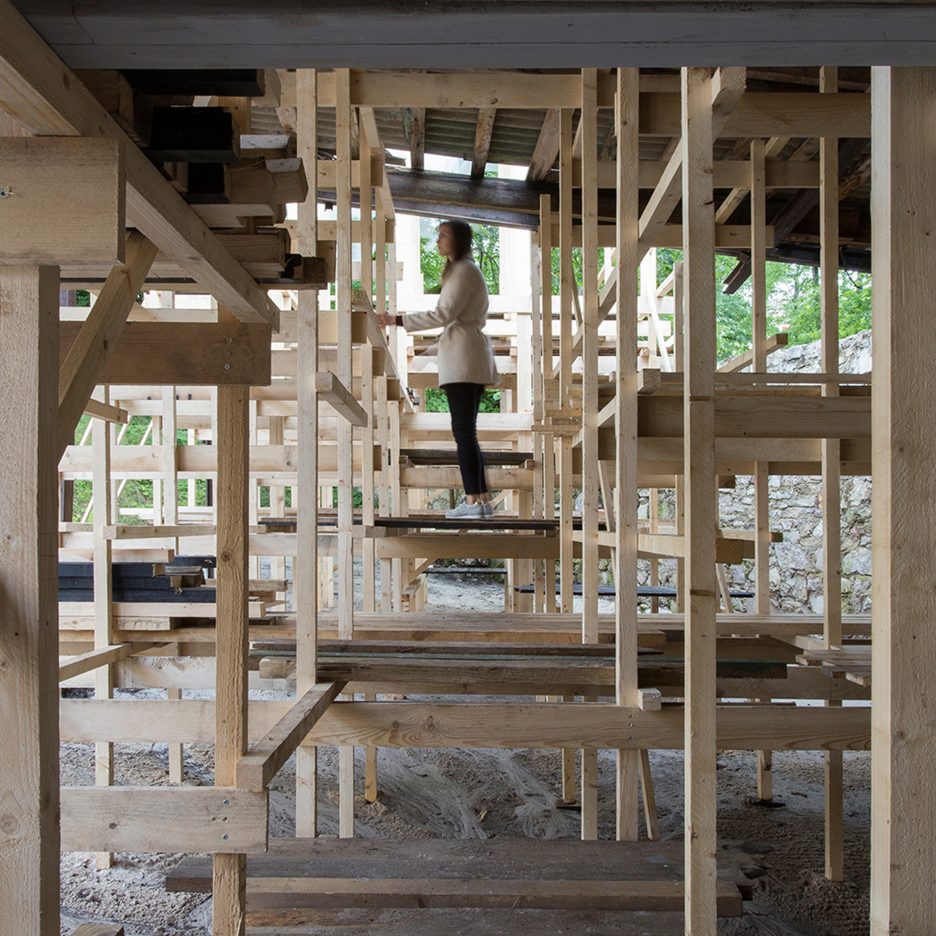
Students build scaffold-like pavilion topped with mesh “cloud” at former Latvian brewery
Splow House / Delution Architect

© Fernando Gomulya
- Architects: Delution Architect
- Location: Tebet, Daerah Khusus Ibukota Jakarta, Indonesia
- Architect In Charge: Muhammad Egha, Hezby Ryandi, Sunjaya Askaria, Fahmy Desrizal
- Area: 120.0 sqm
- Project Year: 2016
- Photographs: Fernando Gomulya
- Client : Firman & Dissy
- Design Team: Indira Pramundita Setiadewi, S.Ars
- Technical Team: Pandu Eka Panca
- Contractor: CRI (Past Conclution)
- Project Manager: Fadlil Fikrudin, Tegar Prabasaki
- Site Area: 90 sqm
© Fernando Gomulya
From the architect. As Jakarta is one of the most populous city in the world, we as the architect should find solutions when our client wants us to design a comfort house in small area with plenty of required room and limited budget. In 6 m x 15 m land area, the architect tries to make the house gets a lot of sunshine and good air circulation so the house can save the energy from lamps or air conditioners, with suitable space and budget.
© Fernando Gomulya
The house with 6 m width in a dense environment in Tebet, Jakarta Selatan. Limited budget with plenty of required room make the architect create Split-Grow House concept which means a split house that can be grown or build more someday depends on client’s budget to build the house. The split concept is used to manipulate the face of the house. The house requires 3 floor height but with split concept it only seen as 2 floor height from facade. It also makes this house adjust other houses height.
© Fernando Gomulya
3 floor house seems like 2 floor house from facade, make it equal to other house. Split concept makes each floor is counted as half floor, start from first mezzanine to fifth mezzanine. Each floor will be built adjust to client’s budget. For this phase, client decides to build 3 level mezzanine first, and delay 2 other mezzanine. But the architect makes its floor facade to be fully done so the house seems like completely done from the outside. From the first mezzanine to the last mezzanine are connected by one big void which is becoming the main source for natural light and air. The void also has stairs as main access of the house. With the void, people can interact and communicate directly from different floor.
© Fernando Gomulya
The void that can make people interact each other from different floor. It also become the main source for natural light and air.
Beside the void for natural light and air source, the architect also makes 1 m width corridor alongside the house from front to back to be light and air alternative source, because the upper void has louvre glass. The corridor also use to placed water pump, bicycle, outdoor equipments, and also become second access for housekeeper. The architect also placed many biopore as absorption to avoid flood because the ground level lower than the street.
Diagram
Louvre glass on the upper void as light and air resource, and side corridor as alternative resource so the house has cross ventilation. There is kitchen integrated with dining room in first mezzanine floor. To get around with limited space, the dining table made with folded style so it can be opened wide if needed. The architect also uses bottom glass under second mezzanine facade so people in first mezzanine can see if there any people coming to the house.
© Fernando Gomulya
Folded table that can be opened as needed to get around with limited space. Kitchen and dining room in first mezzanine can see through bottom glass under second mezzanine facade so people in first mezzanine can see if there any people coming to the house. Bottom glass as alternative light source and see through way from first mezzanine.
© Fernando Gomulya
For the front area of the house, the architect makes the upper half of the house overstek for 2,5 m so it can cover the carport and front terrace as an outdoor area for guest. In second floor of the facade, there is a horizontal bouvenlicht as a bottom glass and air circulation for main bathroom. It also become an interesting facade element. Overstek as cover for carport and terrace. Horizontal bouvenlicht as a bottom glass and air circulation for main bathroom. It also become an interesting facade element.
© Fernando Gomulya

