Aedas’ Pebble-Inspired Lè Architecture in Taipei Nears Completion


Courtesy of Aedas

Courtesy of Aedas

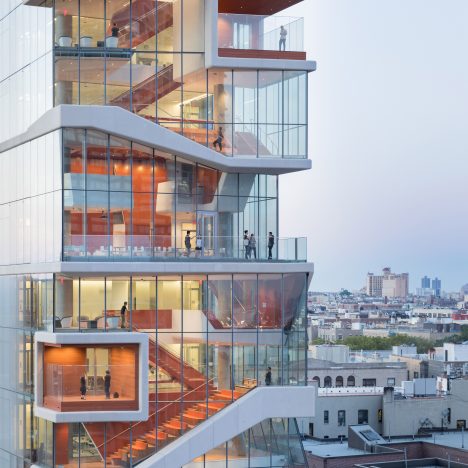
Aedas has released new renderings and photos of Lè Architecture as the 18-story building approaches completion. Inspired by the form and striations of river pebbles, the office building will provide a unique work environment along the Jilong River and will mark an important milestone in the revitalization of the Nangang District of Taipei.


Courtesy of Aedas


Courtesy of Aedas


Courtesy of Aedas


Courtesy of Aedas


Courtesy of Aedas

Courtesy of Aedas

Imitating a moss-covered pebble found in a river, the building employs multiple strategies for adding greenery to the facade. On the west face, a series of vertical green belts provide sunshading for the interior office spaces, while the north and south ends feature a series of vegetated outdoor terraces to create “diverse façade layers with unparalleled views.”


Courtesy of Aedas

Courtesy of Aedas

Courtesy of Aedas

Courtesy of Aedas

“Efficient, interactive and healthy” office spaces have been carefully arranged to provide “an urban living room” centered around communal areas with kitchens, coffee shops, libraries and “brainstorming spaces.”


Courtesy of Aedas

Courtesy of Aedas

The design has been conceived with environmental sustainability in mind to aim for a LEED gold certification. The glass facade of the building has been optimized for construction feasibility, while vertical aluminum fins and the green planters on the west facade lower the interior temperature in the summer through sunshading, reducing the need for mechanical cooling.


Courtesy of Aedas

Courtesy of Aedas

Project: Lè Architecture
Location: Taipei, Taiwan
Architect: Aedas
Client: Earnest Development & Construction Corporation
Gross floor area: 14,169 square metres
Completion year: 2017
Director: Andy Wen

News via Aedas.


Courtesy of Aedas
Courtesy of Aedas

http://ift.tt/2bDKl3x

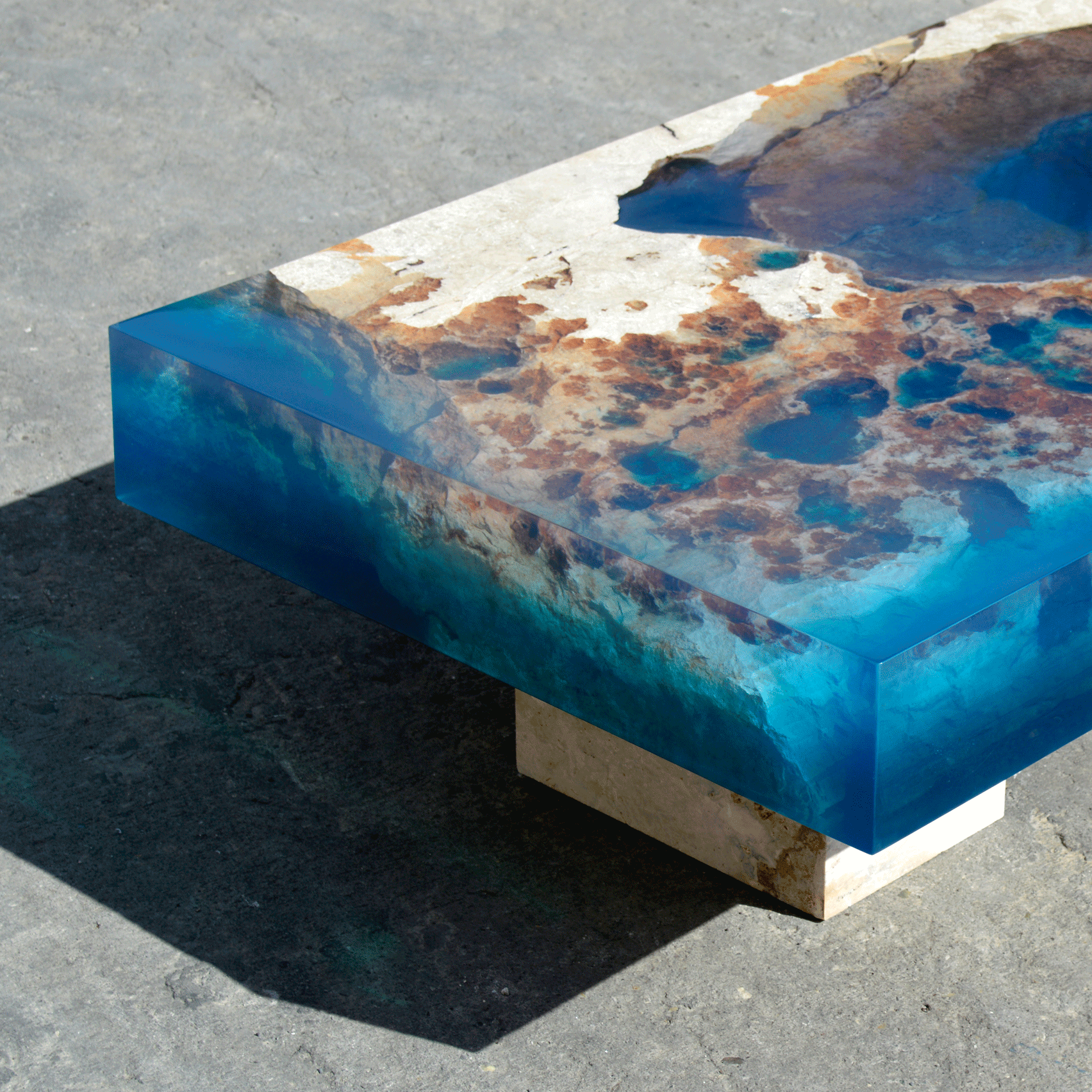
Alexandre Chapelin designs resin tables to look like the ocean


Saint Martin-based designer Alexandre Chapelin combined resin and stone to create a table that resembles ocean reefs (+ slideshow).  (more…)

http://ift.tt/2c9kDp5

Malleco Governorship / Francisco Javier Correa, Cristóbal Fernández, Pedro Hoffmann, Andrés Mas, Sebastián Mundi, Soledad Pérez Martinez


© Felipe Fontecilla

© Felipe Fontecilla


© Felipe Fontecilla


© Felipe Fontecilla


© Felipe Fontecilla


© Felipe Fontecilla

  • Client: Gobernación de Malleco
  • Structural Calculations: Ernesto Domínguez
  • Construction: Larraín Prieto Risopatrón S.A.
  • Sanitary Instalation: Jaime Vivanco
  • Electrical Installation: Luis Farías
  • Lighting: Mónica Pérez
  • Landscape: María Eugenia Muñoz
  • Energy Efficiency Advisory: José Antonio Espinoza
  • Air Conditioning: Francisco Avendaño R.
  • Acoustic Consultancy: Mauricio Canales
  • Paving: Mario Quiñones
  • Building Inspection: MOP Araucanía
  • Models: Patricio Herrera
  • Budget: 44 UF/m2
  • Land Surface: 2000m2

© Felipe Fontecilla

© Felipe Fontecilla

Text by ARQ. In October 2011, the Ministry of Public Works opened a competition to rebuild the Malleco Province Hall Building in the city of Angol through a public bid, bringing together eleven public services that were scattered throughout the city.


© Felipe Fontecilla

© Felipe Fontecilla

Our proposal was a building with a simple design and durable materials that would permit the flexible use of its spaces to respond to the variety of the services and activities that would be offered in the coming decades.


© Felipe Fontecilla

© Felipe Fontecilla

Both the building and the esplanade that precedes it are designed to support everyday life and events, using the state investment to create a condenser of citizen activities in Angol.


© Felipe Fontecilla

© Felipe Fontecilla

The strategy consisted in using the length of the terrain, 110 m, to build a continuous façade, a backdrop for the plaza of the Seven Foundations, Angol’s Civic Center. 


Plan

Plan

The volume is set back from the building line to leave a public space along the block. 


© Felipe Fontecilla

© Felipe Fontecilla

The setback also generated a narrower building width that optimized natural light and allowed for cross ventilation.


© Felipe Fontecilla

© Felipe Fontecilla

Two existing araucarias defined an access patio that divided the building in two wings, one containing and auditorium and the civil registry and the other with ten public services.


Section

Section

Plan

Plan

Section

Section

To strengthen the civic character of the building and specify its relationship with the plaza, we connected its pavement and created an esplanade where the pedestrian is the primary user.


© Felipe Fontecilla

© Felipe Fontecilla

The covered walkway along the facade functions as a protected access area as well as a meeting space in a rainy region of the country. 


© Felipe Fontecilla

© Felipe Fontecilla

This covered sidewalk also plays the role of connecting the esplanade, the building and the surrounding streets to integrate the new Government of Malleco with the city fabric.

http://ift.tt/2bPEkpA

Gallery: Calatrava’s WTC Transportation Hub Photographed by Hufton+Crow


© Hufton+Crow

© Hufton+Crow

Hufton+Crow have shared with us their latest set of photographs: Santiago Calatrava’s World Trade Center Transportation Hub in New York City. Hardly requiring an introduction, the spiky structure has opened in stages since last year to mixed critical response, with new retail spaces lining the central “Oculus” space debuting to the public earlier this month.

Continue on for the British duo’s photographic impressions of the ribbed structure.


© Hufton+Crow


© Hufton+Crow


© Hufton+Crow


© Hufton+Crow


© Hufton+Crow

© Hufton+Crow

© Hufton+Crow

© Hufton+Crow

© Hufton+Crow

© Hufton+Crow

© Hufton+Crow

© Hufton+Crow

© Hufton+Crow

© Hufton+Crow

© Hufton+Crow

© Hufton+Crow

© Hufton+Crow

© Hufton+Crow

© Hufton+Crow

© Hufton+Crow

© Hufton+Crow

© Hufton+Crow

© Hufton+Crow

© Hufton+Crow

© Hufton+Crow

© Hufton+Crow

© Hufton+Crow

© Hufton+Crow

Find more images in the gallery below.

http://ift.tt/2bPV0vw

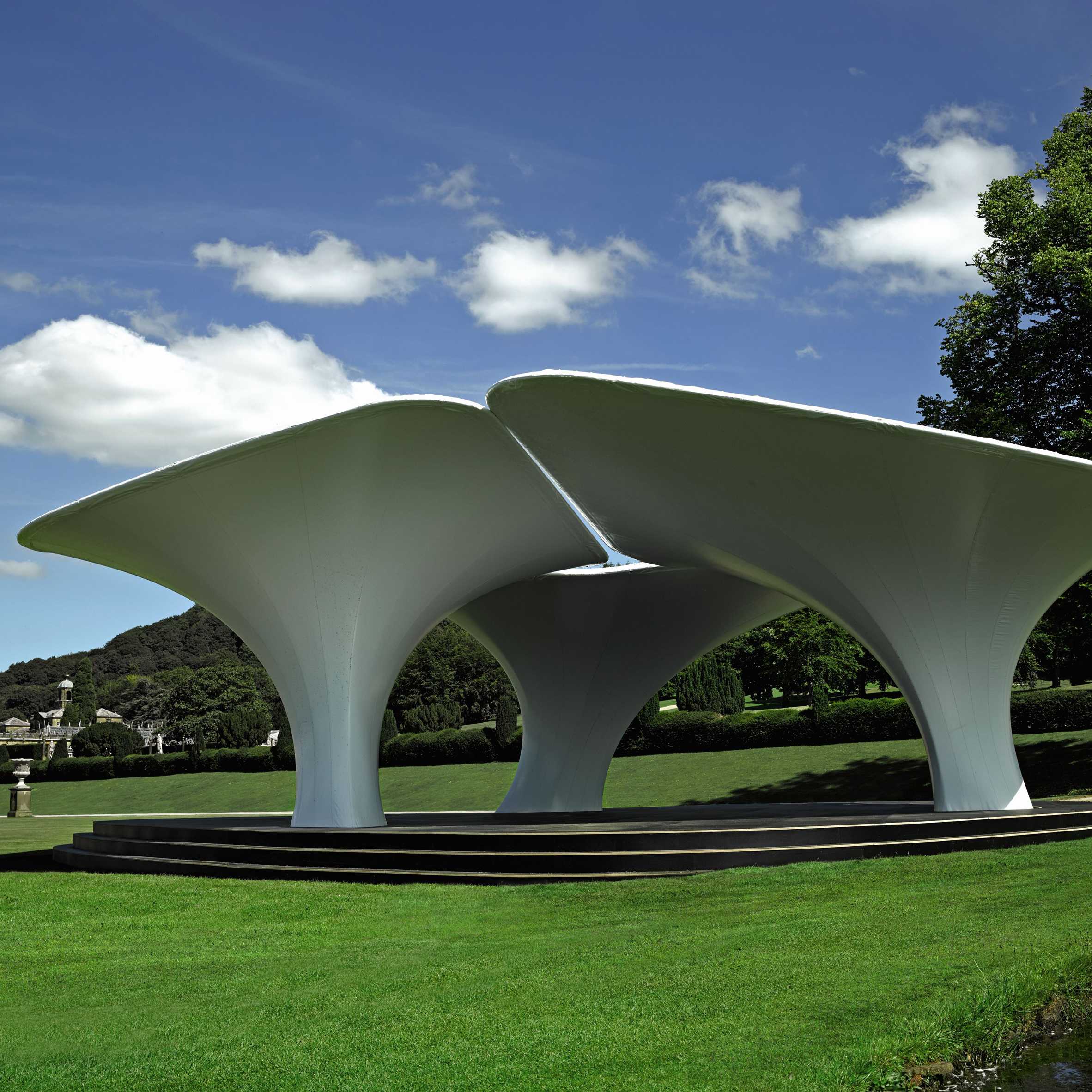
Zaha Hadid’s 2007 Serpentine Gallery Pavilion put up for sale at Chatsworth House


A pavilion designed by the late Zaha Hadid for London’s Serpentine Gallery has been installed in the grounds of a stately home England’s Peak District, ahead of its sale. (more…)

http://ift.tt/2bzLbhv

Tree Top Residence / Belzberg Architects


© Bruce Damonte

© Bruce Damonte


© Bruce Damonte


© Bruce Damonte


© Bruce Damonte


© Bruce Damonte

  • Architects: Belzberg Architects
  • Location: Los Angeles, CA, USA
  • Partner In Charge: Hagy Belzberg
  • Project Manager: David Cheung
  • Design Team: Dan Rentsch, Jennifer Wu, Chris Sanford, Barry Gartin, Susan Nwankpa
  • Area: 1290.0 sqm
  • Project Year: 2015
  • Photographs: Bruce Damonte, Art Gray
  • Project Contributors: Brock DeSmit, Chris Arntzen, Glenn Ginter, Andrew Kim, Ashley Coon
  • Landscape Architects: Pamela Burton & Company Landscape Architecture
  • Interior Design/Decor: Curated, Inc.
  • Soils Engineer: Grover Hollingsworth & Associates, Inc.

  • Civil Engineer: Fuscoe Engineering, Inc.

  • Structural Consultant: Thornton Tomasetti
  • M/E/P Consultant: South Coast Engineering
  • Specifications: InterSpec

  • Surveyor: Northlake Surveying
  • Expeditor: Kimberlina Whettam & Associates
  • Project Management: Planning Partners Limited
  • General Contractor: Winters Schram Associates
  • Special Fabrication: Spectrum Oak (Stairs), Funtime Cabinet Factory (Millwork), Fusion Flooring (Kitchen Stair and wood flooring)

© Bruce Damonte

© Bruce Damonte

The Tree Top Residence celebrates the site’s complex landscape, merging seamlessly and emerging from atop the canopy of trees that surround it. Built along a natural ridgeline, the long and narrow plan of the three-story house mimics and inverts the angles of the site’s topography, creating dynamic vertical and horizontal relationships.


© Bruce Damonte

© Bruce Damonte

Section

Section

© Bruce Damonte

© Bruce Damonte

Vertically, an eccentrically-helical stair functions as a primary organizing element and a sculptural gesture upon entry into the house. On the ground floor, it acts as a threshold into the open plan; on the floor above, it separates the master suite and children’s quarter, while providing a light well to the basement. Horizontally, walls are used sparingly in favor of fluidly connected spaces. Movement and views between dining areas, kitchen, play and gathering spaces are uninterrupted, and floor-to-ceiling sliding glass doors blend the interior with the outside.


© Art Gray

© Art Gray

Hidden from the street, the residence is insulated from its neighbors, but open to its site. Canted limestone louvers, and dense planting on the north facade shield the interior from the closest adjacent neighbor. Conversely, the rest of the building opens to the site with floor-to-ceiling glazing, relying on both the house’s generous distance from the property line, and the densely wooded valley below to create a natural screen. The orchestration of this view, overlooking a dense canopy of trees, embodies the intent to offer respite from the city below. 


© Bruce Damonte

© Bruce Damonte

http://ift.tt/2ccg7cy

Renzo Piano to Lead Reconstruction Efforts Following Italian Earthquake


Red Cross Responders aid victims of the magnitude 6.2 earthquake to hit central Italy last week. Image © flickr user IFRC. Licensed under CC BY-NC-ND 2.0

Red Cross Responders aid victims of the magnitude 6.2 earthquake to hit central Italy last week. Image © flickr user IFRC. Licensed under CC BY-NC-ND 2.0

Italian Prime Minister Matteo Renzi has asked architect Renzo Piano to lead in the reconstruction of the central Italian towns devastated by last week’s magnitude 6.2 earthquake that claimed the lives of at least 290 people. Renzi announced a national action plan for recovery and risk prevention on Monday after meeting with Piano to discuss strategies for housing the over 3,000 displaced survivors and rebuilding the historic towns in a manner that would mitigate damage caused by future seismic activity.

“We have to act quickly, with the utmost urgency,” said Piano in a telephone interview with The Guardian. “Anti-seismic requirements must be inserted in the laws of the country to make our homes safe, just as it’s compulsory for a car to have brakes that work.”


Red Cross Responders aid victims of the magnitude 6.2 earthquake to hit central Italy last week. Image © flickr user IFRC. Licensed under CC BY-NC-ND 2.0

Red Cross Responders aid victims of the magnitude 6.2 earthquake to hit central Italy last week. Image © flickr user IFRC. Licensed under CC BY-NC-ND 2.0

The recovery plan will consist of several phases: over the next six months, the Italian government will transfer displaced residents from the 58 tent camps and temporary shelters where they are currently staying to longer-term wooden “chalet-style” huts close to their damaged or destroyed homes. Following successful relocation, reconstruction of the towns will begin.

“Reconstruction should be coordinated in the wisest and fastest way,” commented Renzi in a statement. “It’s right to do it quickly but even better to be done well and above all with the involvement of the affected people.”

Drawing from his experience working with UNESCO on disaster recovery and prevention, Piano’s comprehensive plan calls for stricter anti-seismic regulations, as well as special attention to protecting the cultural heritage of the region’s architecture. The strategy is expected to take 50 years to fully implement.

“We are speaking about the ridge of the Apennines, the backbone of Italy from north to south, an operation projected over 50 years and two generations,” he said. “We are talking about millions of buildings, it is not impossible if you work through generations.”

The 78-year-old architect was appointed an Italian senator for life in 2013.

News via The Guardian, BBC.

http://ift.tt/2bXHl60

“It looks like a mess from a distance until you see how perfectly it is executed”

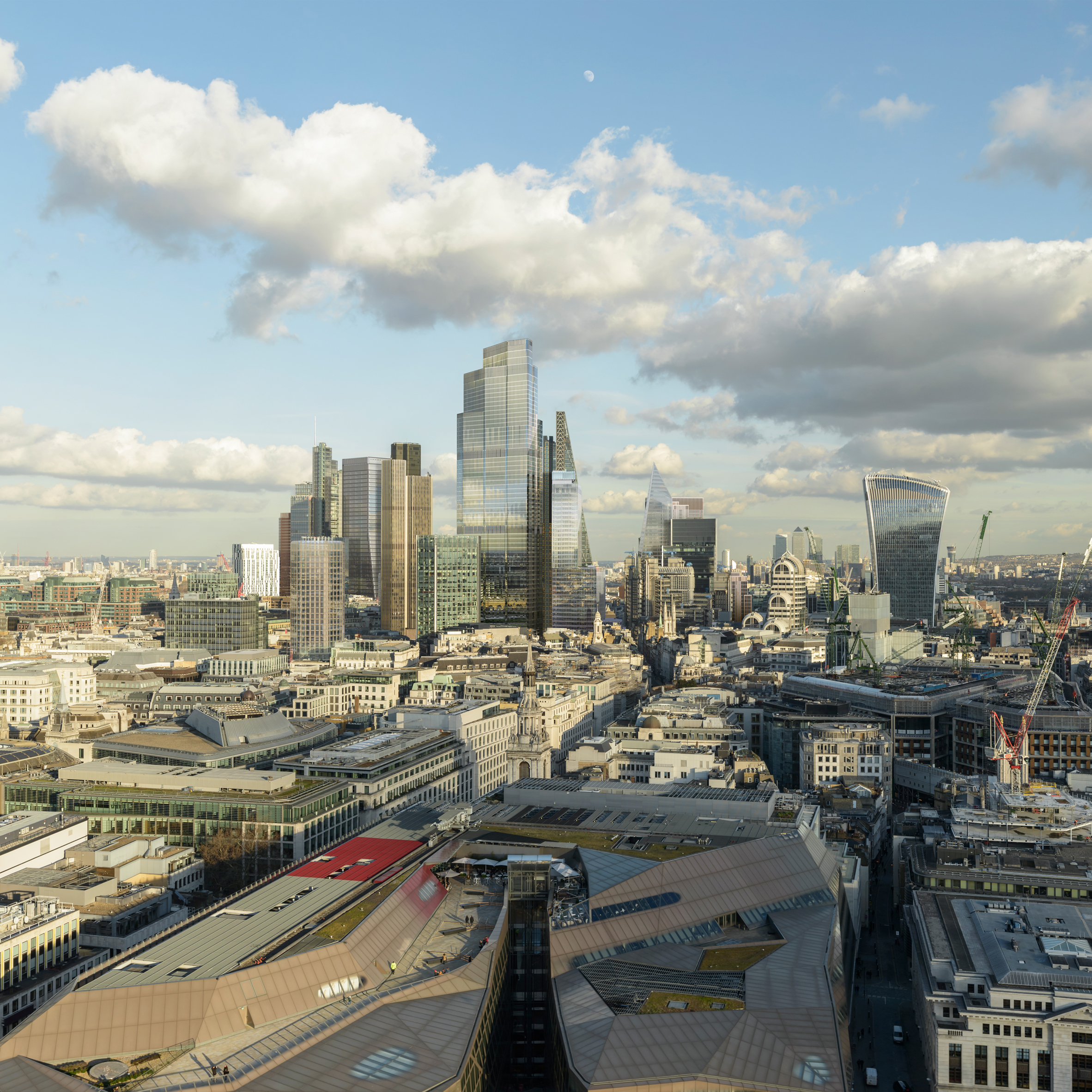
Londoners demand skyscraper height restrictions


London residents have called for height caps and no-build zones to protect the city from the increasing number of new skyscrapers. (more…)

http://ift.tt/2coKEFg

Warren Cottage Extension and Renovation / McGarry-Moon Architects


© Adam Currie

© Adam Currie


© Adam Currie


© Adam Currie


© Adam Currie


© Adam Currie


© Adam Currie

© Adam Currie

The charming hung tiled Warren Cottage in Kingston upon Thames has been beautifully renovated and extended to turn the formerly dilapidated gatehouse into an elegant contemporary home.


© Adam Currie

© Adam Currie

Model

Model

© Adam Currie

© Adam Currie

The mid-nineteenth century Victorian dwelling once marked the entry into Richmond Park, and set in its own spacious gardens, it is designated as a building of Townscape Merit in the Coombe Wood conservation area.


© Adam Currie

© Adam Currie

Commissioned in 2012 to extend the cottage and create a large family home required an architecture of restraint. With the cottage restored to its former glory, the new extension meets the old with a touch of glass. Its palette is muted but precise, with crafted iroko timber glulams meeting sharp board-marked concrete walls. Together they form a restrained but striking palette that sits comfortably next to the detailed tiled faces of the cottage.


© Adam Currie

© Adam Currie

The finished scheme manifests itself as a new two-storey extension, with a separate garden room building. The double height space above the kitchen and dining area flow into the more secluded lounge. Looking out over the still pool and the retained mature trees, one encounters the garden room. A separate building, the garden room acts as a self-contained retreat, approached under a louvered timber walkway.


© Adam Currie

© Adam Currie

© Adam Currie

© Adam Currie

Environmental concerns were considered throughout the project, with the concrete walls and flooring providing essential thermal mass, and green roofs reducing the water run-off and also filtering pollutants.


© Adam Currie

© Adam Currie

The result is a project that allows the architectural languages of the contemporary and Victorian to relate to each other and form a stimulating and respectful dialogue. The delightful cottage has been fully restored and can again be appreciated for its architectural and historical interest, whilst now also providing a 6 bedroom family home.


© Adam Currie

© Adam Currie

http://ift.tt/2bXvrJm