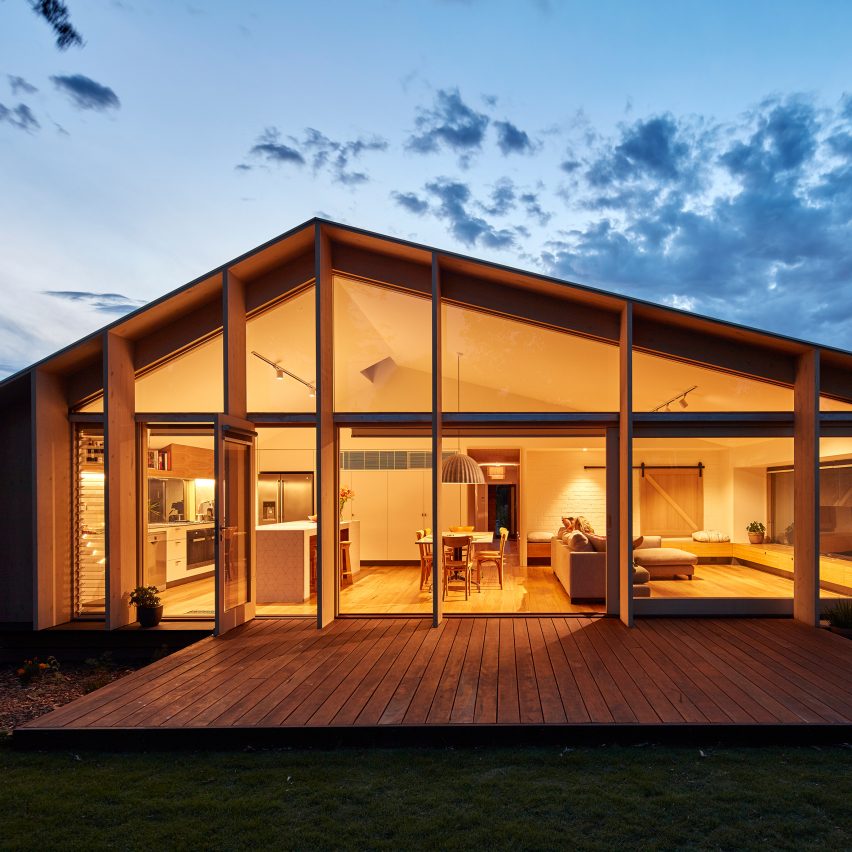
Warc Studio has reinterpreted the typical lean-to extensions of many Melbourne houses with this timber and glass addition to a home in the city’s Oakleigh suburb. Read more
Warc Studio has reinterpreted the typical lean-to extensions of many Melbourne houses with this timber and glass addition to a home in the city’s Oakleigh suburb. Read more

The Regional Government of Andalucía (Spain) has decided not to move forward with plans to build “Puerta Nueva,” the project for the new gate of Alhambra. Designed by Álvaro Siza and Juan Domingo Santos, the proposal won an international competition held in 2010. According to the newspaper El País, the decision follows the latest Icomos report, which rejects its construction and suggests it would have a “negative impact on the exceptional universal value of this monument World Heritage.”
The 1992 Pritzker Prize winner’s project sparked a long-running dispute between the Monument Patronage, the Mayor’s Office of Granada and cultural institutions of Andalusia for the high concentration of commercial services that would be included in the project. “How is it possible to argue that the project is not integrated and is invasive in the landscape when the jury noted that one of its main virtues was its integration in a place so sensitive and intervened since the twentieth century?” remarked Siza and Santos on the decision of Andalucía, according to El País.
Reacting to the decision, Siza and Santos asked, “How is it possible to argue that the project is not integrated and is invasive in the landscape when the jury noted that one of its main virtues was its integration in a place so sensitive and intervened since the twentieth century?” according to El País.
With a budget of 45 million euros, the 5,700 square meter project offered a transition zone between the arrival area and access for the 2.5 million yearly visitors to the Alhambra. Its program included a lobby, tourist attention areas, cultural information delivery, as well as shops, cafes, and restaurants. Planned submerged parking sought to eliminate the visual impact of visitors’ vehicles.
The design proposed a series of enclosed spaces, shaded courtyards, and large sunny terraces. In 2014 the project was presented in Berlin at the exhibition “Visions of the Alhambra,” where curator António Choupina stated that “the building merges with the landscape, articulating manuscript documents that sketch the old farmland with the elevations of the garden terraces that are in the village Generalife.”
According to El País, the direction of the Alhambra will focus on “restoration of the whole and restoration of heritage in the Albaicín neighborhood.”
Álvaro Siza + Juan Domingo Santos Design “New Gate of Alhambra”
//cdn.embedly.com/widgets/platform.js
News via: El País.

From the architect. The project is a conversion of three pump stations originally constructed in the late 1960s in connection with the large land reclamation project where Skjern River was straightened out. A large number of environmental problems were associated with this alignment of the river, leading to the river being restored to its original run in 2002. In this way a vast and rich natural area reappeared with many visitors.
The original pump stations contained underground water chambers, large halls for the pumps, storage rooms and high voltage rooms. The original pumps in the pump hall were essentially taken out of operation and there has been established a new type of pumps located in the underground water chambers. In this way, the upper part of the building was no longer in use. A framework for the new life of the area has been provided with the rebuilding and extension of the over ground parts of the three pump stations, in the form of exhibition spaces, indoor and outdoor viewpoints to look out over the landscape, rooms for different kinds of events, and accessibility for disabled.
Generally, the original pump stations are detailed alike but different in size and shape. In the same way the new additions to the three pump stations are both the same and different. The extensions and the new interior building elements are mainly simple wooden constructions and reiterate the dimensions and rhythm of the original pump stations’ concrete relief. This creates a direct link between the old structure and the new, while adding a new material and another texture that is pleasing to the touch. With this detail, the cladding and the main structure become one, reducing the complexity of the building, which is reflected in the budget as well as the final expression.
Myhrwold and Rasmussen engineered the original pump stations to be unsentimental and raw in their materiality, and the vertical relief of the concrete façades reminds us of the surrounding ploughed furrows of the fields, and profiles of the soil that control the run of the river. In the conversion of the three pump stations the aim has been that the individual pump stations would still appear as a united whole, to challenge their massive and heavy character and enhance their figure in the landscape, and to add a human scale and materiality.
The project exemplifies how the transformation of ”the negative heritage” can fill the purpose of mediating between a repressed past and contemporary life.

Have you ever witnessed a house that’s so breathtakingly modern and huge that you feel as though you could get lost just wandering its hallways and rooms to marvel at the aesthetic and decor? Well, that’s how we felt when we first saw pictures of Wind House, a private home in Bangkok, Thailand. The more we looked, however, the more we realized that there was something a little bit more..
The post OPENSPACE DESIGN Creates a Private Residence in Bangkok, Thailand appeared first on HomeDSGN.

From the architect. The series of buildings and pavilions are part of a new 113 hectare large public green space along the Seine river, in Carrière-Sous-Poissy, at the end station of the RER métro line A and close to Le Corbusier’s renowned Villa Savoye. The Park designed by Paris based landscape architects Agence TER will be an ecological showcase for local residents and a leisure destination for people living in and around Paris.
The site of the project is exceptional. Along one edge is the Seine river. The presence of barges, fishing huts and houseboats, which have inhabited the site until now, has been a powerful source of inspiration. Along the other edge is nondescript, suburban detached housing. The design springs from a process of hybridization between these two existing habitat models: the floating barge and the archetypical suburban house.
Among other public infrastructures like a visitor’s center, a restaurant (“guinguette”), and an observatory, the competition brief included the construction of a museum to exhibit a large collection of insects, both living and conserved. For this the museum brief asked for public areas like exhibition spaces, an event hall and the welcoming area as well as for a series of non publicly accessible areas like offices, storage and designated spaces for raising different kind of insects.
With the exception of the observatory, which is a steel construction, the collection of pavilions and small “follies” is based on a modular wood system, repeating and combining different sized and angled timber frames. This approach allowed for interesting and unusual constructions, enabling a wide range of possible variations with a very limited number of elements. At the same time the relatively low priced construction method enabled the integration of local building know how and local companies.

SITE
The project is located in a field in Geroskipou. To the north is the only neighbour, another residence, sitting higher than the project. To the east is a public road, with a row of mature conifer trees forming the boundary. The plot is generally level and exposed to the neighbour and views from the public roads to the south and west. Access to the site is from the road to the east.
CONCEPT
The concept was born of the combination of two materials often found near this location: concrete tube pipe sections and metal sheet. The materials are translated here to the residence’s two separate envelopes: a metal structure clad in metal and glass, and the two walls of stacked concrete pipe sections running along the north and south facades of the residence.
The first envelope comprises the load-bearing structure of metal beams and columns sitting on a concrete slab foundation. The roof is formed of corrugated metal sheet, and the exterior walls are formed of aluminium-framed double glazing, fixed and moving. The glass envelope contains the interior of the house, providing unobstructed views to the outside. Clean, minimal, and technologically advanced, it creates a strong contrast with the second envelope.
The second envelope of concrete tubes is heavy, earthy, low-tech. It provides additional sheltering from the environment, specifically the sun and air, and filters views from and towards the house. The tube walls is where the privacy of the residence ends.
DESIGN AND LAYOUT
The layout of spaces is linear along the east-west axis. The open plan living area is to the east, providing a dining area, kitchen, and sitting area. Three bedrooms and a study are placed along a corridor-gallery that runs the length of the house. Huge glass doors slide open to the deck veranda that runs outside to the south. The veranda is dispersed with garden pockets, containing small trees and fragrant plants.To the North is a water corridor that abuts the house. The same large sliding doors open directly to it. The water corridor sets the ambience of the soundscape and influences the light, reflecting it to the interior.
Product Description.The interior benefits from a high degree of thermal insulation thanks to the Envelop system. In the winter the south façade enjoys passive solar gains. An awning above the glass provide shade in the summer and prevent overheating, whilst the concrete tube walls shelter from strong winds.
The Envelop 3D system used here is an integrated system with modules for different functions: fixed external walls, sliding and fixed windows, entrance door, all are provided by the system. It is installed in a single continuous track, 76 metres long, without the need for extra framing.
The walls contain polystyrene and fiberglass thermal insulation and are sealed externally with white glass. The internal surface is a double layer of plasterboard.
The sliding doors are designed to lock in an open position, small enough to be secure, whilst allowing natural ventilation to all spaces.

Headquartered in Beijing, Xiaozhu commissioned People’s Architecture Office and People’s Industrial Design Office to design Sliced House, their latest office space located in the city’s hi-tech center. Xiaozhu (literally ‘small pig’ but homophonous with ‘short stay’) is a peer-to-peer housing rental website. The startup is China’s rival to Airbnb and part of the country’s new ‘shared economy’.
Launched four years ago, Xiaozhu is now valued at $300 million plus. The unpredictability of such rapid growth requires a highly flexible work environment. Our design features spaces and furniture that easily combine and separate, mobile meeting rooms, and power outlets that swing to desired locations. Like Xiaozhu’s online business, the office interior consists of a collage of various domestic spaces. The design inserts the casual comfort of home life into the workplace, reflecting the company’s open spirit.
Sliced House is conceived as a house that has been divided and its parts dispersed throughout an otherwise banal office interior. Shared interior finishes between split spaces make apparent that adjacent portions refer to a single room. These sliced samples of domesticity include kitchen, living room, and bedroom and double as ad hoc meeting areas. Sliced House also features converted tricycles – workspaces and informal meeting areas on wheels – that are inspired by our Tricycle House and the often unique living spaces found in China. Such spaces reflect Xiaozhu’s rental offerings, providing users with a wide spectrum of settings to choose from.
The office features custom-designed furniture by PIDO. Long span cantilevering tables supported by only four legs create undisrupted space underneath to provide seating flexibility. Not only does this allow for space to expand, but passersby can sit down and squeeze in for spontaneous conversation. Numerous mobile Tetris Tables can be detached, combined and rearranged to working in groups or individually. Red ‘umbrellas’ swivel to different locations to provide overhead light and electricity. A long conference table can be separated into three smaller tables, allowing the conference room itself to be divided into three smaller rooms when necessary.
At Xiaozhu’s headquarters flexibility and diversity of workspaces and furniture facilitate spontaneous interactions in order to encourage the exchange of ideas. Such designs are essential in fostering innovation in China’s emerging service economy.

Santa-Monica-based Steven Christensen Architecture has won the 2016 AAP American Architecture Prize for Recreational Architecture, with its design for the Liepāja Thermal Bath and Hotel in Latvia.
In an exploration of the role of the dome throughout the architectural history of public baths, the project utilizes dome shapes—both upright and inverted “as a rhizomatic formal and organizational embodiment of a contemporary public that is democratic, horizontally empowered, and increasingly networked” explained the architects.
Through these spherical forms, the project aims to create an unorthodox spatial experience “that is both spirited at atmospheric.” Furthermore, the use of the dome form in the bath and hotel seeks to “undermine the conventional symbolic performance of the much-maligned hemisphere by challenging its centripetal tendencies as well as its hierarchical basis.”
The Liepāja Thermal Bath and Hotel project was selected by a jury, and won the Silver Award for Recreational Architecture, under the 41 categories of AAP American Architecture Prize awards, as well as five other national and international awards.
Learn more about the project here.
News via: v2com.

In somewhat of a departure from its usual parametric, experimental work, Margot Krasojević Architects has created a recycled, 3D printed LED light, in an investigation of the importance of reappropriating plastics. The project—Lace LED—however, aligns with the firm’s exploration of renewable energy and environmental issues within architecture and product design.
Printed with post-consumer plastics like synthetic polymer packaging from takeout food containers and 3D printer off-cuts, Lace LED is a light diffuser with fractal pattern configurations resembling a piece of woven lace.
The light’s geometry is a series of complex dimensions, similar to a fractal the shapes perceived are neither one or two-dimensional, they are considered fractional dimensions suggesting the surface is neither a plane or a complete form. Fractal dimensions reserve self-similarity across scales, only being restricted through context, in this case the envelope boundary of the light’s form explains Margot Krasojević.
Moreover, Lace LED is an example of scale invariance, “where at any magnification, there is a smaller piece of the object that is similar to the whole.”
The light diffuser is hinged on a pivot, which rotates within a frame, allowing for light dispersion to vary.
The LED bulb is energy-efficient, emitting no heat, [and] is a bright 60 Candela white warm, visible for four meters in a dark room.
News via: v2com.

From the architect. The clients for this 500-square-foot addition to a very traditional log house wanted something different for a contemplative study away from the rest of the house. Being avid art collectors, they also had several key pieces that needed to be incorporated into the design including a large outdoor sculpture.
Located on a butte overlooking Jackson Hole, the addition responds to views, playing upon the contrast of prospect and refuge. This was achieved with rammed earth walls on the south and east, and a full wall of glass on the north. Horizontal slot windows in the rammed earth walls provide framed views to the Sleeping Indian and Wolf Mountain to the east and south. A simple shed roof floats above the entire composition, reinforcing the grounding effect of the rammed earth walls. A skylight parallel to the east wall illuminates the horizontal striations of the earth layers, celebrating the inherent beauty of the materials. A curving wood and copper gallery links the existing house and new space. An outdoor shower, sheltered by a steel screen commissioned from a local artist, occupies the space between the existing house and the addition.
The form of the addition creates a protected courtyard that mediates between old and new. A monumental bronze sculpture is placed strategically to frame views from both the existing house and the new studio. Bronze-clad windows, bonderized steel walls, and rammed earth deliberately contrast with the existing traditional log house. Stained concrete floors, clear vertical grain millwork, integrally colored plaster, and a copper ceiling complete the interior expression. The room is minimally furnished with classic modern furniture and a 400-year-old Chinese Buddha head.
The firm was hired for a second project that consisted of a 225-square-foot bath renovation. Similar to the approach taken at the addition, the character of this renovation was a deliberate departure from the existing log house. A large floor-to-ceiling window connects the space to the outdoors and creates a light, bright interior. Walls and floors are clad in Salvatori lava stone to provide a spa-like feel. A free-standing bathtub and a functional light sculpture become focal points for the room. A minimalist approach to the vanities include cantilevered counters and deliberately off-set sinks to maximize space.
Product Description. Located on a butte overlooking Jackson Hole, the addition responds to views, playing upon the contrast of prospect and refuge. This was achieved with rammed earth walls on the south and east, and a full wall of glass on the north. Horizontal slot windows in the rammed earth walls provide framed views to the Sleeping Indian and Wolf Mountain to the east and south. A simple shed roof floats above the entire composition, reinforcing the grounding effect of the rammed earth walls.
 Sig Nordal