WilkinsonEyre was appointed to design this new swimming pool for Worthing Borough Council following a RIBA Design Competition. The new pool complex includes a six lane, 25 metre pool; a combined learner/diving pool; indoor leisure pools with rapids, flumes and outdoor waters; a health and fitness centre; café; crèche and flexible space for other activities.
This new complex, located adjacent to the existing Aquarena and close to the town centre, is an exciting development on a unique seafront site. The design maximises the potential of the site with ‘ribbons’ of accommodation flowing from north to south to emphasise the connection between land and sea. Each pool has its own terrace, opening up the façade to animate the beachfront elevation and enliven this prominent location in line with the Council’s aspirations for an Active Beach Zone.
Cities across the world are full of white elephants – something which ArchDaily has recently explored. In the latest episode of Section D, Monocle 24’s weekly review of design, architecture and craft, the team examine similar cases from the unfinished Palestinian Parliament to redundant projects in Belgrade. This edition also looks at the RIBA’s new International Prize, which was awarded this year to Grafton Architects for their University of Engineering and Technology building in Lima.
Courtesy of Monocle 24
Unfinished Palestinian Parliament Building. Image Courtesy of Monocle 24
Palestinian Parliament Building
Twenty years ago, with the Israeli-Palestinian peace talks in full swing, the Palestinians began constructing their first parliament building. But when the peace process fell by the wayside, violence swept the region and the half-finished parliament became an afterthought. Monocle contributor Mary Pelletier went to the East Jerusalem neighbourhood of Abu Dis to see why this sandy-coloured monolith is still stuck in limbo.
Santiago Calatrava's Constitution Bridge in Venice. Image Courtesy of Monocle 24
Belgrade
Belgrade used to be the capital of Yugoslavia. Now it’s the capital city of a considerably diminished Serbia. And that’s left it with all sorts of redundant buildings – everything from banks to army barracks – all designed to serve a much larger country. Campaigners say these places could be repurposed so they’ve called on experts from other European countries with experience of turning white elephants into something more useful.
When dealing with the refurbishment of this old carpenter’s workshop placed at Barcelona’s Poble Sec neighbourhood, the main goal was to set up this space for inhabitation while the main constructive components were mantained. They gave charm and singularity to the space.
These elements were poorly conserved. Brick and stone walls were hidden under thick linings of gypsum and mortar, as well as the ceiling surface was. Wodden beams in the ceiling were vastly damaged by termites at points, and it could affect the whole building stability.
However, the property had multiple light openings. The existance of an inner patio allowed us to use translucent glass in the street windows to keep the house privacy. The main spaces of the house will be visually connected with the courtyard which will be their focus point.
The existing valuable components which we wanted to restore formed the upper shell of the project: walls and roof. Owing to that the floor would be the new constructed element in charge of the space configuration. It becomes a magma that fills the whole base of the space. It creates open areas that are organized with the levels and objects generated.
First of all, it solves the conflict produced by the two entrances at different heights. It also gives a solution for the relation between the main level and the patio level which is depressed by 45cm.
In second place, some of the fixed furniture of the house is raised from the floor. The living-room sofa, the kitchen tables and some of the bathroom sinks are brick-made, and covered with a concrete lining as the floor is.
Section
In some of the main areas generated, space is organized with the use of closed boxes. They contain the more private uses of the house, such as bathrooms and dressing rooms. With its positioning, bedroom spaces are also generated, remaining separated from the daytime areas of the house.
The layout singularity arises from the owner requirements. He wanted to have a small independent apartment for the frequent visitors he will have during the year. At the same time, this space will be used as his studio while no guests are in the house. That is the reason why house is conceived with two separated spaces that can be used independently if wanted.
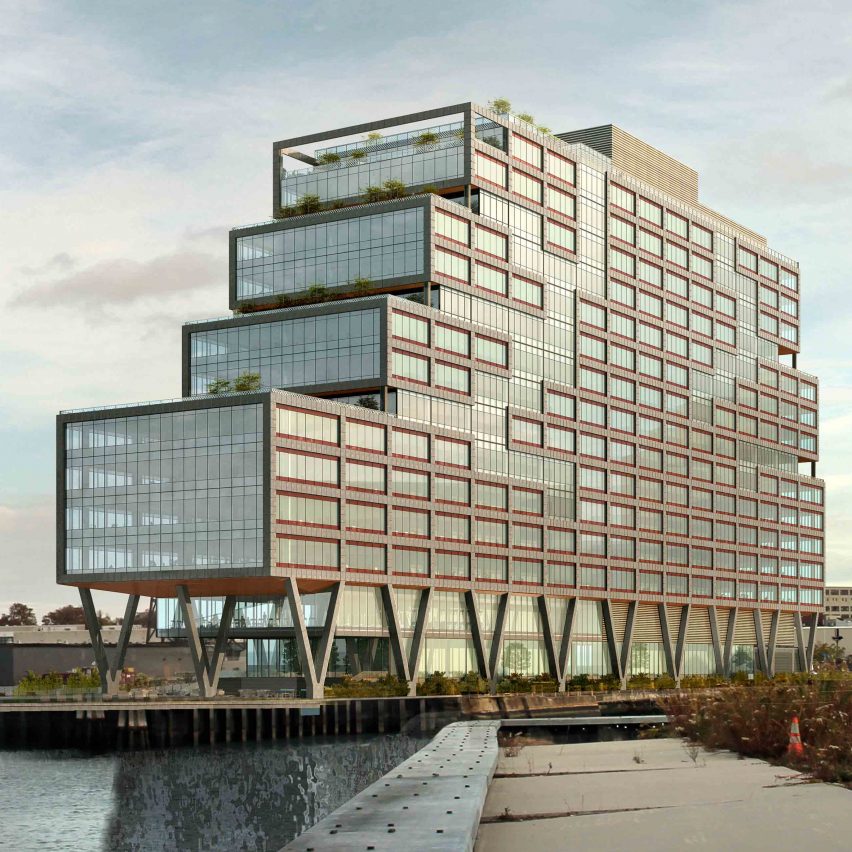
New York studio S9 Architecture has conceived a 16-storey office building for a waterfront site that is intended to house 4,000 employees working for tech and creative startups. Read more