Cielo Mar Residence / Barnes Coy Architects + SARCO Architects


© Paul Domzal

© Paul Domzal


© Paul Domzal


© Paul Domzal


© Paul Domzal


© Paul Domzal

  • Structural Design: Heriel S.A.
  • Electric Design: Circuito S.A.
  • Installations: Termoaire
  • Lightning Design: PATDO Light Studio
  • Landscape Design: Bryan Carlson

© Paul Domzal

© Paul Domzal

© Paul Domzal

© Paul Domzal

The Cielo Mar residence is a collaboration project between NY-based firm Barnes Coy Architects, who created the original concept & design of the home, and SARCO Architects Costa Rica who performed the design development, final plans and construction management of the project.


© Paul Domzal

© Paul Domzal

The home is a three-story upside-down design, created on a bluff with a sharp slope at the end facing the ocean.  The home appears from the road as a simple, one-story structure with a sloping and curving wall, and really hides the rest of the home dug into the hillside.  The main level of the home is done in the middle level, where all social spaces, outdoor areas, master bedroom and pool are all located.  In the lower level the home houses additional guest rooms, a gym and a media room.


© Paul Domzal

© Paul Domzal

The shape of the home was inspired on a bow-and-arrow idea, with a concentric shape housing the main social area, and some bedrooms on the opposite end, which represent the bow. The arrow is represented by an entrance canopy that continues outward as a cantilevered steel bridge over the swimming pool.


© Paul Domzal

© Paul Domzal

The bridge became the central element of the outdoor space, under which was created a space for outdoor dining, used by the family and guests throughout the year except when it rains.  The bridge also provided the structure from which to attach retractable shading, created by the use of boat sails full with sailing hardware to retract the sails in and out.  When furled up, the sails are neatly tucked away in their rollers attached to the underside of the bridge.


© Paul Domzal

© Paul Domzal

Main Level

Main Level

© Paul Domzal

© Paul Domzal

The exteriors of the home are modern, natural and muted at the same time, with accents of color in the exposed steel structural elements.  Extensive deck areas are done in natural Ipé wood from Brazil, with the swimming pool was finished in volcanic stone.  Exterior volumes are comprised of either glass curtain walls done in wood-framed window system, the kitchen & bar box clad in Porcelain tiles to replicate cor-ten steel, and the “Bento Box” at the other end clad in Ipé wood siding.  All exterior railings are custom-fabrication 316 Stainless Steel with stainless braided wire for horizontals.


© Paul Domzal

© Paul Domzal

This home was a massive construction and engineering undertaking done by SARCO Architects in many aspects.  The swimming pool, for example is of varying depth with 9ft. depth at the deepest end, and still this is elevated around 7ft. off the ground.  The structural anchoring of the pool to prevent from failure during earthquakes included 3 massive 10X10X10ft reinforced concrete anchors dug into the rock hillside, with reinforced concrete beams attaching the anchors to the pool’s floor structure.  The engineering ingenuity and safety measures were all in good measure, as in late 2012 the home went through a 7.6-Richter Scale earthquake whose epicenter was around 60 miles away from the home, with no damages.


© Paul Domzal

© Paul Domzal

The steel bridge was manufactured off-site in two sections and trucked to the site to be hoisted in place by two cranes and welded on site to the inverted-A steel support.  The bridge cantilevers a total of 29ft from this point, aided by 1-inch thick solid stainless-steel bar tensioners to both sides of the support.


© Paul Domzal

© Paul Domzal

The entire home was fitted with first-generation LED lighting, design led by NY-based Gary Novasel at PATDO Light Studio.  At the time this was the first full LED-equipped home in Costa Rica.


© Paul Domzal

© Paul Domzal

http://ift.tt/2fruIBI

HOK + FXFOWLE + SPEECH Unveil Designs for Moscow City’s Final Skyscrapers


Courtesy of Renaissance Development

Courtesy of Renaissance Development

Visualizations of the last full-scale skyscrapers in Moscow’s new International Business Center (“Moscow City”) have been revealed. Designed by an international team made up of HOK (USA), FXFOWLE (USA) and SPEECH (Russia), the two “Neva Towers” will provide additional residential and office space to the skyscraper district, which includes many of Europe’s tallest structures, including Europe’s tallest building, Federation Tower (sometimes called Vostok Tower); and one of the world’s tallest twisting buildings, Evolution Tower.


Courtesy of Renaissance Development


Courtesy of Renaissance Development


Courtesy of Renaissance Development


© Flickr user v_mats. Licensed under CC BY-ND 2.0

Located on a triangular site in the northwest of Moscow City, the two rectangular towers rise from a 4-story podium, arranged to create an open plaza and green space surrounding the buildings that will be free from future development. The landscaped space will serve as the entry point to the towers, as well as to the aboveground and underground retail galleria and parking deck.


Courtesy of Renaissance Development

Courtesy of Renaissance Development

Program types will be split between the two skyscrapers – the taller of the two buildings will reach a height of 338 meters and will contain 77 floors of residential units, while the shorter tower will provide 63 floors broken up between office and apartment levels. In total, the project will add 1,210 new apartment units.

As they rise, the towers retain a classic form that gradually steps back to a fully glazed top tier to give the structure a visual lightness and provide the penthouse apartments with panoramic views of the city.


Courtesy of Renaissance Development

Courtesy of Renaissance Development

“The tower configuration is expressly laconic: the shape of the flat high-rise buildings is modified by slight shifts of the central parts forming a sort of a core of the towers, which is enveloped on both sides by three tiers tapering upwards,” explain development group Renaissance Development.

“The facades of both towers are decorated with pylons getting narrower from the bottom up. Such design imparts a special appeal to the structure, being both effectively up-to-date and recalling the legendary specimens of the 20th century high-rise construction.”


© Flickr user v_mats. Licensed under CC BY-ND 2.0

© Flickr user v_mats. Licensed under CC BY-ND 2.0

The project has been estimated to be completed by 2019.

News via Renaissance Development.

  • Architects: HOK, FXFOWLE, SPEECH
  • Location: 1-y Krasnogvardeyskiy pr-d, 17-18, Moskva, Russia, 123317
  • Area: 349232.0 sqm
  • Project Year: 2019
  • Photographs: Courtesy of Renaissance Development, Flickr user v_mats. Licensed under CC BY-ND 2.0

Moscow’s High Rise Bohemia: The International Business District With No Business
//cdn.embedly.com/widgets/platform.js

http://ift.tt/2fSynqK

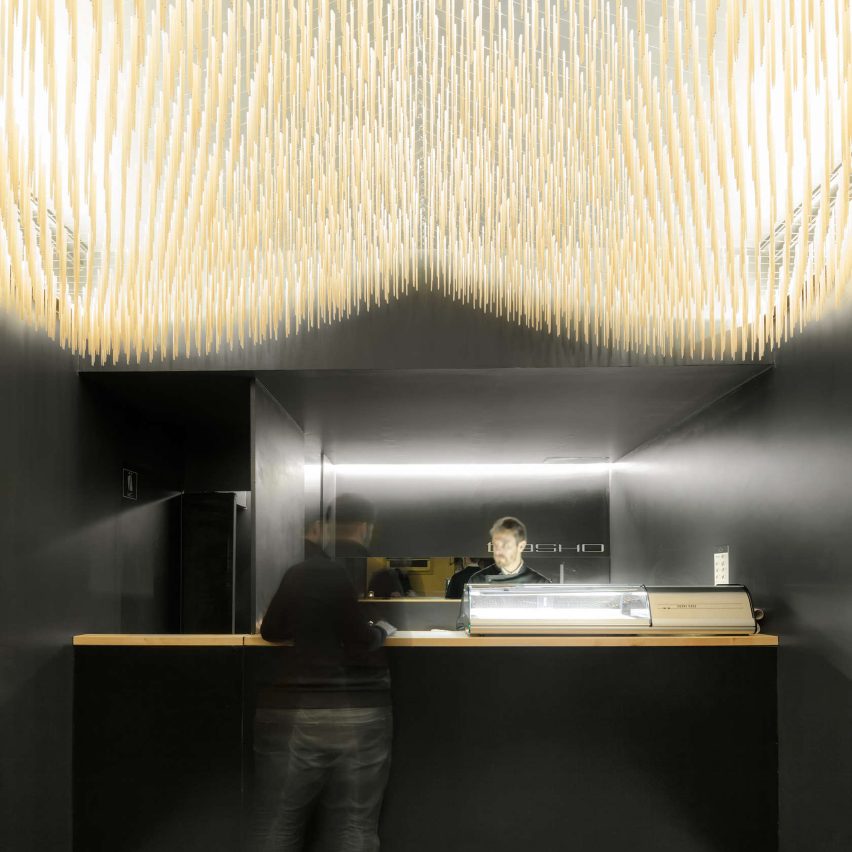
Paulo Merlini suspends chopsticks from ceiling of minimal sushi bar

basho-sushi-house-restaurant-interior-design-paulo-merlini-gondomar-portugal-architizer-a-awards-sqa

A+Awards: over 8,000 wooden chopsticks hang above diners at this “sober and simple” sushi bar in Portugal, which was designed by architect Paulo Merlini and lauded at this year’s Architizer A+Awards. Read more

http://ift.tt/2eXEXgp

House in Estoril / António Costa Lima Arquitectos


© Francisco Nogueira

© Francisco Nogueira


© Francisco Nogueira


© Francisco Nogueira


© Francisco Nogueira


© Francisco Nogueira


© Francisco Nogueira

© Francisco Nogueira

From the architect. The house is located in one of the so characteristic Estoril neighborhoods that had their origin in a summer occupation and expanded along the edge of the so called Costa do Sol. It is an orthogonal grid, with dense articulation, narrow streets and small scale plots.


© Francisco Nogueira

© Francisco Nogueira

The house has a personal relation with the Client: it represents the journey of a lifetime of a family that has lived in several places around the world.


Model

Model

This idea combined with the need to overcome the obstacle created by the blind wall of the neighbor building, resulted in an ascetic movement from the land that searches the light and views of the valley in the east and the sea to the south.


Section

Section

This promenade around the patio runs through different moments of the house: the ground floor patio, the social area (living room, dining room and kitchen), private area (rooms and offices) and a terrace, including a roof top garden.


© Francisco Nogueira

© Francisco Nogueira

It is the extension of this route into the house that defines the entire inner and outer space. The patio result of this continued movement gallery ramp and are defined two distinct altimetric volumes separated from each other through half floor height.

http://ift.tt/2eTr8vT

2Y House / Sebastián Irarrazaval


© Felipe Díaz Contardo

© Felipe Díaz Contardo


© Felipe Díaz Contardo


© Felipe Díaz Contardo


© Felipe Díaz Contardo


© Felipe Díaz Contardo

  • Collaborators: Macarena Burdiles, Alicia Argüeles
  • Structural Engineer: Felipe Cardemil
  • Construction: Jorge Ibacache

© Felipe Díaz Contardo

© Felipe Díaz Contardo

From the architect. The main objectives of the house are two. Firstly; that it integrates the forest in the daily experience of the user and Secondly; that it receives as much light and sun as possible during the entire day. For that purposes the program is fit in a 2Y letters diagram that creates not only double orientations for entering sun at different times of the day but also exposes the inhabitant to views that surround him. In other words, the extremely extended perimeter of the house and it bifurcations, in opposition to a compact organization, potentiates the experience of been, not in front of the exteriority, but within it.  More specifically, of been among the sun and the trees in a parietal relationship.


© Felipe Díaz Contardo

© Felipe Díaz Contardo

Additionally this shape also made possible to fit into the existing trees without having to clean the site.


© Felipe Díaz Contardo

© Felipe Díaz Contardo

Regarding the materialization of the project, timber was chosen not only because it is a local material that could anchor the house to the place by affiliations with the natural and the cultural, but also because the wooden structures, in opposition with other kind of material ensembles, are naturally built using infinite linear elements that as a result, resemble the sense of infinity that is present in forests and could enter in a sort of vibration with the exterior. In this respect, the structural and the architectural plans were done simultaneously and in a permanent conversation. At the end it is hard to distinguish one from the other.

Whit regard to the relation with the ground, the above-mentioned 2Y diagram negotiates the slope in different manners. Sometimes it underlines and rests upon the ground and others it contrasts with the soil, stressing the artificiality of the architectonic body.

With respect to the exterior treatment of the skin, the objective was to create a constant vibration with the mostly green exterior that, as it is well known, can be achieved using a red colour.


Floor Plan

Floor Plan

© Felipe Díaz Contardo

© Felipe Díaz Contardo

http://ift.tt/2fN9ig8

Architects and designers celebrate launch of Dezeen Hot List in London

dezeen-hot-list-sq

Architects, designers and industry figures including Patrik Schumacher, Michael Young, Alison Brooks and Lee Broom joined Dezeen at London’s Ace Hotel last week to celebrate the launch of the inaugural Dezeen Hot List. Read more

http://ift.tt/2eSYmeU

USB stick diagnoses HIV in 30 minutes

HIV USB

A group of scientists have developed a home HIV testing kit that speeds up diagnosis and allows patients to monitor their own treatment. Read more

http://ift.tt/2fPzgPd

Installations Accent Stuttgart Region During Light Art Festival


© Karolina Halatek

© Karolina Halatek

The KulturRegion Stuttgart successfully wrapped its three-week Aufstiege (“Ascents”) Light Art Festival in October. Curated by Joachim Fleischer, the festival showcases work by over 40 artists from 10 countries. The 37 installations were available for viewing nightly from 8 p.m. to midnight across 25 cities near Stuttgart, and particularly popular exhibits have been extended. 


© Frank Kleinbach


© Robert Seidel


© Hitoshi Kuriyama


© Frank Kleinbach


© Frank Kleinbach

© Frank Kleinbach

For example, artist Karolina Halatek’s light sculpture Terminal will remain on display until November 21 in Gerlingen. Hatalek works at the intersection of visual, architectural, and sculptural objects, describing her art as an invitation for drama and reflection. Situated like a UFO in the Gerlingen’s town square, the installation emphasizes the duality between light’s powerful realness and its intangibility. Terminal is simultaneously separate from its site and open to it, setting a stage for interaction with its spectators.


© Frank Kleinbach

© Frank Kleinbach

Other extended works include Max Frey’s “In the River,” which can be viewed at the Eugenstaffel for the next ten years; “Vertex” by Susan Helenmiller, Martina Kändler, and Katharina Heubner, which will become a permanent addition to the Schlossbergplateau stairway; and “Runners 10” by Christine Camenisch and Johannes Vetsch, which will remain at the subway station for another year. The festival encourages people to explore the region, using light to highlight new paths and places for those who are unfamiliar. The installations aim to provide opportunities for people to discover and participate in their built environment.

News via: KulturRegion Stuttgart

http://ift.tt/2fqJicB

Guadalajara offers “extraordinary opportunities very early” for young architects

V House by Abraham Cota Paredes

Guadalajara is emerging as Mexico‘s architecture hotspot, as young firms forgo Mexico City for better chances to test ideas and stand out. Read more

http://ift.tt/2fqAwvg

8 Short Architectural Texts You Need To Know


© Sharon Lam, using an image by <a href='http://ift.tt/2fQMdfk user Martin H.</a> licensed under Public Domain

© Sharon Lam, using an image by <a href='http://ift.tt/2fQMdfk user Martin H.</a> licensed under Public Domain

Quality over quantity, so the saying goes. With so many concepts floating around the architectural profession, it can be difficult to keep up with all the ideas which you’re expected to know. But in architecture and elsewhere, the most memorable ideas are often the ones that can be condensed textually: “form follows function,” “less is more,” “less is a bore.” Though slightly longer than three words, the following lists a selection of texts that don’t take too long to read, but impart long-lasting lessons, offering you the opportunity to fill gaps in your knowledge quickly and efficiently. Covering everything from loos to Adolf Loos, the public to the domestic, and color to phenomenology, read on for eight texts to place on your reading list:

1. Planning the Powder Room by Denise Scott Brown


© Sharon Lam, using an image by <a href='http://ift.tt/2fyobmm user LynnGilbert5</a> licensed under <a href='http://ift.tt/2az3KSe BY-SA 4.0</a>

© Sharon Lam, using an image by <a href='http://ift.tt/2fyobmm user LynnGilbert5</a> licensed under <a href='http://ift.tt/2az3KSe BY-SA 4.0</a>

A lesser-read piece from the co-author of the seminal Learning From Las Vegas, is Denise Scott Brown’s witty essay Planning the Powder Room. Penned in 1967 but still capable of making one sigh in agreement throughout, the essay gives an honest critique on public bathrooms—the all too often hookless cubicles, and the always hookless sinks that leave one awkwardly sandwiching belongings between legs. Scott Brown then shows how simple design can end the everyday impracticalities easily brought about by unaware able-bodied male architects. The essay shows how toilets are worthy of thoughtful design as well, and that it should be at least a number two, if not number one, priority.

2. Ornament and Education by Adolf Loos


© Sharon Lam, using an image by <a href=' http://ift.tt/2fQMdfk user Martin H.</a> licensed under Public Domain

© Sharon Lam, using an image by <a href=' http://ift.tt/2fQMdfk user Martin H.</a> licensed under Public Domain

Adolf Loos was prolific in his architectural writing, penning many articles across various journals and newspapers, with Ornament and Crime being the most famous. However, Loos would come to be disenchanted by the sloganizing and radicalization of a strictly anti-ornament stance. Wanting to distance himself and to clarify his own position, he later wrote Ornament and Education. Published 14 years after Ornament and Crime, Loos rejects those who misread his original essay to mean that “ornament should be systematically and consistently eliminated.” Giving a more holistic view than before, he reaffirms that “modern people, with modern nerves, do not need ornament,” while acknowledging that “classical ornament brings order into the shaping of our objects or everyday use.”

3. Short Stories: London in two-and-a-half dimensions by CJ Lim


© Sharon Lam, using image via screenshot from <a href='https://www.youtube.com/watch?v=SvGbciNlvD4'>CJ Lim - Food City</a>

© Sharon Lam, using image via screenshot from <a href='https://www.youtube.com/watch?v=SvGbciNlvD4'>CJ Lim – Food City</a>

Part fiction, part architectural model eye candy, the ten short stories in this collection imaginatively weave together narrative and architecture. “The ultimate purpose of this book is to demonstrate that architectural representation need not be a neutral tool… that there are alternatives to the reductive working methods of contemporary architectural practice,” introduces CJ Lim. The seamless combination of the real and unreal, architecture and fiction, models and text, results in one of the most enjoyable architectural reads out there.

4. Towards a Critical Regionalism by Kenneth Frampton


© Sharon Lam, using an image via screenshot from <a href='https://www.youtube.com/watch?v=NzZ1VsrUyXU'>Kenneth Frampton Archiculture Extras Interview</a>

© Sharon Lam, using an image via screenshot from <a href='https://www.youtube.com/watch?v=NzZ1VsrUyXU'>Kenneth Frampton Archiculture Extras Interview</a>

Drawing on the likes of Hannah Arendt, Paul Ricœur, Walter Benjamin and Martin Heidegger, Kenneth Frampton explores architecture’s role in proliferating a “universal placelessness” through artificial light and bulldozing land into tabula rasas. These are but a few of the consequences of what Frampton identifies as architecture’s polarization between a “‘high-tech’ approach predicated exclusively upon production” and “the provision of a ‘compensatory facade’ to cover up the harsh realities of this universal system.” Across six salient points, the case for Critical Regionalism is made, offering an architecture that values universal aspirations and geographic context, rather than “the Western tendency to interpret the environment in exclusively perspectival terms.”

5. How to Colour by Lisa Robertson


© Sharon Lam, using image via screenshot from <a href='https://www.youtube.com/watch?v=Vc5XmTbGtVQ'>12.1.12 Lecture / Reading Lisa Robertson et Abigail Lang</a>

© Sharon Lam, using image via screenshot from <a href='https://www.youtube.com/watch?v=Vc5XmTbGtVQ'>12.1.12 Lecture / Reading Lisa Robertson et Abigail Lang</a>

“It is we who have caused this stirring called colour. Nevertheless, we cannot control it. When we stumble against limits we blush. Disproportion and fragility are shameful and funny,” writes Lisa Robertson. Part historical chromatic discourse, part literary fiction, the essay is a refreshing look at the mystery and affect of color. How to Colour is just one of many short essays on buildings, space, place, art and everyday interactions with the environment in Robertson’s book Occasional Work and Seven Walks from the Office for Soft Architecture. The complete book, with a free open-source PDF version, can be found here.

6. The Eyes of the Skin by Juhani Pallasmaa


© Sharon Lam, using an image by <a href='http://ift.tt/2fynvxb user Soppakanuuna</a> licensed under <a href='http://ift.tt/2aA6y58 BY-SA 3.0</a>

© Sharon Lam, using an image by <a href='http://ift.tt/2fynvxb user Soppakanuuna</a> licensed under <a href='http://ift.tt/2aA6y58 BY-SA 3.0</a>

Making appearances on many first-year reading lists (and often therefore appearing perpetually closed on the floors of student bedrooms), The Eyes of the Skin is worthy of a proper reading despite its misunderstood cliche position in architectural literature. The book is written with great readability, revealing the ties between architecture and our own bodies, memories, senses and time, almost conversationally. For a word, phenomenology is long, but for a book, Eyes of the Skin is not—making it the perfect text to revisit (or finally get around to reading).

7. In Praise of Shadows by Junichiro Tanizaki


© Sharon Lam, using an image by <a href='http://ift.tt/2fykInw user Suiten</a> licensed under Public Domain

© Sharon Lam, using an image by <a href='http://ift.tt/2fykInw user Suiten</a> licensed under Public Domain

Published in 1933, Junichiro Tanizaki’s essay remains relevant, if not even more charged, in today’s increasingly multicultural society. By considering shadows, light is shed on the all-consuming cultural influences we blindly accept. Pondering a non-colonial environment where hospitals are tatami-ed, brushed pens melt into soft, thick paper, where toilet trips become “a physiological delight,” Tanizaki poetically uses Japanese aesthetics as a lens to discuss architecture, objects, and contrasts between Western and Asian cultures.

8. Window by Beatriz Colomina


© Sharon Lam, using an image by © <a href='http://ift.tt/2fQUAra user Strelka</a> licensed under <a href='http://ift.tt/2d3G0ZW BY-SA 2.0</a>

© Sharon Lam, using an image by © <a href='http://ift.tt/2fQUAra user Strelka</a> licensed under <a href='http://ift.tt/2d3G0ZW BY-SA 2.0</a>

It’s common knowledge that Le Corbusier is a “problematic fave” of the architecture world, and no-one explains this quite as well as Beatriz Colomina. In Window, an especially accessible essay in Privacy and Publicity: Modern Architecture as Mass Media, Colomina uses the window and Le Corbusier case studies to discuss the public, the private, the representation of buildings and the representation of women.

http://ift.tt/2f8s4Oc