
Tlv Gordon 8.2 Apartment is a private residence renovated by Dori Interior Design. It is located in Tel Aviv, Israel and was completed in 2016. Photos by: Adi Choen-zedek
Concrete apartments slot into cliff overlooking Porto’s Dom Luís I Bridge
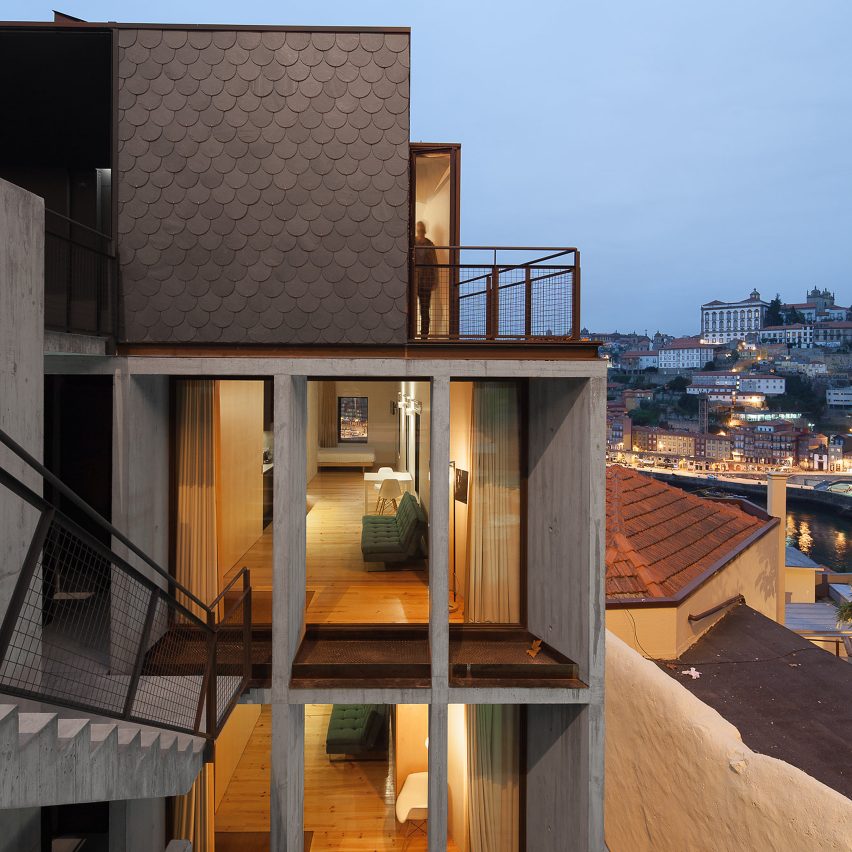
Architects Nuno Melo Sousa and Hugo Ferreira have created a apartment block for holidaymakers in Porto, backing onto a steep granite cliff beside one of the city’s most prominent bridges. Read more
MF+ Arquitetos creates modernist-inspired house with walled garden in Brazil
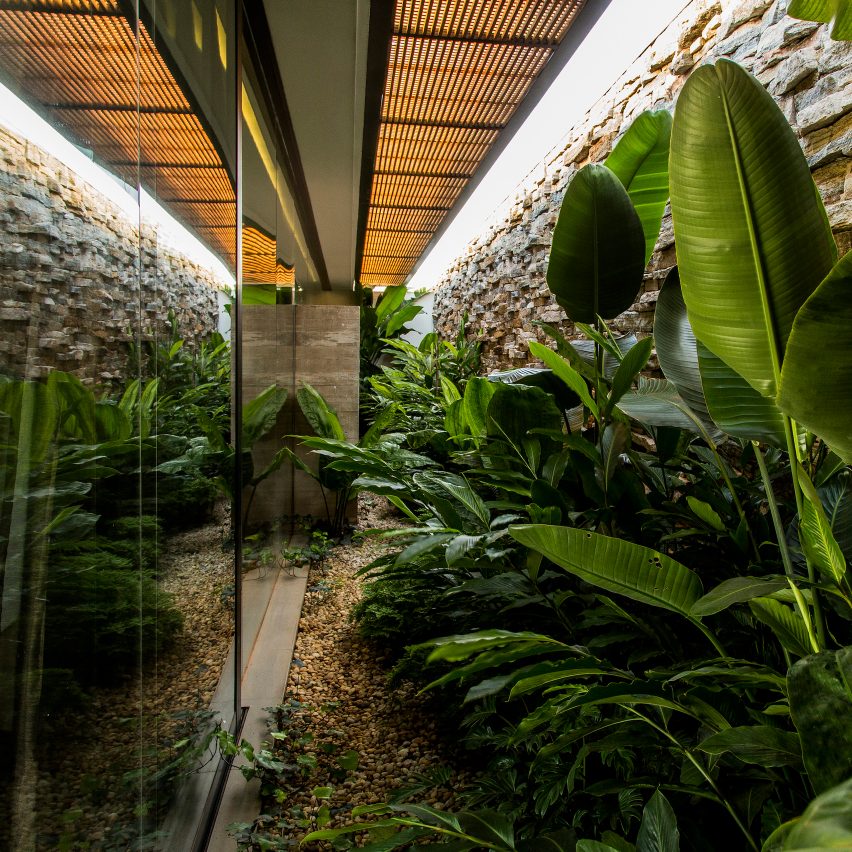
A walled garden filled with tropical plants flanks a glazed hallway at this house in the Brazilian town of Franca, which is influenced by the country’s modernist architecture. Read more
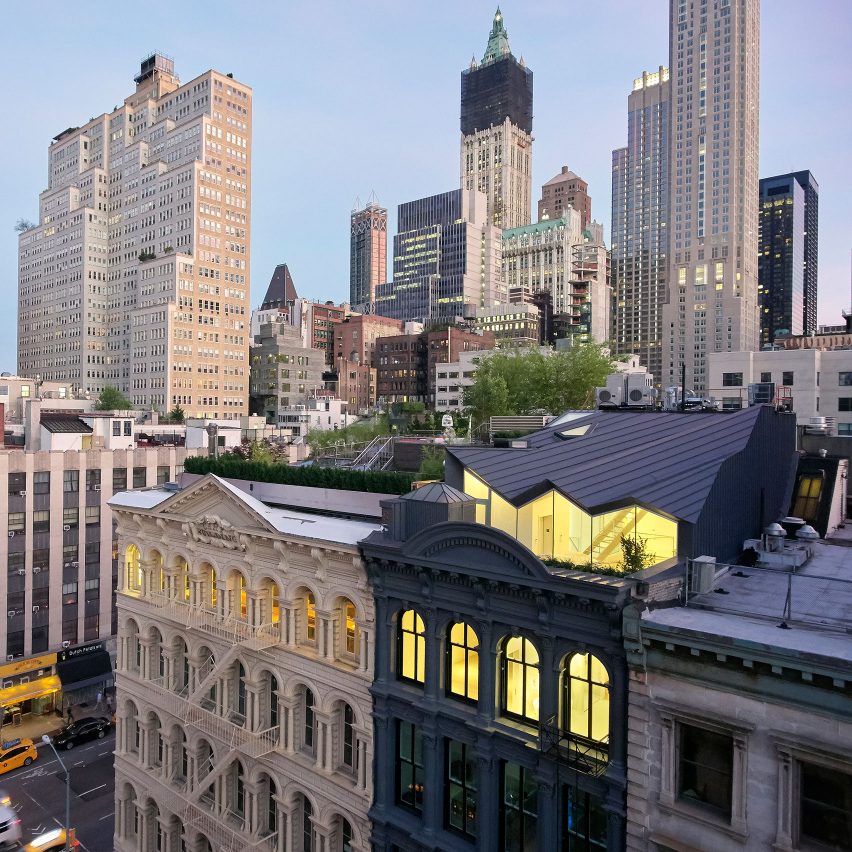
WORKac adds jagged black rooftop extension to historic Manhattan building
James Dyson opening own university to bridge UK engineering skills gap

After being the only prominent designer to argue in favour of Brexit, James Dyson is giving UK design education a boost with the creation of a new engineering university. Read more
Dining Room by Gisele Taranto – Week 4: Work – Casa Cor 2016

For Casa Cor Rio 2016, the most important architectural and interior design event in Brazil, Gisele Taranto Arquitetura was challenged to create six different designs for a dining room. The 26th edition of the event takes place in a house surrounded by Burle Marx gardens in Gávea, an affluent residential neighborhood located in the South Zone of the city of Rio de Janeiro. Ovoo Dining Room by Gisele Taranto –..
ETIE / François Martens + Edouard Brunet

© Studio Dennis De Smet
- Architects: François Martens + Edouard Brunet
- Location: Flanders, Belgium
- Area: 370.0 sqm
- Project Year: 2016
- Photographs: Studio Dennis De Smet
- General Construction Company: MATRIX PL sprl + ZUBER CONCEPT
- Outside Steelwork: ECOVITRE sprl
- Stability Engineer: MATRICHE sprl
© Studio Dennis De Smet
Attracted by the large garden and the tranquil environment of this house located a few kilometres away from Brussels, the new owners wished to carry out works to make it brighter and to open it up on the outside.
© Studio Dennis De Smet
As they were ambivalent about the aesthetics of the existing house, part of the project was also to redesign the architectural expression, outside as well as inside, while keeping the original spirit. One of the childhood friends of the new owner put him in contact with architect François Martens who asked his colleague Edouard Brunet to team up with him.
© Studio Dennis De Smet
With its rather old-fashioned architecture, the house is characterized by a visually heavy slate roof. Over the years, the artificial black slates gradually took a pink hue which is not in harmony with the bricks of the ground floor. The eaves, the size of the windows and the materials make for a particularly dark interior which lacks opening on the large tree-filled garden.
© Studio Dennis De Smet
Architectural principles
The intention of the architects was naturally to build large windows on the back of the house (opening on the garden) as well as on the side façades. The new extension on the back is largely glazed and opens on the long garden. The large side windows that have been opened allow to track the sun’s path and to take advantage of the natural light throughout the day.
Courtesy of François Martens + Edouard Brunet
In order to respect the existing architecture, the two architects deliberately chose to make sure their works would be clearly identifiable. To achieve this, each new opening was highlighted by a black frame that extends from the inside to the outside. They act as frames for the environment of the house.
© Studio Dennis De Smet
Slates and the roof insulation have been replaced while maintaining the shape of the distinctive roof. The interior set up was modified with a kitchen in contact with the terrace and a room made available in the basement via a new staircase on the rear of the house.
© Studio Dennis De Smet
A new extension open on the garden and natural light
The spaces enlarged thanks to the extension appear even larger as the continuity between the inside and the outside has been thought in the smallest details. Thus, in order to minimize as much as possible the visual presence of the poles and sliding frames of the extension, these have been aligned. This allows that each pole hides behind another in a simple and rhythmic architectural expression.
This also reinforces the great visual axes that accentuate the feeling of open space through new perspectives, including that going from the front door to the garden.
© Studio Dennis De Smet
Thanks to a specific technical detail, the sliding frames of the extension go up beyond the ceiling, allowing to see the sky and the treetops from the living rooms.
Large windows to track the sun’s path
Following with the idea of renewing a link with the house environment, details of the newly windows opened in the brick walls was worked so that the inner and outer black frames would only be interrupted by a glass slide. The indoor / outdoor continuity is striking and reduced to its bare minimum. The frames thus formed are like animated pictures conversing with the artworks set up by the residents.
© Studio Dennis De Smet
The façade being rather closed, the lobby and upstairs hallway were relatively dark. To overcome this, the architects suggested to set up a new roof window above the lobby. This allows to open a view from the upstairs hallway but also to bring light to the lobby through the glazed ground. This also creates a fun visual link between the two levels and divide them both in terms of acoustics and temperatures.
The level of details into which the architects went to set up the new roof window make it look like it was gently placed on the roof.
© Studio Dennis De Smet
Materiality serving architecture principles
While respecting the existing volume, the architects wanted to improve it by modifying the dimensions of some windows and reducing the heaviness of the roof. To achieve this, they used shaded slates with dimensions similar to the existing bricks. These bricks were kept. This gives a new coherence to the house by reducing the feeling of juxtaposition of two separate volumes (the roof and the base). The continuity of lines between the different sides of the roofs was achieved thanks to the collaboration with the roofers.
© Studio Dennis De Smet
The choice of a matte and textured black for the new openings is also part of the reflexion of the architects on materiality. In contrast with the sand-coloured bricks and slates, the overall is harmonious and elegant.
The owners’ choice for interior materials with similar colours to those of the facades give a coherence to the inside as well as the outside.
© Studio Dennis De Smet
Conclusion
With limited yet precise interventions, architects François Martens and Edouard Brunet managed to transform the outside expression of the existing house while keeping the original spirit. The technical details serving the architectural intentions enable to bring lightness and elegance to a rustic original building. Besides the external makeover, these interventions have also helped to add to the quality of life of the residents by offering a bright interior connected to its environment. The house is all the more generous and enjoyable.
© Studio Dennis De Smet
Camillo Botticini Designs a Contemporary Residence on the Alpine Hills of Lumezzane, Italy

Alps Villa is a private home located in Lumezzane, Brescia, Italy. It was designed by Camillo Botticini in 2014. Photos by: Nicolo Galeazzi
Winter Cabin on Mount Kanin / OFIS arhitekti

© Janez Martincic
- Architects: OFIS arhitekti
- Location: Kanin
- Area: 9.7 sqm
- Project Year: 2016
- Photographs: Janez Martincic, Ales Gregoric, Courtesy of OFIS arhitekti
- Client: PD Bovec
- Structural Engineers: CBD structural engineers
- Collaboration: PZS, PD Bovec, JZS, Permiz d.o.o. and Ortar in Jerman d.o.o.
- Project Team: Rok Oman , Spela Videcnik , Janez Martincic, Andrej Gregoric, Sara Carciotti, Jamie Lee, Maria Della Mea, Vincenzo Roma, Andrea Capretti, Jade Manbodh, Sam Eadington, Roberta Costa, Soo Woo,Bruno Dujic, Jure Jancar
- Structural Engineering And Principal Contractor: CBD Contemporary Building Design Execution Team: Jure Jancar, Ziga Stepisnik, Martin Gradisnik
- Contractor: Permiz, Bostjan Perme – Matevz Jerman, Ortar in Jerman d.o.o.
- Organization Support: PZS Planinska zveza Slovenije, Matej Planko, Dusan Prasnikar – PD Bovec,Robert Rot – Turistično društvo Bovec, Janko Humar
- Winter Cabin Maintainance: PD Bovec (Rober Rot, Milivoj Sulin)
- Helicopter Flights: Slovene Armed Forces helicopter crew, Chief pilot Davorin Draginc, Co-pilot Peter Paskulin, Pilot technican Grega Ponikvar, Pilot rescuer Dusan Hrncic
- On Site Construction Team: Janez Martincic, Andrej Gregoric, Isa Plibersek, Matevz Jerman, Davor Rozman, Nikolaj Gregoric, Robert Rehar, Claudio Bratos, Andrej Fratnik, Matej in Jernej Naglost, Marko Plevelj, Gregor Plevelj, Miha Luzar, Aljaz Hribar, Marjan Kogovsek, Kristina Seljak, Tjasa Rutar, Gregor Basiaco, Luka Zalokar, Zdenka Zitko, Blaz Ortar, Jernej Ortar, Uros Grilj, Erik Cudr, Marina Pintar, Gregor Pintar, Matej Blatnik , Marjan Baricic, Andrej Drevensek, Jerry Ruditser, Robert Rot
- Sponsors And Donators: Lidl Slovenija, Komenda, Slovenia and Zavarovalnica Triglav, Slovenia
© Janez Martincic
From the architect. The challenge is to install real objects, shelters in 1:1 on remote sites and study their response to extreme weather, radical temperature shifts, snow and rugged terrain. The harsh conditions of wind, snow, landslides, terrain, and weather require a response of specific architectural forms, structures and concept.
Structure Exploded
Courtesy of OFIS arhitekti
Axonometric
The site is accessible only by climbing or helicopter – the modules and loads are prepared according to the maximum weight and equilibrium limits.
© Janez Martincic
Its position within the wilderness requires respect of natural resources ensuring the shelter stability while having a minimal impact on the ground.
Courtesy of OFIS arhitekti
Diagram

Courtesy of OFIS arhitekti
Kanin is a mountain above a small town, Bovec, with beautiful resorts around the valley. The area is also important due to battles that took place during the World War I. Soldiers were fighting along the Isonzo front and many remains of the battle can still be found in the area. In collaboration with Slovenian mountaineer association and PD Bovec, this particular site was chosen because of its 360-degree views over Slovenia and Italy, and spectacular views to Triglav, Soca Valley and Adriatic sea. It will become a destination for hikers, climbers, cavers, mountaineers, nature lovers and romantics.
© Ales Gregoric
Weather conditions are very harsh, especially during the winter. Snow cover lasts more than half of year.
The area of Kanin is known for rainfall and extreme snow records. During the winter more than 10 meters of snow can fall. Strong rainstorms and winds can hit this place – rainfall record in Bovec for one day is 363 litres/m2. Mountain area is full of caves and abysses, earthquakes occasionally occur.
© Janez Martincic
Concept
Kanin Winter Cabin forms a compact wooden volume organized with three floor resting platforms. These platforms are hanging towards the valley and a large glazed panoramic window offers astonishing views. A cantilevered overhang, resting part of the cabin, reaches the smallest footprint on the rock. The interior design dictates modesty, subordinate to the function, providing accommodation for up to nine mountaineers.

© Janez Martincic
The cabin settlement and transportation was an extremely difficult task. It was realized by the Slovene Armed Forces helicopter crew. Bad weather and unexpected turbulences lead to the cabin being placed and fixed on site at the third attempt. However, the challenge of the project is to gain new knowledge through unexpected weather conditions.
© Ales Gregoric
Winter cabin has been fully implemented with donations, also the setup resulted a lot of hard working volunteer hours.
The research for the Cabin was initiated by OFIS arhitekti and CBD structural engineers in collaboration with PZS, PD Bovec, JZS, Permiz d.o.o. and Ortar in Jerman d.o.o. to develop Self-contained wooden shell, which resist extreme conditions on top of the mountain.

© Janez Martincic
Wheat Youth Arts Hotel / X+Living

© SHAO Feng
- Architects: X+Living
- Location: No. 9, Tai’an Road, Binjiang District, Hangzhou, Zhejiang, China
- Design Director: LI Xiang
- Design Team: FAN Chen, CHEN Dan, WU Feng, ZHANG Xiao, REN Li-Jiao
- Area: 4500.0 sqm
- Photographs: SHAO Feng
© SHAO Feng
From the architect. Hangzhou, a city enjoys a long history, modern civilization and striking features. How could it be possible missing a starting point that makes tourists excited about the trip to Hangzhou even when booking hotel on Ctrip.
© SHAO Feng
Target customers of Wheat Youth Arts Hotel are young people or people who think they are still young. The goal is to design a hotel which itself will flirt with tourists, and a place welcomes tourists to tease at each other.
© SHAO Feng
The hotel is located in Binjiang District, Hangzhou, and within the trade area of Avenue of Stars. The entry is not eye-catching and it is inside a shopping mall; it is on the 7th floor. Upon approaching, two simple words “Mai Jian (Wheat)” could be seen on the small, simple and white door of the hotel. The designer creates a small lobby at the door; guests need to go through the small lobby when they see the name of the hotel, and then they will arrive at the hall. At the end of the small lobby, instead of using decorations like traditional pictures and work of art, it is a vertical display of all necessary supplies for hotel guest room. All the items are painted into white and sealed with glass to form a showcase. At the exterior side of the glass, it is the word “hallo” in orange-yellow. It makes people feel like that all items in the guest room are gathering here to welcome future guests.
© SHAO Feng
Entering the the lobby, the space looks like a study and a living room. Book shelves are against four walls, the white wall and glass folded-paper styled partition separate the resting area from the book shelves. The big dog in front of the bar is like a hospitable steward who welcomes the guests on behalf of the host, and the chain fastens him has become a queue line. The designer uses Chinese checkers to describe people, so he decorates a map of the world on one of the walls using Chinese checkers, which carries a message that the hotel welcomes friends from all over the world to gather here. Also the designer uses Chinese checkers to represent the service personnel of the hotel, thus Chinese checkers – like stools are designed. Sitting on them, makes guests feel like being served.
The design of the corridor is concise but powerful and is winding forward. There are paintings and graffiti on every corner of the corridor and part of the ceiling is decorated with colored Chinese checkers, which is as sweet as skittles.
© SHAO Feng
The designer uses music, painting and reading which are loved by people in our daily life to decorate the whole atmosphere of the hotel. There is piano in the corridor of every floor, this allows guests to amuse themselves and share the charm of music and take music as a tool of silent communication between strangers.
© SHAO Feng
The easel next to the window is specially designed for guests, the designer hopes every guest could leave some cherished moments. The TV is blocked by a huge painting which is slidable and with greetings on it. The designer wants to use simple furniture to present a concise space. The function and aesthetics of desk, bed and clothes hanger combines with each other smartly.
© SHAO Feng
© SHAO Feng
When the sun falls, guests could come to the coffee shop of the hotel to enjoy their leisure time. On the ceiling, seven small figures fall from the sky carrying parachutes. Flying is the most graceful posture to embrace the world, the designer believes.
© SHAO Feng
Hallo! How is going today! Very happy to see you! What’s up man! And the greeting said by hotel stuffs humorously in which they use Chinese pronunciation “Beng Zhu” to express the French word “Bonjour”. A sense of caring and communication could be felt everywhere, personified words are appeared in wherever in sight to interact with guests. This is a hotel who says hello to guests with walls, a hotel looks like a gallery, a hotel that is willing to accompany you, and a hotel that makes you willing to sing a song or draw a painting for others. This is Wheat Youth Arts Hotel!
© SHAO Feng

