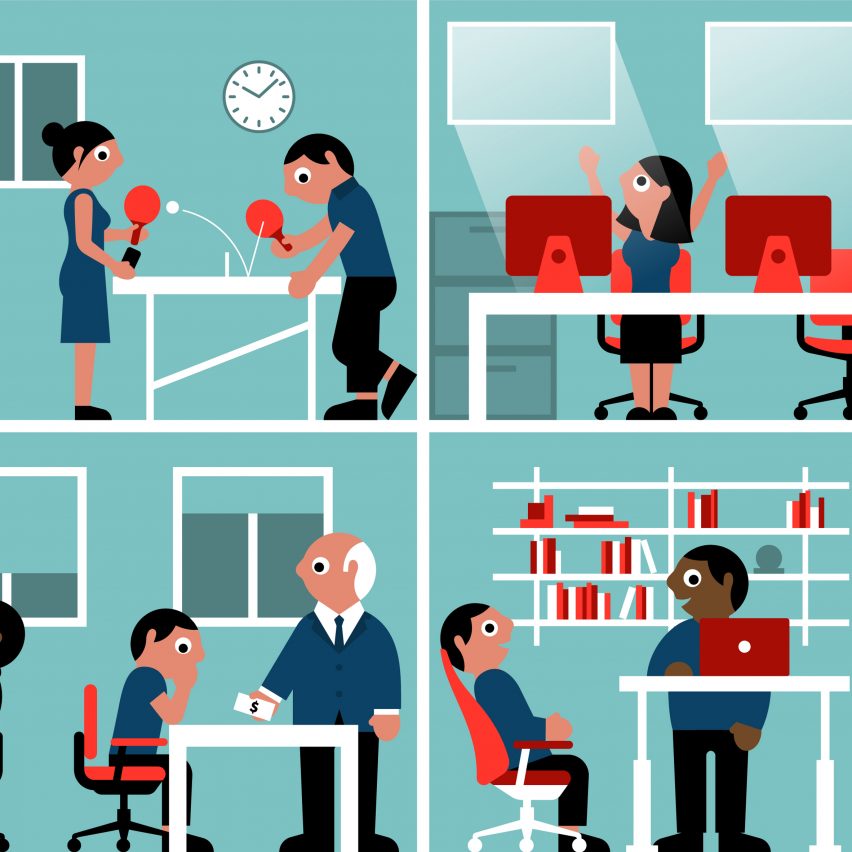
Haworth white papers: the right office design can increase the happiness of employees, whereas ping-pong tables, slides and even pay rises can’t, according to new research by Haworth. Read more
Haworth white papers: the right office design can increase the happiness of employees, whereas ping-pong tables, slides and even pay rises can’t, according to new research by Haworth. Read more

This house is located in the area of San Andres, on the north hillside of Ranco Lake, which leads us to the first condition that we must respond to in the project: views to the south and natural light from the north, for which we propose public areas plus bedrooms overlooking the lake and living room located towards the hills of Futrono.
The site where the house is located spans from a valley of the condominium to the highest hillside overlooking the lake, thus ut is located at the top, which generates its form, a resounding parallelepiped anchored on stilts over the ground.
The house, a second home, proposes integrated common areas to become meeting places, besides being able to join each other generating flexibility in their use depending on the time of year and number of people
The materials we proposed were black Fibrocement to give it a warehouse look, and a contrast with the interior which was designed in local wood painted white, so that it was warm and noble like the floors and doors.

As a way to obtain a sample of participatory architecture from all over Mexico, last October, the Mexican Fine Arts Institute (INBA) published an open call for entries. Works by 31 teams—out of more than 200 registered—were selected to be part of Mexico’s Pavilion in the Venice Biennale, which was curated by Pablo Landa.
Among the teams selected are Arquitectos Artesanos and RootStudio, both based in the city of Oaxaca. Works by these offices stand out because they recover and adapt traditional building techniques for new contexts, and because they are often realized through the collaboration of architects and organized communities.
The featured project by Arquitectos Artesanos is Clay Women (“Mujeres de Arcilla”). A decade ago, a group of catechist women visited the parish house in the city of Huajuapan, Oaxaca. Surprised by the spatial and visual qualities of this house, the women approached its architect—Juan José Santibáñez—to ask him for help in the design of their own houses in nearby rural communities.
They started working soon after: women learned how to make adobe bricks and put them together into elaborate structures. Together, they erected sixteen houses after a design by Santibáñez. Mexico’s pavilion in Venice includes isometric drawings of this design and photographs by Marcela Taboada.
As part of the same project, María Santibáñez started producing a self-building manual that would allow for the construction of more houses. As her work progressed, however, the manual became a short story illustrated with engravings that shows what can hardly be captured by manuals: the spiritual dimension of the house among the people of the Mixtec highlands. The book Voz de Sol – La Casa Viva, the result of María Santibáñez’s work in collaboration with Dánae Cházaro, is also featured in Mexico’s pavilion.
The second team from Oaxaca whose work is on view in Venice is RootStudio, an office that recovers and adapts vernacular typologies and building techniques. Often, this firm designs and builds simultaneously; architects work alongside a structure’s future users.
The form has done a number of works in San Pedro Apóstol, a small town in Oaxaca state. A decade ago, members of the indigenous council in this community began an environmental management project. They built small dams, planted trees, and reintroduced endangered native animals. Later, they started building common spaces; at this stage, they invited RootStudio to collaborate with them. The firm built a sports center in rammed earth and bamboo, and a community-owned house for events and retreats. These buildings have contributed to the re-evaluation of vernacular building techniques and have reactivated traditional community work.
RootStudio has started the construction of a daycare center in Atzompa, a suburb of the city of Oaxaca, through a collaborative process with local families and OIDHO, an organization that defends the human rights of indigenous communities. The daycare will be built over the course of the Biennale, and will be the site of workshops and conversations among different people participating in this event. This work seeks to further conversations on the social dimensions of architecture and its potential to generate benefits for local communities.
Similarly, the book Voz de Sol – La Casa Viva—the second edition of which was produced as part of the preparatory work for Mexico’s Pavilion—will be presented in different locations in Oaxaca and other Mexican cities. The dissemination of this book and the works of architecture it describes will activate conversations on the potential contributions of vernacular architecture to works by other offices and to housing policies and regulations in Mexico.

Interiors is an Online Publication about the space between Architecture and Film, published by Mehruss Jon Ahi and Armen Karaoghlanian. Interiors runs an exclusive column for ArchDaily that analyzes and diagrams films in terms of space.
Kanye West followed up his demented masterpiece Yeezus with an art project—an album never officially released, never officially completed, and one that is continuously being revised and restructured. It’s a continuous work in progress, a painting that’s never finished, which has evolved before our eyes (known by many titles including So Help Me God, Swish, Waves, until finally settling on the anachronistic The Life of Pablo).
It’s no wonder then that The Saint Pablo Tour, which kicked off in Indianapolis on August 25th, 2016 and is tentatively scheduled to end in Brooklyn on December 31st, 2016, feels unlike anything Kanye West has done before, while staying true to his creative vision. If 2013’s Yeezus Tour was an operatic experience that was more about the performance aspect, 2016’s Saint Pablo Tour is an active experience that is more about creating a Disneyesque attraction.
The planning process, which Kanye West has said lasted at least eight months, began with his team traveling around the world, meeting with top stage designers. In addition, Kanye West worked with his longtime collaborators and fellow visionaries, such as Elon Rutberg and Virgil Abloh (who has an accomplished background in Architecture). The intention was to create a new idea in touring, something that goes beyond the idea that it’s about idly watching the artist. The result is that people actually become part of the experience, taking the concept of a concert to another level. In this sense, audience members are singing, dancing and engaging with Kanye West. It is the first concert in recent memory that actively uses the crowd as part of the experience of the show.
The design of the tour is broken down into two stage components, its Main Stage and Secondary Stage (or “Spaceship” Stage as it has been named by many). These stages feature an elaborate pulley and track system. The open web steel joists compose the elaborate framing system that attaches to the structure of each arena.
The Main Stage is roughly a 30 by 20-foot (9 by 6 meter) rectangular steel platform that is less than two feet thick. Kanye West is attached to the center of the platform with a type of carabiner and wire. This stage is attached to two parallel steel joists that span roughly 75 feet (23 meters). These parallel steel joists allow the main stage to travel left and right, forward and backward through a type of motorized track system. It’s also able to tilt along its long axis with a pulley system, with the ability to also drop and move closer to the crowd.
These parallel steel joists are connected to a larger steel frame system—a second pair of parallel steel joists—that span almost the entire length of the arena, which is at least 200 feet (60 meters). The Main Stage has roughly 36 spotlights surrounding the edges of the platform and roughly 28 spotlights lining the bottom of the platform surface (which shine directly onto the crowd during certain moments of the show).
The Secondary Stage is roughly a 200 by 45-foot (60 by 14 meter) rectangular steel platform, also less than two feet thick. This stage has roughly 172 spotlights surrounding the edges and over 1,000 spotlights lining the bottom of the platform surface, which provide different light cues throughout the show and change color and brightness depending on the song that is being performed. In addition, parts of this stage are able to detach from the rest. There are four rectangular forms (each roughly 65 by 10, or 20 by 3 meters) that can move independently from one another, which allows for different designs during songs like “Heartless” and “Wolves.”
The Saint Pablo Tour is divided into three sections with two transitions. The first section of the show consists of Kanye West entering on the main stage during “Father Stretch My Hands Pt. 1”—at first, only the spotlights on the edges of the platform are on for the first group of songs, with lighting cues that represent Kanye West’s arrival, gradually building energy and momentum for the show. The second section includes additional lighting cues with Kanye West traveling closer to the opposite end of the arena. The third section sees parts of the stage transforming with more lighting cues and effects from the Secondary Stage and ultimately concluding with Kanye West traveling back to a bright spotlight in the center of the stage during “Ultralight Beam.”
Interiors has created two diagrams for The Saint Pablo Tour, which includes two elevation drawings showing each side of the show. The short elevation depicts the show during “Freestyle 4” where a large crowd is directly below the Main Stage. The long elevation depicts the show during “Wolves” where the Secondary Stage breaks apart, rotates, and shines onto the crowd.
The Saint Pablo Tour draws heavy inspiration from a variety of sources (most notably the films of Ridley Scott and Stanley Kubrick). The shows consist of two intermissions where the Secondary Stage rotates along its short axis, bearing a striking resemblance to Steven Spielberg’s Close Encounters of the Third Kind (1977). The show even takes on a Mad Max: Fury Road (2015) feel with Kanye West’s time on the Main Stage with the crowd directly under him.
There are few artists, if any, who do as much for the sake of art as Kanye West. This is an artist who has continuously combined Film, Architecture, and Fashion into his work, creating concerts that feel like theatrical experiences—even going so far as to redefine our understanding of tour merchandise, making tour shirts feel like their own in-demand clothing line. Kanye West has transformed Stage Design and Performance Architecture, with each live performance now redefining the way we envision and experience the medium, much in the same way his idols, Steve Jobs and Walt Disney, transformed their respective fields.
The Yeezus Tour was a feat in terms of design and production, but the Saint Pablo Tour is a feat in terms of engineering—and few artists can say they’ve created a transcendent experience that goes beyond what is expected of a “concert.”
These diagrams, along with others, are available for purchase in our Official Store.
Architectural Drawings and Graphics were created by Interiors (www.INTJournal.com)
Interiors is an Online Publication about the space between Architecture and Film. It is run by Mehruss Jon Ahi and Armen Karaoghlanian. Check out their Website and Official Store and follow them on Facebook and Twitter.

Rooiels Beach House is a residential project completed by Elphick Proome Architects. The 10,225-square-foot home is located in Cape Town, South Africa. Rooiels Beach House by Elphick Proome Architects: “Elevated above dune fynbos on a rugged ocean peninsula, this vacation beach house is a steel framed structure able to be opened to connect with its extraordinary site on all sides. The exo-façade is a bespoke top hinged timber slated screen..

London-based firm Nex—Architecture has unveiled its plans for a new Royal Air Force (RAF) Museum as a part of the RAF’s 2018 Centenary Program. The new project will revitalize an existing RAF museum in North London that was created in 1972, transforming it into a visitor facility and promoting the airfield heritage of the museum’s location.
The new scheme will put emphasis on improving visitor experience by “establishing a clear route through the exhibition spaces.” A prominent new 40-meter-long entrance and visitor center will be placed inside the Hangar 1 building, acting as a welcome and orientation point.
Inside, the hangar will be reconfigured to incorporate a new central hub providing a café, shop, members’ room, public viewing galleries and flexible use spaces. Clad in extruded aluminum fins and inspired by the overlapping blades of a jet turbine engine, this new element plays with visitors’ perceptions of transparency and solidity as they move around the building stated the architect in a press release.
The inside of the 5,200-square-meter space will additionally be finished in dark tones in order to compliment and provide a muted backdrop for the Sunderland bomber aircraft housed inside. Because this aircraft is too fragile to be moved, construction will be carried out around it. A new industrial door will be installed for access to other large aircrafts.
In addition to renovating Hangar 1, the project includes a new restaurant converted from a former officers’ mess dating from the 1930s. In this space, original brick walls and steel roof trussing will be complimented and contrasted with new ash paneling, display cabinets, and stained oak flooring.
The new buildings and masterplan will bring a much-needed coherence to the site, and will offer new spaces that enhance visitor experience and better communicate the story of RAF people and technology for its centenary year and beyond described the architect.
Work on the project will begin in January 2017, with completion expected in the Spring of 2018 to coincide with the RAF Centenary.
Learn more about the project here.
News via Nex—.

An existing semi-detached house nearby the city Centre Leuven (Belgium) was extended to a vivid and sunny home for a couple with a passion for sports, travel and books.
The difference in level between the street and the garden as well as the orientation of the façade was used as a reason for architect Rob Mols to design an extension that pulls the light all the way through the house. The patio situated in de middle of the home intensifies this element of light and creates an intimate space between the gym and the living room. The expansion includes a timber construction in which columns, beams and finishing panels are left exposed.
studio k replied to the expansions existing contrasts with a design for the interior and exterior space. The various rooms throughout the house are a variety of intimate, dark atmospheres opposite to bright, open atmospheres. To establish the link between the several areas, materials and colors where reused. The customer had a specific demand to provide plenty of space for storage purposes to exhibit books and paintings together with creating different reading and leisure areas each with their own function and atmosphere.
The library is located next to the entrance area on street level. The Wengé colored stained oak floor and dark stained oak veneer bookcases causes an intimate reading atmosphere. The large window opens onto the gently sloping roof terrace illuminating the spacious room. A green roof with ornamental grasses and flowers causes a green oasis that fades away into the underlying garden and trees. The large dining table can be used to give intimate dinners, as a workplace or to exhibit books.
Through a floating open staircase finished in a massive oak Wengé colored and a white painted frame you reach the garden level. A bright polished concrete floor extends to the outside garden and patio to enhance a continuity and coherence throughout this home. The furniture consists of vintage and new pieces that blend beautifully with the current white walls, large windows and visible wooden structure.
The kitchen can be closed off by large white sliding doors to extract the kitchen from its view. The same ambience has been created as upstairs in the library. You can alter the space into a closed or open, calm harmonious or warm intimate atmosphere. A movable cupboard unit can be used as an extra worktop or dresser. The cabinet wall in the kitchen also hides the access door to the bedroom. The gym is housed on the other side of the patio.
In the bedroom the wooden beams and ceiling are left visible. The orbicular shower creates a little intimate spa retreat. A simple freestanding white block separates the bedroom from the bathroom. The old cellars, situated behind the sleeping area, where rearranged as sauna, laundry, toilet and storage space. On the first floor are a reading corner, second bathroom and office located. A new staircase was put up to the attic to serve as a guest and movie room.

The Forest is a residential project completed by GRUPOURBAN Arq. The home is located in Sendero del Bosque, Villa Allende, Córdoba, Argentina. Photos by: Gonzalo Viramonte

Welcome to the fourth installment of The Long(ish) Read: an AD feature which uncovers texts written by notable essayists that resonate with contemporary architecture, interior architecture, urbanism or landscape design. Ornament and Crime began as a lecture delivered by Adolf Loos in 1910 in response to a time (the late 19th and early 20th Centuries) and a place (Vienna) in which Art Nouveau was the status quo.
Loos used the essay as a vehicle to explain his distain of “ornament” in favour of “smooth and previous surfaces,” partly because the former, to him, caused objects and buildings to become unfashionable sooner, and therefore become obsolete. This—the effort wasted in designing and creating superfluous ornament, that is—he saw as nothing short of a crime. The ideas embodied in this essay were forerunners to the Modern movement, and especially those practices that would be advocated at the Bauhaus in Weimar.
The human embryo goes through all the phases of animal life while still inside the womb. When man is born, his instincts are those of a newborn dog. His childhood runs through all the changes corresponding to the history of mankind. At the age of two he looks like a Papuan, at four like one of an ancient Germanic tribe, at six like Socrates, at eight like Voltaire. When he is eight years old, he becomes conscious of violet, the colour discovered by the eighteenth century, for until then violets were blue and purple-fish were red. The physicist today points out colours in the spectrum of the sun that have already been named, but whose comprehension has been reserved for future generations.
The child is amoral. So is the Papuan, to us. The Papuan kills his enemies and eats them. He is no criminal but if a modern man kills someone and eats him, he is a criminal or a degenerate.
The Papuan tattoos his skin, his boat, his rudder, his oars; in short, everything he can get his hands on. He is no criminal. The modern man who tattoos himself is a criminal or a degenerate. There are prisons in which eighty per cent of the prisoners are tattooed. Tattooed men who are not behind bars are either latent criminals or degenerate aristocrats. If someone who is tattooed dies in freedom, then he does so a few years before he would have committed murder.
The urge to decorate one’s face and everything in reach is the origin of the graphic arts. It is the babbling of painting. All art is erotic.
The first ornament invented, the cross, was of erotic origin. The first work of art, the first artistic act, which the first artist scrawled on the wall to give his exuberance vent. A horizontal line: the woman. A vertical line: the man penetrating her. The man who created this felt the same creative urge as Beethoven, he was in the same state of exultation in which Beethoven created the Ninth.
But the man of our own times who covers the walls with erotic images from an inner compulsion is a criminal or a degenerate. Of course, this urge affects people with such symptoms of degeneracy most strongly in the lavatory. It is possible to estimate a country’s culture by the amount of scrawling on lavatory walls. In children this is a natural phenomenon: their first artistic expression is scribbling erotic symbols on walls. But what is natural for, a Papuan and a child, is degenerate for modern man. I have discovered the following truth and present it to the world: cultural evolution is equivalent to the removal of Ornament from articles in daily use. I thought I was giving the world a new source of pleasure with this; it did not thank me for it. People were sad and despondent. What oppressed them was the realization that no new ornament could be created. What every Negro can do, what all nations and ages have been able to do, why should that be denied to us, men of the nineteenth century? What humanity had achieved in earlier millennia without decoration has been carelessly tossed aside and consigned to destruction. We no longer possess carpenters’ benches from the Carolingian period, but any trash that exhibited the merest trace of decoration was collected and cleaned up, and splendid palaces built to house it. People walked sadly around the showcases, ashamed of their own impotence. Shall every age have a style of its own and our age alone be denied one? By style they meant decoration. But I said: Don’t weep! Don’t you see that the greatness of our age lies in its inability to produce a new form of decoration? We have conquered ornament, we have won through to lack of ornamentation. Look, the time is nigh, fulfilment awaits us. Soon the streets of the town will glisten like white walls. Like Zion, the holy city, the metropolis of heaven. Then we shall have fulfillment.
But there are some pessimists who will not permit this. Humanity must be kept down in the slavery of decoration. People progressed far enough for ornament to give them pleasure no longer, indeed so far that a tattooed face no longer heightened their aesthetic sensibility, as it did with the Papuans, but diminished it. They were sophisticated enough to feel pleasure at the sight of a smooth cigarette case while they passed over a decorated one, even at the same price. They were happy with their clothes and glad that they did not have to walk about in red velvet pants with gold’ braid like monkeys at a fair. And I said: look, Goethe’s death chamber is more magnificent than all the Renaissance grandeur and a smooth piece of furniture more beautiful than all the inlaid and carved museum pieces. Goethe’s language is finer than all the florid similes of the Pegnitz Shepherds.[1]
The pessimist heard this with displeasure and the State, whose task it is to retard the cultural progress of the people, took up the fight for the development and revival of ornament. Woe to the State whose revolutions are made by Privy Councillors! A sideboard was soon on show in the Vienna Museum of Arts and Crafts called The Rich Haul of Fish, soon there were cupboards called The Enchanted Princess or something similar, relating to the ornament that covered these unfortunate pieces. The Austrian government takes its task so seriously that it makes sure that puttees do not disappear from the borders of the Austro-Hungarian Monarchy. It forces every civilized twenty-year-old man to wear puttees instead of knitted hose for three years. For every government still labours under the supposition that a nation on a low standard is easier to govern.
All right, then, the plague of ornament is recognized by the State and subsidized by State finds. But I look on this as retrogression. I do not allow the objection that ornament heightens a cultivated man’s joy in life; I do not allow the objection: “but what if the ornament is beautiful…” As far as I am concerned, and this goes for all cultivated people, ornament does not give zest to life. If I want to eat some gingerbread, I choose a piece that is quite plain, and not in the shape of a heart or a baby or a horseman, and gilded all over. The man from the fifteenth century will not understand me. But all modem people will. The advocate of ornament believes that my urge for simplicity is equivalent to a mortification of the flesh. No, my dear art school professor, I’m not mortifying myself. I prefer it that way. The spectacular menus of past centuries, which all include decorations to make peacocks, pheasants and lobsters appear even tastier, produce the opposite effect on me. I walk though a culinary display with revulsion at the thought that I am supposed to eat these stuffed animal corpses. I eat roast beef.
The immense damage and devastation wrought on aesthetic development by the revival of decoration could easily be overcome, for no one, not even governments, can arrest the evolution of mankind. It can only be retarded We can wait. But it is a crime against the national economy that human labour, money and material should thereby be ruined. This kind of damage cannot be put right by time.
The tempo of cultural progress suffers through stragglers. I may be living in 1908, yet my neighbour still lives in 1900 and that one over there in 1880. It is a misfortune for a country if the cultural development of its people is spread over such a long period. The peasant from Kals lives in the twelfth century. And in the jubilee procession there were contingents from national groups which would have been thought backward even in the period of the migrations of the tribes. Happy the country that has no such stragglers and marauders! Happy America! In our country there are old-fashioned people even in the cities, stragglers from the eighteenth century, who are shocked by a picture with violet shadows because they can’t yet see violet. They prefer the pheasant on which the chef has had to work for days, and cigarette cases with Renaissance decoration please them better than smooth ones. And how is it in the country? clothes and furniture belong entirely to earlier centuries. The farmer is not a Christian, he is still a heathen.
Stragglers slow down the cultural progress of nations and humanity; for ornament is not only produced by criminals; it itself commits a crime, by damaging men’s health, the national economy and cultural development. where two people live side by side with the same needs, the same demands on life and the same income, and yet belong to different cultures, the following process may be observed from the economic point of view: the man from the twentieth century becomes ever richer, the one from the eighteenth ever poorer. I am supposing that each lives according to his inclinations. The twentieth century man can pay for his needs with much less capital and can therefore save. The vegetables he likes are simply boiled in water and then served with a little melted butter. The other man doesn’t enjoy them until honey and nuts have been added and someone has been busy cooking them for hours. Decorated plates are very dear, while the plain white china that the modem man likes is cheap. One man accumulates savings, the other one debts. So it is with whole nations. Woe to the country that lags behind in cultural development! The English become richer and we poorer…
Even greater is the damage ornament inflicts on the workers. As ornament is no longer a natural product of our civilization, it accordingly represents backwardness or degeneration, and the labour of the man who makes it is not adequately remunerated.
Conditions in the woodcarving and turning trades, the criminally low prices paid to embroiderers and lacemakers, are well known. The producers of ornament must work twenty hours to earn the wages a modern worker gets in eight. Decoration adds to the price of an object as a rule, and yet it can happen that a decorated object, with the same outlay in materials and demonstrably three times as much work, is offered for sale at half the price of a plain object. The lack of ornament means shorter working hours and consequently higher wages. Chinese carvers work sixteen hours, American workers eight. If I pay as much for a smooth box as for a decorated one, the difference in labour time belongs to the worker. And if there were no ornament at all – a circumstance that will perhaps come true in a few millennia – a man would have to work only four hours instead of eight, for half the work done at present is still for ornamentation.
Ornament is wasted labour and hence wasted health. That’s how it has always been. Today, however, it is also wasted material, and both together add up to wasted capital.
As ornament is no longer organically linked with our culture, it is also no longer an expression of our culture. Ornament as created today has no connection with us, has no human connections at all, no connection with the world as it is constituted. It cannot be developed. What has happened to the decorations of Otto Eckmann and those of Van de Velde? The artist always used to stand at the forefront of humanity, full of health and vigour. But the modem ornamentalist is a straggler, or a pathological case. He rejects even his own products within three years. To cultivated people they are unbearable immediately, others are aware of their unbearableness only after some years. Where are the works of Otto Eckmann today? Where will Olbrich’s work be in ten years’ time? Modern ornament has no forbears and no descendants, no past and no future. It is joyfully welcomed by uncultivated people, to whom the true greatness of our time is a closed book, and after a short period is rejected.
Mankind today is healthier than ever, only a few people are sick. But these few tyrannize over the worker who is so healthy that he cannot invent ornament. They force him to make the ornaments they have invented in the greatest variety of materials.
Changes in decoration account for the quick devaluation of the product of labour. The worker’s time and the material used are capital items that are being wasted. I have coined an aphorism: The form of an object should last (i.e., should be bearable) as long as the object lasts physically. I shall try to clarify this: A suit will change in fashion more often than a valuable fur. A ball gown for a lady, only meant for one night, will change its form more speedily than a desk But woe to the desk that has to be changed as quickly as a ball gown because its shape has become unbearable, for than the money spent on the desk will have been wasted.
This is well-known to the ornamentalists, and Austrian ornamentalists try to make the most of it. They say: “A consumer who has his furniture for ten years and then can’t stand it anymore and has to re-furnish from scratch every ten years, is more popular with us than someone who only buys an item when the old one is worn out. Industry thrives on this. Millions are employed due to rapid changes.” This seems to be the secret of the Austrian national economy; how often when a fire breaks out one hears the words: “Thank God, now there will be something for people to do again.” I know a good remedy: burn down a town, burn down the country and everything will be swimming in wealth and well-being. Make furniture that you can use as firewood after three years and metal fittings that must be melted down after four years because even in the auction room you can’t realize a tenth of the outlay in work and materials, and we shall become richer and richer.
The loss does not hit only the consumer, it hits the manufacturer above all. Today, ornament on items that need no ornament means wasted labour and spoilt materials. If all objects were aesthetically enduring for as long as they lasted physically, the consumer could afford to pay a price that would enable the worker to earn more money and work shorter hours. I don’t mind spending four times as much for an article which I am certain I can make use of and use up completely as I would for one inferior in shape and material. I don’t mind spending forty kronen for my boots although I could get boots for ten kronen in another shop. But in trades suffering under the tyranny of the ornamentalists, good or bad workmanship does not count. The work suffers because nobody wants to pay its true value.
And that is a good thing, because these decorated objects are only bearable in the cheapest form. I can get over a fire’s havoc more easily if I hear that only worthless rubbish has been destroyed. I can enjoy the tripe in the Künstlerhaus because I know that it has been put up in a few days and will be torn down in a day. But throwing gold coins around instead of pebbles, lighting cigarettes with a banknote and pulverizing a pearl and than drinking it is unaesthetic. The most unaesthetic decorated objects are those made of the best materials with the greatest care, those that have demanded hours of work. I cannot deny having asked for high quality work above all-but not this kind.
Modern men who revere ornament as a sign of the artistic expression of earlier generations, will immediately recognize the painfully laboured and sickly ornament of today. No-one can create ornament now who lives on our level of culture.
It is different for people and nations who have not yet attained this level.
I am preaching to the aristocrats; I mean, to the people in the forefront of humanity who still fully appreciate the needs and strivings of those beneath: them. They understand the native weaving ornaments into textiles to a certain rhythm, which can be seen only when torn apart, the Persian knotting his carpet, the Slovak peasant woman embroidering her lace, the old lady crocheting wonderful objects in beads and silk. The aristocrat lets them be, for he knows they work in moments of revelation. The revolutionary would go there and say “This is all nonsense.” Just as he would pull the old woman away from the roadside shrine with the words: “There is no God.” But among the aristocrats the atheist raises his hat on passing a church.
My shoes are covered over and over with decoration, the kind made up of pinking and perforations. Work done by the shoemaker but not paid for. I go to the shoemaker and say: “You want thirty kronen for a pair of shoes. I’ll pay you forty.” In this way I have raised the man to a level of happiness which he will repay me for by work and material of a quality absolutely out of proportion to the extra cost. He is happy. Good fortune rarely comes his way. Here is a man who understands him and appreciates his work and does not doubt his honesty. In his imagination he can already see the finished shoes before him. He knows where the best leather is to be had at present, he knows which of his workers he can entrust the shoes to. And the shoes will boast perforations and scallops, as many as can possibly be fitted on an elegant shoe. And then I add: “but there’s one condition. The shoe must be quite plain.” With that I’ve toppled him from the heights of contentment into Tartarus. He has less work, but I have robbed him of all his pleasure.
I am preaching to the aristocrats. I tolerate ornaments on my own body if they afford my fellow-men pleasure. Then they are a pleasure to me, too. I put up with the ornaments of the natives, the Persians, the Slovak peasant woman and my shoemaker’s ornaments, for these workers have no other means of reaching the heights of their existence. We have art, which has replaced ornament. We go to Beethoven or Tristan after the cares of the day. My shoemaker can’t. I must not take away his joy as I have nothing to replace it with. But whoever goes to the Ninth Symphony and than sits down to design a wallpaper pattern is either a rogue or a degenerate.
Lack of ornament has pushed the other arts to unimagined heights. Beethoven’s symphonies would never have been written by a man who was obliged. to go about in silk, velvet and lace. Those who run around in velvet nowadays are not artists but buffoons or house painters. We have become more refined, more subtle. The herd must distinguish themselves by the use of various colors, modern man uses his clothes like a mask. His individuality is so strong that he does not need to express it any longer by his clothing. Lack of ornament is a sign of spiritual strength. Modern man uses the ornaments of earlier and foreign cultures as he thinks fit. He concentrates his own powers of invention on other things.
Footnotes
[1] A society founded in 1644 by Georg Philipp Harsdörffer and Johann Clajus, devoted to ennobling the German language.
The Long(ish) Read: Walter Benjamin Unpacking his Library
//cdn.embedly.com/widgets/platform.js
The Long(ish) Read: Louis Sullivan Discusses the Tall Office, “Artistically Considered”
//cdn.embedly.com/widgets/platform.js
The Long(ish) Read: John Ruskin Considers ‘The Seven Lamps of Architecture’
//cdn.embedly.com/widgets/platform.js

The Ezinge education park is located in Meppel extending from the Ezinge residential neighbourhood, between the railway and cluster of sports fields. The elongated, bronze-tinted buildings accommodate five secondary schools and a sports complex. A new street, Dahliastraat, separates the school from the residences, and also enables the neighbourhood to end with a new row of dwellings.
Orientated perpendicular to the railway, the relatively narrow bands of buildings span between Ambachtsweg and Ezingerweg. This horizontal division, which also varies subtly in height, splits the building mass visually into smaller volumes. This connects the buildings better with the smaller scale of the adjacent residential neighbourhood. The integrated complex features a multi-storey building called the Hart van Ezinge, which serves as a landmark for the education park.
Inviting
The entrances of the three large schools and auditoriums are placed in glass sections positioned between the bronze bands. Contrast in material and transparency lend the entrances an inviting quality. The entrances of the two special schools are facing the park which connects the school and sports complex . The design of the sports complex echoes the elongated form of the main buildings. Connected to the sports fields and green banks of Reest creek, the elevated complex accommodates bicycle parking and car park underneath.
Although the schools operate independently with their own classrooms and open areas for working, they are mutually connected by shared workshops for practical subjects. The technical workshops are strategically placed along the new Dahliastraat; in this way, the students can showcase their work to the public. The classrooms for hospitality subjects front a terrace in the park. Visible from a distance is the multi-storey building with theatre and dance hall, and classrooms for art and music.
A building containing shared facilities for five different schools must be united by a clear concept. A central waterfall stair that cascades along voids and dynamic walkways form a true architectural route through the building.
Anodised aluminium
With its glimmering tints of bronze, the building has a striking appearance. Light bounces from the distinctive facade cassettes made of anodised aluminium, both flat and sloped. The ribbed aluminium panels on the plinth form a light-coloured band that wraps around the building. The tower landmark stands out through the colour full artwork . A limited range of windows was specified for the facade, their deep reveals and playful arrangement contribute to the building’s lively appearance.

