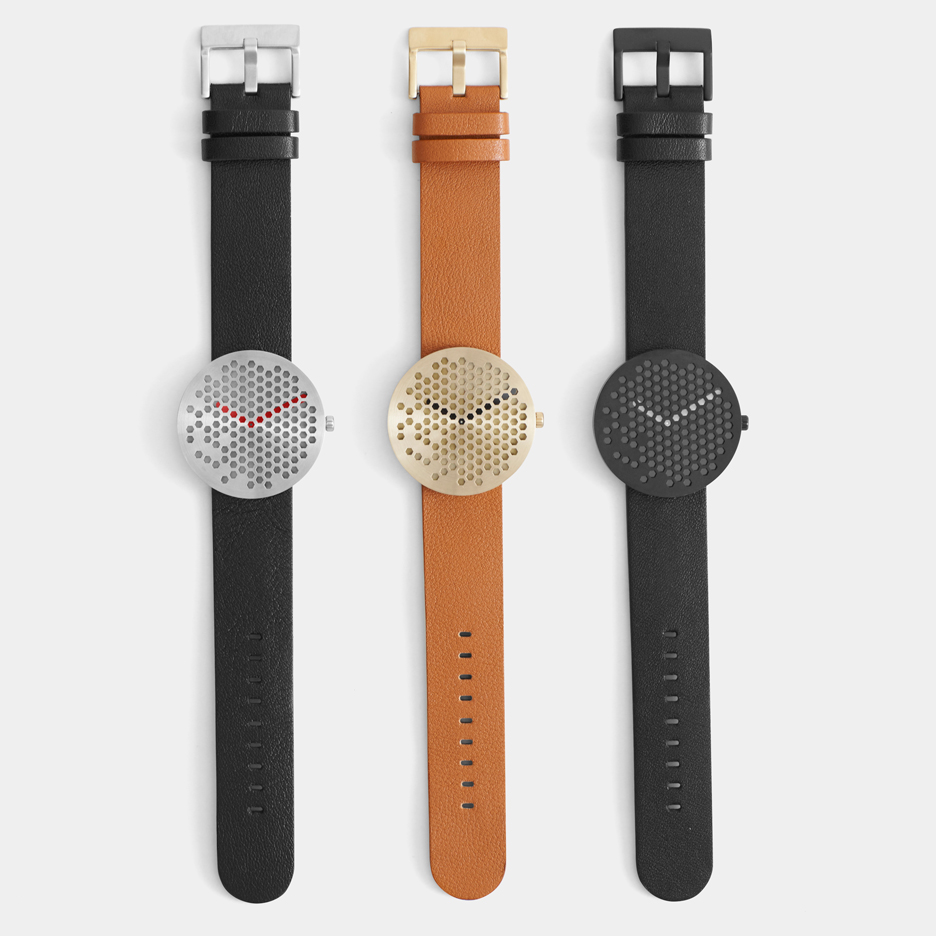
Dezeen Watch Store: Swedish designer Alexander Lervik‘s first wristwatch, which features a circular case punctured by hexagonal holes, is now available for exclusive pre-order. (more…)
Dezeen Watch Store: Swedish designer Alexander Lervik‘s first wristwatch, which features a circular case punctured by hexagonal holes, is now available for exclusive pre-order. (more…)

Spanish, New York-based architect Andrés Jaque (Office for Political Innovation) has been awarded the 10th Kiesler Architecture and Art Prize by the Mayor of Vienna, citing Jaque’s “capacity to go beyond assumptions about traditional practice and urban life.” In 2015 Jaque was declared the MoMA PS1 YAP (Young Architects Programme) winner for COSMO – a complex, and beautiful, water purifying prototype that has been installed in Brooklyn. He and his office are also collaborating with Mark Wigley and Beatriz Colomina on the design for the upcoming Istanbul Design Biennial, Are We Human?
The prize, which is considered “one of the world’s most important recognitions for creators working in the intersection of art and architecture” and is awarded every two years, has previously been bestowed upon architects including Cedric Prize, Toyo Ito, Frank Gehry, and Olafur Eliasson. €55,000 will be presented to Jaques, funded by the Republic of Austria and the City of Vienna, in honour of “extraordinary achievements in architecture and the arts that relate to Frederick Kiesler’s experimental and innovative attitudes and his theory of ‘correlated arts’ by transcending the boundaries between the traditional disciplines.”
Jaque has said: “I believe that daily life is there to be reinvented, discussed and taken care of, that is what we try to do with our work in the Office for Political Innovation. If we had to find friends on this purpose we would put the previous Kiesler awarded on top of the list.” Hani Rashid, President of the Frederick Kiesler Foundation, has said: “Andrés Jaque is […] an architect who fearlessly turns all on its head confronting the banal that at times burdens the pursuit of pure fantastical space. His work stood out this year for its vibrancy, playfulness and uncompromising commitment to seeking out the new and the unorthodox.”

This article by Rosanne Somerson, president of the Rhode Island School of Design, was originally published by Metropolis Magazine as “We Need More Boredom in Our Lives.”
When I used to teach graduate students in furniture design, I would assign them an abstract problem that required them to sit in the studio and draw through free association over a long period of time without getting up from their seats. After about 45 minutes, most students would start to squirm and get uncomfortable. If they hadn’t been in my class they would likely have stood up, checked their e-mail, gone online, or found other distractions. But I encouraged them to push through the discomfort because, after many years of running the same exercise, I had learned that right after the “squiggly” stage, something incredible happens. Often, a whole new direction for their work would emerge—something completely unfamiliar and unexpected.
What was it about those uncomfortable moments that unleashed their creativity? Was it something magical or mysterious? Hardly. I believe it was boredom, pure and simple—something all of us (and artists and designers in particular) need more of in our lives.
When curious minds are given enough time, space, and freedom, the imagination has room to roam. We all harbor imagination, but most adults are trained to rein it in—so much so that it falls asleep. So we need to give it time and space to reawaken.
In our digitally determined lives, when every moment is accounted for and distraction is just an iPhone swipe away, where do we find space for imagination to flourish and for ideas to percolate? At a time when our culture celebrates disruptive, inventive thinking, we need to work harder—by actually doing nothing—to foster breakthrough moments that lead us in new directions, create improved systems and structures, and enhance the quality of our everyday lives.
In today’s world, boredom is almost a bad word—a concept banished from our lives by relentless work schedules and nonstop entertainment options. Distraction is easier than ever to find and harder than ever to resist. But until we push back and avoid getting sucked into the void of mindless media consumption, we will discourage our overextended minds from opening up to allow for creativity and discovery. Being creative hurts. It strains our brains. It requires hard work. Being creative isn’t simply opening a spigot and watching the ideas gush out. For a lot of us it’s more like opening a vein. Artists and designers make discoveries in unexpected ways. A lot of people looking to innovate or discover new knowledge ask a specific question or pose a problem and labor to find answers. But artists and designers have found that true breakthroughs result when they drive the inquiry down a new path. They question the question. And willingly stumble into the unknown.
This reversal of a more standard methodology is at the heart of art and design thinking. I call it “critical making” rather than “design thinking”—a type of innovation and knowledge creation that emerges from the realm between thinking and making. Through their work, artists and designers hone the skill of radical questioning and develop their perception, imagination, and dexterity. They show that making can be a powerful new form of thinking—a way to conceptualize new ideas in expansive, elastic, nonlinear ways and to see beyond traditional perceptual and cognitive divisions. They recognize invisible patterns, relationships, and forms of order. They adroitly deconstruct, combine, and recombine concepts, materials, and methods. They comfortably thrive amid uncertainty.
And they value both process and failure. This sharpens intuition, empathy, and understanding. To them, failure is not a stopping point, but rather a call to reassess, to dig deeper, to come at a question from a new perspective. When an idea fails at first, the materials themselves can suggest alternate paths. And the processes can take them in new directions. With these insights and abilities, artists, and designers humanize questions and answers, problems, and solutions. More than most, they understand “user-centered experience”—or simply, human experience.
When I would discuss the sequenced drawing exercise with my students afterward, we would conclude that when creative people are bored and uncomfortable, their imaginations route them into completely new territory. But students also said that following their imaginations into these unknown spaces could be unsettling. Our natural inclination is to pull back and stay grounded in what we know. But the push through can be that small “aha,” something that our alumni still reference as what most acutely taught them how to sustain and encourage creative breakthroughs.
Over years of teaching, I have watched students become less capable of sustaining that bored and uncomfortable moment for prolonged periods of time. As the rhythm of our day-to-day lives has changed and as technology “interferences” increase, we are more likely to check our Instagram accounts or sneak in a bit of online shopping rather than sitting through willful boredom.
Recent signs of people opting to put themselves through “technology detox” offer hope for a resurgence of boredom. The rising mindfulness movement and an uptick in meditation practice, even in the boardroom, both point to an increasing awareness of what human minds need in order to function best.
Someday, when you reflect back on your life, will you remember the time you spent on Facebook or surfing the web? Or will you think about the time when a creative spark fired up a new idea? Will you have filled your time with observing other people’s content? Or will you have actively participated in creating your own?
Perhaps it’s time to pay more attention to allowing ourselves not to pay attention. Maybe now is the perfect moment to bring back boredom.
Rosanne Somerson is the president of the Rhode Island School of Design. She founded the school’s furniture design department in 1995 and continues to maintain her own studio, where she designs and makes furniture.

Frente al pedido de diseñar una tienda departamental lo primero en lo que pensamos fue en el recorrido que hace el cliente. Que ve, como se siente, que distancia camina, que paisaje lo rodea. Que elementos hacen que la experiencia sea divertida, no repetitiva, atrayente.
Dado las dimensiones del galpón, nuestra intervención funciona como un paisaje interior, haciendo que la circulación dentro de un edificio de 70 m de largo, con un primer piso y un subsuelo, sea fluida y sin perder la sorpresa.
Repensando el objeto-escalera y cargándolo de funciones se generó un sistema de tarimas rodeadas de vegetación que funcionan como acceso al primer piso, generando espacios de exhibición de producto, alojando un café por debajo, un depósito, y una serie de estanterías y bancos en su recorrido.
La fachada se trabajó como una piel metálica y continua, que envuelve la construcción existente y mediante un pliegue genera el acceso y la vidriera.
Cada tipo de producto exigió la creación de un tipo de equipamiento específico que responde no solo a la mejor manera de exhibición del mismo, sino a colaborar en la composición general de un paseo diverso y heterogéneo. Para esto generamos un catálogo extenso de displays (estanterias,walk-ins,mesas,cubos,tarimas,percheros sueltos,probadores,cajas) y con variadas materialidades (madera,hierro,chapa,osb,laqueados,vidrio).
Los sectores de la planta se articulan a través de esta serie de equipamientos dispuestos como islas que generan subespacios, cortan largas perspectivas y crean atmosferas diferenciadas para los distintos productos y marcas.

The University of Southern California’s American Academy in China (AAC) has announced the seven winning designs for the international Napavilion Competition. Entrants had to design prefabricated wood structures with the sole function of providing space for guests to nap in. The winning designs will be built at Jade Valley Winery outside of Xi’an in western China, with three to be completed in time for the Napavilion Festival in July.
Competition juror and director of the AAC Dean Ma, has been instigating similar projects within the Jade Valley for over a decade. These projects aim to use culture, agriculture, and nature to “define and redefine the landscape, combining nature with the man-made, while using architecture in a minimal, strategic way,” said Ma. While the first designs are to be built in Jade Valley, the possibility exists for them to become prototypes, erected in limitless environments.
“The goal of the Napavilion competition is to challenge designers to find solutions that have clear ideas behind them and can accommodate an uncertain site, since they may be built in other locations after Jade Valley,” said Dean Ma.
The competition sought innovation within a restricted palette, encouraging entrants to not overcomplicate their designs. The pavilion had to be easily constructed by a small number of people, able to be disassembled and moved to new locations, and be constructed with a few basic tools. Only standardized wooden panel sizes could be utilized and built-in contingencies for diverse terrains had to be taken into account.
The winning designs adhered to the requirements for material and construction clarity, while also presenting interesting and original results. “The Woodokan” by Hajime Yoshida Architecture, the “SkySleeper” by Estudio ESSE and the “PODNA” by a team of four undergraduate USC students, are the three currently under construction to be revealed at the Napavilion Festival on July 23. “SkySleeper, that’s the one I want to nap in,” said Dean Ma.
The remaining winning entries to be constructed in the future are: “Mooring Pavilion” by a group of architects and engineers in Tianjin, China; “Pillow” by Ida&Billy Architects in Hong Kong; “Pinocchio’s Whale” by Architect Andrea Falcon (aaf) in Bologna, Italy; and “Unlimited Expandable Pavilion” by Farhad Arbab, Fariba Arbab, and Mercedeh Vazirian from Mashhad, Iran. Alongside the winners, AAC and Jade Valley have commissioned six architects; Lawrence Scarpa, Gary Paige, Scott Uriu, Geoffrey von Oeyen, Noreen Liu (NODE), and Tiantian Xu (DnA); to design and construct Napavilions due over the summer.
Check out the gallery below to see the seven winning designs.

Competition: Dezeen has teamed up with What Design Can Do to offer readers the chance to win one of three tickets to its annual conference on the social impact of design, held in Amsterdam (+ slideshow). (more…)

OMA founder Rem Koolhaas says that Britain’s EU Leave campaigners believe they can change England back to the way it was, but don’t understand what that really means. (more…)
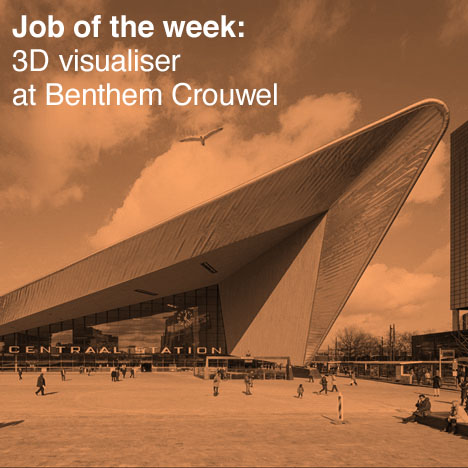
Our job of the week on the new and improved Dezeen Jobs is for a 3D visualiser at Benthem Crouwel Architects, which led the remodelling of Rotterdam Centraal station (pictured). Visit the ad for full details or browse more architecture and design opportunities on Dezeen Jobs.

Layvir is a residential project designed by Ramesh Patel & Associates. It is located in Mehsana, Gujarat, India. Layvir by Ramesh Patel & Associates: “Ramesh Patel reflected the grandeur and power of the stature of the client with a linear singular massive built form evolving up to three storeys with a vast garden as a foreground and a small backyard with a swimming pool. The built form seems unified from..