Belarusian Memorial Chapel / Spheron Architects


© Joakim Borén

© Joakim Borén


© Joakim Borén


© Joakim Borén


© Joakim Borén


© Joakim Borén

  • Project Manager: Diocese of Westminster
  • Landscape Designer: Spheron Architects
  • Planning Consultant: Alpha Planning
  • Quantity Surveyor: Change Project Consulting
  • Cdm Consultant: BBS Site Services LLP
  • Structural Engineer: Timberwright
  • Mechanical And Electrical: Arup
  • Main Contractor: Timberwright
  • Client: The Congregation for the Oriental Churches of the Roman Curia of the Holy See

© Joakim Borén

© Joakim Borén

From the architect. The first wooden church built in London since the Great Fire of 1666 has been built for the Belarusian diaspora community in the UK, and is dedicated to the memory of victims of the 1986 Chernobyl nuclear disaster.


© Joakim Borén

© Joakim Borén

The chapel sits surrounded by 13 statutorily protected trees in the grounds of Marian House, a community and cultural centre for the UK Belarusian community in north London. Its design offers a mixture of traditional and contemporary elements and, like many rural churches in Belarus, the chapel will offer a gentle presence among the trees of its garden setting.


© Joakim Borén

© Joakim Borén

The chapel was designed by Spheron Architects, an emerging London-based architecture practice, following painstaking research into Belarus’s wooden church tradition. Spheron Architects Tszwai So spent time in rural Belarus, recording and sketching traditional churches there.


Ground Floor

Ground Floor

The after-effects of the nuclear reactor explosion were felt particularly severely in Belarus, where 70% of the fallout fell, forcing many thousands of people to leave their homes and resettle around the world, including in the UK. The domed spire and timber shingle roof are common features of hundreds of traditional churches in Belarus and will offer familiarity, comfort and memories to London’s Belarusian community, many of whom moved to the UK following the Chernobyl disaster, while others have displaced by subsequent political and economic upheaval in their homeland.


© Ioana Marinescu

© Ioana Marinescu

A series of contemporary twists have been introduced to the basic traditional form, such as the undulating timber frill of the flank walls which enlivens the exterior. Natural light enters through low-level and concealed clerestory windows running the length of the chapel, and through tall frosted windows on the front elevation. At night, soft light from within allows the chapel to gently glow. Inside the chapel will be decorated with a series of historic icons set into a timber screen separating the nave from the altar area in the apse. 


Section

Section

The chapel has been funded by the Holy See, and replaces the Belarusian Catholic Mission’s makeshift place of worship inside the existing community centre. Accommodating up to 40 people, the new chapel serves not only as an important spiritual focus for the Belarusian community, but also as a lasting memorial to the victims of the 1986 Chernobyl disaster.


© Ioana Marinescu

© Ioana Marinescu

Product Description. Belarusian Memorial Church has been designed to serve as a reminder of the traumatic loss of a great number of rural settlements in Belarus and Ukraine after the Chernobyl Disaster, since many villages with their wooden architectural heritage were razed to the ground. The materials palette was restricted to wood and glass, and very small areas of lead. Soft wood was chosen instead of Oak, a prevalent choice in the UK, in order to reflect the Wooden Church Heritage of Belarus.


© Joakim Borén

© Joakim Borén

The principal structural frame was made from Douglas Fir and prefabricated off site. It went up in just a few days, infilled with pine CLT panels manufactured in Spain. The timber floor is made up of 35mm thick T&G Douglas Fir boards and the entrance doors and handles are also made from Douglas Fir with infill glazing.


Detail

Detail

With the exception of the floor boards and entrance doors, which are finished in a clear lacquer, the entire interior is of natural unfinished wood


© Joakim Borén

© Joakim Borén

The internal area is approximately 69sqm and is level throughout with the exception of the raised altar, which is 200mm above finished floor level and only accessible to the clergy.  The altar is divided by the iconostasis, which is again formed of Douglas Fir posts with infill CLT panels, occasionally broken by the Royal Doors, made from Douglas Fir


© Ioana Marinescu

© Ioana Marinescu

600mm high fixed thermally broken frameless glazing units run at low level along within the nave with clerestory glazing running around the perimeter of the chapel with further glazing units in the tower.  All double glazed units are 28mm thick made up of two panes of toughened glass with clear outer pane consisting of low-e soft coat (cavity face) and inner pane Pilkington Optifloat Opal


© Hélène Binet

© Hélène Binet

The warm roof and cupola are clad in Canadian cedar shingles with the cupola housing a bell donated by Chevetogne Abbey, Belgium.  Above that is a ventilation stack made up of oak grilles with insect mesh internally.  The dome is a timber frame structure clad entirely in lead.  This is topped off with a metal cross, anchored within the dome.


© Joakim Borén

© Joakim Borén

http://ift.tt/2j0ir6F

Headquarter Mitsubishi Electric Europe / Kresings


© HG Esch Photography

© HG Esch Photography


© HG Esch Photography


© HG Esch Photography


© HG Esch Photography


© HG Esch Photography

  • Architects: Kresings
  • Location: Mitsubishi-Electric-Platz 1, 40882 Ratingen, Germany
  • Area: 37000.0 m2
  • Project Year: 2015
  • Photographs: HG Esch Photography
  • Building Contractor Rs&Partner: Immobiliengesellschaft mbH, Düsseldorf (Germany)
  • Building Owner : Mitsubishi Electric Europe B.V., branch office Germany
  • Project Staff: Stefan Fuchs (Projektleiter), Guido Becker, André Pannenbäcker, Jörn Brambrink, Ralf Tielke, Kilian Kresing, Rainer M. Kresing, Nicolas Oevermann, Heinrich Nelling
  • Landscape Architecture: RMP Stephan Lenzen Landschaftsarchitekten, Bonn (Germany)
  • Framework: IBS GmbH & Co. KG, Bochum (Germany)
  • Building Services: Planungsgemeinschaft Haustechnik, Düsseldorf (Germany)
  • Front Technic: Strobelplan, Schorndorf (Germany)
  • Engineers Leed Certification: Cushman&Wakefield, Frankfurt (Germany)
  • Acoustics / Raum Akustik / Heat Insulation: ISRW Klapdor, Düsseldorf (Germany)
  • Fire Protection: Ingenieurbüro Löbbert, Wuppertal (Germany)

© HG Esch Photography

© HG Esch Photography

The architectural conception of the new construction of the head office of Mitsubishi Electric Europe is based on the target of connecting different departments both horizontally and vertically across a total of six floor levels.


© HG Esch Photography

© HG Esch Photography

Floor Plans

Floor Plans

© HG Esch Photography

© HG Esch Photography

The building with its great variety of types of use including office space, conference rooms, workshops and a show room is grouped around a class-clad connecting hallway. Thanks to its transparent appearance, which contrasts with the otherwise massive parts of the building, it sends out an appealing and welcoming flair that can already be noticed from a distance. 


© HG Esch Photography

© HG Esch Photography

The manifold occupation with flexible furniture, product exhibitions and small meeting rooms makes the connecting hallway a central venue for both the 750 employees of the company and for any visitors, thus facilitating intercommunion and sociability and creating a sense of well-being. Its effect as a recognition feature of the building is intensified and kept up through the vegetated courtyards annexed. Across these courtyards, the floor-to-ceiling windows establish visual connections to each workplace at each spot of the building. In this way, an open and lively spatial feeling, which conveys a sense of coherence and identity, is created within the flexibly designable working environments and office landscapes, with sufficient natural light being provided.


© HG Esch Photography

© HG Esch Photography

Floor Plans

Floor Plans

© HG Esch Photography

© HG Esch Photography

In addition to the product exhibitions, the building equipment and appliances are made visible in a purposeful manner. The uncovered ceiling installations and air conditioning systems present themselves self-confidently as further developments and innovations of the company. That way, the building does not only constitute a meeting point and a place of communication, but it also develops further to turn into an aggregate, identity-generating Mitsubishi world.


© HG Esch Photography

© HG Esch Photography

Sections

Sections

© HG Esch Photography

© HG Esch Photography

The building, which was designed and realized by the architecture firm kresigns, received the Platinum Award as the highest level possible of LEED (“Leadership in Energy and Environmental Design”) certifications.


© HG Esch Photography

© HG Esch Photography

http://ift.tt/2iEfd7T

[In]Exterior, Falahatian Yard-House / [SHIFT] Process Practice


© Parham Taghioff

© Parham Taghioff


© Parham Taghioff


© Parham Taghioff


© Parham Taghioff


© Parham Taghioff

  • Architects: [SHIFT] Process Practice
  • Location: Pir Bakran, Isfahan Province, Iran
  • Architects In Charge: Rambod Eilkhani, Nashid Nabian
  • Team : Rambod Eilkhani, Nashid Nabian (Senior and Founding Partners), with Ehsan Karimi , Parnian Ghaemi, Dorna Mesrzadeh (Junior Partners)
  • Area: 677.0 m2
  • Project Year: 2016
  • Photographs: Parham Taghioff
  • Project Manager: Dorna Mesrzadeh
  • Designer Associate: Golnaz Jamshidi
  • Presentation & Graphic Associates: Naghmeh Asadbeigi, Mohammad Hasan Tavangar, Amir Fallahi, Mahta Aminali
  • Physical Model Associate: Forouzan Farhadi
  • Constrouction Manager: Pouria Shafiee
  • Structural Consultant: Pedram Mosahebi Mohammadi (Sarvin Structural Consultants)
  • Mechanical Consultant: Ali Piltan

© Parham Taghioff

© Parham Taghioff

[In]Exterior is an exercise in challenging the well-established conventions of designing for a second home or a retreat family house.


© Parham Taghioff

© Parham Taghioff

Conventionally speaking, retreat homes are conceptualized as villas in the park with a focus on maximizing the visual access of the interiors to the surrounding natural vista through transparent exterior thresholds of a solid volume.


© Parham Taghioff

© Parham Taghioff

First Floor Plan

First Floor Plan

© Parham Taghioff

© Parham Taghioff

[In]Exterior is a family house located in a retreat village in the periphery of City of Isfahan. The suburban context of the project offers no substantial natural view or meaningful topographic variation. Hence, the spatial organization of the project is fundamentally transformed to introduce two connected semi-courtyards. Instead of looking outward at a non existing natural vista or impressive view, the project is shifting its visual focus to the inner yards, arriving at maximum transparency of the architectural thresholds where the interior spaces meet the interiorized yards.


Section

Section

The redefinition of inside/outside relation is also deriving the material condition of the architectural surfaces. The commonalities of surface material and texture, both in interior and exterior voids, allow for certain level of ambiguity in differentiating the interior and exterior condition from a perceptual point of view.


© Parham Taghioff

© Parham Taghioff

The spatial uncertainty in identifying the borderline between in and out is further established through the introduction of sliding walls that transforms the interior yards of the project to semi-open gardens. 


© Parham Taghioff

© Parham Taghioff

Meanwhile,  the introduction of the yards within the heart of the spatial organization of the house, allows for performative division of the house between the categorically different  functions with private and public nature. 


© Parham Taghioff

© Parham Taghioff

Product Description: For the facade of the building we decided to go for a white modular material to emphasize on the abstractness of the platonic forms of the project. Hence, the white industrially produced bricks of Namachin Esfahan were chosen. 


© Parham Taghioff

© Parham Taghioff

http://ift.tt/2iedbue

Philip Johnson’s Interfaith Peace Chapel vandalised in Dallas

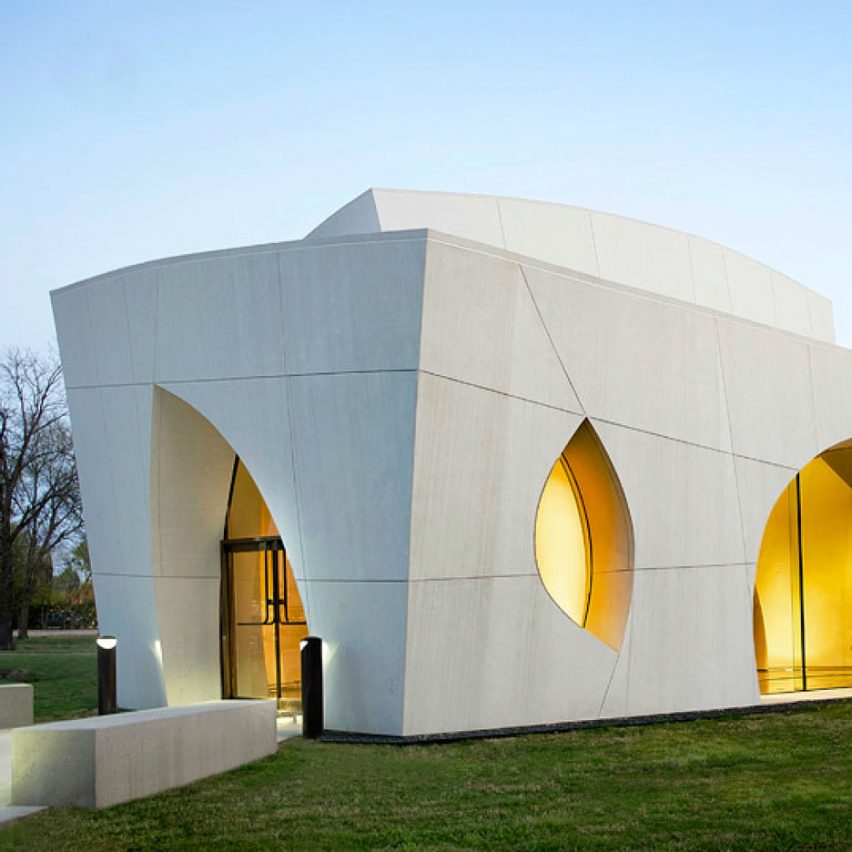
Interfaith Peace Chapel by Philip Johnson

A Philip Johnson-designed chapel in Dallas, Texas, has been defaced with graffiti. Read more

http://ift.tt/2idXJOI

Chetian Tourist Center / West-line studio


© Jingsong Xie / West-line studio

© Jingsong Xie / West-line studio


© Jingsong Xie / West-line studio


© Jingsong Xie / West-line studio


© Jingsong Xie / West-line studio


© Jingsong Xie / West-line studio


© Jingsong Xie / West-line studio

© Jingsong Xie / West-line studio

The Tourist Center is located just outside Chetian Village (车田村), on the main road arriving from Guiyang, the capital of Guizhou province. The stone village, famous for its houses built with local blue-stones, has more than 400 years of history and its population is mainly composed by Miao (苗), one of the oldest ethnic minority groups in China. 


© Jingsong Xie / West-line studio

© Jingsong Xie / West-line studio

The Village runs parallel to a river and the local traditional architectural style is characterized by single units (stone houses with open air courtyards) repeated in a parallel way. Each unit is linked to the others and all these parallel bands form separated groups.


© Jingsong Xie / West-line studio

© Jingsong Xie / West-line studio

Floor Plans

Floor Plans

© Jingsong Xie / West-line studio

© Jingsong Xie / West-line studio

The Architects integrated this characteristic parallel feature in the design of the tourist center. Three parallel units (bands) are arranged following a L shape, which creates interesting outdoor spaces, in China categorized as “Yuan” (院), courtyard. This first band is characterized by white walls embracing the courtyards, white walls which create a ritualistic impression in contrast with the stone ones.


© Jingsong Xie / West-line studio

© Jingsong Xie / West-line studio

Categorized as “Xiang” (巷), lane, the space created by the second band is located on the widest area on site, on its north end. The building at the very end of the long quite secluded corridor hosts the restrooms facilities and has been built according to Chetian Village’s traditional stone masonry techniques.


© Jingsong Xie / West-line studio

© Jingsong Xie / West-line studio

The third band is the largest volume on site and it is categorized as “Tang” (堂), hall. Here are located the visitor center’s public functional areas: reception and info point, an exhibition hall and a tea room. Upstairs is the private office area. The interior units follow the parallel flow and have been partitioned according to their functions. Architects deliberately designed the turn near the south end of the first band and the second band in order to combine the three bands into one structural group. Group which still preserves the singular L shape units in aim of retaining the relative independence among the parallel bands, while gaining the benefits of uniformity and integrity. 


© Jingsong Xie / West-line studio

© Jingsong Xie / West-line studio

Axonometric

Axonometric

© Jingsong Xie / West-line studio

© Jingsong Xie / West-line studio

http://ift.tt/2iDfvvM

Residence S-91 / Design Buro Architects


©  Aman Sonel

© Aman Sonel


©  Aman Sonel


©  Aman Sonel


©  Aman Sonel


©  Aman Sonel

  • Architects: Design Buro Architects
  • Location: 91, Phase 2, Shri Krishna Avenue, Rani Bagh, Indore, Madhya Pradesh 452020, India
  • Architect In Charge: Navendu Shrivastava
  • Area: 270.0 m2
  • Project Year: 2014
  • Photographs: Aman Sonel
  • Structural Consultants: Pyramid Consultants

©  Aman Sonel

© Aman Sonel

The house was conceptualized around keeping the family interactive all round the day. The footprint of the residence was confined to only half of the available site, overlapping the spaces for increased interaction; as well provide an open space for various activities. The dichotomy between the built and the un-built, play of light, space and materials provided for the quality of spaces.


Section

Section

The residence is built only on a narrow plot of 1050 sqft, and utilizing the complete width of the plot, the rooms and spaces stay comfortable for a lavish living. The walls are only 125m thick and with no columns in the residence, the spaces come out to be neat and cozy.


©  Aman Sonel

© Aman Sonel

The minimalistic approach makes the whole depth read as a single space, integrating the way the family lives. The sequence of spaces ensured that the privacy wasn’t hindered but at the same time maintained a connection when required. The extended living room eradicated the feeling of living on a busy city street with the hybrid between the organic nature and rectilinear concrete.


©  Aman Sonel

© Aman Sonel

The void in the centre of the building envelope celebrates the spaces connected to it and maintains the joy in the family. Sunlight filling in from the courtyards and the greens segregating the spaces provide a comfortable atmosphere for living. 


©  Aman Sonel

© Aman Sonel

The light washes smoothly on the walls through the large glass opening and skylights, creating a strong dialogue between the rough and the smooth.


©  Aman Sonel

© Aman Sonel

Product Description:The postform sunmica panels provided for a clean and minimalistic furniture that blends seamlessly with the plain concrete walls and roof and at the same time providing a contrast in the colour and texture.

http://ift.tt/2idRBpZ

Hamptons home by Bates Masi features cantilevering upper floor

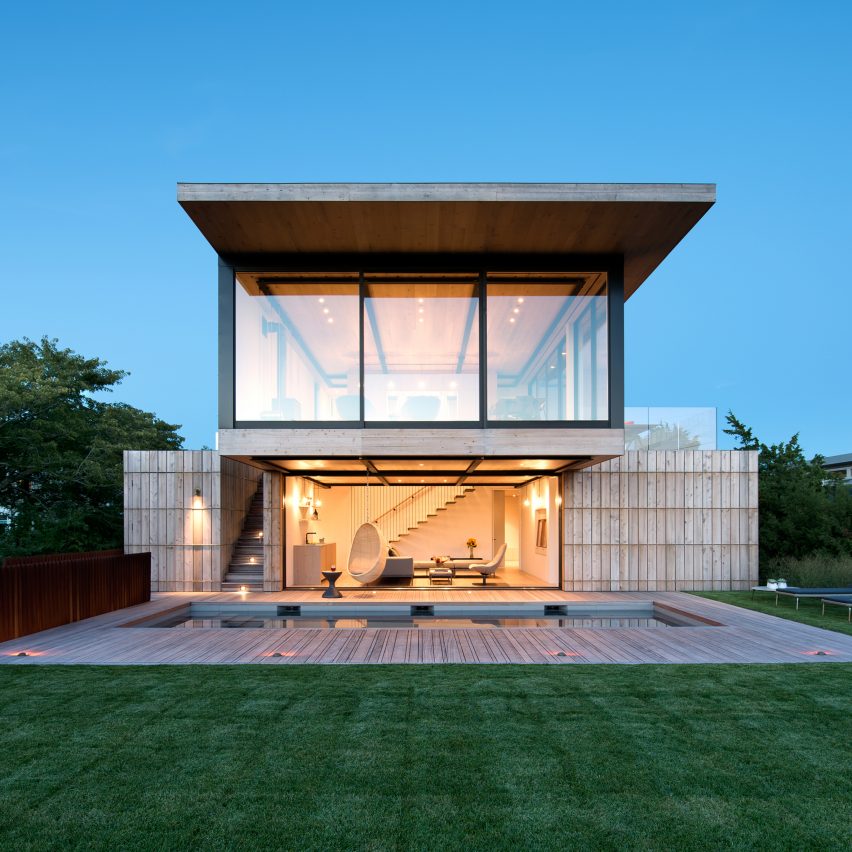
Atlantic by Bates Masi + Architects

American firm Bates Masi + Architects took cues from a historic lifeguard station while designing this cedar-clad dwelling on Long Island, New York. Read more

http://ift.tt/2idGsoR

Las Vegas hopes to entice Oakland Raiders with $1.9 billion stadium

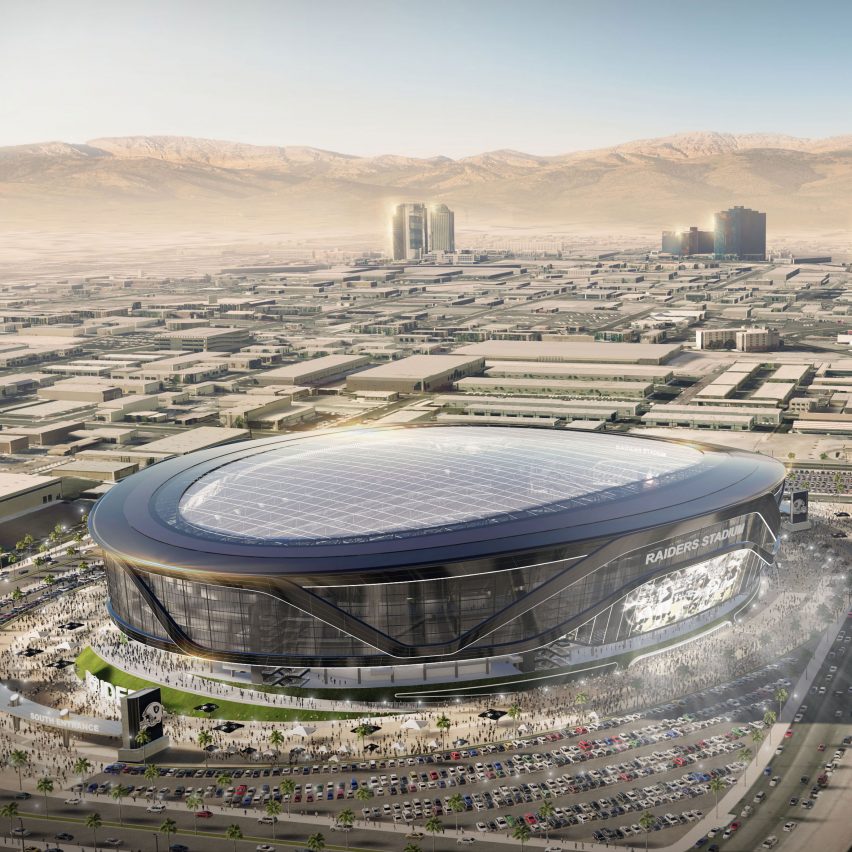
Oakland Raiders stadium for Las Vegas by Manica Architecture

This new stadium designed for the Oakland Raiders could facilitate the American football team’s proposed move to Las Vegas. Read more

http://ift.tt/2iCfk49

Rapt Studio designs office space to allow HBO to “reimagine entertainment”

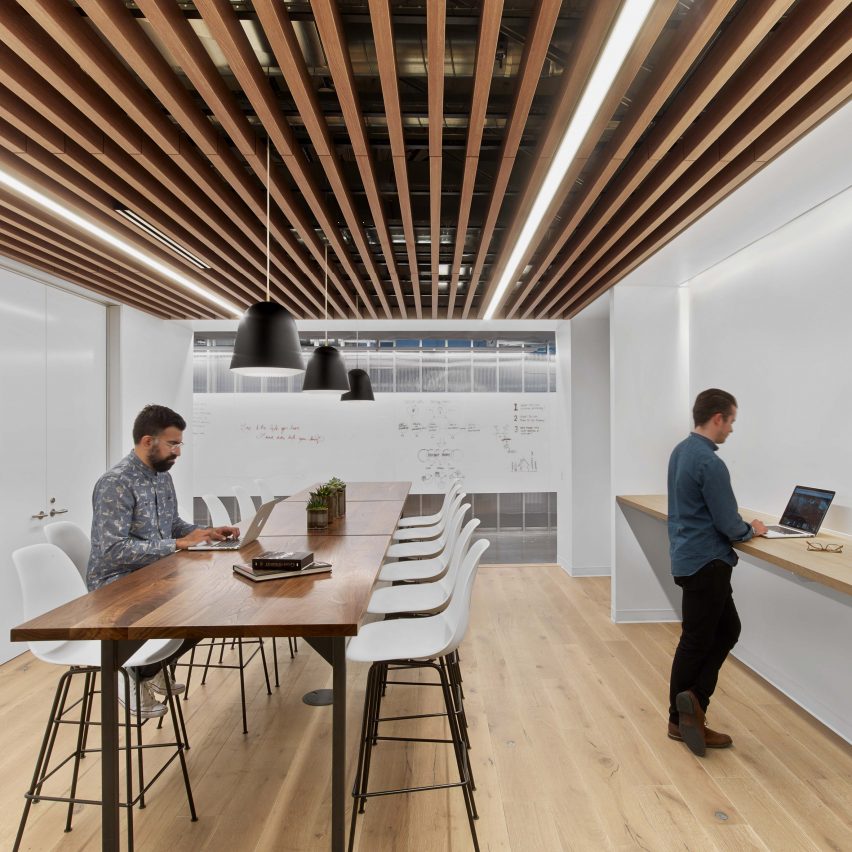
hbo-code-labs-rapt-studio-office-interiors-usa_dezeen_2364_sqc

Entertainment powerhouse HBO uses this office space in Seattle, designed by New York firm Rapt Studio, to develop and test its digital and interactive products. Read more

http://ift.tt/2j4RZvk

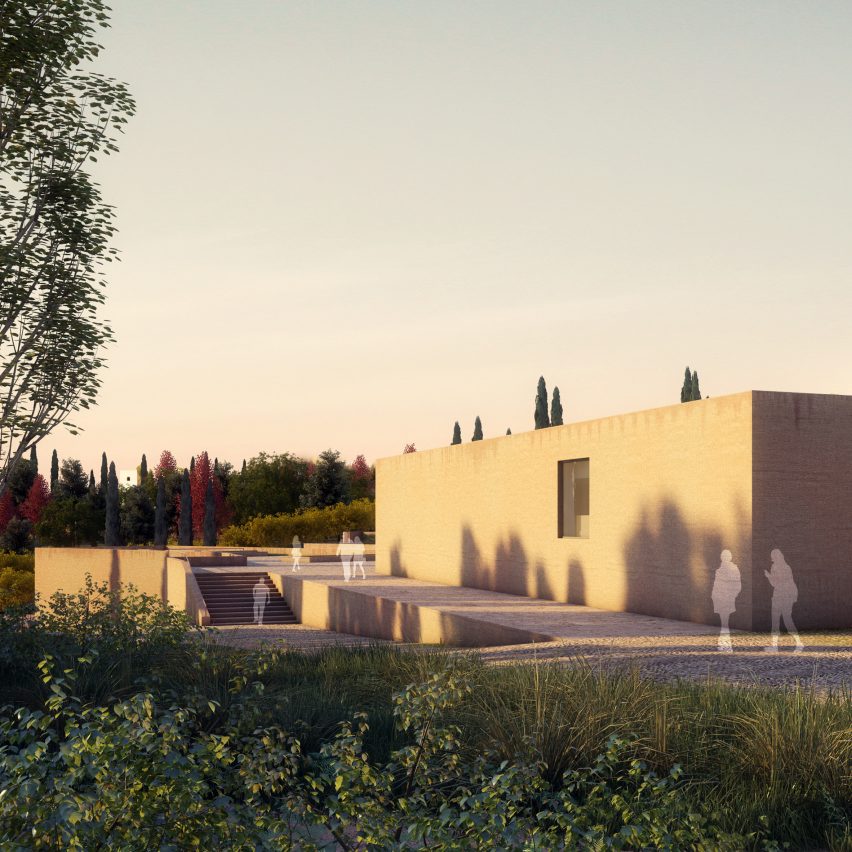
“Granada is withholding a modernist masterpiece”

alvaro-siza-alhambra-project-rejected-architecture-news-cultural_dezeen_sqb

Readers are decrying the decision to scrap Álvaro Siza’s design for a new entrance and visitor centre at historic Granada palace the Alhambra in this week’s comments update. Read more

http://ift.tt/2jAfGfK