For U.S. architects, working abroad will now be easier than ever, as the National Council of Architectural Registration Boards (NCARB) has announced a new mutual recognition arrangement with the licensing authorities of Australia and New Zealand. Effective as of January 1, 2017, the agreement allows architects to earn reciprocal licenses that authorize architects to work in the two countries.
“The arrangement is an exciting opportunity for architects seeking to expand their careers internationally,” said NCARB President Kristine Harding, NCARB, AIA. “NCARB Certificate holders have been able to pursue licensure in Canada and Mexico for some time, and this arrangement represents a significant step in providing additional benefits to these architects.”
So far, 29 of the 54 U.S. state and regional licensing boards have accepted the arrangement:
Alabama
Alaska
Arizona
California
Colorado
Connecticut
Iowa
Kansas
Louisiana
Missouri
Montana
Nebraska
New Hampshire
New Mexico
North Carolina
North Dakota
Ohio
Oregon
Pennsylvania
Puerto Rico
Rhode Island
South Carolina
Tennessee
Texas
Vermont
Virginia
Washington
West Virginia
Wisconsin
This arrangement is the result of over two years of research and negotiation conducted by a special NCARB evaluation team, who determined the path to licensure in Australia and New Zealand mirrors that of U.S. requirements, with emphasis of the three pillars of accredited education, structured experience, and comprehensive examination. The agreement was signed by the Architects Accreditation Council of Australia and the New Zealand Registered Architects Board.
Similar to the agreement with Canada, U.S. and foreign architects hoping to work in Austalia and New Zealand must meet the following requirements:
Citizenship or lawful permanent residence in the home country
A license to practice architecture from a U.S. jurisdiction that has signed the arrangement
6,000 hours (approximately three years) of post-licensure experience in the home country
Validation of licensure in good standing from the home authority
Licensure in the home country not gained through foreign reciprocity
For more information about the new Mutual Recognition Arrangement and to inquire about earning a license to practice architecture abroad, visit http://ift.tt/2iUJekE.
When it comes to sleek, angular home architecture, Japan is certainly the place to look for inspiration. Countless homes across the country feature beautifully streamlined decor schemes and both interior and exterior designs. NT House, for example, is a veritable poster home for the kind of clean, angular aesthetic that immediately jumps to our minds when we think “modern living”. When design company Baqueratta began to customize this residence, they..
From the architect. The Suvela chapel was commissioned by the Espoo Parish Union and it will be used jointly by the Espoo Parish Union, the Swedish Parish of Espoo and the City of Espoo to serve the entire community of Suvela. It is a multifunctional building that offers a space for the people of the community to use together for their many different needs regardless of their religious affiliation.
OOPEAA embarked on the design and planning for the Suvela Chapel and the nearby community park in 2012. The goal was to create a building that has a strong identity of its own while also entering in dialogue with the multicultural context of its suburban neighborhood. With roughly one third of the inhabitants being of foreign descent, Suvela is one of the most multicultural districts in the Helsinki metropolitan region. Cultural diversity is both a rich potential and a challenge to the community. In the design for the Suvela Chapel and the adjacent community park, the goal was to create a building that offers opportunities for a rich variety of activities and provides a framework for the residents to come together in a flexibly adaptable and functional space.
Due to the relatively long, dark, and cold winters, communal indoor spaces play an important role as places for people to gather in Finland. Public buildings, such as schools and libraries, as well as churches and chapels offer spaces that are open to all. Providing schools, libraries and churches as places where people can come together on the common ground of a shared space has deep roots in the cultural tradition of Finland. These buildings serve as platforms for a variety of activities initiated by the citizens, thereby facilitating the exchange of ideas through collaboration and working and enjoying life together. They are designed to include communal spaces that offer places where local communities may hold meetings and events and where they can come together around various activities, both in the everyday as well as for special occasions. The Suvela Chapel is part of this tradition in which the architecture of church buildings and chapels offers a framework for a multiplicity of functions and a place for people of the community to come together.
Elevations
Sections
The chapel offers an approachable and welcoming space with a human scale and an inviting atmosphere. The building serves many functions providing a home base for many different kinds of organizations and forming as a dynamic place of activity. It is first and foremost a meeting place that serves members of the parish and other groups of people in the community alike.
The local community park with its services is one of the three principal users of the building offering the children and their parents an opportunity to use the space in various ways. There is afternoon care for children after school as well as day care services for younger children. There are spaces for the youth as well as spaces for the various local community clubs to use for their activities. The building offers office space for the employees of the parish as well as for social workers and family services provided for helping people in their various needs in their lives.
A soup kitchen providing food for a very low cost is operating in the premises as well. The chapel naturally also serves as a place for mass, concerts, weddings, funerals, and baptizings. The location of the various functions in the different parts of the building is identifiable from the outside. While the height of the building varies greatly with the chapel hall as the tallest part, all functions are placed on just one level, and the building wraps into a single U-shaped entity forming an intimate interior courtyard in the middle. The belfry is embedded in the main building volume providing further closure to the yard.
The different functions in the building orient themselves around the inner courtyard. The main entrance is placed in a corner where the U-shaped building opens to the courtyard, The main chapel hall with its auxiliary spaces is located in the north-east part of the building. Offices and work spaces of the parish staff as well as additional meeting and group work spaces are located in the middle part of the U-shaped volume. Spaces for children and the youth as well as spaces that are rented out to the city to serve the community park are located in the west part of the building. While the majority of the interior spaces face the yard, the spaces occupied by the community park face outward to the park.
Diagram
The building is a hybrid structure with wooden as well as concrete and steel elements. A tactile sense of material has a deliberately strong presence both in the interiors as well in the exterior of the building. The exterior shell is entirely clad in copper to emphasize the unity of the varied volume of the building. Copper was an ecological choice of material for the exterior. It is both durable and recyclable and therefore sustainable. It also ages well and acquires a beautiful patina over time. Local spruce is the material used in the interiors. In the spaces for the children’s activities, wood is present also in the outdoor canopies that provide shelter from rain giving the children an opportunity to play outside even in rainy weather. The presence of wood is most prominent in the tall chapel hall where the walls are covered with wooden scantlings.
The Suvela Chapel is one of the four finalist candidates nominated for the Finlandia Prize in Architecture in 2016. It has also been awarded bronze in the American Architecture Prize 2016.
London-based firm Tate Harmer has won a competition to design a new £6 million ($7.4 million USD) museum for The Scout Association (TSA) at the group’s headquarters in Chingford, east London. Their proposal takes the form of a big, colorful tent that will tell the story of the Scouting movement within a fun, environmentally conscious structure.
The new museum will be located within Gilwell Park, the first place where Scout leaders were trained in 1919, and now a Scout Adventure Center that is home to several national events. The new facility will provide accommodation for these events, as well as new activities for both the Scouts and the general public.
The focal point of the 1,600 square meter (17,200 square foot) visitor’s center will be the structure’s ‘Big Tent’ canopy, made up of a quilt of brightly-colored Scout neckerchiefs symbolic of the various troops from around the world. The panels will be made from coated polyester, and will span from the perimeter of the central gathering space up to a 15 meter tall timber clock and bell tower. The tent and tower will serve as a beacon guiding visitors through the park’s new heritage trail, while provided stack-effect ventilation for the heritage center.
The single-story buildings that make up the complex will be constructed from pre-fabricated, cross-laminated timber to minimize construction time on site and clad in timber to integrate into the surrounding mature landscape. The scheme will contain exhibition space telling the history of the Scouting movement, a climate-controlled archive, a new cafe and shop. Opening exhibits will range from founder Robert Baden-Powell’s Rolls Royce and Caravan to delicate film and paper items.
The project is aiming for a BREEAM Excellent or Outstanding rating, and will feature finishes that project the Scouting philosophy of self-reliance and sustainability.
“The concept is to provide a space for celebration – a place that is rooted in Scouting history, but also looks towards its future. The new Camp Square will be at the beating heart of Gilwell Park and the Scouting movement, and will reflect the energy and diversity of Scouting in the twenty-first century”, says lead architect Jerry Tate of Tate Harmer.
Authors: Alfredo Britto, João Pedro Backheuser, Anna Backheuser e Elaine Fachetti
Team: Ilana Luztman, Evelyn Gomes e Valmir Azevedo
Construction : Studio G
Lighting : Rio Branco e Faccini
Set Design : Pedro Lessa
Acoustic : Celso Junto e Roberto Thompson Motta Arquiteto Ltda.
Collage
From the architect. The Casa do Choro Institute seeks to endow a city of a place where a preservation, teaching, practice and production of the brazilian kind of music 0 “choro” will be adequately sheltered.
The building that houses the institute integrates an architectural set of great cultural interest for the city of Rio de Janeiro and is implanted in a typical glebe of the center of the city, with dimensions of 10,00 m of front by 21,00 m of depth. A two storey floor planted in the period of predominance of Eclecticism and stylistic freedoms with a facade with clear Moorish inspiration, which earned him a nickname of “Mourisquinho”.
The implementation of the architectural program necessary for the full functioning of Casa do Choro’s activities required a withdrawal of the remaining internal elements and an introduction of a metal structure independent of a new internal spatial organization. It means a presentation of one building within another. The volumetry, its cover with a remarkable dome and a main façade with its mass adornments, iron details and wooden frames were rigorously restored from prospecting and research of photographic material.
The new occupation allowed a reception and a small auditorium at the ground floor with capacity for 100 people that allow an agenda with the best of the musical genre; a space to store all the collection of the School of Choro – one of the best in Brazil with space for studie, administration and classrooms in various dimensions in the middle floors and the last floor a bar for students, meetings and realization of “Rodas De Choro. All interconnected by a single prism consisting of a metalic stair and elevator.
Section
The contrast between the “old building” and the new is maintained on walls with apparent massive brick and a new metallic structure highlighted in the guava color. The other materials facilitate the maintenance of intense day-to-day movement with a predominance of molded concrete flooring, demolition wood and laminate type coatings.
Few things are as beautiful as an open concept home. That is, perhaps, except for an open concept home with so much architectural personality that it actually compels the owners to give it a beautiful name to match its whimsical appearance. If you’re curious about the kind of home we’re talking about, then just check out The Kite! The Kite is a gorgeously unique residence in Australia that we recently..
The Cuevas del Pino estate sits in the foothills of Sierra Morena, in calcarenite stone terrain arranged in slightly sloping strata that gives rise to various geological formations native to the area, among which are the caves that traditionally have been used for farming and livestock.
Historically, the product of these hollows in the rock emerged when livestock watchmen used them as small shelters. Today they have been rehabilitated to form rural housing and accommodate new countryside activities.
Both the pre-existing walls and the rock itself enclosed and defined an area of great spatial and material wealth, and for this reason, we decided to focus the intervention toward a fluid and continuous dialogue between those pre-existing conditions and the new architecture, always from a respectful position seeking proximity rather than direct contact.
Within this dialogue we have created a new spatial experience that manages to value the tectonic nature of the area through the use of new architectural elements: clean and quiet volumes, bright and ample spaces, use of stone materials for the flooring, such as concrete or marble, glass openings to the south to conjure natural light and handcrafted wooden furniture to give warmth to the cave house.
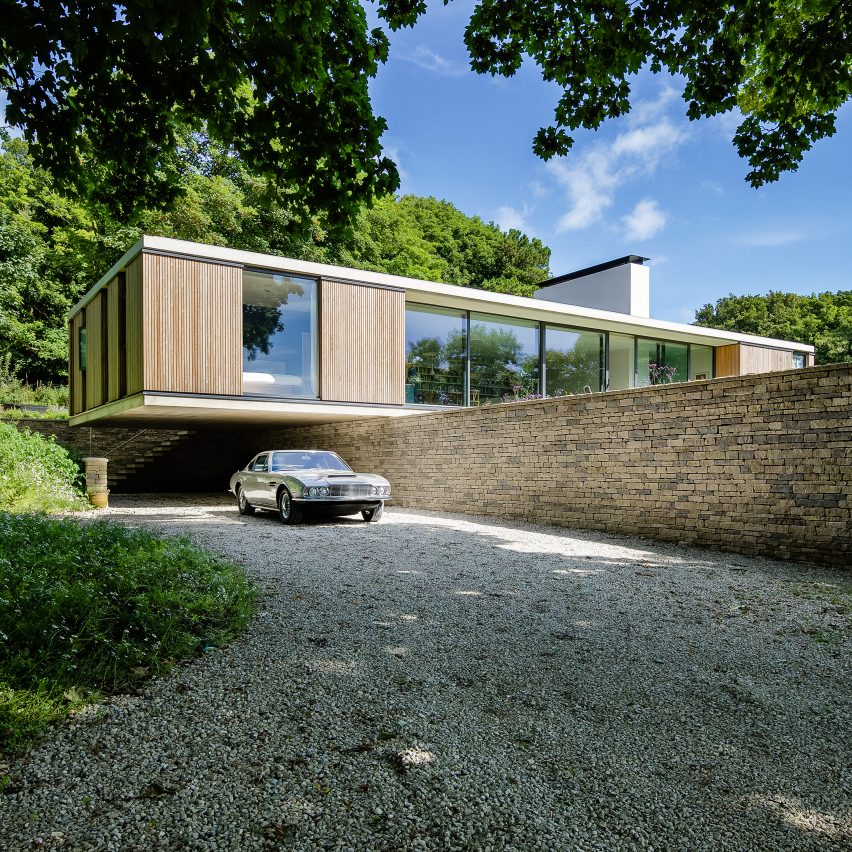
One end of this larch-clad retirement residence in the English countryside by Ström Architects cantilevers over a wall to protect a parking spot for a vintage car. Read more
Californian start-up Mayfield Robotics has revealed its first domestic robot, which responds to its user with facial expressions, head movements and sounds. Read more



 Sig Nordal