When the Crystal Cathedral was constructed near Los Angeles in 1980, its design was pure Hollywood: designed by Philip Johnson and John Burgee for televangelist star Robert Schuller, the design combined traditional elements of church design with features that made it suitable for television broadcasts. However, when Crystal Cathedral Ministries filed for bankruptcy in 2010, the building was passed to a very different tenant, the Roman Catholic Diocese of Orange, who then commissioned Los Angeles-based firm Johnson Fain to adapt the building to be a better fit for the Catholic Church.
A recent article by Mimi Zeiger for Architect Magazine investigates how Johnson Fain are converting the 1980 classic into something more suitable for its new life out of the spotlight—including modulating the light within the vast all-glass structure and rearranging the seating.
Visit Architect Magazinehere to find out more about the renovation by Johnson Fain—including a set of renders—or find out more about Philip Johnson’s original design for the cathedral via the link below.
Architectural assignment. This project in Piedra Roja is a house designed for a family consisting of a couple and their four children, two small children and two teenagers. Due to this assignment , the house should have rooms that allow and make compatible the different activities of its members, at the same time foster the convergence of the family group and its friends.
It was also a requirement that parents have some control over spaces in the house, understanding its spread dimensions.
Floor Plan 02
In addition, the house had to be developed on one floor and take full advantage of the relationship with its surroundings and natural lighting through large windows.
The land and the location of the house. The site adjoins a park that is part of the condominium, and within its almost triangular form, a good part of its boundaries are faces exposed to public spaces.
Therefore, the first design strategy was to extend the house as much as possible, in order to generate a protected border from the outside, where the main enclosures of the house will be located, in a succession of open volumes To the north, separated by small courtyards and interior planters. This would keep the house garden indoor and private, and all rooms open to this interior space.
The Algarrobo. (Prosopis chilensis) On the site there is a large Algarrobo tree. Then, the house, along with being extended, was designed to give space to this tree and include it as an integral part of the project. The House´s family spaces are related directly to the algarrobo through terraces and windows.
Elevations
Passive architecture. Energy efficiency considerations were taken through passive architecture design, using ventilated skins (perimeter walls and decks), orientation to the north of the main enclosures, inclusion of landscaping as a tool to avoid overheating, study and application of Layers of thermal insulation, use of DVH Low-e, etc.
It emphasizes the projection of ceilings with eaves, according to the solar inclination in order to take care of the room´s sunning, which makes that the house is formally distinguished, without pretending, of the rest of the neighborhood.
Promenade. Because of the house´s geometry, programmatic relations between the more domestic spaces are produced; for example, between the workshop, the dining room and the family room is materialized a small south patio that is finally configured as a new way to meet and walk through the house.
Currently, the gardens of the house have been integrated with the adjacent park and the natural landscape of the hills, making their boundaries blur. Likewise, it is the house that defines its limits and the scope of protection of family privacy, regardless of fences or other normative obligations of the condominium. Indoor, the house is constantly looking at itself.
Chilean architect Alejandro has been selected as one of “28 creative geniuses who defined culture in 2016” by the New York Times, in a list that includes personalities such as First Lady of the United States Michelle Obama, singer Lady Gaga, photographer William Eggleston and designer Junya Watanabe.
Together with musicians, chefs, designers and artists, the Chilean is one of three architects selected by the publication alongside the iconic duo of European Postmodernism Trix and Robert Haussmann.
The new building of the CHU de Poitiers gathers all the administrative services, which were originally scattered around the campus of la Milétrie, in a single place. The personnel, whose members have been working without ever meeting or seeing each other, are henceforth grouped together in the same building.
The project is based on three powerful ideas: -Placing the landscape of the site in the heart of the project, -Creating brightly lit work spaces and friendly spaces for sharing, -Proposing iconic architecture as a landmark in this vast area
Floor Plan
More than just the form, the originality of the administrative building of the CHU de Poitiers resides in the ambiguity created inside and on the exterior by the presence of an immense central lobby.
The project of the CHU of Poitiers is composed of two E-shaped branches joined by the large central void, the agora. The site is characterized by the presence of a magnificent wooded landscape and a traffic circle that will undoubtedly become a new axis for entering the CHU.
The two naves frame the landscape. The ETFE roof further links these volumes, creating a sort of display case for the scenery. In this interior/exterior space, plants and a waterfall are domesticated evocations of a luxuriant natural environment.
The two branches of the building are placed in parallel and, through a series of gaps and raised volumes, the forecourt and the lobby can be seen from the intersection. These branches enjoy interior patios and generate pleasant workspaces and an interior distribution that enjoys generous natural light, all brought together around the great central plaza.
Section
Section
The interior street, the first contact with the administrative building serves as reception area and visitor orientation, while also offering a pleasant environment for users. Spaces designed for rest and relaxation and sharing are made available on every level; they all benefit from natural light and the views offered by their triple height volume.
Developed by the architects of the “think-act tank” Archquid, in connection with the indigenous community and other institutions of the parish of San Rafael de la Laguna (Otavalo, Ecuador), this project revolves around the material research of the totora plant, a subspecies of the giant bulrush sedge. The Totora Cube project deepens the understanding of the art and craft with which these fibers have been used since pre-Inca times.
Courtesy of Archquid / Federico Lerner
From the architects: The “Totora Cube” is an experimental structure and although it has a specific function —to promote the handicrafts created in the local community and to raise awareness of their culture— also has a degree of flexibility that allows different programs.
It is clearly a definable object: the view we have of it from the adjacent road, and its morphology and materiality, make evident their qualities as an object that are well beyond the limits of the idea of “Architectural Program.”
Courtesy of Archquid / Federico Lerner
A fundamental part of this project revolves around the material investigation of the vegetable fiber known as “totora” from the design and building of a structure. Inside the multiple implications needed to concrete the project, it was essential the understanding for the art and craft with which these fibers have been worked since pre-Inca times.
It was created an experimental cubical module of 3 meters long, with nine panels on each side, forming what it can be seen as an experiential catalogue of the different fabrics worked by the artisans. It was used a simple pure morphology, resignified from the material aspect, where they explored certain technical, structural and expressive qualities.
Courtesy of Archquid / Federico Lerner
An unprecedented use of totora allowed reaching a specific and significant interiority that sieves the light and changes its character in a constant way.
Courtesy of Archquid / Federico Lerner
The development of the building, as a result of communitarian work, was able to impregnate in a notorious way the inhabitants’ identity, which recognized and stimulated the autochthonous practices.
Courtesy of Archquid / Federico Lerner
In the shores of San Pablo Lake, there are “totorales” in constant regeneration. It can be perceived the existence of a spirit and consciousness in the permanent relationship between the people of San Rafael and the material, which establishes an identity with the territory, the population, and the architecture.
Courtesy of Archquid / Federico Lerner
The structure is made of wood, formed by two beams with a support strip and joints design to link the elements. The lower plane simply leans on a concrete slab where the cube stays pinned by its own weight. A secondary structure allows the collocation of the totora panels.
Courtesy of Archquid / Federico Lerner
We propose, from the start, to consider this project as a living structure that allows changes, replacements, different configurations and combinations with other cubes. All these, allow us to put into practice the idea of program change. This is an interesting fact: locals, as the days passed and they were starting to see results, and especially at the end when they saw and felt the impact of the new structure began to talk to me in a different way. They began to think of different possible uses. And this raises an interesting challenge. In a community where resources are not many, therefore we must manage them with special care, it is important to think about these structures as projects that meet several functions at once.
Courtesy of Archquid / Federico Lerner
The “Totora Cube” raises several issues and challenges:
How to work in this particular geography and climate with these aspects: an altitude that on average is about 3000 meters above sea level; the magnificent and imposing presence of the Imbabura volcano —which can be seen from various parts of the province—; a considerable temperature range; a strong sunshine several hours a day and a marked rainy season.
How to work with a material —totora— that is not used for architectural purposes, but for some small handicrafts or floor mats. The issues we address here, in relation to the totora, are basically divided into two groups:
The specific properties of this material: its tensile strength, its response when combined with certain paints and other chemicals, its reaction to the use of some particular dyes (both natural and processed) and its resistance to this particular climate.
Understanding this material from a new cultural angle.
Courtesy of Archquid / Federico Lerner
How to organize a particular teamwork, combining very local interests (those of the communal handicraft company and the local population in general) with other topics specifically related to our field (e.g.: ideas and program use, morphology, durability and strength of materials, context, etc.) Apart from these issues, we must consider the governments, the local one (village council) plus the provincial authorities: they also have, of course, their own goals and procedures.
The cube finally establishes itself as a milestone highly visible from a very busy way, in a particular geographical context (a lake and a volcano) and a specific sociocultural area, which generates a center of identity, reunion, and participation.
The link between the local artisans, the architects, the academy and the government reached identity reinforcement, a vernacular rescue that represented an opportunity to leave a contribution to the community which was tectonically manifested.
Architect: Archquid think-act tank Director: Federico Lerner Location: San Rafael de la Laguna, Imbabura, Otavalo, Ecuador Team: Equipo Archquid / Arq. Andrés Fuentes (Coordinador en Ecuador), Arq. Victoria Jones, Arq. Oscar Jara, Arq. Mercedes Mena Year: 2016 Construction: Archquid, Totora Sisa and local workers Images: Federico Lerner and ARCHQUID With thanks to: Otavalo Municipality, Prefectura de Imbabura, local community.
The Totora Cube project was one of the winners on the XX Panamerican Biennale of Architecture Quito 2016 (BAQ 2016) in the C category.
From the architect. Building an unper ceved 750m2 house are two feactores that should not appear in the same operation, but never the less this two requirements/condition are assencial for the request/petition.
It is a weekend house proyect, and future residentt place, for a family that lives in Cordoba now adays. They also sped most of ther affective and work life in Ascochinga. This location is a 60 kilometres north of the city, between the rural areas and the Sierras Chicas foot hill.
In a place saturated of acacias (aproximatels 1 ha). surrounded by a gully from south to west that ceids in a hidden river, that happens to be the best view-side, is where we try to “disolve” the impact of this big surface.
In splite of we nigth think the program does not have anything at of the ordinary. It is very gererous with each space and by requirement of the client, a one floor house. The place is orieted west and south.
In the case of this project, looking for a small construction would be a mistake. We have plentique land and great views for adding several yords to dispere the succesions of the different areas on the house.
Axonometric
Taking advantage of a slightly slape on the field (8 metres high and 80 metres lang) we can accomplish the clients requirements: the big building is at the same time, looking smaller. We take as a pont of reference the unique algarrobo tree, that now is inside a gallery. We were able to “buty” port of the bedrooms volume, and at the same time, the material that was dig up we used it on other areas of the constructions to hide it from the outsiders.
The quality space of the haouse is we to the galleries, in addictios to the yards and the magnificent landascape. This argument give significance to the whole proyect. In this space where there is no difference between inside and outside is where makes the difference with the life. This new one is more relaxed and bucolic to finished, we would like to emphasise that mis dwelling is mean to be ageless, timellss, beyond ony style. The materials used in the constructions.
From the architect. UCN Campus in Aalborg (DK) is a vision of an educational hub bringing together several specialized study programs under one roof. Faced with the demands for an alternative and sustainable learning environment, ADEPT have worked closely with both staff and students to design a building that merges innovative spaces and new synergy. UCN Campus is education in three dimensions.
The new building is now the natural meeting place on Campus and has quickly become the backbone of the building complex. Coming through the new main entrance it is obvious why, as your eyes start to explore the atrium landscape of group spaces, small terraces, the library and several study platforms. The variety of spaces walk hand in hand with the client’s vision of an attractive and future oriented study environment. Besides the new building of 6.000 m2, large parts of the remaining 20.000 m2 within existing property was transformed and renovated.
Diagram
Section
The heart of the building is a large atrium creating the identity of the Campus. With an almost cliff-like character, it creates small niches and plateaus, supporting a varied study life spanning all floors. An airy and multifaceted space that adds life, color and movements to its three dimensions from customized furniture and the students themselves.
The new identity of the Campus stands out in a design that connects space, facade and interior design. The tree in the center of the atrium is a symbol of the shared expertise and synergy springing from the many study programs exchanging ideas and results. Adding to the expression of life and presence, students and staff alike are visible to each other throughout the building.
Level 1
Level 2
The unity between new and old reflects in the interior spaces as well as in the facade design and the outdoor areas. The design focuses on creating an overall architectural kinship by bridging, both physically and mentally, between the existing structure and the new building. The new building has its own identity in the play of unique details in the brick work.
Product Description.The brick used for the UCN facades have a careful adaption to the overall design of the existing campus buildings. Our aim was to create an obvious kinship between the new building and the old ones by translating the brick tradition into a modern design.
The rational outer shape does not reveal much of the lively interior atrium and the play of open and closed, shadow and reflection in the façade is a way of creating a relationship between inside and outside.
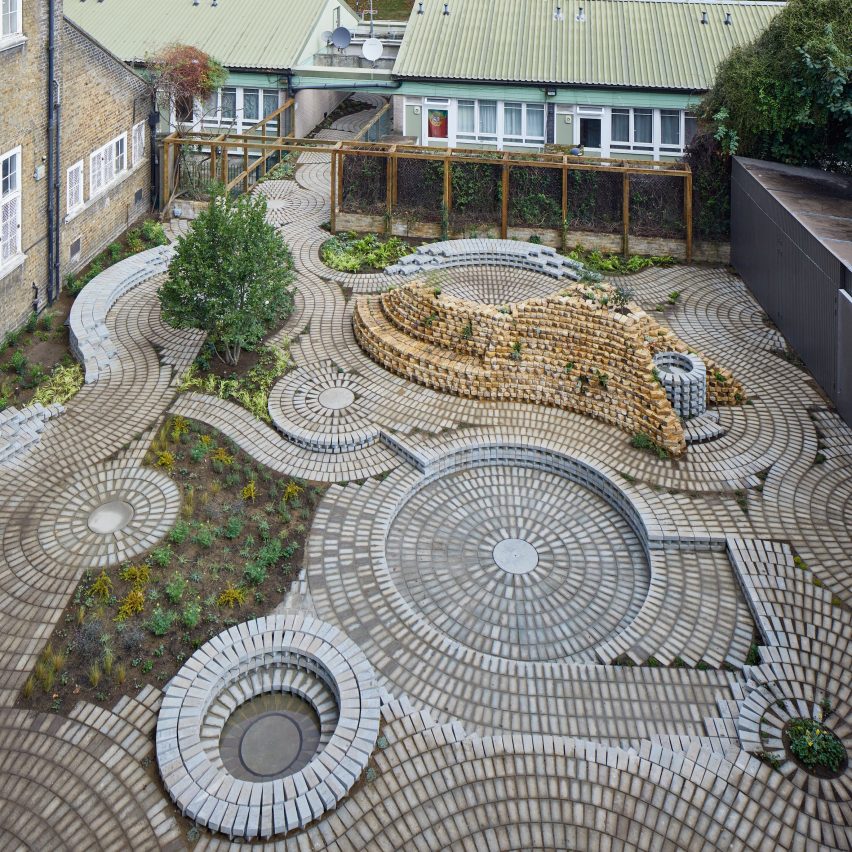
Mexican artist Gabriel Orozco has worked with 6a Architects to create a sculptural garden paved in a pattern of interconnected circles for the South London Gallery. Read more


 Sig Nordal