29 Habits of Extremely Considerate People

8 Creative Ways To Motivate Yourself To Reach Goals

Image of a cheerleader with pompoms

“Self-pity is our worst enemy, and if we yield to it we can never do anything wise in this world” – Helen Keller

From the moment our kindergarten teachers asked us what we wanted to be when we grew up to the job interview question that asks us to envision where we see ourselves in five or ten years time, everyone seems to want to know what we’re doing (or hope to do) with our lives. Some of us have detailed road maps in our minds, with mile-markers for each goal: Obtain a college degree, land a dream career, start a family, visit Mars, achieve world domination—whatever. Others like the scenic route. We have a vague picture of someone in the distant future who looks like us and is doing amazing things, but they’re too far off in the distance for us to see just what those amazing things are. Whether you’ve had your entire life planned out since you were 5 yrs old or are just winging it, we all need a jump start from time to time to keep us moving in the right direction—or any direction. Here are eight creative ways to motivate yourself to reach your goals.

1. Sing to yourself

Seriously. Like laughter, sunshine, and fresh air; singing elevates our moods and increases our well being. It can even be a useful group exercise to enhance collaboration in the workplace. Read more about it here. Studies have shown that singing triggers a release of endorphins, which are the body’s natural way of chemically relieving pain and stress. When we’re happier, we get more done. This might be why Snow White likes to whistle while she works.

2. Visualize your success

According to Dr. Frank Niles, visualization is a simple but useful motivational technique because when you form a picture of succeeding in your mind, you begin to see the possibility of reaching your goal. When I was working on my dissertation in graduate school, there were days when meeting the daily writing goal I’d set for myself seemed insurmountable, let alone finishing the entire book-length project that sat in my stomach like a baby with an unknown due date. When I began to feel overwhelmed, I’d often visualize the moment of achievement, walking across the stage, receiving my degree, finally earning those three letters at the end of my name that I’d poured so much blood, sweat, tears, and vodka into. Six years and quite a few drinks later, I managed it.

3. Speak about achieving your goals in definitive, positive terms

Instead of saying, “if I get married,” “if I get that raise,” “if I quit smoking,” say “when I get married,” “when I get that raise,” “when I quit smoking.” This shifts your focus from possibility to actuality. Spiritual teacher and best-selling author Dr. Wayne Dyer has written and spoken extensively about the “I Am” discourse, which is a form of positive thinking that takes its name from Judeo-Christian Scripture but is portable in any walk of life. Dyer tells us humorously that God didn’t introduce himself to Moses as “I will be,” or “My name is I hope things will work out.” No. He said simply “I am.” Using this affirmative vocabulary in our own lives, argues Dr. Dyer, can help us to visualize our goals and keep our eye on the prize.

4. Use sticker charts

We all remember the thrill of achievement when we rushed home from school to show our parents the shiny gold star we’d received on our homework assignments in school. Who’s to say this positive reinforcement can’t work for adults too? Draw up a chart of your goals, with various benchmarks. Each time you achieve a benchmark, give yourself a gold star, or a smiley face, or a googly-eyed cat. Whatever gives you a sense of accomplishment. This ties into the visualization technique as well, because charting the trajectory of completion gives you verifiable proof that you’re making progress.

5. Keep a goal diary

Like creating a chart with eye-catching visuals, writing down your goals and reflecting regularly on their progress helps you to both focus on the desired outcome and holds you accountable. In 1979, a study conducted in the Harvard MBA program asked students if they had goals and if they’d written down those goals. 3% had written down their goals, 13% had goals but hadn’t written them down, and 84% had no clearly defined goals. Ten years later, the study revealed that the 3% who had written down their goals were the most financially successful. While financial stability is only one quantifiable way to measure success, the study still points to a link between clearly defining one’s goals and achieving them.

6. Find a “study buddy”

While this can be a useful way to motivate students to complete homework, it can also work well for anyone who has a hard time settling down to work. I used to notice that I graded papers much more efficiently when my boyfriend was sitting in the other room doing the same thing. While this might not work for everyone, I’ve always found that glancing up now and then to make a comment about something I’ve read does more than allow for a break in the action. The other person becomes a sounding board to bounce my ideas off of. Even Sherlock Holmes relied on Watson’s insights to solve his cases.

7. Keep a corkboard in your workspace or someplace visible, with empowering quotations

Personally, I find Yoda a great inspiration. It’s hard to quit anything when you’ve got “do or do not. There is no try” staring you in the face. Turn to your favorite books and movies, or your role-models. Pick your favorite inspirational quotes and keep them close to remind you that you can do whatever you set your mind to.

8. Daydream

It might sound counter-intuitive, but I’m going somewhere with this. You probably remember being told off in Biology class for staring into the fathomless blue eyes of your lab partner instead of concentrating on the frog you were supposed to be dissecting. However, according to Margrit Tarpalaru, there’s a way to procrastinate “consciously, creatively, and, most importantly, guiltlessly.” Tarpalaru, a teacher who uses this technique to plow through grading, refers to it as the “micro-break,” which many of us probably think of as that reflexive urge to check Facebook for five minutes, only to look up twenty minutes later and wonder how we got sucked into the social media vortex. Instead, Tarpalaru suggests techniques like a quick daydream. Glance up from the computer screen and spend a few minutes thinking about all of the glorious things that await you once you’ve gotten through the day, or the week: biking with your partner, having drinks with friends, the summer cruise you’re planning. Like the other visualization techniques we’ve talked about, this practice keeps your eye on the prize, and it’s a conscious form of procrastination because you can’t have that drink, or board that cruise ship unless you meet that deadline, which inevitably forces your mind back on work.

How do you motivate yourself? Can you think of any other useful tips? Share your thoughts in the comments!

Featured photo credit: Cheerleader via pixabay.com

The post 8 Creative Ways To Motivate Yourself To Reach Goals appeared first on Lifehack.

http://ift.tt/1JDXqHh

5 Secret Uses of the Trello App to Overcome Procrastination and to Boost Productivity

desk-602975_1280

The Trello app is a simple, yet brilliant productivity tool.  Don’t be fooled by its simplicity, however — Trello is not just a basic to-do list app. Using Trello will help you feel calmer and more productive.  Being organized and in control of your time, plans, and activities will unleash a tremendous amount of energy in you.

The Trello design is a straightforward series of “lists” arranged from left to right on a plain background “board.” Each “list” represents a category of tasks. Within each “list” are “cards” which are to-do type items within that category of tasks. “Cards” can be shifted to other “lists” through a drag-and-drop motion.

Trello can serve as:

  • a way to plan a project
  • a way to keep track of who is doing what in a group
  • a way to see all of the working parts of a project together on one page (or multiple pages)
  • a historical record of the action steps you have taken through a particular project

For people who tend to avoid their work, Trello provides a clear, easy-to-access space for depositing relevant information for getting things done. Once you become familiar with using Trello, both to enter your to-do list items and to remind yourself of them, you’ll have a smoothly functioning system of recording your activities and plans. When you complete any items you have on your Trello lists, you have the option of archiving or deleting the notes you have on those items.

You will get a healthy rush of good feelings when you archive or delete the items. As you continue to rely on Trello over time, your confidence in your ability to get things done will grow.

Trello also comes to the rescue for people who tend to be forgetful.  You can access your Trello boards from your smartphone, tablet, or computer and enjoy the benefit of having all of your information synched across devices.  You can jot down any type of note to remember any sort of thing.  You can also add attachments, e.g. photos or clippings from the web, to your cards.  You can keep a list for “to be filed later,” for names and information you’d like to remember about people you just met, or ideas for characters for your upcoming novel.  Having the ability to capture your thoughts as soon as they occur to you through Trello will help you to be more consistent in your work and life.

Trello also functions as a planning and action guide for people who have difficulty knowing how to get things done, since individual cards are moveable both within lists and to different lists, Trello users have a reliable method for figuring out what is of highest priority and in what order items should be addressed.

Taking the planning process out of the brain and on to a visual-based tool will help you to stay lucid in your thinking and judgment.  Get in the habit of entering to-do list items with action words in front, e.g. buy broccoli, and you’ll soon become a master at completing those actionable items.

Here is a list of 5 ways to use the Trello app to your best advantage:

1. Use Trello on your desktop monitor.

When you set Trello up to display on your desktop monitor, you will have the sense of having “everthing at your fingertips.”  Trello will serve as your own personal Command Central.  Admit it — you’ve always wanted to have a Command Central. Start and end your day with a quick review of your Trello lists and keep yourself functioning at your best.

You’ll be able to make decisions about what needs to get done and how much more quickly with Trello.  You’ll know what is “in play,” or what tasks you have started, but need to wait for someone else to complete. You’ll have a neat, accurate record of your progress — beginning, middle, and end — on all of your projects as Trello date and time stamps your entries.

2. Design your boards and lists to fit your needs perfectly.

Your connection with Trello will deepen when you figure out the most useful array of lists for your needs. This will be somewhat of a trial-and-error process, but an easy one. Make a list to handle each area and type of “worry” you have in your life. Once your lists are set up, your worry will seem to lessen. Trello will serve as a reliable reminder of what you need to get done.

Suggestions for lists to keep include:

  • TODAY – which should be self-explanatory
  • $$$$$$ – since there always seems to be some task that involves giving or receiving money that needs to be tracked carefully
  • WAITING FOR – because you’ll need a reminder of those actions you started but are waiting for someone else to complete

Here’s a screenshot of what a Trello layout might look like: Trello picture

The possibilities for Trello arrangements are endless.  Have Trello boards with information on books you’d want to read, movies you’d want to see, and apps you’d want to try. These are items you won’t need to review every day but might like to have readily accessible. Other suggestions for ways to use your Trello boards and lists include arranging a wedding or graduation party, keeping track of expenses, finalizing packing lists for a business or vacation trip, and remembering details about your medical treatment.

3. Construct and design your lists to guide you to tackle your priority items.

Once you’ve decided which cards should go in which lists, do another round of sorting and determine which cards should go to the top of each list. In other words, top priority tasks should go to the top of each list. You can also highlight any task by using the “labels” function. You can choose which colored label you’d like to tag a card with and assign your own label to it, e.g. “urgent,” “Julie,” or “important.”  Each card can have multiple labels.

Here’s a screenshot of how you might organize your own set of labels: Trello labels
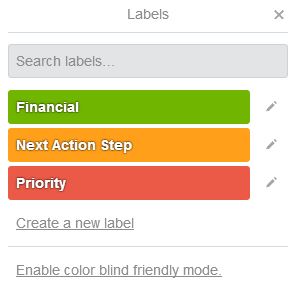
When you organize your Trello boards with an eye towards priority and purpose, you’ll have a much easier time initiating your tasks, maintaining your momentum, and bringing them to completion.

4. Consider ways to “share” your Trello lists.

Trello lists can be “shared” so you can invite one or more people to see a particular list and to edit its contents. You can use this function when working with an assistant or collaborator on a multi-pronged project. Other suggestions for ways to “share” a Trello list include:

  • maintaining a grocery list with your spouse, partner, or roommate
  • keeping a list of chores, homework, and scheduling issues for your child or teenager – Trello removes the need for in-person nagging
  • enabling smooth communication among members of a team, troop, or organization or between an employer and employee

By sharing lists, you’ll be able to delegate tasks and to keep track of the entire back-and-forth interaction.  You’ll save yourself time and aggravation in the process.

5. Use Trello as your memory bank.

Using the Trello app will help you if you have ADD or ADHD, if you are disorganized, if you are forgetful, or if you feel overwhelmed.

Get in the habit of turning to Trello to capture loose details which you might forget if you relied just on your memory. Log in due dates, ideas for blogposts, upcoming birthdays – anything that requires action on a later date. Having all of your to-do items and plans in one place will be a great source of sanity and relief.

Trello provides a way to have a view of your own life — past, present, or future. Once you determine how to tailor Trello to your needs and lifestyle, you will be more efficient in your planning and more accountable in your actions. And then the sky is the limit.

To get the Trello app, follow this link: http://ift.tt/RJjc1R

For more inspiration for how to use Trello in your own life, follow these links: https://trello.com/tour http://ift.tt/12qfsXW http://ift.tt/1zkyEY2 http://ift.tt/1zkzdkF

The post 5 Secret Uses of the Trello App to Overcome Procrastination and to Boost Productivity appeared first on Lifehack.

http://ift.tt/1ElWPmL

Europe

#googleearth

The long roads of New Zealand. Photo by Trey Ratcliff

http://ift.tt/1IaKQOU

4 Keys To Self-empowerment by Living the Examined Life

self empowerment

self empowerment

Our world is rapidly changing and often presents obstacles and events that other generations have not experienced nor learned to cope with. Clearly life in the twenty-first century has vastly changed from the kind of environment that most of us grew up to accept as normal. Today’s children must learn to adapt to information, technology and rapid change in a way that most adults never dreamed possible as they grew to adulthood.

Life has always been, but now vastly more so, a series of changes, challenges and transitions. Navigating through “troubled waters” can often leave us in various states of dismay. However, if we have learned to consciously deal with and move through the smaller changes and challenges on a regular basis, then the larger ones that loom before us seem a little more manageable.

Here is a four-step process that aids both individuals and organizations in moving through both adversity and opportunity, while at the same time, learning new skills and adjusting to new realities.

CLARIFYING VALUES

Take time, both as individuals or as a group, to define your values. What is the code of ethics or principles that you wish to live by? It is important to determine what values you believe to be true, as opposed to what you have been programmed by family, culture, or others to believe is true. It’s a good idea to review these from time to time in order to stay current with any new insights that have been gained.

MODIFYING BEHAVIOR

After ascertaining just what values you want to live or operate by, the next step is to take a good look at how your life aligns with those values. You may need to make some adjustments here.

INNER EXPLORATION

Often there are unconscious or childhood memories that keep us from expressing our truer nature. By confronting and understanding them, we are better able to ameliorate any inappropriate behavior.

And, also, give thought to the body/mind connection. Often the egoic mind fools us into thinking we can’t do something before we even try. The mind is a wonderful servant, but a poor master. Go into your heart space for the most accurate information.

SEEK THE EVOLUTIONARY PERSPECTIVE

There is an evolutionary process that seems to seek the higher good. In psychology this has often been referred to as the “Organic Process,” or in some circles it is called the “Evolutionary Impulse.” Religion would call it “God’s Will,” while other spiritual movements would say “Divine Order.” All are speaking of the same process. It is here that hindsight is better than foresight, and acceptance of what can’t be changed, or “going with the flow,” is the wiser way. And, in the end, we often find that which we resisted most eventually produced incredibly positive results.

__

This article is written by Ione Jenson, an educator and counselor in both public and private school systems. She was also an owner and director of a Holistic Retreat and Spiritual Counseling Center for over 23 years.

9781504328579_COVER.inddShe has written, among other books published by Hay House, the recently released book: Coming Full Circle through Changes, Challenges and Transitions. Available at book stores and Amazon.

Find her on Facebook at http://ift.tt/1cQ63ll and her blog at http://ift.tt/1Pg19zv.

The post 4 Keys To Self-empowerment by Living the Examined Life appeared first on Pick the Brain | Motivation and Self Improvement.

http://ift.tt/1BdXAOx

Europe

London – Houses of Parliament (by Zoltán Endrédi)

http://ift.tt/1PYOjAK