You know you care. You feel it in your heart all the time. The love you feel for someone whether it be your partner, your child, your best friend or whoever. This person is super special to you and you care about them deeply. Oftentimes though, we forget to show people that we do care or we take it for granted that they know we care and feel we don’t have to do anything to prove it or show it.
For the most part, you really don’t have to prove you care. You know you do, they know you do and that should be enough, right? Well, it is enough, really but every now and then it’s nice to show people so they don’t think we have forgotten or are taking for granted that they know and that’s all that matters. Here are a few simple, yet loving ways to show you care, so they don’t forget. It also makes them feel a little extra special and let’s face it, sometimes we need those little subtle acts.
1. The I love you text.
Simple, effective. Who doesn’t love to get a random text from someone special that simply says I love you? This doesn’t have to be just your partner it could be your best friend, sister or anyone you love really.
2. Bring treats.
You know what their favourite tea or cookie is. Make a special trip that café up the street that sells them, get one and bring it to them. Want to make it even more special? Stick a bow on it. Why not?
3. Pick up the phone and call them.
Texting is quick easy and fun but there’s nothing like hearing someone’s voice on the phone. That’s the kind of special act that puts a song in our heart and a skip in our step.
4. Grab them for a random road trip.
Text your friend, tell her be ready in 5 minutes, pick her up and hit the open road. If your friend has been low lately, this will certainly pick up her spirits and show her that you care.
5. Music is therapy.
Download their favourite song and email it to them or share it with them on their FB page. Music makes everyone feel love and happy. They will know you have been thinking of them and that you go the extra mile for them.
6. Happy notes.
This could be a love note or an inspirational note or maybe even just a fun cute note to make them giggle. Stick it in their coat pocket, their lunch pail, tape it to their cell phone cover or wherever you know they will find it easily. We all love fun notes.
7. Offer your time.
You are both super busy with work and family but every now and then one of you crashes. Go and sit with them for half an hour or half a day, without them asking you to and just listen to them or hold them or do whatever they need you to do or be for them.
8. Take them somewhere they have always wanted to go.
I don’t mean Paris or Ireland, unless of course you have the means, then, by all means, but maybe they just really want to go to the movies or out to dinner. Either take them there yourself or buy them a gift certificate so they can do that with a family member or someone else.
9. Give them praise or compliments.
Maybe they just faced one of their fears or achieved something that they’ve been meaning to do for a long time. Or maybe they haven’t done anything but they are just a super awesome person. Let them know. Don’t be afraid to tell them just how fantastic they really are.
10. Mail them a card.
You know, like snail mail, through the post office with a stamp on it. These days the only thing we get in the mail is junk and bills. Wouldn’t it be nice to receive a cute loving and fun card? I know I sure would love to receive something like that.
There are many ways to make someone feel special, quite possibly, millions. These are just a few ways I could think of. Some cost a few dollars, others are free. Use your imagination. What are some of the ways you can think of to make someone feel special? Share below!
Maisonette Paris 16 is a private residence designed by Equipe Eitan Hammer et Ulli Heckmann. It is located in Paris, France. Maisonette Paris 16 by Equipe Eitan Hammer et Ulli Heckmann: “Paris based architects Ulli Heckmann and Eitan Hammer have converted two apartments into a maisonette for a couple and their three children. Before achieving the upper apartment and deciding to join the two apartments the family lived in the..
The following article was first published by Volume Magazine in their 47th issue, The System*. You can read the Editorial of this issue, How Much Does Your System Weigh?, here.
The movement and management of sediment is arguably the largest continuous project of spatial manipulation on the planet. This ongoing battle between geology and industry is most apparent through the act of dredging. Dredging is the excavation, gathering, transport, and disposal of sediment from subaquatic areas, enacted to maintain depths of shipping channels, harbors, and ports as well as to reclaim land, create sea defences, and remove toxic chemicals.[1] The primary impetus for dredging is to sustain logistical routes for the shipping industry by countering the forces of erosion, movement, and settling of sediments. Like the logistics of the global shipping industry it serves, dredging is a continual process whose magnitude and significance have fostered their own series of ‘geologics’ – the engineering of material processes that operate in temporal and spatial scales that are geological in scope.[2] Currently in the United States alone, more than four hundred ports and over 25,000 miles of navigation channels are being dredged.[3]
The combination of integrated globalized shipping as well as growing ship sizes has created logistical routes that, as they approach shallower depths close to urbanized areas, require incessant dredging to counter the natural tendencies of erosion and sediment movement. Accordingly, dredging is continually reconciling the meeting of anthropogenic forces on land with shipping logistics on water. This ceaseless process of dredging – the co-making of hydrological and geologic processes – has been termed the ‘dredge cycle’. It is cyclical because it is constantly driven by anthropogenic influences that produce erosion (urbanization, agriculture, deforestation, damming, etc.) and the desire to tame the effects of these forces that cause shoreline fluctuations.[4] Ironically, dredging accelerates the forces of erosion that they are established to counter, thus stimulating more-and-more dredging.[5]
Given the complexity of engineering a logistical cycle to counter geology, dredging is currently a highly top-down process. It should be no surprise that the largest dredging organization in the United States is a branch of the army, given that logistics itself was born from military operations. To execute this massive land manipulation project, The US Army Corps of Engineers uses an extensive number of (relatively) small instruments such as barges, geotubes, mechanical dredges, hydraulic dredges, cutter dredges, dragheads, suction pipes, trucks, tractors, backhoes, geotextiles, pumps, and silt fences, amongst others.[6] These almost ubiquitous instruments are the primary components of a logistical sequence that includes the removal, transport, and disposal of sediment. What varies in the dredge process is the selection of technologies – decided through a combination of natural geology, available technology, volume, and costs – as well as both where and how to dispose of its material. Traditionally, dredge material was highly contaminated and placed in confined disposal facilities (CDFs), which are now approaching maximum capacity and becoming a costly venture.[7] Another method of disposal has been open water dumping, but the environmental ramifications of this approach are still not fully understood. As a consequence, new ‘beneficial uses’ are actively being sought for dredged material that positions this sediment as a resource.[8] Beneficial uses are part of a longer-term strategy of sediment management that focuses on environmental health, such as: topsoil creation, aquacultural facilities, beach nourishment, aggregate for construction material, brownfield improvements, and habitat restoration. Yet in the context of the United States, despite this transition from a linear process of dredging and dumping to a productive and opportunistic cycle of sediment management, little design effort has been granted to how the engineered geologics of dredging itself – a continual backdrop to urban life in most cities – can be rethought more holistically to benefit currently unheard yet affected subjects.
The dredge cycle can be used to unpack the relationship between anthropogenic and geologic influences that are negotiated through dredging. To short-circuit this relationship would entail the introduction of currently silent subjects that are implicitly implicated in the dredge cycle and question how these subjects can leverage the actual geologics of dredging. For instance, how can local populations re-appropriate this process for socio-political engagement and empowerment? How can ecological processes be an integral component to this system to reduce the environmental footprint of dredging? How can dredging be used as a mechanism to remediate territorial ecologies that it has traditionally impacted? The potential here is to re-envision how smaller components – both physical (instruments of dredging) and systemic (within the geologics of dredge) – can be tactically expanded to both engage and integrate local populations and environments, while strategically aggregated to address urgent issues at a territorial scale. Using differential and overlapping timescales, we ask how incrementalism, dispersion, and iteration enable new subjects – human and environmental – to co-evolve with the dredge cycle.
Dredgescaping Toledo is a design case study that attempts to advance a new discussion on the geologics of dredge by focusing on the Maumee Bay on the western edge of Lake Erie and part of the Great Lakes navigation system. Dredging in the Great Lakes began over one hundred and fifty years ago, and currently over three million cubic yards of sediment are dredged annually from its 136 harbors and 745 miles of federal navigation channels. The removal of this sediment from the Great Lakes shipping channels costs the U.S. Army Corps of Engineers between twenty and thirty million dollars annually.[9] Shipping, however, generates over thirty billion dollars in annual revenues for the region.[10] Almost one-third of dredged material from the entire Great Lakes system – approximately 800,000 cubic yards – originates in the Maumee Bay adjacent to the City of Toledo. Dredgescaping Toledo proposes a series of tactics that we have termed tributaries, islands, sponges, and lakes to expand the geologics of dredge.
As Toledo grew beyond its urban core, its fabric encircled the industrial lands that first colonized the riverfront. These lands are still extremely productive – the port of Toledo is ranked seventh in the Great Lakes in total tonnage, generating nearly seventy million dollars in personal income and supporting fifty thousand regional jobs.[11] While these industrial lands are vital to the city’s economic health, they have forged a wall between the expanded city and water. A continuous linear public waterfront is perceived as a cultural catalyst for gentrification in struggling cities such as Toledo, though here rendered implausible. Instead of negating industry, this study employs a series of connectors between land and water – tributaries – that provide a public easement and access through the port’s terrain vague while seldomly interfering with the industrial lands and processes themselves.
Presently, Toledo’s dredged material is disposed of in an existing two square mile open-lake placement area, located at the mouth of the Maumee River. Not only has this disposal technique been associated with inciting algae blooms in Lake Erie that suppress aquatic ecosystems,[12] but by dumping this material far from the City of Toledo it is difficult to leverage as a public amenity. Due to the Maumee River’s narrow width, steady flow, and considerable shipping routes, it is impractical to dispose of this dredge sediment in the river itself. We see this material as being capable of creating vital and lacking public waterfront lands for the city. Working within the geologics of dredging, we ask how land can be operationalized in its different states of matter – from slurry to soils – and cleanliness – from partially contaminated to remediated – to enable the co-existence and symbiosis of industry and public life. Our proposal utilizes a series of geotube pontoon islands to process the dredged slurry in close proximity to the city.
Geotubes are massive ‘sand bags’ fabricated from flexible geotextiles that hold and dewater newly extracted dredge slurry. Dredge material is pumped directly into these bags, and over the course of three months purified water slowly seeps out. What is critical about this technology is that the tubes can be fabricated in a variety of sizes and are easily filled, deployed, emptied, stored, and transported. This enables dredge slurry (both water and sediment) to be dewatered and remediated in close proximity to the city of Toledo without disrupting draft depths or navigation routes. Geotubes can be inhabited during the dewatering phase as islands and treated as public land. During the dewatering phase, these islands host a series of programed platforms that connect to the easement tributaries, forming a poly-nuclear public waterfront – an evolving archipelago. These pontoons are grouped into larger figures to provide different programmatic opportunities for a city starved of public space and access to water. This disaggregated approach to managing dredge sediment establishes a highly flexible and resilient system, as temporal public land is incrementally deployed alongside and within the dredge cycle and can therefore be calibrated to seasonal changes, festival and event schedules, or the general needs and desires of local citizens. This inserts a bottom-up, tactical, and iterative approach to forming public space within the geologics of dredge.
After the dewatering period, the public island platforms are removed and reinserted into newly dredged pontoons, while the dewatered pontoons are ‘unzipped’ and hydro-seeded for a phase of phytoremediation. These floating wetlands are connected to the stormwater culverts and detention basins that are integrated within the easement tributaries. Once the sediment is remediated and safe for open-lake placement, the soil in the pontoons is mixed with a rare-earth bentonite and water solution, which acts as a sponge to suppress and absorb algae growth. This allows territorial issues like harmful algae blooms or other specific ecologies to the lake to be addressed in an appropriate timescale. The sealed geotubes are then tugged into the bay and the slurry is distributed throughout Lake Erie. Over several years, this process is anticipated to return Lake Erie to its original nutrient composition. The emptied geotube pontoons can be either reinserted into the dredge process or stored, depending on the season.
The last component of this design study examines how the dredge cycle can more robustly interface with the hydrological cycles of water management in the city. Due to a large number of combined sewer overflow events, the Environmental Protection Agency has mandated new forms of stormwater management for Toledo. While the city contemplates a series of hard infrastructures and the consolidation of stormwater onto three sites, our proposal investigates how a distributed approach to water management can reduce contaminants caused by the large distances traveled by stormwater run-off, and once again, disaggregate a sizable (and potentially expensive) problem into a series of distributed soft components. The study proposes the employment of foreclosed home sites in Toledo as a series of distributed detention basins. These ‘waiting lands’ are operationalized by creating a perimeter curb of dredge-filled bags around the house and property line to allow stormwater to fill these sites and reduce pressure on the sewer system. In total, this ‘distributed lake’ consists of an area of land equivalent to the three sites currently set aside by the city. Further, public platforms from the islands could be placed on these lots – resting on the curb foundations – to enable local neighborhood public programs when not in use on the river.
The proposed geologics of dredge enable local environments and citizens as well as territorial transformations to co-evolve with and through the dredge cycle. The expansion of ‘beneficial uses’ that moves beyond sediment repurposing requires engaging with the system of dredging itself and asking how it can be a resource to cities and their ecologies. This strategy has the potential to implicate new subjects into what was once a top-down linear system. While the health and growth of industry instigates dredging operations, these operations also accelerate erosion and therefore more dredging. This means that where industry is steady or flourishing, dredging operations are continually increasing in scope. Dredged sediment acts as a material index to the prosperity of industry, yet in mid-sized towns with industrial waterfronts, how this new land is processed and disposed of can be advantageously reconsidered. While dredge material is often used to create new lands, particularly in cities boasting high real estate values, as the histories of Toronto, Boston, New York, and San Francisco, amongst others has shown, these cities have used these same real estate values to push industry to the periphery and return their waterfronts to the public. In the context of mid-sized cities such as Toledo, where low land values, productive industry along the water, and an associated depravity of public space collide, a system of producing land in a malleable, temporal, transformable, and transportable logic enables the symbiotic co-habitation of industry, culture, and ecology. This positions land not as a commodity to capture and hold, but rather a temporal material state that is iteratively deployed and used by local constituents and then redistributed within a territorial ecology. Within this expanded geologics, culture, politics, economics, and ecology find synergetic opportunities that empower new subjects to be agents within what was once an engineered system of global capital.
References
[1] Brett Milligan, ‘Suites of New Elemental Landscapes’, Ground Up Journal, Issue 2: Grit (University of California Berkeley, 2013), 38. [2] Brian Davis, ‘Index of Landscape Typology: Easements’. In: Neeraj Bhatia and Mary Casper (eds,), The Petropolis of Tomorrow (Barcelona: Actar, 2013), pp. 402. [3] US Army Corps of Engineers, ‘About Dredging’. [access] (accessed 8 February 2016). [4] Dredge Research Collaborative, ‘Packaging Sludge and Silt’. In: Elizabeth Ellsworth and Jamie Kruse (eds.), Making the Geologic Now: Responses to Material Conditions of Contemporary Life (Punctum Books 2012). [access] [5] Stephen Becker, Rob Holmes, Tim Maly, Brett Milligan, ‘Dredge’. In: Neeraj Bhatia and Lola Sheppard (eds.), Bracket [Goes Soft] (Barcelona: Actar 2013), pp. 154. [6] W.J. Vlasblom, ‘Introduction to Dredging Equipment’. In: Designing of Dredge Equipment, (TU Delft, 2005). [access] (accessed 8 February 2016). [7] In the context of the Great Lakes, The U.S Army Corps of Engineers estimates that thirty-seven percent of dredged sediment is placed in open waters, while forty-five percent is placed in CDFs. See: Great Lakes Commission, Building more Sustainability into Great Lakes dredged material Management, (Great Lakes Dreading Team, December 2015), pp. 3. [access] (accessed 8 February 2016). [8] Great Lakes Commission, Testing and Evaluating Dredged Material for Upland Beneficial Uses: A Regional Framework for the Great Lakes, (Ann Arbor: Great Lakes Commission, 2004). [9] Ibid., Great Lakes Commission, (2015). [10] Great Lakes Dredging Team, Beneficial Use of Dredge Material in the Great Lakes (Great Lakes Commission, March 2013), pp. 2. [access] (accessed 8 February 2016). [11] US Army Corps of Engineers, Great Lakes Navigation System Five Year Development Plan Fact Sheets, (Cincinnati: Stakeholders Meeting Report, 2006), pp. 96. [12] Ibid., Great Lakes Commission, (2015).
Project Credits Office:The Open Workshop Team: Neeraj Bhatia (Lead), Anesta Iwan, Cesar Lopez, Jeremy Jacinth Year: 2014
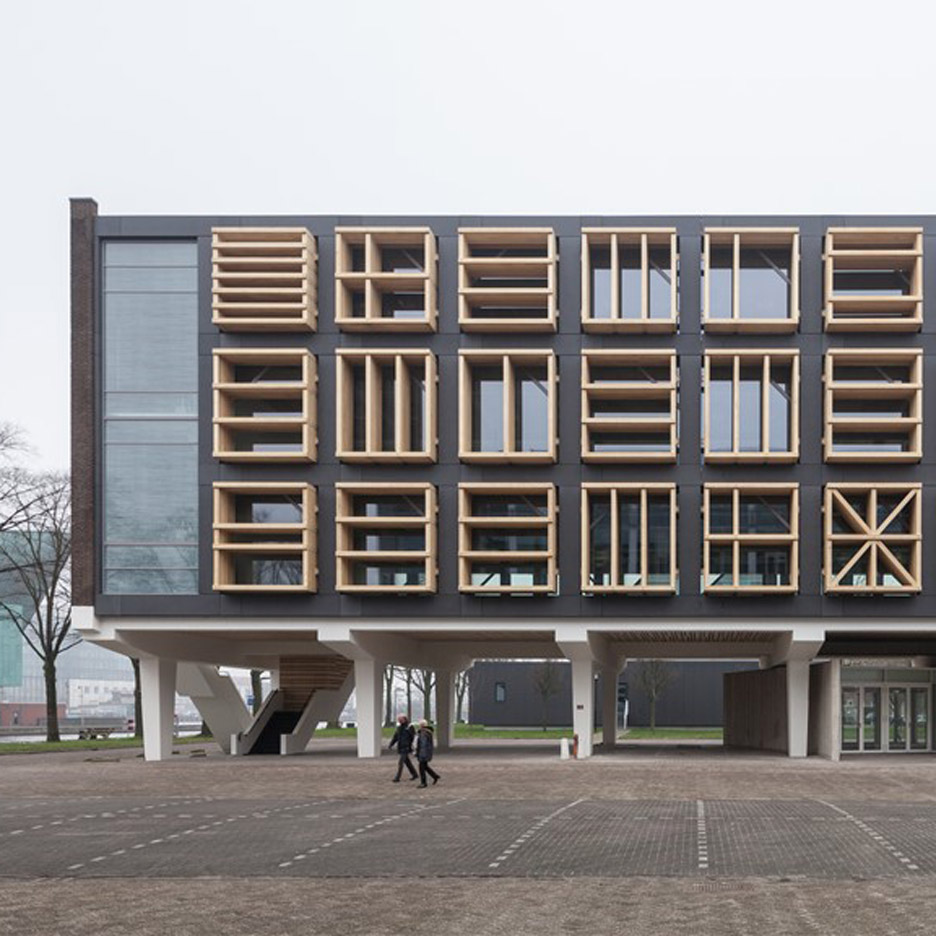
Geometric screens based on flag designs flank the windows of this former marine base in Amsterdam, which Bureau SLA has converted into offices to mark the Dutch Presidency of the Council of the European Union (+ slideshow). (more…)

 1. The I love you text.




 Sig Nordal