Boston Public Market / ArchiTerra Inc.


© Chuck Choi

© Chuck Choi


© Chuck Choi


© Chuck Choi


© Chuck Choi


© Chuck Choi

  • Architects: ArchiTerra Inc.
  • Location: United States, Boston, MA, USA
  • Architect In Charge: ArchiTerra Inc.
  • Area: 28000.0 ft2
  • Project Year: 2015
  • Photographs: Chuck Choi
  • Mep/Fp Engineering: R.G. Vanderweil Engineers Structural Engineering, McNamara-Salvia Inc
  • Energy Modeler: TNZ Energy Consulting Inc Construction Manager, Lee Kennedy Co Inc
  • Food Service Consultant: Ricca Design Studios Lighting Designer, Horton Lees Brogden
  • Client: Boston Public Market Association

Diagram

Diagram

From the architect. Design Excellence

The design of the first public market in the country to feature local, sustainable food reflects the triumph of place-making and architectural creativity over mind-boggling infrastructure complexity, transforming the ground floor of a previously vacant state office building into a vibrant destination that anchors a growing market district. 


© Chuck Choi

© Chuck Choi

User Experience

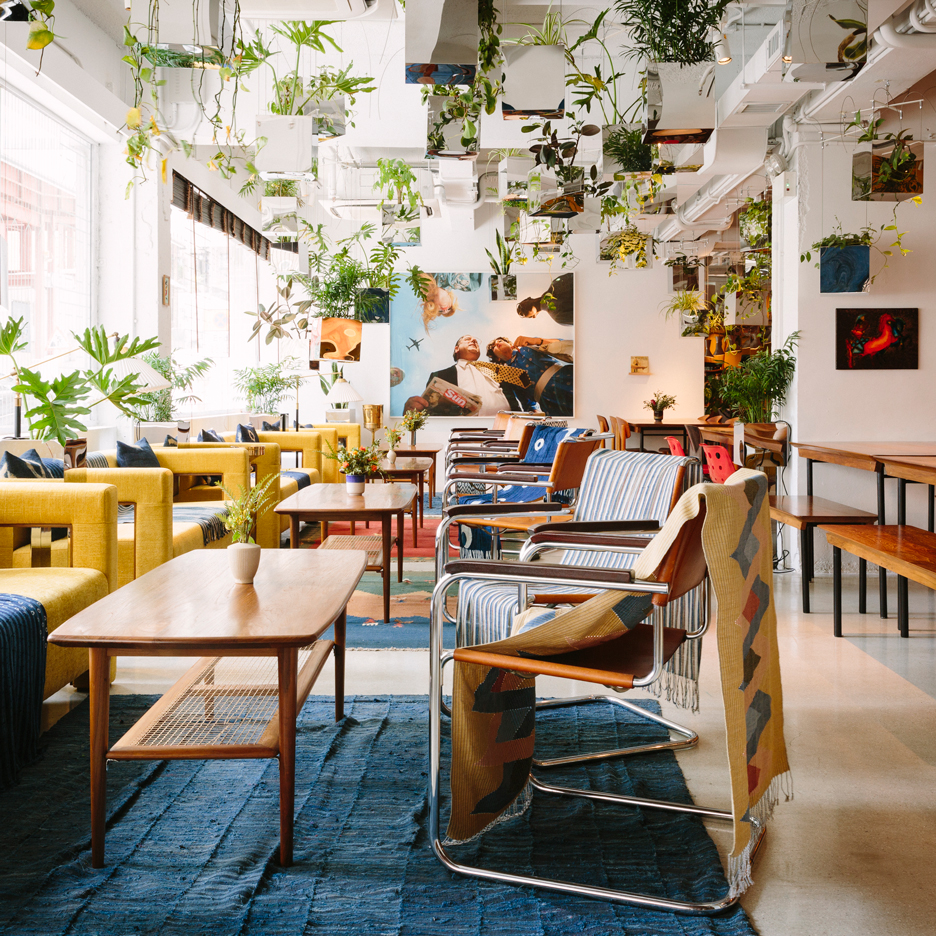
Crisply detailed white canopies of corrugated metal are evenly washed with up-lights, creating luminous canted ceilings that vault over 40 distinctive vendor stalls. Rectangular pylons clad in metallic copper laminate conceal utility risers and simulate a pillared market hall. Pendant lights of copper and silver define the aisles and central hub and evoke a culinary theme. With overhead utilities left in shadow and copious use of salvaged barn board, the overall ambiance is that of a bustling market street at twilight.


© Chuck Choi

© Chuck Choi

Vendor Experience

Creative stall and signage designs are encouraged to express individual vendor personalities while exacting tenant design standards safeguard the appearance and performance market as a whole. An ingenious system of regularized rental modules, sign supports, and plug-and-play utility service connections eases vendor start-up and supports flexible change over time. Aisle layouts and selling walls are designed to maximize rentable area and encourage visitor/grower-seller interaction while integrated LED track lighting highlights the bounty of food and optimizes retail sales.


Exploded Axonometric

Exploded Axonometric

Infrastructure Ingenuity

The design reconciles extreme site constraints – Central Artery Tunnel

ventilation shafts, Haymarket subway station, parking garage, and new Registry of Motor Vehicles – with complex infrastructure requirements. With no basement, sub-floor utilities had to be designed within a raised slab. With no ceiling plenum, overhead utilities had to be thread through a morass of existing infrastructure serving the upper office floors.


© Chuck Choi

© Chuck Choi

The design integrates seven entrances, drawing visitors and residents from all parts of the city. The Teaching Kitchen and Market Hub create memorable urban destinations. Through displays, signage and active instruction, the entire market is designed as a platform for public education. Building- scale signs, exterior lighting, and window decals designed as part of the project announce the market as the cornerstone of the emerging market district.


© Chuck Choi

© Chuck Choi

Sustainability

The new market supports local agriculture and promotes land conservation while reducing carbon emissions associated with food transport by air. Ninety percent of all the food sold in the market is grown, caught or produced in Massachusetts, supporting the local economy. The design minimizes energy and water use while providing for recycling and composting. Designed to meet LEED standards for Interior Design & Construction (v. 4, Retail), the project is currently being submitted for LEED Silver certification.


Section

Section

Site Section

Site Section

© Chuck Choi

© Chuck Choi

http://ift.tt/23aM2ux

Casas Melhoradas Reimagines Affordable Housing in Maputo, Mozambique


Context. Image © Johan Mottelson

Context. Image © Johan Mottelson

In an effort to create affordable housing in Maputo, Mozambique, Casas Melhoradas is an applied research project aimed at eliminating city slums. Organized by the Institute of Architecture, Urbanism & Landscape, at the Royal Danish Academy of Fine Arts Schools of Architecture, Design and Conservation, in collaboration with the Mozambican NGO Estamos, the Faculty of Architecture and Urban Planning at Universidade Eduardo Mondlane (FAPF) and the Danish branch of Architects Without Borders (AUG), the project is part of research initiative on urban development in the Global South.


Street view. Image © Johan Mottelson


Old house prior to vertical addition. Image © Johan Mottelson


View from private outdoor space. Image © Johan Mottelson


Street view. Image © Johan Mottelson


Street view. Image © Johan Mottelson

Street view. Image © Johan Mottelson

Casas Melhoradas has a tripartite focus: the development of alternative construction methods to improve building quality while decreasing the cost of housing; the development of new housing typologies, which utilize space and infrastructure more economically for more sustainable urban development; the construction of affordable rental housing through public-private partnerships to enlarge positive effects.


Old house prior to vertical addition. Image © Johan Mottelson

Old house prior to vertical addition. Image © Johan Mottelson

“The project develops multi-story housing typologies, rooted in the local socio-economic and cultural conditions, seeking to utilize space more efficiently, in order to contain the urban sprawl and use the infrastructure more economically,” say the project organizers. “Thereby, the project seeks to facilitate the development of more compact urban environments in the slums and make future infrastructure investments more cost-effective. On this background, the project seeks to improve mobility, improve the access to infrastructure and economize space.”


Street view. Image © Johan Mottelson

Street view. Image © Johan Mottelson

Previously featured on ArchDaily, this newest example of the Casas Melhoradas project, designed by Johan Mottelson and Jørgen Eskemose, was built in 2016 and features a vertical addition to an existing house near the center of Maputo; part of a slum area known as Polana Canico. The expansion was achieved by using concrete supports at ground level to create a foundation for the first floor timber expansion. The project utilizes prefabricated wood elements that were made at a local timber workshop, brought to the site on foot, and assembled on site in a short period of time.


The old house is the common “Casa de Blocos” (local housing type consisting of concrete blocks). Image © Johan Mottelson

The old house is the common “Casa de Blocos” (local housing type consisting of concrete blocks). Image © Johan Mottelson

“Casa de Madeira e Zinco” (local housing type consisting of a timber and corrugated iron sheets). Image © Johan Mottelson

“Casa de Madeira e Zinco” (local housing type consisting of a timber and corrugated iron sheets). Image © Johan Mottelson

In a city not known for effective planning, regulation enforcement, or infrastructure, this newest Casas Melhoradas example riffs on local Maputo tradition, adding to what was strictly a Casa de Blocos construction – a house built with only concrete blocks – and creating a variant on the Casa de Madera e Zinco typology of timber housing clad in corrugated iron sheeting. Some of the house’s notable features are a plywood ceiling with insulation foil, mosquito net coverings over natural ventilation openings, new windows added to the old ground floor, and a gallery oriented towards a private outdoor area, which also serves a covered porch.


View from private outdoor space. Image © Johan Mottelson

View from private outdoor space. Image © Johan Mottelson

Maputo has a population of 2.5 million with approximately eighty percent of inhabitants living in slums. The city’s population has been expanding at a pace of approximately five percent a year, with new buildings that are overwhelmingly on the horizontal plane. As Maputo’s footprint increases and puts greater strain on existing and yet-unbuilt infrastructure, land values at the city center have grown, adding incentive for greater densification in the future.


Small scale public space added to the street. Image © Johan Mottelson

Small scale public space added to the street. Image © Johan Mottelson

Casas Melhoradas’ housing units are rented out and fully financed over 10 to 15 year periods. To complete the work, project organizers rely on public-private partnerships, and are seeking donors and investors for future collaboration. More information can be found, here.

Architects: Johan Mottelson and Jørgen Eskemose, Institute of Architecture, Urbanism and Landscape, The Royal Danish Academy of Fine Arts, School of Architecture, Design, and Conservation
Location: Polana Caniço, Maputo, Mozambique
Area: 30 m2
Year: 2016
Photo Credits: Johan Mottelson

http://ift.tt/1OpAsJg

Tran Quoc pagoda by quanglv by quanglv

Tran Quoc pagoda, a must visit place in Hanoi

via 500px http://ift.tt/1S5OmLb

The Chamber Of A King by michaelwilhelmi by michaelwilhelmi

In some of its 900 year history parts of the Tower Of London were used as a palace. This is a recreation of a room in the Tower Of London where King Edward I stayed in 1294 (reigned 1272 – 1307).
King Edward I completed an ambitious building program for the Tower Of London, building a new ring of towers and walls around the existing castle. He also moved the Royal Mint to the Tower Of London.

via 500px http://ift.tt/28FeIzP

Roquebrun Reflections by KevinDrewDavis by KevinDrewDavis

Beautiful Europe

Charles Bridge, Prague (by Tania L)

http://ift.tt/1lsocZL

Sou Fujimoto combines geometric forms with Indonesian crafts for Hong Kong venue


Japanese architect Sou Fujimoto has combined elements of his previous structures with traditional Indonesian craftwork to create a shop and restaurant venue in Hong Kong – his first project in the city (+ slideshow). (more…)

http://ift.tt/1rqscxt

4 Decluttering Hacks: How and Why to Get Organized

You’re reading 4 Decluttering Hacks: How and Why to Get Organized, originally posted on Pick the Brain | Motivation and Self Improvement. If you’re enjoying this, please visit our site for more inspirational articles.

Getting Organized

Getting yourself into an organized lifestyle is not as easy at the morning show hosts would make it seem. After an eclectic run at grad school which featured a half put-together dresser and experiments in paper flooring, I’ve at least learned that much. Looking back on those years, I’ve come to realize that my problem was as much a motivational one as it was a practical one. I simply wasn’t aware of how crucial it was to my health to get organized and, in my brief moments of clarity, I genuinely wasn’t sure where I could possibly begin.

If this sounds like you, then check out my analysis of the science behind organization and some tips of my own to get you off the ground.

Health and Organization

The psychology here is pretty clear: getting organized is good for you. When you’re organized you’re more easily able to identify where the balance in your life lies and, with less clutter, there’s less in the way of stopping you from achieving that balance yourself.

It’s not just the fruit of your labour that’s good for you here. Cleaning things up is itself good for you. Indeed, some therapists use decluttering in their therapy to help patients copes with their organization and other issues.

There’s no two ways about it, then. Getting organized is good for you, but it’s not always clear how to be healthy. I’ll tell you how below!

1. Don’t Just Tackle Little Projects

There are a lot of arenas in which it’s a good idea to divide and conquer, satisfying yourself with completing a few small tasks as frequently or infrequently as you’d like, finally fitting everything together into a completed project long after you started.

Decluttering is not one of these battlegrounds. Unlike other projects, decluttering your life is something that will get undone by waiting around. The good news is that the more organized you become, the less junk will creep up on you over time.

So you need to make a big push to hit your clutter, instead of just moving on thing at a time. Some ways to do this include: scheduling a cleaning party. You can’t clean everything in your house in one day, but a you and your friends can. Try trading decluttering favours and promising food afterwards. Doing a regular spring cleaning is also great idea.

2. Start Big

First things first, try to get rid of larger pieces of clutter. You can make a huge impact on your clutter by getting rid of old appliances or other big items that have stayed past their due. This gives you a morale boost and gives you more space to work with while you figure out the remainder.

Just be careful moving heavy appliances like old washers or refrigerators. These can contain harmful chemicals with greenhouse gasses that can be released if handled improperly, not to mention the backbreaking work of getting this stuff out the door. Don’t be afraid to get some help if you’ve got this kind of clutter.

3. Stay Organized

Don’t let all your hard work be for not. Find ways to preserve your efforts and stay organized. The fact of the matter is that it usually doesn’t take long for clutter to find its way back into your home. Either because we’re always bringing in new things or our haphazard piles of ex-clutter start to unwind.

To attack the first fork of de-organizing, think about frugal living. It’s amazing how much you can do without once you start to really think about what you need. For the second fork, consider how you can store your things in more efficient ways. Often times clutter starts to form when you store a bunch of stuff contrary to the way that you’re going to use it. For instance, throwing a bunch of books that you reference often on a bookshelf far from your desk. One great tip here is to get a set of small lockers and use them to store things. They’ll help out a lot when it comes to keeping stuff of the floor and you’ll find that with several separate compartments you’ll be able to split things up in terms of function. In the spirit of frugal living, you can find discounted lockers that schools aren’t buying up.

4. Be Mindful

Whatever you do to get organized, do it mindfully and with respect for the environment. All too often it’s popular to “get organized” by taking a garbage bag around the house and tossing everything that may or may not be junk inside. Ta-da! Everything’s clean.

Or not.

When you do this you’re not only running the risk of discarding dangerous items improperly (like appliances with those GHGs that we talked about earlier). Perhaps even worse, when you treat your junk like junk you can deprive people in need. They say that one declutterer’s junk is another’s treasure and that couldn’t be more true. Find ways of donating the things you don’t need anymore and do good when you declutter.

These are some of my tips for following the science and getting healthy through organization. Let me know how your decluttering projects went in the comments!

————————–

Nick is a violist and writer from Boise, Idaho. When he’s not writing he likes to find new ways to organize his viola practice and ride his bike in the beautiful Boise foothills. You can find Nick on Twitter @cesare_nick.

You’ve read 4 Decluttering Hacks: How and Why to Get Organized, originally posted on Pick the Brain | Motivation and Self Improvement. If you’ve enjoyed this, please visit our site for more inspirational articles.

http://ift.tt/1trhnfO