Month: July 2016

Lily Pond House / Theodore + Theodore Architects

© Trent Bell
- Architects: Theodore + Theodore Architects
- Location: United States, Biddeford, ME 04005, USA
- Architect In Charge: Theodore + Theodore Architects
- Area: 140.0 sqm
- Project Year: 2015
- Photographs: Trent Bell
© Trent Bell
From the architect. Located on the a granite knob 30′ above a lily pond the house overlooks the Atlantic Ocean to the south. It is an optimal orientation that combines water views with a positive solar aspect. The house replaced an existing structure lived in by the current owners for the past 25 years. They were committed to building a low impact house which relies less on fossil fuel and produces most of it’s own power via a 7kw solar array.
© Trent Bell
The three main cubic volumes are clad in white cedar boards and zinc panels which will all weather to a silver gray further connecting the building to the site of granite ledges and native ground cover, shrubs and trees. The construction techniques include a high performance building envelop and triple glazed windows. The plan is very compact and organized around a series of split-levels. This allows the house to both hug the ledge and provide a series of high outlooks while reducing the overall height and mass of the house. A series of flat roofs provides an upper terrace and platforms for the solar PV panel system.
© Trent Bell
The cantilevered sunscreens extend the boundaries of the building envelop and provide a branch like quality to the facade.
© Trent Bell
The contemplative mood of the site is reflected in the limited palette of materials on the inside. Exposed concrete floors, unpainted plaster walls, natural wood and blacked steel all contribute to the serenity of the house. Natural light suffuses every room. The main living spaces have multiple orientations that celebrates the changing light during the course of the day.
© Trent Bell
Floor Plan
© Trent Bell
James Corner Field Operations’ ICEBERGS Brings the Chill to the National Building Museum

© ICEBERGS at the National Building Museum, by James Corner Field Operations. Photo by Timothy Schenck.
This year’s installment of the National Building Museum’s Summer Block Party Series, James Corner Field Operations’ ICEBERGS, is now open to the public. On display until September 5th, ICEBERGS takes the form of a shimmering, underwater world of glacial ice fields located in the museum’s expansive Great Hall to provide the public with an escape from the hot Washington, D.C. summer.
© ICEBERGS at the National Building Museum, by James Corner Field Operations. Photo by Timothy Schenck.
Wrapping around the Great Hall’s large corinthian columns, a “water line” has been suspended at 20 feet to bisect the room and turn the space into a literal representation of a 3D ice cube drawing. Massive polycarbonate icebergs poke their way through the water, becoming slides and viewing platforms as they approach the ground.
© ICEBERGS at the National Building Museum, by James Corner Field Operations. Photo by Timothy Schenck.
To beat the heat, visitors are invited to relax and chill on white cushions along the ocean floor, traverse an undersea bridge or sample Japanese kakigori shaved-ice snacks provided by Daikaya restaurant. Occupying a total area of 12,540 square feet, the icebergs reach heights of up to 56 feet, tall enough to reach the third story of the museum.
In addition to its theme of respite, the exhibition also addresses more serious concerns such as climate change and material waste. To show how building materials can be used with a full life-cycle in mind, ICEBERGS has been constructed out of reusable construction materials such as scaffolding and polycarbonate paneling.
© ICEBERGS at the National Building Museum, by James Corner Field Operations. Photo by Timothy Schenck.
“ICEBERGS invokes the surreal underwater-world of glacial ice fields,” said James Corner, founder and director of James Corner Field Operations. “Such a world is both beautiful and ominous given our current epoch of climate change, ice-melt, and rising seas. The installation creates an ambient field of texture, movement, and interaction, as in an unfolding landscape of multiples, distinct from a static, single object.”
Tickets to ICEBERGS are $16 for adults and $13 for youth, students and senior. To learn more about the exhibition, visit the museum’s website here.
Watch as James Corner Field Operation’s “Icebergs” Comes Together at the National Building Museum
//cdn.embedly.com/widgets/platform.js
Snarkitecture Turns National Building Museum into Massive Ball-Pit
//cdn.embedly.com/widgets/platform.js
BIG Maze Opens at National Building Museum
//cdn.embedly.com/widgets/platform.js
Have You Found Any Pokémon Near Famous Landmarks in Pokémon GO? Show Us!

//platform.instagram.com/en_US/embeds.js
Unless you’ve been living under a Geodude for the past few days, you’ll have heard about the launch of Pokémon GO, the latest release from the world-conquering Pokémon franchise and Niantic, the people behind the groundbreaking 2013 game Ingress. The game’s central premise is that, using augmented reality, the classic creature-capturing game that we’ve known for the past 20 years can be overlaid onto the real world, requiring players to get out and explore their surroundings to find the Pokémon lurking in the streets and parks of their neighborhood.
Of course, the game’s augmented reality element allows for some interesting juxtapositions between the real world and the game world, and opens up a new kind of “wildlife photography”—as exemplified by the above image of a Krabby at Sydney Harbor, captured on a mass “Pokémon GO walk” that was organized in the city over the weekend. We’d like to see our readers’ best snaps of Pokémon alongside famous landmarks. Have you seen a Staryu at the Statue of Liberty? A Grimer at the Golden Gate Bridge? A Weepinbell at the Washington Memorial? We want to see it!
Upload your very best shots in the comments, and we’ll feature our favorites in an upcoming article.
Watch Wang Shu and Lu Wenyu’s Royal Academy Lecture live on Dezeen tonight

Chinese architects Lu Wenyu and Wang Shu will deliver the Royal Academy’s prestigious Annual Architecture Lecture tonight. Tune in at 6.45pm UK time to watch it live on Dezeen or on our Facebook page. (more…)
Overcoming Invisibility: Mychal Denzel Smith in Conversation with Melissa Harris-Perry
If you’ve read Mychal Denzel Smith’s work, in the pages of The Nation or The New York Times or The Atlantic or The Guardian, among other venues, then you already know that Mychal’s writing sizzles and pops, it dissects and dissents, it’s prose that makes us pay attention, turn pages — and talk to one another.
That incandescent, indelible voice is just part of what makes Smith’s essay collection, Invisible Man Got the Whole World Watching, so urgent and necessary right now, and a natural pick by Barnes & Noble’s Discover Great New Writers selection committee. And if you’ve read any of Mychal’s work on race, politics, social justice, pop culture, hip-hop, mental health, feminism, LGBTQ issues, and black male identity, you’ve had the experience of lighting upon multiple insights, each one more incisive than the last, that circle back to a single, powerful question: How do you learn to be a black man in America?
“Affirming, necessary, even delightful despite its brutality and angst. We owe it to all the lost black boys and more importantly to ourselves to read Mychal’s book and render visible what we would rather forget,” is part of what Melissa Harris-Perry, Maya Angelou Presidential Chair at Wake Forrest University, has to say about Invisible Man Got the Whole World Watching. Last month, she joined Mychal Denzel Smith on stage at Barnes & Noble on Manhattan’s Upper West Side to talk about his writing and the questions that still drive his quest for understanding, justice and change. The following is an edited transcript of their conversation. —Miwa Messer
Melissa Harris-Perry: I want to start with Ferguson. Talk to me about how Ferguson shapes this book for you.
Mychal Denzel Smith: I was finishing up the proposal, and then Michael Brown was killed. One, it was just the urgency became more palpable. We saw, lying there in the street, his lifeless body, and the disregard for his humanity, and then the way in which the narrative was shaped after all of that, after the tanks and the tear-gas. Really, it’s about where . . . What I’m trying to accomplish with this book is getting into the interior lives of young black men. No one was doing that for Michael Brown. No one was affording him that . . . One, it was taken away from him, the chance to examine and interrogate himself. And then, in the aftermath of that, the way in which his humanity was stolen.
Then, a year later, while I was working on the book, visiting Ferguson for the second time for the one-year anniversary, and being in the street, watching beautiful, like, protest of all these young people celebrating their own lives in the wake of this tragedy, and pressing forward for some sense of justice, and just wondering what is the world that they will inhabit, that Michael Brown is not going to have a chance to . . . What are they going to learn? What lessons about activism and politics and gender and sexuality are going to be imparted on them? Because that’s the thing that falls by the wayside in these narratives after these tragedies. We focus in on the fact that these lives can be taken, just like that. But what about those of us who are lucky enough to survive? Where do we sit? Who are we going to be?
There’s a scene in the book from that time where I went back, and watching all of these young boys running around, like, free . . . It was beautiful. With their shirts off, running through the water! It was so free! But there’s still the understanding that, you know, particularly for these young boys, they will grow up in a world where they will inherit misogyny and homophobia and transphobia, and there’s not a guarantee that they are going to be asked to interrogate that. In some ways, adopting those stances will feel liberatory for them. Hopefully, what the book is, is an intervention in that conversation.
MHP: It was interesting to watch you start low and spin up a little bit, even be able to laugh a little bit. I’m glad you got there, because I’m going to tease you a little bit now. I have done a lot of events today; it’s my fourth event of four in two different cities. So I’ve been teasing all day that the fourth thing I had to do was to go talk to a twenty-nine-year-old about his memoir. I see a bunch of you smiling when I just say it. It’s funny. But even in that answer, you helped, I think, respond to why a twenty-nine -year-old would have a memoir to write. But maybe flesh it out a little bit more.
MDS: That’s the thing. I never approached this as writing a memoir. Right? Because I don’t think my life is that interesting. What I was attempting to do here is locate for people in the personal what the political context is. I just think that that’s for me a better narrative tool, to talk about my own experiences, and then draw it out to the bigger issues. So I don’t want people to walk away from the book feeling like that was just about Mychal Denzel Smith. I’m used as a proxy for understanding black male life. A very small slice, obviously, because I can’t represent every young black man. But to tease out what is it to grow up with an understanding of one’s blackness and all that it brings but also not have to challenge oneself on certain privileges that you may bring to the table, because we don’t, with regards to black men, have that conversation. And then to be challenged and pushed to examine that. Reading Hazel Carby’s book, Race Men, and then the first essay is about Du Bois and The Souls of Black Folk, and the way in which Du Bois constructs a masculine identity out of his intellectualism, and then The Souls of Black Folk becomes the preeminent black literature that everyone is told this is the exemplar. And what does it mean for us to be handed down such a masculinist narrative about intellectualism and activism, and to set that as the stage? For young black men, what does that mean? When you want to do better, when you want to do more, when you want to not be a part of systems of oppressions, how are you going about extracting yourself from that?
Yes, it’s me, it’s my life, but hopefully you don’t get the sense that it ends there with me.
MHP: Will you read the first sentence for us?
MDS: “The NBA Western Conference All Stars had a sizable lead over the Eastern Conference All Stars, 88−69, when George Zimmerman killed Trayvon Martin.”
MHP: I think I always forget why he was walking through the store, the context in which it’s happening.
MDS: Yeah.
MHP: Tell me more about that first sentence.
MDS: It’s doing a lot of work. Not just in terms of reminding us all of what happened, and very purposefully saying George Zimmerman killed Trayvon Martin. We have to keep reminding ourselves that that’s what happened. He did not die. His life was taken away from him. But to situate him, to juxtapose the way in which black men are generally being consumed by the American public. Millions of people watching and flattening those men on the basketball court while Trayvon Martin’s life was also being flattened. But the difference is in the way that those flattenings operate. We dehumanize athletes all the time, particularly black athletes. But the way that that manifests for Trayvon Martin is his death. Right? George Zimmerman sees him and sees no more than White America has always told him about black boys. He sees a killer. He sees a thug. And he goes about the work of maintaining white supremacy by taking that boy’s life. To make us have to reconcile the fact that those things are happening at the same time — there are black men playing basketball on your TV screen and making millions upon millions of dollars, and you can think that this is freedom, you can think that we’ve been liberated. But, at that very moment Trayvon Martin was killed — it sets up really the whole idea of the whole world watching, because the whole world started to look at Trayvon Martin, to look at his life, to examine him. It’s about these basketball players, because of their talent, are afforded that opportunity to be seen — in a very limited way, but they are afforded that opportunity. Trayvon was only seen in death. We only got the chance to meet him in death. And what does that mean for us, that we keep meeting, we keep being introduced to these young boys as a result of someone killing them?
MHP: I want to stay for minute upon this. We won’t stay down here the whole time. But after it was announced that the officer who shot and killed Tamir Rice would not face charges, you wrote an article for the Nation, “Black Children Are Not Children”: “The video didn’t matter to McGinty because killing black people is not a crime. Police are not afraid of cameras because the cameras only capture the police doing their jobs.”
MDS: Yes.
MHP: This question of visibility, and of watching, and of the world watching is obviously central not only to the title but to the work that you’re doing here. As a writer, part of what you’re trying to do is to render visible these experiences. But you’re also suggesting to us that visibility doesn’t inherently bring justice. So what are you up to?
MDS: I’m constantly trying to figure that out. Intellectually, yes, I know visibility does not bring justice. We’ve seen that over and over again. We knew that for Rodney King. Right? But I don’t think that resigning ourselves to that is useful. I think it’s still important to talk about it, to illuminate the fact that that doesn’t bring justice. So if people who claim to be invested in that idea are really invested in it, and they realize that the body cameras and the dashcam cameras and the Walmart security cameras do not bring justice, then what next? Figure something else out. We need new ideas about it.
Also a reframing of what justice looks like. It’s justice in one sense if these people were convicted. For me, the sense of justice is that these young men, and, increasingly and often, young women who are killed by police, who are assaulted by police. If we started there, by trying to actually end it — I think people think that those convictions will bring about an end, and I am just not convinced of that, simply because the function of this violence is a maintaining of our second-class citizenship. It is maintaining the idea of blackness as less-than. And if we are still structurally invested in that idea, then no amount of convictions are going to get us to shift that. It does take a radical reimagining of what our democracy looks like, what justice looks like.
MHP: I’m interested in this book because of what you started trying to make me talk about initially, but I just wasn’t taking the bait, which is the inter-sectionality parts of it. I almost cringed initially with the description of it as sort of this, you know, understanding around black manhood, because I think then the presumption is that this is a particular kind of book.
All the work you were just doing around Tamir and around Trayvon and around Michael brown, we don’t ever think of that work as specific, as presumably about straight black men.
MDS: Right.
MHP: But you purposely force us to think about it in that way. Why is that so important?
MDS: It’s important because of the way that chapter five starts, with recounting the tales of two gay black men who were killed, shot in the face. All they did was express their attractions to other men; like, that was their crime. The idea of leaving them out of our narratives of justice is unsettling because . . . they are us. They always have been us. But we continue to try to act like they’re not, to act like there’s something abnormal, unnatural and unwanted about being a black gay man. And we can’t afford to keep doing that. Because if we’re actually invested in this idea of freedom, if we’re actually invested in a politics of liberation, how are we going to leave people out? And how are we going to leave people out based on something like sexual identity, of all things? It bothers me. And it didn’t always. And that upsets me — that it didn’t always bother me, that I had to be challenged and be pushed on this, constantly.
When I told you I was writing a book for seventeen-year-old me, what would I want seventeen-year-old me to have known about me to have known about the world? I wouldn’t want seventeen -year-old me walking around being the homophobe that I was. That really is the long and the short of it, that we can’t afford to continue doing this. We can’t afford to continue writing people out of the story. On the basis of what?
MHP: On page 62, can you read the section on black rage?
MDS: “That anger has not only drawn attention to injustice, it has driven people to action, sparking movements and spurring them forward. At the very least, the public expression of black rage has allowed communities of people who have felt isolated in their own anger to know that they are not alone. Anger is what makes our struggle visible. We almost lost that rage. We almost sacrificed it in its truth-telling abilities for a symbol of hope. Now, we’ve done so, choosing an option Baldwin hadn’t imagined. America would have lost, too, its chance for redemption. Anger is what makes our struggle visible, and our struggle is what exposes the hypocrisy of a nation that fashions itself a moral leader. To rise against the narrative and expose the lie gives opportunity to those whose identity depends on the lie to question and hopefully change. Our struggle has inspired oppressed people the world over, because if we former slaves can make the most powerful nation face itself, there’s a chance for everyone else. In a twist, our rage becomes hope for others. We almost gave it away.”
MHP: How is it that we almost gave it away?
MDS: This chapter starts with Kanye West and the “George Bush doesn’t care about black people” moment, and that as a public expression of black rage, and how, for me, I was hopeful that that was a resurgence of grass-roots organizing activism. Like any young radical, I had nostalgia for days that I didn’t experience. But what I saw then was the way in which that energy moved to Obama in 2007 and 2008. Obviously, this is a big deal. This is not anything to be, like, written off, that a generation directed political energy into the idea of electing the first black president, who came in and said, “I do want to change things; I have hope for you, and be a symbol and a political operative on your behalf.”
I think that what we then have to reconcile with is the fact that, one, American government is small-c conservative in that it’s just not built for rapid change. Our bureaucracies are just not equipped to do that. But also, if we were looking for some type of radical change in the body of Obama, we’re looking in the wrong place. His temperament and his politics are just more of a mainstream American, like, Democratic politics. That’s who he is. That’s why he has been so successful as a politician. But the idea that that one act of voting for him was going to produce the sort of shift that, you know, “George Bush doesn’t care about black people” represents, is something that we can buy into. I think we were willing to take a chance on this whole idea. We were willing to say, “OK, we will be a part of the system; we will show up, we will do the voting,” but there was so much disappointment. I wish people would have been a little more clear-eyed from the beginning. But that disappointment meant that there was an opening for that rage to resurface, and it definitely did after George Zimmerman killed Trayvon Martin, and that you see now this movement being built, brick-by-brick, at the grass-roots level.
MHP: Name one person you hope loves this book?
MDS: The person I hope loves this book, I hope I never know their name. I hope it’s just black kids across this country– I’m not going to get a chance to meet all of them, but I hope that they love this book. I hope that they truly engage with it, and it offers something to them.
MHP: I actually think the most important endorsement that you’ve gotten for this book is not on the cover. I think it happened on Twitter. It was a little tiny person, and she said she was going to buy this book without having read it because it was black.
MDS: Because it’s black.
MHP: Is this a black book?
MDS: Is this a black book? Yeah. I’m a black writer. It’s all black. For me, I’ve never shied away from that. I’ve never understood . . . I mean, I understand for some people that they think that’s a limitation placed on them, the idea that they’re being boxed out or ghettoized or whatever. But no, I’m black as it gets.
MHP: What do you wear on your feet?
MDS: These are the Air Jordan Wine Chicago color ones. These are the very first ones that I’ve just put on, fresh out the box, back there. I laced them up and everything just now. This is my first time wearing them.
MHP: Why does that matter?
MDS: Sneakers are a thing for me because of the place that they’ve always held for . . . that they’ve come to hold in broad black male culture. The idea of your heroes doing these amazing things and accomplishing these amazing feats, and wanting a piece of that for yourself, and feeling like you can have that, that you can stand just as tall, that you can fly just as high. Jordan, for all of his political apathy, sort of represents bodily genius in his ever-present blackness, the disruption of a narrative of the simple black brute, and the idea of owning a piece of that for yourself, and then, these particularly, just because these particularly, just because they are the first one, and I am sitting here with my very first book . . . It feels special.
Image of Mychal Denzel Smith courtesy Nation Books.
Image of Melissa Harris Perry via melissaharrisperry.com.
The Barnes & Noble Review http://ift.tt/29th7Dk
London mayor suspends Garden Bridge construction over funding concerns
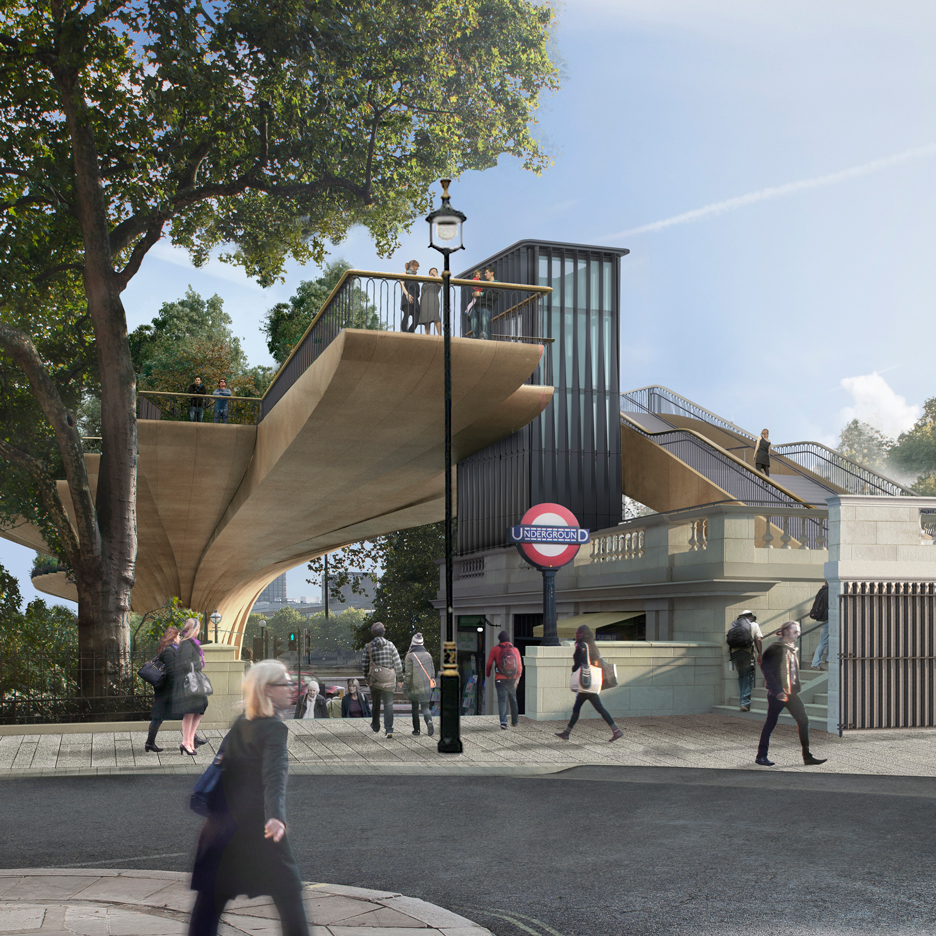
London mayor Sadiq Khan has frozen a building project for the Thomas Heatherwick-designed Garden Bridge to ensure no more public money is committed to the £175 million scheme. (more…)
The Best Tools for Successful Lifestyle
What does being successful actually mean? Success is a very wide term and there is not a single definition that can describe success. However, the right question is actually – what does it take to be successful? Well, it takes discipline, determination and many other things that we all possess more or less.
Nowadays, people have various things that can help them achieve success and computer is certainly one of them. Of course, a computer by itself is not enough for that and what everyone who wants to be successful needs to do is start using the right tools that are offered in order to boost his or her success and start leading a successful lifestyle. Let’s see now what tools that can help us with achieving and leading a successful lifestyle are.
 iMindQ – a tool to organize your thought process successfully
In order to achieve great success and lead a successful lifestyle, one has to have a very good idea. However, the idea itself is not enough and the whole thought process needs to be put down in paper. In order to successfully organize your thoughts, you should definitely consider using iMindQ which is a tool that helps you do exactly that. As a matter of fact it functions as a mind mapping tool, where you start with the most general things about your idea and break them down to more specific.
Freedcamp – organize your life into one big project
Achieving success is not easy at all and the main thing that most of us lack is organizational skills when it comes to organizing our own life. One tool that can definitely help everyone become better at organizing not only their life but everything is Freedcamp. Freedcamp is a very simple tool to use and one only needs to know the basics of Internet browsing in order to see what it has to offer. For example, you can make a task and then keep its progress by dragging and dropping it through the various stages.
IFTTT – connect everything with everything
The certain aspects of our lives certainly require a small amount of automation, especially for those processes that are not really difficult to do but we still have to do them. We cannot really automate our car (yet!) but we can automate all the tools and apps with this great tool called IFTTT. IFTTT (which stands for If This Then That) is a very simple tool that can connect several of your apps and devices and execute a task that you give it. For example – if someone uploads a picture of me on Facebook, save it automatically to Google Drive.
RescueTime – understand how time-consuming your daily habits are
RescueTime is yet another unique and interesting tool that will help us understand the way we spend our time. It is a fact, of course, that people cannot really have this feeling of time because sometimes time flies and sometimes it drags. For example, imagine you checking your Facebook on your job. You might just say that you will be on Facebook no more than minute and you end up being for 2 hours, watching your neighbor’s dog videos. Luckily, RescueTime will keep track of your activities, notify you about the time spent and it will even set the alarm off when you do something for too long.
Pocket – stay informed about the topics you like the most
There are too many interesting articles and eBooks connected to the topic that we like and that is likely to bring us success, but we cannot read them all because we are usually too busy doing other things. In order to solve that problem, someone came up with this simple yet brilliant idea of the website (app) called Pocket. In Pocket, you will be able to immediately store all the things that you think might be interesting to you and you can read them later. It seems like bookmarks, but it is actually more than that. In pocket, you can literally put anything and then view it afterwards on any device that you want as long as you have Pocket installed.
Prezi – make great presentations in minutes
The thing about achieving success is that you will have to present your ideas and actions many times in front of many important people. In order to present something successfully, you need to create a presentation that will be both captivating and interesting and that will keep the attention of the people who look at it. Prezi is the tool which grants a completely new and unique approach to creating presentations, which is interesting and very simple as well. It is basically a next-gen presentation creator which has already overcome Power Point.
Bitrix24 – the ultimate company organization platform
If you are working with people in order to achieve success (which is inevitable, as a matter of fact), then you will need to organize them and keep track of their work. Furthermore, you will have to keep track of all the tasks, projects, finances, etc. Well, Bitrix24 is a platform that offers a solution to all of that by keeping it all in one place and giving you the ability of video chat, document management, social media overview and even their own drive. In other words, this tool is basically all-in-one tool for all the entrepreneurs who want to be successful and who need help in leading their company.
To sum up, achieving success and leading a successful lifestyle seems like a very good idea but in order to make it a reality one should definitely use all that is in his or her power, including using tools that are mentioned in this article. These tools here, among dozens of others that the internet offers will not achieve success instead of you, but if you use them smartly, you will be able to feel a significant boost in your productivity which is, after all, the most important thing in leading a successfully lifestyle.
The post The Best Tools for Successful Lifestyle appeared first on Change your thoughts.
Conversion of a Building / Antonio Citterio Patricia Viel and Partners

© Amendolagine Barracchia
- Architects: Antonio Citterio Patricia Viel and Partners
- Location: Milan, Italy
- Collaborators: Sara Busnelli, Carmine D’Amore, Roger Colombo, Roberto Mariani
- Area: 5200.0 sqm
- Project Year: 2011
- Photographs: Amendolagine Barracchia
- Consultants: Planning s.r.l. (MEP, acoustic, fire prevention), SCL Ingegneria (structure), Coima Image (interior design)
- General Contractor: GDM Costruzioni S.p.a.
- Client: Dolcevita Salaino 10 s.r.l.
© Amendolagine Barracchia
From the architect. The operation calls for the urban renewal of the area and its conversion for residential use. The total reconfiguration of the volumes of the area has been made possible by the autonomous character of the construction, which is now an isolated building inside an enclosed garden, with walls along the street, and bordered by a transparent enclosure toward the greenery, permitting the residents to perceive it as a single green zone continuous with the Solari Park.
© Amendolagine Barracchia
Plan
© Amendolagine Barracchia
The main entrance remains at Via Salaino 10, a low volume that reflects the footprint and profile of the existing building, and controls vehicle access to the main volume, in the courtyard, while permitting pedestrian access sheltered by a pergola with plantings, and access to the underground garage. This building is organized with a series of patios and raised gardens that transform its horizontal levels into spaces with greenery rather than roofs, thanks to the construction of planters for small trees; the basement levels contain cellars, parking facilities and technical spaces. The facade on the street has been treated with decorative concrete, with a texture and a pattern of perforations that evoke the Liberty motifs of the finest building in the surrounding context, underlining the private residential character of the complex.
© Amendolagine Barracchia
The main volume, taken to a height of 8 above-ground levels plus an attic, is aligned in height with the buildings of Via Solari and Via Valparaiso. The elevation has been completely redesigned, creating a facade with a double skin, overlooking the city with a discontinuous surface of golden bronze-tone screen-printed glass panels that protect the loggias and a continuous balcony along the whole perimeter of the building on all levels. Textile sunscreens are inserted to protect the entire volume. The detail of the continuous balcony accentuates the layered composition of the volume, leaving the metal floor-marker profile highly legible; the glass/textile exterior skin protects and conceals the perforated internal facade, with the marked recessing of the loggias.
Section
The aim is to offer a building with an absolutely contemporary language that expresses its residential character through the apparently random composition of the decorated glass panels and the presence of the white fabric behind the glass, while at the same time offering elegant decorum in its use, thanks to the privacy provided by the set-backs in the facades and the protective screening.
© Amendolagine Barracchia
Alexander McQueen’s DNA turned into human leather goods by Tina Gorjanc

Graduate shows 2016: Central Saint Martins student Tina Gorjanc has proposed a conceptual range of leather accessories made of skin grown from late fashion designer Alexander McQueen‘s DNA (+ slideshow). (more…)

