An articulated two-storey framed volume is sensitively stitched to the rear original fabric, while retaining its front Federation masonry and hipped envelope as part of its environmental, economic and planning values. It has a sectional split-level relationship to the original house that harnesses the fall of the site to the rear, enabling the cellular front plan to vertically and horizontally unfurl into a series of connected interior spaces that expand to its setting.
The built form and its program resolution respond to its immediate setting and the established conditions of the original dwelling. The two-storey volume mediates the scale and massing of its larger and smaller neighbours, with the existing southern setback extrapolated to the extent of a former rear wall and rear setback of its southern neighbour to mitigate adjacent impacts. An intermediary form folds from the underside of the reinstated rear edge of the old dwelling to meet the two-storey volume, serving as a nexus for utility spaces, circulation and a northern courtyard at the centre of the plan. Projecting ‘wedges’ at the rear further unfurl the envelope to provide ground floor storage on the terrace, a daybed nook within the ‘public’ living space, and a private reading space within the upper bedroom, for strengthened connections to its external environment.
Sustainability, cost and planning values entailed in retaining the original fabric are augmented by a modestly sized footprint and lightweight-framed envelope in a crafted ‘new build’ enabled at the rear. Fenestration placement allows expansive enjoyment of outdoor spaces, harnesses natural light and promotes passive ventilation. Projecting hoods and external blinds temper solar penetration, and acoustic attenuation measures for alternative air ventilation, insulation and internal linings assist the performance of the envelope in ameliorating latent aircraft noise. A central vaulted ceiling allows a volumetric expansiveness over a rigorously organised core and circulation zone, and surrendered floor area enables generously carved voids flanking an upper bridge for diverse views to sky, trees, and outdoor spaces, while encouraging a spatial interplay of public, semi-private and private rooms.
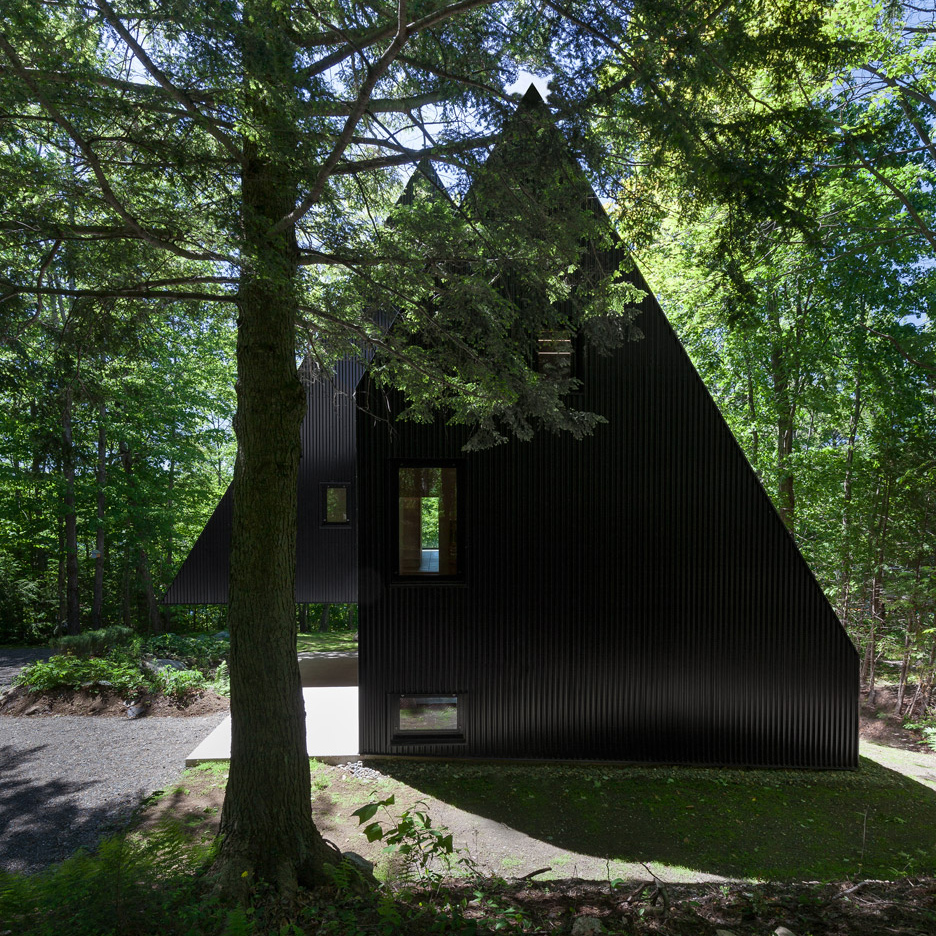
Jean Verville Architecte has designed cabin in rural Quebec with dark metal cladding and pointy roofs that “seems to emerge from a children’s story” (+ slideshow). (more…)
Bringing together architects, artists, chefs, designers and engineers, pop-up restaurantFood Ink. has laid claim to the title of “world’s first 3D-printing restaurant.” The restaurant utilizes 3D printers produced by Dutch company byFlow to create dishes out of hummus, chocolate mousse, smashed peas, goat cheese or pizza dough – essentially anything that can take the form of a paste. The paste can then be fed through the extruder to create culinary sculptures.
Food Ink.’s mission is to explore the intersection between dining and technology-enhanced user experience. According to their stated philosophy, the team is “putting [to] work most innovative technologies, like 3D-printing and augmented reality, in order to elaborate the most exquisite interactive edible experience.”
The restaurant hopes to inspire conversation about the future of sustainable food, nutrition, and health as well as demonstrate how emerging technologies may be changing our dietary and cultural habits.
Following a successful opening in Venlo, the Netherlands this April, Food Ink. will travel to a new location in London from July 25-27. The temporary gastropub’s new setting will allowing diners to eat around 3D printed furniture, including 3D printed stools by architect Arthur Mamou-Mani. The stools are being built using “Silkworm”; an open-source plug-in for Rhino developed by Mamou-Mani. Previous works of his using Silkworm have included a pop-up store for Xintiandi Style in Shanghai and “Cloudcapsule Columns” installed in London.
Dutch fashion house Viktor & Rolf has used fabrics leftover from past seasons to create the haute-couture garments in its Autumn Winter 2016 collection. (more…)
From the architect. Known as “El Coso”, the place was a great void at the back of the old part Cehegín (Murcia, Spain). After a big snow storm in the 1950s, many of the houses of this neighborhood collapsed or were damaged, leaving that big, sloped empty space. Besides this, the old part of Cehegín seemed to lack inhabitable gardens. The city needs to breathe through them.
We collect the rain water and the waste water from the sewing network in the high part of the site. The water goes along a pond network with riparian plants with the purpose of producing clean water. The result is used to irrigate the rest of the plants in the garden.
We located the “desire paths”, made by the footsteps of the neighbours, the ones who tried to walk through to the other side. By tracing the paths based on those tracks on the ground, the streets on the borders were connected by using comfortable slopes, making the paths accessible for all the neighbours. Green colour floods the hard floors and tints the facades of the adjacent buildings.
The contractor and the municipal officials were able to contract local workers for developing many of the tasks. Even several of them were former inhabitants of the dwellings that collapsed in that neighborhood.
We hid a building in a pocket of the walk path. The building gives its roof to the park’s paths network and hosts a business incubator. This way, the park will be able to produce new jobs and recycled water, two important and scarce resources, given the current situation of the town and the Region.
The result is a garden that produces water, where flora attracts fauna.
When commissioned to design public equipment along the bicycle track at Av. Central in Ecatepec, Estado de México, we saw an opportunity to achieve common spaces at a very low cost in an area that urgently needs qualified public infrastructure. Thus, we proposed three modules of baths and 13 pairs of kiosks intended to create a democratic urban fabric.
Toilets and kiosks were proposed as permeable pavilions with a microclimate favored by the presence of plants, a small oasis in the harsh climate of the bicycle track. Within the overall slab of each group of toilets, there are four double modules deployed in swastika. Each of these modules is a vacuum with a glass cover, so that when you enter them you are going outside. Three other openings, designed as small courtyards, are located over the beds of plants that cross the roof slab into the sun. Finally there is not a clear distinction between being inside and outside.
Kiosks are planted intermittently along the bicycle track. Its walls are also located in swastika with benches and tables that are embedded in the walls of block, using the gaps left by it as formwork. At each kiosk there is a central patio traversed by a large palm tree. Both for the construction of toilets and kiosks, concrete blocks and steel sheet walls painted white, were used.
The landscaping project incorporated one hundred new trees. Vines covered the fence that divides the avenue and the bicycle track, creating a green division between traffic and cyclists, joggers and pedestrians. Palm trees are generally located within the kiosk in the small central courtyard and jacaranda trees are planted in a more organic arrangement within the bays. Bamboos were used only in toilets modules to create a visual division between male and female toilets. Common sinks are located in the central space favoring the respectful coexistence of all users.
Axonometric
In both typologies was intended to explore the gradations of interior and exterior and the ability of an extremely simple initial program to welcome the richness and unpredictability of uses of life.
Dreem Arkitekter have been announced as the co-winners of a competition to design a new urban plan for a three block area in the Stockholm neighborhood of Kista. The project will include a large mixed-use complex consisting of residential, commercial and active public spaces, and is anchored into the neighborhood through a cornerstone residential tower. Together with joint winner ÅWL, the offices will finalize the project this fall.
According to the jury’s statement, “Dreem’s submission showed that they had developed a clear, international proposal that contributes to Kista’s vision of a diverse city – a strong concept with an urban design that reinforces the vision of the ‘future city’ we would like to create in Kista. It comprises three modernly designed residential neighborhoods with active ground floors, each with their own distinct identities, and dynamically creates residences that benefit from heights in an interesting way.”
Dreem’s proposal contains space for 67,000 square meters (720,000 square feet) of residential and commercial buildings, including a 40-story tall apartment tower. The skyscraper is designed to reach a height of 120 meters (394 feet), which would match Wingardhs’ Victoria Tower as the tallest building in Stockholm, and second tallest in Sweden. With its sleek facade and floating appearance, it could become a new landmark for one of Europe’s biggest information and communications technology (ICT) districts.
“We are proud to have the confidence to continue developing Kista,” says Dreem founder and CEO Maya Iwdal. “We wanted to create blocks of an international nature – blocks ‘Micro’, ‘Meso’ and ‘Macro’ – to represent the different social organization levels and territorial scales, which together make our project unique.”