From the architect. Leading Brisbane architecture firm Shane Thompson Architects has designed the new Elements of Byron resort on the beaches of Byron Bay, Australia.
Central Facilities Plan
The project is respectful of its unique and special site set on 50 acres, with almost two kilometres of beach frontage.
The design pays homage to the resort’s landscape, including the critically-endangered littoral rainforest, natural lakes, ponds and diverse wildlife.
Courtesy of Elements of Byron
Shane Thompson Architects’ design of the central facilities and accommodation (94 villas) is inspired by local naturally-occuring forms – sand dunes, native trees, ocean and lakes.
Courtesy of Elements of Byron
The leisure and conference facilities are housed under three separate pavilions, which represent the sand dunes bounding the resort. The signature curved shape of these central facilities is an organic form, which unifies the resort and links it to its iconic surroundings.
Typical Studio Cabin
Colour schemes, patterns, textures and finishes were drawn from traditional and rural activities, creating a powerful connection to the landscape, site, and environmental and cultural sensitivities of the area.
Courtesy of Elements of Byron
An infinity lagoon pool weaves through the resort, alongside a communal fire pit and sun beds, encouraging water play.
The resort is an exemplar of sustainable design, with a minimal 10% building footprint. Shane Thompson Architects proposed the reestablishment of the original dunal and wallum landscape to minimise future maintenance and irrigation demands.
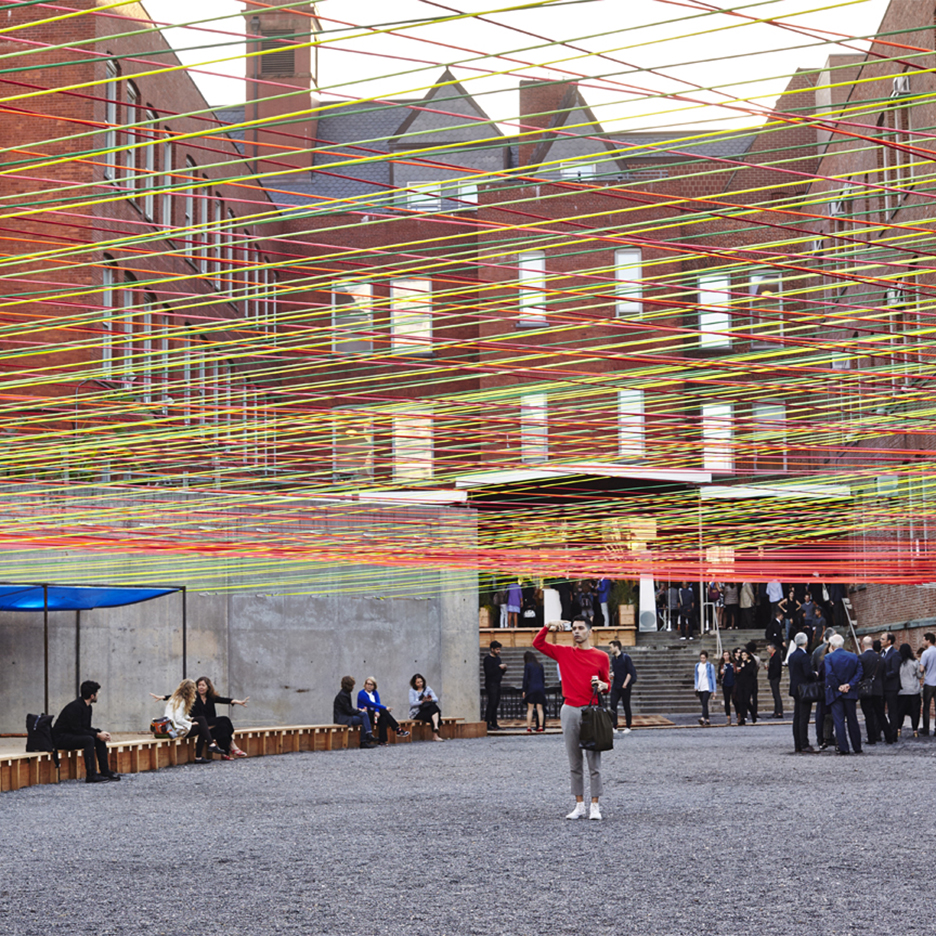
Currently on display at the Philadelphia Museum of Modern Art, Award-winning African architect Diébédo Francis Kéré has created Colorscape, a installation made from steel and brightly-colored fiber, to accompany his first solo show in the United States. The exhibition is titled The Architecture of Francis Kéré: Building with Community, and features of a retrospective of the architect’s career that includes material artifacts, tools and scale-models created for stand-out projects in both Africa and Europe.
Francis Kéré was raised in the rural village of Gando, Burkina Faso, where architecture is designed through a transparent process involving the entire community. Kéré had carried those community-driven traditions into his work throughout the world, employing local knowledge and materials to give his buildings a sense of place.
The exhibition dives deeper into this construction process, displaying a curated selection of photos and models from his firm’s projects including the Camper pop-up shop, the Gando school library and the Sensing Spaces Pavilion, along with three interactive films featuring clips from Kéré’s childhood and the construction of his most recent project, the Schorge Secondary School.
The dynamic Colorscape serves as the centerpiece of the display; inspired by Philadelphia’s long tradition of textile-work and weaving, it serves as an example of how using a simple material in an innovative way can captivate and unite a community. The installation uses a locally-sourced lightweight cord to wrap around prefabricated steel geometries, resulting in a gentle draped effect.
When placed in close proximity within the museum’s Perelman atrium space, the colors begin to blur and vibrate as you move around them. Extending from Kéré’s community-driven design philosophy, Colorscape’s simple construction required no tools or skilled techniques, allowing local children to participate in its assembly.
Conceptually, the installation takes inspiration from the contrasting city plan geometries of the African village and the American city. Overlaying the organic plan of Gando with the rigid grid of Philadelphia, Kéré shows that despite the two cities’ obvious differences, underneath you can find many similarities in how the societies use architecture to provide a gradient of social spaces ranging from the individual and private to the collective and public.
Part of the Philadelphia Museum of Modern Art’s Creative Africa series, which highlights the themes of cultural and community found in historic and contemporary African art and architecture, The Architecture of Francis Kéré: Building with Community will be on display until September 25th.
Production / Project Management: Jack Schlecter, Jamie Montgomery, James Bassett-Cann (PMA)
Curators: Kathryn B. Hiesinger, Colin Fanning (PMA)
Audio/Video: Stephen Keever (PMA)
Collaborators: University of Pennsylvania Undergraduate Architecture students (sounds)
Fabricators: Philadelphia Museum of Art (cord assembly and structure), Moorland Studios (metal fabrication)
Volunteers: PMA staff and volunteers, Young Friends of the Philadelphia Museum of Art Executive Board and event committee, and Museum visitors
Supplier: Gladding Braid
Sponsors: The Pew Center for Arts & Heritage, Institute of Museum and Library Services, The Arlin and Neysa Adams Endowment Fund, The Kathleen C. And John J. F. Sherrerd Fund for Exhibitions, Osagie and Losengelmosogie