From the architect. Royal House Recording represents a new approach to inspiring the creativity of today’s recording artists. It functions as a small campus with an array of amenities and private courtyards that help artists break from the generic confines of a typical studio. This adaptive re-use project is situated along Delemere Avenue in Royal Oak’s primary industrial corridor, providing the privacy and flexibility required for its users. Built from the remains of an old manufacturing warehouse, Royal House Recording intends to help bring back the status of Greater Detroit’s legendary past in the music industry.
This fully equipped studio accommodates every need of its artists for intense recording sessions. It is supplemented with a kitchen, lounge, exercise room, basketball court and outdoor patio. These amenities allow the artists to work with an uninterrupted creative flow. The campus is entirely enclosed with a perimeter wall creating a private environment for the high profile artists.
The building’s exteriors take cues from the original industrial aesthetic yet is accented by a glass entry, custom steel doors, and a large glass and steel bi-folding hanger door. Free-standing red cedar screen walls provide warmth and contrast while lush trees and shrubs soften the courtyard landscapes. A pierced brick privacy wall serves to shield the entrance of the secondary office and storage building from the street and creates yet another private courtyard.
The interior of the project carefully blends industrial elements with custom stained cedar walls and a theatrical “Hollywood glam” selection of finishes. Much of the interior was built as separate structures within the original warehouse as the existing building had a limited structural capacity. These new structural frames and beams were left exposed to identify with the original architectural character. Luxurious finishes and nuanced details coexist harmoniously with concrete block and raw steel to create an environment that stimulates the senses and encourages creativity. With construction starting in May of 2014 and finishing in August of 2015, Royal House Recording has been fully booked ever since with a lot of talent entering its doors. Their success continues to grow more and more and has seen a lot of support from the music community of Greater Detroit.
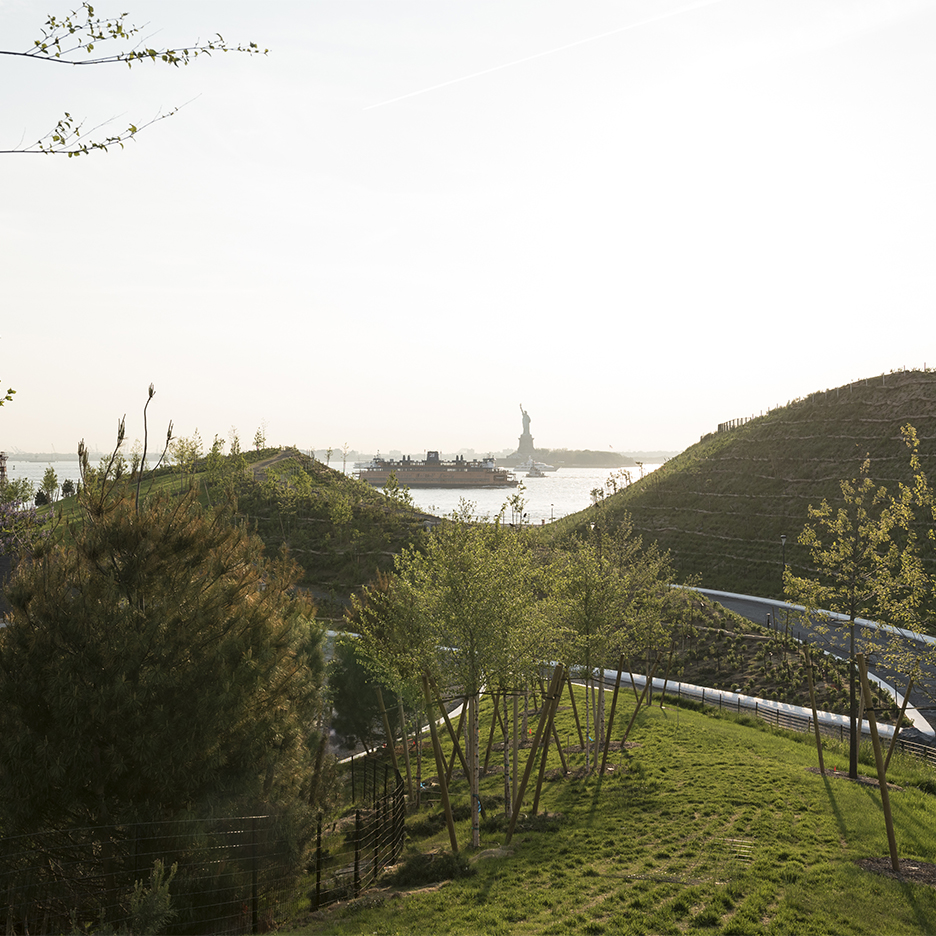
Landscape architecture firm West 8 has added rolling hills with playgrounds and art installations across Governors Island in New York harbour (+ slideshow). (more…)
Brexit crisis: London art school Central Saint Martins is to fight to save the UK’s involvement in the Erasmus students exchange programme, as designers warn of the “loss of opportunity” for young creatives. (more…)
The American Institute of Architects (AIA) has selected seven recipients of the 2016 Small Project Awards. This is the 13th edition of the program, which was established to recognize firms for their excellence in small-project design. This year the winners have been placed into two categories: Category 1, which awards “a small project construction, object, work of environmental art or architectural design element up to $150,000 in construction cost,” and Category 2, given to “A small project construction, up to $1,500,000 in construction cost.”
This year’s winners include a wide variety of program types and sites. Continue after the break for the list and descriptions of the projects.
The Studio Hive is part of the Teen Zone in the East Liberty Branch of the Carnegie Library of Pittsburgh. Made of wood and sound absorbent industrial felt its creation has contributed to a 350% increase in attendance at the library’s teen programs and events. The design team developed a 3-dimensional digital model of the hive which allowed designers to tune the form and refine it to minimize material waste. The connection to both the remaining library space and to the street provides teens with a sense of their social context and environment while they occupy a space that is uniquely personal.
A simple wooden frame defines the small space and supports two porch swings. The smocked screening creates curtains that can be opened and closed to allow access, as well as provide shade and enclosure. A rectangular opening in the roof allows a defined shaft of daylight to enter the space. This opening is echoed in the small turf area cut into the floor. The project was designed and constructed adjacent to the courthouse square in Winterset as a pro bono effort to support The Iowa Preservation Alliance. The wood was salvaged from a demolished home, and the labor to sew, fabricate, and construct the space were provided by the design team. As a result, the budget for the project was $900.
This floating sauna, funded through the support of a crowdfunding campaign, functions as a boat that can be moored at a marina or private property and taken out on the open water as needed. The interior space is heated by a simple efficient wood burning stove. As a mobile piece of architecture, wa_sauna is able to engage with the many inhabitants living aboard boats and houseboats as well as the large community of boaters, kayakers, paddle boarders and rowers. Using a pre-manufactured aluminium frame and floatation system for the deck, wa_sauna can be seen quietly exploring Seattle’s lakes on a regular basis.
This pro-bono design is for thirty-five craft exhibit huts for an authentic German Weihnachtsmarkt (open-air Christmas market). The huts feature a steeply-sloped roof designed for snowfall and a ridge line borrowed from traditional Moravian vernacular. With a limited budget for materials ($286 per unit), paired with the necessity for the structures to be taken apart and stored every year, the deck, walls, and roof panels are constructed as single units to be taken apart, transported, and stored flat with ease. The poly-carbonate roof is not only easy to dissemble, but also allows for a large amount of light and warmth inside during the day. During the night the huts are illuminated from within and emit a lovely glow to add to the magical Christmas atmosphere of Bethlehem’s historic district.
Camp Prairie Schooner features a dining hall, five permanent units, two buildings for troop use, a 40-foot rappel tower, an archery range, a swimming pool and a zipline. The load bearing walls of the structures are constructed of 2×6 wood studs, that in turn support a series of common & scissor trusses. The envelope is clad with corrugated metal panels, complementing the wood and aluminum clad windows and skylights. The end of the bunk houses are a combination of fluted polycarbonate glazing and painted concrete board over a rain screen system. All mechanical systems are concealed within the trusses. The pendant lights are custom fixtures designed and built by a former girl scout.
The Linear Cabin is a small family retreat, its low-slung body sitting in a small clearing in Wisconsin’s North Woods. The building consists of three identically sized, nearly opaque boxes tied together with a continuous thin roof plane. The voids between the boxes serve as picture frames, allowing for unobstructed views through the building from the outside and into the sylvan landscape from within. The interior is clad in knotty pine, and is tempered by its crisply detailed joints and the simple lines of the lacquered millwork throughout. On the outside, the cabin is wrapped in blackened cedar, its somber darkness echoing the weathered monochrome of traditional Wisconsin cabins.
Designed as a quiet refuge and intimate sanctuary for sacred reflection and contemplation, the new chapel is a subtle addition to the landscape. The sanctuary, which complements the modernist character of the adjacent church (circa 1963), is small but tall, keeping occupants close while inspiring reverence. Beyond a few pieces of furniture and religious items, the space’s power and purpose is enhanced by its very simplicity allowing occupants worship in quiet and contemplative solitude, without distraction.
The challenge was to create a spacious interior while packing Studio Dental’s required program for its mobile unit, which travels to businesses offering convenient dentistry. The 26-foot-long trailer with 230 interior square feet features a waiting area, sterilization room, and two operatories. The sterilization room is hidden behind millwork panels that wrap around to form the patient waiting bench. A centralized, double-sided millwork panel houses equipment for both operatories and gestures up to 11-foot-plus ceilings with translucent sculpted skylights. The materials reinforce Studio Dental’s identity with natural wood millwork, bright-white surfaces, and a custom perforation pattern.
Embedded in the mountainside of an off-the-grid rural village in Burundi, this 18-bed staff housing is a bridge between East African elemental aesthetics and inventive sustainability. Cutting a skewed line in the terrain, the 6000-square-foot dormitory captures breathtaking mountain views. The same moves that establish its visual presence, such as airflow enhancing porches, also advance its sustainability. Currently rebuilding after many years of horrific civil strife, the villagers hope that this housing will create a model for the sustainable future of both the community and the country.
Finished in 2010, the Pompidou Metz center imagined by Shigeru Ban quickly became an architectural icon not only for the city of Metz, but also for the region and even the country. Given the important number of visitors to the Museum and the restaurant, the need for more inside eating space on the terrace soon became apparent. However, the idea of intervening on an existing building does not come without important implications regarding architectural integrity ― the intervention will indeed modify the façaces and volumes of the existing structure.
How can a 100 sqm extension be thought and built onto the Pompidou Metz Centre? A mere “feather” compared to the bold and colossal building. What would be the best way to intervene on a masterpiece such as this one, and which positioning should be adopted?
Our response was to distance and detach ourselves from the existing architecture. This independence remains, from our point of view, the best way to solve issues of identity and amalgam between coexisting architectures. Our approach strives to be precise and elegant, as we deeply respect Shigeru Ban’s work. Our addition to the building respects its heritage and character, while at the same time giving it specific meaning and identity.
Diagram
Diagram
The volume is formed of a glass monolith, clear and light ― making it radically different from the Museum in terms of architectural vocabulary and choice of materials (i.e. the use of wood, large white shapes and framed windows). The façades, abstract and intangible, are materialised by the reflections forming onto the clear shapes. The roof seems to be non-existent, as its edge is hidden by the windows. Thirty-three thin white blades form an enveloping structure around the compartment. The new room does not strike us as an extension, but as an autonomous object appearing to avoid contact with its environment. The museum’s integrity is preserved as the new structure simply sits in place ― and could one day be easily removed, if need be.
The atmosphere created by the new architecture is a microcosm formed with the terrace and its surroundings. Although the lines forming the architectural volumetry are simple and pure, we have chosen to a bolder approach when it comes to the choice of materials; three local artisan trades were invited to work on the project, in an effort to connect the building with the Lorraine region.
The façades of the new space are made of large glass volumes, some of which are curved and held together onto the metallic frame by a cloud of dots. The shiny rounded shape can be seen as a tribute to the glass-making expertise represented in the Lorraine region by Emile Gallé, Daum, Baccarat, Saint Louis and Meisenthal.
Ceramic and Earthenware From Lunéville to Saint Clément and Lonwy, the art of ceramic, enamel and earthenware making has also been an important cultural heritage of the Lorraine region. We can find a reference to this trade in our choice of flooring, which forms a perfectly continuous pattern running between the terrace and the floor of the restaurant.
Textile and weaving The development of the textile industry in the Vosges region through the 19th and 20th century is also exploited. We were particularly interested in the patterns generated by the singularities of the weaving techniques, which make the fabric so distinctive. A large white curtain is there to envelop and shelter the inside space when required, notably to avoid direct sunlight or over-heating problems. This unique piece of work was weaved in the workshops of the “maison Garnier Thiébaut” in Gerarmer (Vosges region). The white fabric reveals its geometric pattern subtly and almost imperceptibly at certain angles only, through different states of shininess of the white thread.
Through these three different kinds of surfaces (glazing, flooring and veiling), the three Lorraine traditional trades find themselves both united and confronted by the contemporary graphic matrix of the pattern, created in collaboration with the graphic designer Morgan Fortems.