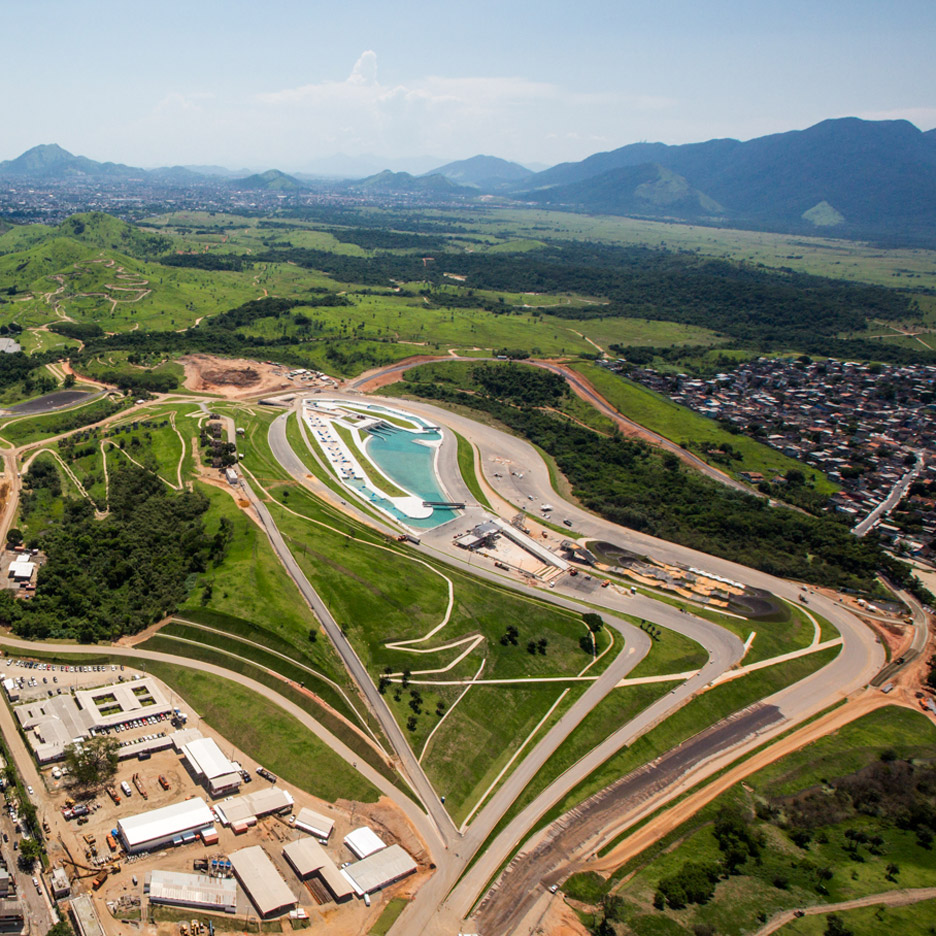
Rio 2016: a 2.5 million-square-metre area west of Rio de Janeiro has been transformed by Brazilian firm Vigliecca & Associados to become one of two major locations during the city’s Olympic and Paralympic games (+ slideshow). (more…)
Rio 2016: a 2.5 million-square-metre area west of Rio de Janeiro has been transformed by Brazilian firm Vigliecca & Associados to become one of two major locations during the city’s Olympic and Paralympic games (+ slideshow). (more…)

From the architect. 3DReid have completed a new Health & Wellbeing Centre for the Thistle Foundation – a charitable organization who offer support to those with disabilities, enabling them to live independent lives, in their own homes.
The new facility is located at the heart of the original Thistle Foundation development, now a designated Conservation Area. A philanthropic gesture, put in place at the end of the Second World War, the original scheme comprised 103 houses, in a model village-esque arrangement, with the Arts & Crafts-style Robin Chapel, at its heart (both now Listed developments). Pioneering at the time, the scheme was one of the first to be designed to cater for those with disabilities – specifically, injured returning service men.
Replacing a former facility that was no longer fit for purpose and uneconomical to reshape to suit current needs, the footprint of the building was rotated through 90 degrees, forming a more permeable public realm to the front of the building and improving the setting of the Chapel, whilst creating a secured garden space to the rear.
Anchoring a series of complementary facilities, including a gym, consultation and training rooms and the Charity’s office accommodation, around a double-height ‘Hub’ space, the project has been shaped to best cater for those who come to visit.
Through extensive use of timber cladding, both inside and out, the project offers a warm and inviting environment for those who visit, many of whom suffer from anxiety-related conditions. Crafting a non-institutional and friendly presence was instrumental in ensuring that the built environment did not compound these and that the design of the Centre remained completely aligned to the core ethos of the Charity.
Pressure treated with a blend of preservation and pigmentation, the timber cladding will retain its current hue, throughout its lifespan, maintaining consistency at the interfaces between the internal and external use of the material, whilst offering a palette that tonally aligns to the building’s surroundings. Extended fins to the East and West facades help reduce solar gain and glare, to the first floor office spaces, whilst the cladding also integrates the ‘Thistle’ logo.
Externally, the palette of materials is completed via use of brickwork and pre-cast concrete – selected to complement the stonework of the Chapel and rendered facades of the surrounding houses, respectively. Sited in an area in which some degree of anti-social behaviour has been a historic problem, the application of these, at ground floor level, offers a sense of robustness, without sacrificing the welcoming feeling of the development.
Internally, the Hub provides the main focus of the building. Furniture has been carefully selected to offer a range of seating types and environments, that provide visitors with a choice as to the most comfortable area in which to meet others, or relax. Hinged partitions to the breakout spaces, fronting the Hub, allow these rooms to be open, or closed, to the wider space, offering flexibility in their use.
With the public-access facilities all situated at ground level, the office accommodation occupies the upper floor of the building, offering staff a degree of privacy, whilst still maintaining a connected feel, through the introduction of full height screens overlooking the central double-height space.
Punctuating the open-plan office space, honeycombed acrylic panels have been utilized to form ‘quiet pods’ – spaces in which more sensitive discussions and phone calls can take place – introducing concentrated blocks of colour, aligned to the core branding of the organization.

A new landmark on the Brooklyn skyline, TEN Arquitectos’ DBCD (Downtown Brooklyn Cultural District) South building at 300 Ashland, is nearing completion, with tenants expected to move in by the end of the summer. The mixed-use building will feature 379 apartment units and will also become the new home of a number of cultural tenants, including the performing arts organization 651 Arts, MoCADA, Brooklyn Academy of Music cinemas, and a new branch of the Brooklyn Public Library.
Reacting to its site and context, the 32-story tower has been articulated as three volumes: a central circulation spine and two flanking volumes, where the apartments are located. The tower is skinned in perforated aluminum, which will pick up the colors of the surrounding streets, buildings and sky.
//platform.instagram.com/en_US/embeds.js
Located in booming downtown Brooklyn, the tower rises from the south section of a triangular site at the intersection of Flatbush, Ashland, and Lafayette Avenues in downtown Brooklyn – its slim footprint allowing the majority of the site to be dedicated to a new 15,000 square foot public plaza.
The building podium is comprised of a series of outdoor landscaped terraces that create public spaces screened from the noise of Flatbush avenue and visually connected to the Grand Plaza. The terraces allow for entrances into the building on multiple levels, and the opportunity for outdoor programming like film screenings, dance performances or farmer’s markets.
On the ground floors, the building will house 50,000 square feet of cultural space and 43,000 square feet of retail space along Flatbush Avenue. By folding the civic plaza upwards, the retail space can line the full perimeter of the base, avoiding an internalized “mall organization.”
The bulk of the 32-story tower will be residential, featuring studio, 1-bedroom and 2-bedroom units (20% of which are affordable housing), a 24 hour gym and a 29th floor outdoor roof deck designed by James Corner Field Operations.

You’re reading Stuck In Your Comfort Zone? 10 Tips To Break Free, originally posted on Pick the Brain | Motivation and Self Improvement. If you’re enjoying this, please visit our site for more inspirational articles.
Your life is pretty easy and relaxed. You don’t usually have any problems and you’re able to control most situations to make yourself feel comfortable. But, in the deepest part of your brain, you’re craving something new, something that will make you feel free and alive…you’re looking for a better life.
If you can relate to this, even a little bit, you need a change in your life. Getting out of your comfort zone is the only way you’ll grow and live your dreams!
Maybe you’re bored at work and want a change, but haven’t done anything to change the situation, or maybe you know you’re not really in love with your partner anymore, but you’re comfortable together so you don’t want to risk losing them. You like learning languages, or playing sports, or reading, or going on adventures, but you find it hard to actually start anything new…If you think this may be you, keep reading.
What is the Comfort Zone? It’s a mental state made up of different states where we feel safe, protected, and comfortable with our lives. The comfort zone is different for anyone, so what may be one person’s comfort zone is completely different from another person’s. This way of living might actually be positive for a period of time, but if we get used to it, it might cause us to be passive and lazy when dealing with new situations. Leaving the comfort zone is essential for our personal development, and can help prevent frustration and unhappiness long term.
Did you know that the attachment we feel towards our comfort zone is actually produced in our brains, in the reticular formation, which is the part of the brain that regulates sleep, pain, movements, etc. So, if you think about it, it really means that the brain can be lazy sometimes. When you do something out of the ordinary, maybe you take a new route to work or go on an adventure, your brain uses more energy because it has to work harder to process and be alert to new and different information.
This is why the brain loves routine. When buy the same things at the grocery store every week, your brain can “disconnect” and go on standby. As you already know where the things are that you need, your brain doesn’t have to work as hard to look out for the foods you’re choosing.
You may find yourself asking, why would I want to leave my comfort zone if I’m so comfortable here? Well, just think about what you’re missing. Here’s an example:
Think of a lower class, working family who live comfortably within their own comfort zone. One day, something happens and they are forced to work and change their lives. Initially, it’s hard on everyone, but after a while they realize that they’ve managed to improve their lives and make a full 360º.
That family was forced to make a change, and thanks to that necessity, they got out of their comfort zone and ended up with a better life. But, keep in mind that it’s not only economic things that can change, but a whole range of experiences, ideas, and material things can change as well, and all it takes is the first step out of your comfort zone. A whole new world is waiting for you, why not give it a try?
Getting out of your comfort zone isn’t always easy and you’ll need to really stick with it until you finally get out. But remember, nothing is impossible…you can do it!
1. Figure out where your comfort zone is.
Ask yourself what makes you nervous or uncomfortable. Think about your past, your present, and what you want in the future. Ask yourself things like “Am I happy with what I have, or do I want more even though it’ll be more work?” “Am I happy with my comfortable life, or do I want to take on new challenges and goals?”
Think about your job or your partner. Do you want to keep your boring job, or find something that makes you feel like you’ve accomplished something? Would you rather stay with your partner, even though you don’t feel really happy, or do you want to give yourself the chance to find someone you really love?
2. Make a goal and stick with it.
Goals are specific and personal to everyone. Think about what you want, and acknowledge each little victory that you achieve. Think will help your self-esteem and become more self-confident. “I’m doing something I never thought I could do“.
3. Accept your mistakes.
It may be a little rocky at first and it’s normal to be scared or nervous about getting out of your comfort zone. Be positive and accept that you’re not perfect, and that there may be some situations that are out of your control. If you fall, get back up and try again. Remember that mistakes are life’s best teachers. You’re likely to learn more and grow personally by making mistakes than erring on the safe side.
4. Ch-ch-ch-changes…
This doesn’t only mean personal changes, but physical, environmental changes. Look for something new, meet new people, try new things, change up your house or your room, move your bed, buy a new carpet, change your hair…. There are a ton of options, and it all depends on you. You may even want to think about mindfulness as a possible option. It could help you feel more grounded and happier overall.
5. Do the things that make you feel uncomfortable.
Do you get nervous meeting new people? Think about the excuses that you make up and how much time you put into thinking of why not to do something. Face your fears little by little. Going slowly and making little changes will help make you feel more comfortable as you go along. You see how you’ll feel like you have more control over your life.
Remember that a little bit of stress or anxiety can be helpful, and can help us achieve our goals.
6. Having family or friends who support you is important.
Ask your family to help you overcome some of your fears that keep you back. Support, love, and respect can go a long way.
7. Letting loose ISN’T a bad thing.
Sometimes we keep ourselves from saying or doing something because we’re worried about how others will perceive us. But, you don’t need to worry about what other people think of you. Learn how to laugh at yourself, let your friends laugh at you… and laugh with them! Say something silly or do a funny dance, but don’t worry about what other people are thinking.
8. Take risks.
Taking risks is a vital part of reaching our goals. Like Muhammad Ali said: “He who is not courageous enough to take risks will accomplish nothing in life”. You’re much more likely to regret not doing something, rather than taking the risk and going for it!
9. Relish in the unknown
How long has it been since you’ve tried something new? Take a leap of faith and try something new, remember that there are no second chances at life. But, trying new things and enjoying the unknown doesn’t mean you should be reckless!
10. Fight for what you want, and don’t let anyone hold you back.
The things that give us the most joy are usually the things that we have to fight for. You might feel like it’s too hard, like you don’t have the motivation to do it, or that staying back in your comfort zone is better, but remember that you have to work for what you want. Besides, once you reach your goal, you will be an example to others.
You’ve read Stuck In Your Comfort Zone? 10 Tips To Break Free, originally posted on Pick the Brain | Motivation and Self Improvement. If you’ve enjoyed this, please visit our site for more inspirational articles.


From the architect. On the Norwegian island of Tjøme, NOMA architects transformed the roof of an old garage into a library.
By using natural and untreated materials such as wood, stone and concrete, architects Vincenzo Marchese and Petter Nordahl created a combined library, kitchen and workspace without changing the original size of the area.
The walls are elevated in all directions in order to optimize the number of bookshelves. The windows are integrated into the bookshelves in order to create an exciting geometrical space highlighting the beautiful daylight.

Now on display as part of CURRENT: LA’s Public Art Biennial is “The Waterfall Pavilion,” designed by Los Angeles architects wHY’s Objects Workshop division in coordination with contemporary artist Rirkrit Tiravanija. The temporary installation is located at the point where water from Lake Balboa flows via a waterfall into the Los Angeles River, and consists of an open pavilion and a water purification wagon, corresponding to this year’s festival theme of ‘Water.’
The project as described by the architects:
When the international conceptual artist Rirkrit Tiravanija was commissioned to create a piece for the first Los Angeles Public Art Biennial, our Objects Workshop worked closely with his studio and the City’s Cultural Affairs Department to realize the artists’ vision for a place of meditation and rest as well as a series of programs ranging from watercolor classes to Chado tea ceremonies. Using available panel sizes and common construction-grade materials to keep costs on budget, we were able to work closely with the engineer and contractor to deliver the project on a tight deadline.
The gesture of the structure recalls the act of walking; the two ‘feet’ of the deck step across a spillway for recycled water. Large stones walk to the pavilion, encouraging visitors to linger. A unified roof with upturned beams creates a simple ceiling plan as well as a clean space to meditate, talk, or fish. A hidden helical pile foundation minimizes the impact of the temporary structure on the park.
The architects used the the expertise of non-profit Water One World Solutions to develop the water purification system, which allows the non-potable water from the river to be reclaimed, purified and publicly consumed. The water was also featured in performances during the festival’s opening weekend.
“I am interested in the potentiality of a terrain that is located in the exchanges between the urban fabric, its users, and the wider context, and in the constant reformulation of this relation of exchange,” said Rirkrit Tiravanija. “For CURRENT:LA I propose Waterfall Pavilion, a relational space that socializes and activates this otherwise forgotten area.”
“wHY has a long history of collaborating with artists on structures, bringing the technical expertise necessary to realize their ideas.” added Kulapat Yantrasast, architect at wHY. “This project is exciting because the Waterfall Pavilion introduces an alternative for the LA River – by crossing the river and cleaning the river, we are connecting people back to something they’ve avoided for quite a long time.”
Other collaborators included Logik Structures (Engineer) and Robert Polo Building Studio (Contractor).
The pavilion is open every day from 5:30 am to 10:30 pm, and will be on display until the conclusion of CURRENT on August 14.

 Sig Nordal