Vinted 4TH / YCL studio


© Leonas Garbačauskas

© Leonas Garbačauskas


© Leonas Garbačauskas


© Leonas Garbačauskas


© Leonas Garbačauskas


© Leonas Garbačauskas

  • Architects: YCL studio
  • Location: Šv. Kristoforo paminklas, Šv. Mikalojaus g., Vilnius 01133, Lithuania
  • Design Team: Tomas Umbrasas, Aidas Barzda, Tautvydas Vileikis, Rokas Kontvainis, Justė Surplytė
  • Area: 600.0 sqm
  • Project Year: 2016
  • Photographs: Leonas Garbačauskas

© Leonas Garbačauskas

© Leonas Garbačauskas

From the architect. VINTED is the place where community and staff are connected by common ideas, work environment and friendly office spaces. The new office of 600 square meters which symbolically we call VINTED 4TH is situated in Žirmūnai district in the capital of Lithuania, Vilnius, on the fourth floor of the old administrative building. Entrance to the office is right from the elevator!


© Leonas Garbačauskas

© Leonas Garbačauskas

Our aim was to redesign existing old plan that could represent the company at its best – young, interesting and open minded.


© Leonas Garbačauskas

© Leonas Garbačauskas

Color cuts in the plan shows difference in the taste of every person who works there or who uses its service. Not to enchant colorful environment too much, the main working area we left bright and calm, what counts as strong fundamental stone of the company.


© Leonas Garbačauskas

© Leonas Garbačauskas

Diagram

Diagram

© Leonas Garbačauskas

© Leonas Garbačauskas

Every detail in new interior is little add-on to the idea, that everyone can find the right place in one office. Working areas have their own shapes of light above the tables to find the perfect working position. To erase the limit from work and rest we looked at some little details as hammocks and swings. Those small things helped to escape pressure, be more flexible with working and thinking. Since the office shares common ideas we left old doors from male and female WC but made them lead to the same space and it gave another addition of equality in the working environment. Every space in the office has something to tell and to show, every space has his own new born history in the path of the company.


© Leonas Garbačauskas

© Leonas Garbačauskas

All the little things lead to one big and friendly office to work in and to create the best products and ideas for the clients of VINTED.


© Leonas Garbačauskas

© Leonas Garbačauskas

http://ift.tt/29Rvy9a

The 3 Reasons Why You Don’t need to ‘Fit in’

You’re reading The 3 Reasons Why You Don’t need to ‘Fit in’, originally posted on Pick the Brain | Motivation and Self Improvement. If you’re enjoying this, please visit our site for more inspirational articles.

3 Reasons Why You Don't Need To 'Fit In'

how to build self confidence

Today, I have a very special message for anyone who feels like they don’t belong. I’m writing for the people, who look at the world they live in, or the schools they attend or the work environment they inhabit, and can’t find their place. The ones who, very sadly, try to change themselves in the hope they will become more accepted or perhaps, one day, ‘fit in’.

I’m one of these people and, in this article; I’m going to share 3 very powerful lessons I’ve learned which have enabled me to turn this feeling on its head and use it to my advantage.

So read carefully, apply the insights and you’ll be able to carve out your own place in this world without having to compromise your values or alter your personality.

My Struggle to ‘Fit In’

My first experience of feeling like I didn’t belong occurred when I moved to secondary school (I was 11 years old).

Suddenly, the whole game had changed. Being a kid, and becoming a teenager, was no longer about having fun, it was about being cool.

For some reason, we all had to dress the same and wear a certain type of clothes. If we wanted to seem grown up or hard, we had to smoke and later on drink and do drugs. And our value wasn’t determined by how good a person or friend we were, it was determined by how good you could make someone look if you were friends with them.

I couldn’t ‘fit in’ to this environment and as a result, I spent a lot of time on my own. I barely had any friends; I didn’t go to any parties and never celebrated my birthday. I have memories of sitting down next to kids in class and them moving because I was seen as the loner who nobody wanted to associate with.

My next experience of feeling like I didn’t belong occurred at University.

The problem here was that I didn’t drink. Back then, and I’m sure it’s the same now, the whole social scene, especially in the UK, revolved around alcohol.

However, I couldn’t understand why it was cool to drink to the point where you were physically sick. I didn’t understand how a night out was considered great if you couldn’t remember anything that happened the next day. And I thought that all of these ‘big nights out’ were just detracting from the bigger picture of where our lives were heading.

Again, I couldn’t ‘fit in’ and this time the consequences were worse. I went from having a couple of friends to having no friends at all. Baring a few pleasantries, I barely spoke to anyone for the whole 3 years, spending most of the time in my room. And the absolute highlight of my week, (and I’m ashamed to say this because I despise the place now) was a trip to McDonald’s on a Saturday night and then going to the cinema to watch a movie alone.

My last experience of feeling like I didn’t belong occurred when entering the world of work (or what some people describe as the ‘Real World’).

I was terrified at the prospect of working 40 plus hours a week for 40 plus years of my life in a job which, at best, I wasn’t passionate about and, at worst, bored my brains out. I couldn’t understand why so many adults accepted spending the majority of their life being somewhere they didn’t want to be, working with and for people they didn’t like and receiving little reward beyond their monthly pay cheque.

There was no way I wanted to be a part of this world so I decided to fight back. . .

Fast forward to now, and I’ve been successful in doing so. After many years of struggle and learning, I’m pleased to say that I’m happy, successful at working jobs that I enjoy, and have found a place and people with whom I belong.

If you’re currently feeling like you don’t ‘fit in’ then I’m guessing this is somewhere you’d like to be.

To help you get there, I’ll now share with you the 3 lessons I learned during my journey.

1. Reject the ‘Real World’

You don’t have to accept or live in the ‘Real World’ (or anybody else’s take on how your life should be). Our parents, bosses, colleagues, friends and the media use this term to stop us dreaming and make us conform to the small, limited world that they believe in.

But here’s the really exciting thing, it doesn’t have to be your reality. Accepting the ‘Real World’ with all its bullshit limits and restrictions about what you can and can’t do is just a choice. If you’re like me, and don’t want to have anything to do with it, then you’ve got some exciting options.

With 100% certainty in its success and validity, you can begin to create your world with its own rules for engagement, standards for how people should treat each other and control over how you use your time.

And the reason I say with 100% certainty is that the notion that there’s one way of living to which we all have to adapt is scientifically inaccurate.

Consider this (the following information is taken from a documentary called The Brain by David Eagleman), when we see and take in information from the world around us, there’s six times more traffic along the neurons between our visual cortex and thalamus and there is between our eyes and thalamus.

Why is this relevant?

Think of the Thalamus as the centre point of the brain, and the visual cortex as the storehouse and the eyes as the window to the outside world. Therefore, whenever we take something in from the world, there is 6 times more information about what we’re seeing coming from inside our brain than there is from outside.

This means our world is, largely, created within our brain and the meaning we give to the things we see, rather than being something outside ourselves.

Therefore, since you’re living inside your mind, you have every right to make your world a happy, harmonious one and are under no obligation to accept the world that is presented to you.

2. Not being ‘Normal’ is a Blessing

Have you ever asked why it is that, no matter how hard you try, you find it so difficult to ‘fit in’?

Don’t ever ask to be normal. You’re so much greater than normal. Embrace your uniqueness, show it to the world.

The Imitation Game is a brilliant film about Second World War hero and Enigma code breaker Alan Turing. Turing found it impossible to ‘fit in’. He was gay at a time when it was a crime to be so, a loner and didn’t care for the etiquette’s of society. He made an incredible contribution to the world yet The System treated him shamefully. After the war, he was medically castrated for being homosexual and his code breaking work was ignored due to the Secrecy Act.

This sent him into a deep depression, and towards the end of the film, we see him a broken, lonely man. His one friend, Joan Clarke, consuls him by telling him something that every person who regrets not being ‘normal’ needs to hear,

“No one normal could have done that [referring to Turing’s work]. Do you know, this morning, I was on a train that went through a city, that wouldn’t exist if it wasn’t for you? I bought a ticket from a man who would likely be dead if it wasn’t for you. I read up on my work, a whole field of scientific enquiry, that only exists because of you. 

Now if you wish you could have been normal, I can promise you, I do not. The world is an infinitely better place precisely because you weren’t.” 

3. You are an Agent of Change in the World

There’s a brilliant quote from George Bernard Shaw and it goes like this,

The reasonable man adapts himself to the world,
The unreasonable man adapts the world to himself,
That’s why all progress depends on the unreasonable man.

You feel like you don’t belong because there’s something important you need to change. It may be other people’s attitudes, like Turing it might be a much needed invention or technology you need to develop, or it might be a unique path you need to walk that will result in uplifting others.

So don’t fight this feeling of not belonging. Instead, listen to what it’s telling you and act on it. People are going to tell you to live in the ‘Real World’, and that what you want to do is not possible, but they can’t stop you. The thing you thought was your life’s curse may actually be the blessing that’s going to open the doors to a life beyond your wildest dreams.

(This article is based on a talk I recently performed for Inspire’d Stage in London. To watch that version, click here.)

Special Offer for Pick the Brain readers!!! Want to learn more about how to use your unique gifts to live an extraordinary life? Then Click the link below and get your FREE eBook.

Escape The System: 50 Insights to help you live an Extraordinary Life

About the Author: Joe Barnes is creator of the Screw The System website and author of the critically acclaimed Escape The System. His mission is to give all Dreamers, Adventurers and Entrepreneurs the inspiration and information necessary to pursue their true calling. He also works as a hypnotherapist and tennis coach.

You’ve read The 3 Reasons Why You Don’t need to ‘Fit in’, originally posted on Pick the Brain | Motivation and Self Improvement. If you’ve enjoyed this, please visit our site for more inspirational articles.

http://ift.tt/2aixrN6

Thermo thermometer measures temperature with just a swipe across the forehead


Health technology company Withings has unveiled a thermometer that uses non-invasive methods to take children’s temperatures (+ movie). (more…)

http://ift.tt/2akccY5

Würzburg, Germanyphoto via emily   

Würzburg, Germany

photo via emily   

Khazar Residential Building / S-A-L Design Studio


© Saeed Pirasteh

© Saeed Pirasteh


© Saeed Pirasteh


© Saeed Pirasteh


© Saeed Pirasteh


© Saeed Pirasteh


© Saeed Pirasteh

© Saeed Pirasteh

From the architect. Project’s site is located in one of North Tehran vicinities which comprises of condensed cluster buildings and narrow alleys. Therefore, approximately an amount of 48 sq. m. of the total land area of 350 sq. m. was neglected by the municipality code in order to widen the alley. In addition to the client’s required physical program, this issue led the building to be extremely compressed, as well as parking lots to be hard to design and the mass of building to be solid for shaping.


Diagram

Diagram

Consequently, Building’s outstanding features has been restricted to variety of terraces, altered skyline in comparison with regular flats and a new geometrical patterns which dominate the main facade. The said pattern provides maximum view and natural light into interior spaces, while illusively does not let observer recognize story arrangements and inner structures; in the meanwhile, it makes new and different view layout, by rearranging the floor story levels, horizontal lines and skyline; and this may lead the building to be realized as a unity so long as challenging the observers’ perception.


© Saeed Pirasteh

© Saeed Pirasteh

Facade’s basic structure consisted of large-scale rectangular frames covered by natural honed travertine. The secondary effective layer outlines wooden cribriform panels used in similar pattern and color with the main material. Geometrically, the lattice has square holes in small-scale which inspires ancient Persian architecture with its famous humanized values.


Ground Floor Plan

Ground Floor Plan

1st / 2nd / 5th Floor Plan

1st / 2nd / 5th Floor Plan

3rd / 4th Floor Plan

3rd / 4th Floor Plan

On the other hand, conducting light through the lattice imparts the outer sense continuously into interior space, whereas lights inside the house would be adjusted due to the harmonic moves by casting shadows and lights. Inside the house has been influenced by façade’s theme using wood and natural stone in large tiles and vast areas, which promotes a calm and peaceful place to live .


© Saeed Pirasteh

© Saeed Pirasteh

http://ift.tt/2afky3k

Kyobo Book Center & Hottracks / WGNB


© Taeho Jung

© Taeho Jung


© Taeho Jung


© Taeho Jung


© Taeho Jung


© Taeho Jung

  • Architects: WGNB
  • Location: Seomyeon, Bujeon-dong, Busan, South Korea
  • Collaborators: Jonghwan Baek, Sungchil Park
  • Area: 1860.0 sqm
  • Project Year: 2015
  • Photographs: Taeho Jung
  • Text: Jihyun Lee

© Taeho Jung

© Taeho Jung

Design for commercial space reflects the changing lifestyle basically. Kyobo book Center at Busan Seomyeon shows such a change with two implicative images. Two images of sketch tell the before and after of this space. While the space of existing bookstore had the structure which made purchasers busy to choose, to buy and to go out, the changed space is designed to be a place where people can visit and stay easily even though buying no books. Low bookshelves and open space make this bookstore be a space where people want to stay for a long time. Designer chose Agora, a plaza formed in polis ancient Greek city state, as a motive of this space. Agora is the day was plaza, marketplace, place with storytelling, and such a space where people discussed about politics, economy and society freely. The Agora was the center of daily life for Greek people, this is an open space settled in the daily life for neighboring residents or those who visit it, regardless of buying books or not. Consequently, it was a space of daily life forming culture in it, and the designer plans to create such a space at this project.


Diagram

Diagram

Diagram

Diagram

Kyobo Book Center at Busan Seomyeon consists of the first floor and the first basement. On the first floor, the best-sellers are arranged at the front centering around the entrance, and its layout reflects Korean peculiarity. Behind the corners of poet, novel, culture and essay, corners of magazine, record figure and cartoon are situated. Seminar area is located above the cartoon corner. Space of basement gives the sense of openness to the two floors by expanding stairway on both sides and making a large void. It is divided with see-through walls by each part. The see-through walls categorize the space by using perforating panels.


© Taeho Jung

© Taeho Jung

Plan

Plan

© Taeho Jung

© Taeho Jung

The bookshelves on the basement are divided by categories but they maintain the general concept of open space due to the see-through walls at main human traffic line, books area, and HPTTRACTS area. In the middle of the basement, there is resting place like a plaza, which harmonizes with nature. There are various types of areas, but basically, the designer creates resting place where people can mingle each other naturally while reading. Inner gardening plays the aesthetic role to substitute for signs or to relax dry air, starting from the vertical garden at the cashier area.


© Taeho Jung

© Taeho Jung

http://ift.tt/2a1EpQB

Dunluce Castle, Northern Irelandphoto via dana

Dunluce Castle, Northern Ireland

photo via dana

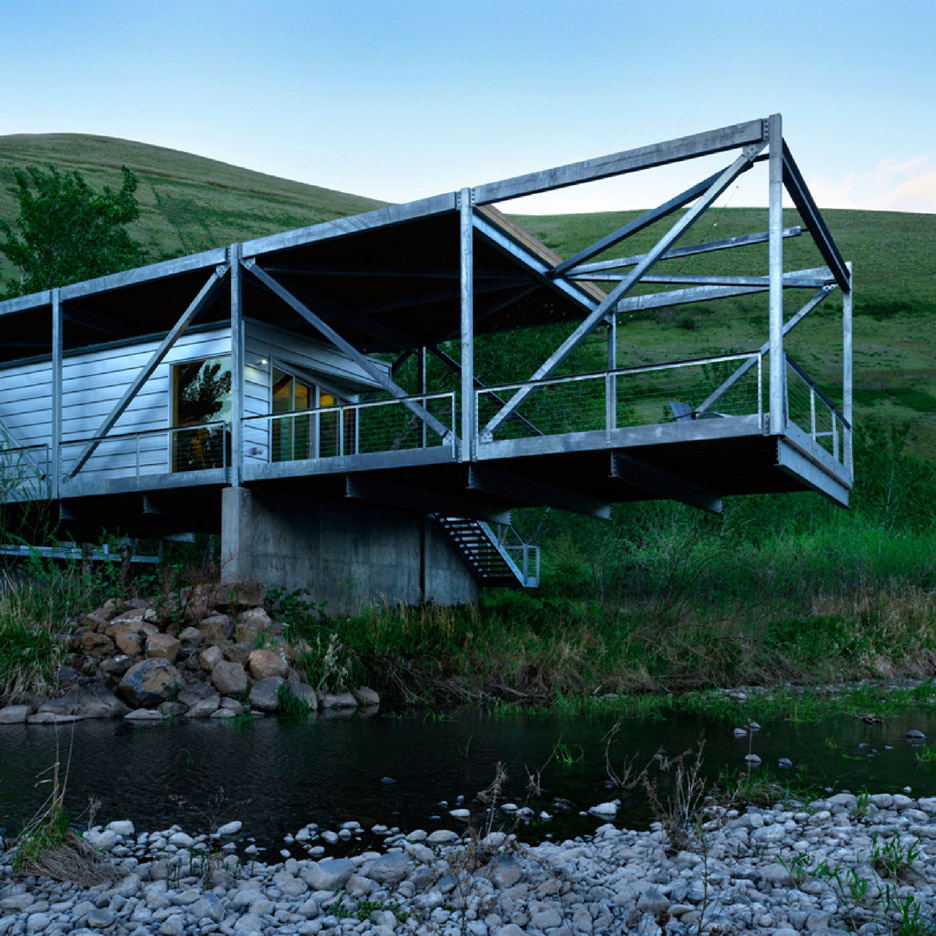
Paul Hirzel lifts home above Idaho river to evade flooding and snakes


Idaho-based architect Paul Hirzel has completed a house raised high above the ground to avoid surging waters and snake infestations in the rural town of Juliaetta (+ slideshow). (more…)

http://ift.tt/2a2wbeo

Bungalow Court Brighton / Steve Domoney Architecture


© Derek Swalwell

© Derek Swalwell


© Derek Swalwell


© Derek Swalwell


© Derek Swalwell


© Derek Swalwell


© Derek Swalwell

© Derek Swalwell

From the architect. Set in a quiet leafy cul-de-sac in the bay side suburb of Brighton, the first glimpse captured of our Bungalow Court project is of the kite-like roof canopy sailing aloft a solid upper level ‘hull’.  It hovers seemingly unsupported, with only the presence of a narrow band of horizontal glazing beneath to suggest a connection to the solid form below.


© Derek Swalwell

© Derek Swalwell

The intentionally whimsical form the roof assumes, signals the design response reinforced throughout this free flowing family home. We aimed to engender an air of relaxed sophistication, a calm welcoming place that would stimulate the senses and instil a sense of wellbeing.


Floor Plan

Floor Plan

Floor Plan

Floor Plan

From first entering the house and passing through, it gradually unfolds and reveals the series of interconnecting living spaces both indoors and out.


© Derek Swalwell

© Derek Swalwell

With only the presence of a meandering glass facade defining the ‘in’ from the ‘out’, an almost resort feel is established, with pool and spa encircling the family living space and rich tropical garden backdrops beyond, the garden t becomes an equal contributor to the overall spatial experience of this home.


© Derek Swalwell

© Derek Swalwell

There is a refined simplicity to the material palette, natural, earthy and honest. An uncomplicated backdrop to the furnishings which add colour, texture and warmth.


© Derek Swalwell

© Derek Swalwell

The home is unashamedly a show piece for our clients, but robust enough to comfortably withstand the rigours of family life and celebrate their positive spirit.

http://ift.tt/2a6THaJ

Photos from Germany

Schwerin (Mecklenburg-Vorpommern)

http://ift.tt/1Re4v3F