
Binh House is a residential project designed by Landmak Architecture in 2015. It is located in Hanoi, Vietnam. Binh House by Landmak Architecture: “This house is built on a bad land shape which is separated from the narrowest part of a large land. It has ugly shape and is most cramped. In suburban, people often build houses on very large land plots, therefore, the small area (in comparison with the..
Europan 10 Project / DROM

Courtesy of DROM
- Architects: DROM
- Location: The Netherlands, Emmen, Netherlands
- Design Team: Timur Shabaev, Marco Galasso
- Area: 2550.0 sqm
- Project Year: 2016
- Photographs: Courtesy of DROM
- Local Architect: Detail10
- Clients: Lefier
- General Contractor: Zomers
Courtesy of DROM
A europan 10 winner, Suture is a project that provided a solution to the problem of a fractured site, the ownership of which was irregularly and inconveniently divided between the Municipality of Emmen and the housing corporation Lefier.
Courtesy of DROM
Masterplan
Courtesy of DROM
The project called on the owners to exchange the land in a way that allowed for a fully usable and useful community space to emerge in the center of the project site. This newly injected garden space worked as glue that bound the pieces of the fractured site to form a whole. The garden also formed the second facade for the privately owned housing lots arranged at the perimeter of the block. The project took into account the existing pattern of informal paths that already functioned as shortcuts to the nearby amenities.
Courtesy of DROM
Floor Plans
Courtesy of DROM
The internal public space will be turned into a green park and will be used for various types of activities. Future tenants will decide how their courtyard will look and will be editable to build and maintain it by their own effort.
Elevations
The housing is composed of 24 rental homes, all of-which are accessible from the ground level. The housing stock includes two typologies or units (5,4 and 6 m wide) with a variety of possibilities for customization available for different types of families, from young couples with kids to senior residents.
The project was a collaboration between Timur Shabaev and Marco Galasso.
Courtesy of DROM
Menu to launch minimal Modernism Reimagined collection at Maison&Objet
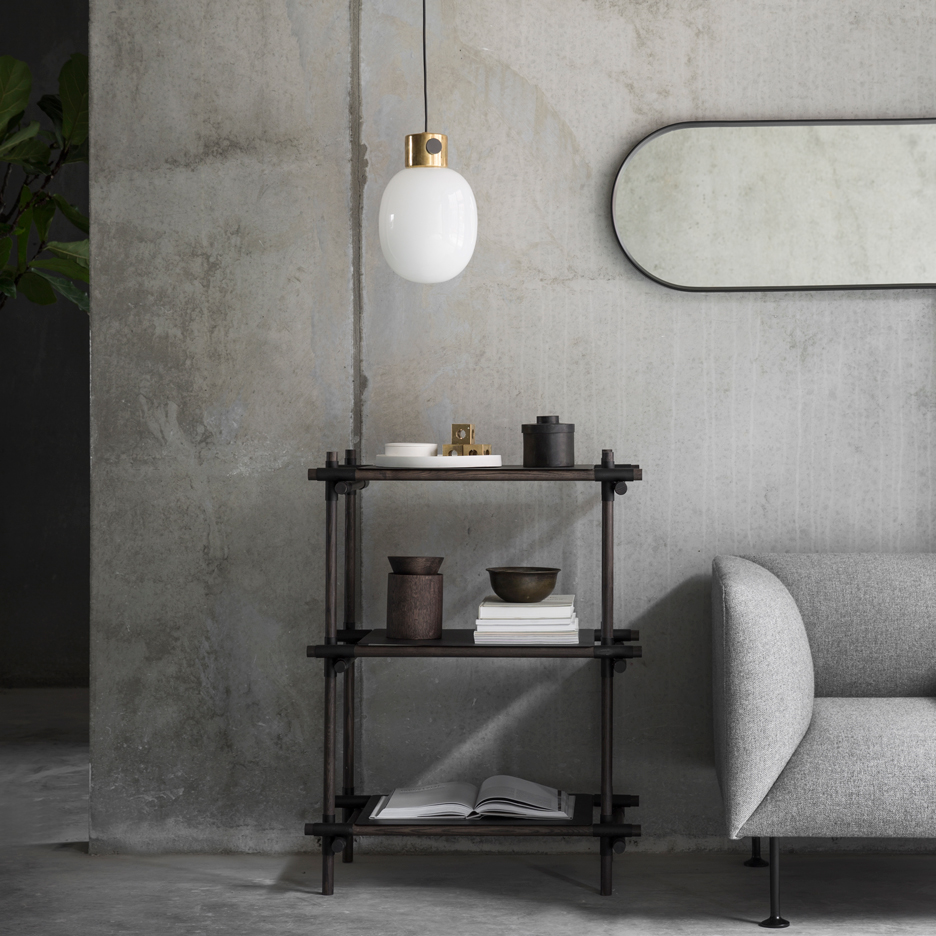
Danish brand Menu will launch its new collection of minimal furniture, lighting and accessories at this September’s edition of Maison&Objet (+ slideshow). (more…)
9 Reasons Why Failure Should be an Asset to Every Entrepreneur

You’re reading 9 Reasons Why Failure Should be an Asset to Every Entrepreneur, originally posted on Pick the Brain | Motivation and Self Improvement. If you’re enjoying this, please visit our site for more inspirational articles.
You are an entrepreneur (or you definitely want to be one). And like all the other entrepreneurs, you are obsessed with success. Your work is your driving passion, and you probably equate failure with a personal shortcoming.
Let’s face it – nobody wants to fail. But some failure is inevitable — at least it is if you ever hope to succeed.
Here are nine reasons why failure is not the end of the world, and may in fact lead to much greater success especially if you’re an entrepreneur.
-
Failure Keeps You Humble
Nothing will check your ego quite like admitting defeat. When your business falls apart and you’re left picking up the pieces, it can be hard to rebuild the confidence you had when you first started. This humility prepares you for your eventual success by ensuring that you’re not over-confident. It teaches you to recognize things as they are, and to (eventually) laugh at yourself.
-
Failure Shows that You’re Willing to Take Risks
“Do the one thing you think you cannot do. Fail at it. Try again. Do better the second time.” –Oprah Winfrey
Being willing to try something new is the backbone of innovation. Successful entrepreneurs thrive because they see a better way to do things, and take the leap. Having a fear of failure is acceptable, but we must not let this paralyze us. So your first great idea didn’t catch on? No big deal. Accept it, and know that next time, you’ll do better.
-
Failure Grows Your Network
Have you ever been stuck behind a bad car accident? Emergency crews make up part of the delay, but it’s the curious onlookers who are largely responsible. This same principle is active in our business wrecks as well. When we fail, others want to know about it. They want to see how it happened, how you’ve recovered, and if you’re ever going to try again. And guess what? They’ve probably failed, too. Acknowledging your failure shows others that you gave it your all and are willing to share your experience. You may learn the key to success from a friend who failed in an entirely different way, or connect with someone who can benefit from the lessons you’ve learned. Don’t be afraid to admit defeat. You never know who you may help, and how that connection may benefit you in the future!
-
Failure Teaches You What Not to Do
Your best idea didn’t pan out. You’re upset, worried, and a little embarrassed. What you may not realize now is that you’ve been given the best examples of how not to do things in the future! There is no greater teacher than getting it wrong the first time. Don’t be afraid to try again, and make sure you implement what you have learned. Take time to analyze where things went wrong, and what you can do differently next time.
-
Failure Saves You Precious Time and Money
Starting your own business is an incredible drain on your resources—mentally, physically, and financially. Accepting an inevitable failure can save you from investing more of your energy on a sinking enterprise. It allows you to shift gears and pool your remaining resources elsewhere.
-
Failure Gives You a Fresh Start
Remember back before you failed, and you were excited, energized, and motivated to try something new? You now have the opportunity to connect with those feelings again! No longer are you tied to the disappointment of things not working out. You get to start fresh, and with the knowledge of what to look out for.
-
Failing Allows You to Recognize the Signs
When did you first realize that failure was inevitable? Was it a gut instinct? A bad return? A loss of profit? You’re now ready to begin again, and you’ve been given the ability to recognize when things start to go south. Listen to your instincts, and react quickly if things seem to take a turn for the worst. You may be able to save it this time. If not, be sure to implement #4.
-
Failure Makes You Appreciate Success
“It had long since come to my attention that people of accomplishment rarely sat back and let things happen to them. They went out and happened to things.” –Leonardo da Vinci
Nothing makes you appreciate something more than having to earn it. Remember when you were a child and desperately wanted a specific toy? Maybe everyone else had it already, or it was the last one at the store. You just had to have it. It had to be yours. And your parents would let you buy it – if you earned the money. How proud were you when you left the store, toy-in-hand? Success works the same way. When we focus our energy and desire on a goal and work hard consistently, it is that much more rewarding in the end. This doesn’t happen without a few failures along the way.
-
Failure Shows Us that We Are Resilient
So you’ve failed brilliantly. Your hard work didn’t pay off. Your vision didn’t come true. You’re not exactly sure how you’ve gotten here, or where to go next. Take a deep breath, and look around. You’re still breathing. You’re not in imminent danger. The worst is over, and now all that’s left is to wipe the slate clean and begin again. Don’t let this stop you from moving forward. You’ve lived through the worst-case scenario once already, and know what to do differently next time. Failure cannot defeat you unless you let it.
Entrepreneurs can take comfort in knowing that failure is not the end. If we embrace it and learn from it, we can grow from each experience and move on to more successful ventures. Don’t be afraid to admit defeat—to yourself, or others, as it can save you valuable resources, and connect you with people who are in a similar situation. And finally, realize that failure is not going to kill you. It may have set you back, but you can turn it into an asset and move forward with your next brilliant innovation. The world needs people who are willing to push past their fears, and embrace possibility.
Have you ever failed miserably that you really wish you hadn’t? Share with us in the comments, and let us know the lessons you’ve learned along the way.
You’ve read 9 Reasons Why Failure Should be an Asset to Every Entrepreneur, originally posted on Pick the Brain | Motivation and Self Improvement. If you’ve enjoyed this, please visit our site for more inspirational articles.
Swedenphoto via devon

Itoi Elementary School / Atelier BNK

© Shinkenchiku-sha
- Architects: Atelier BNK
- Location: Shibetsu, Hokkaido Prefecture, Japan
- Area: 3893.0 sqm
- Project Year: 2008
- Photographs: Shinkenchiku-sha, Koji Sakai
- Collaborators : Kanebako Structural Engineers, SOGO Consultrants
© Koji Sakai
From the architect. This is a small elementary school with approximately ten students in each grade. A merger with neighboring towns has led to the disappearance of the former name of the town, Asahi. However, the school has a long history, and this project aimed to renew the school building as a symbol of the town for future generations. Our design had to take into account the fact that activities outside of the school buildings are extremely limited in cold, snowy areas and most activities have to be done indoors.
© Shinkenchiku-sha
Floor Plan
© Koji Sakai
Also, it was important to create a family-like sense of unity unique to a small school in which a dozen or so teachers form one team and engage with all of the children. Therefore, our design comprised a compact floor plan that integrated the gymnasium into the school building, and adequate interior space was obtained by using corridors and other areas as teaching space rather than having them solely dedicated to movement. We also sought to make the building sustainable in a way that is appropriate to the region. While focusing on reducing the heating load by making the building compact, our design allows natural sunlight and cross-ventilation in the building. Also, eaves and perforated screens were installed to prevent overhanging snow.
© Koji Sakai
Section
© Koji Sakai
In order to build a large roof using locally- produced laminated lumber of Jezo spruce and Sakhalin fir, a hybrid, reinforced concrete and steel structure that reduces the load on the wood sections was employed. Lightening the framework of the roof reduced the required wall volume and, as well as increasing the amount of freedom in the floor plan, created a space in which the light and the flow of air are unobstructed. Natural light coming through the openings between the laminated lumber creates varying patterns of light and shade on the floor surface. Our design included a detailed plan of the furniture layout based on a simulation of the light distribution; however, it also allows for free movement of the living space as the light changes with the time of day and the seasons.
© Shinkenchiku-sha
Oxford, Englandphoto via liz

Haishang Plaza Sales Center / Amphibian Arc

© Zhejia Dai
- Architects: Amphibian Arc
- Location: Zhengzhou, Henan, China
- Area: 1200.0 sqm
- Project Year: 2016
- Photographs: Zhejia Dai
- Design Team: Nonchi Wang (Principal), Luoya Tu, Dennis Roney, David Rodriguez, Nicholas Poulos, Charles Liu, Zhexiong Hu, Nedi Dimova-John, Xiaofeng Mei
- Executive Architects: Atmosphere Architectural Design & Planning
© Zhejia Dai
From the architect. Standing as a precursor to the adjacent shopping mall building, the Sales Center embodies similar characteristics to the design of the shopping mall: the unyielding pursuit of organic and liquid-like geometries, which allows it to blend harmoniously with its future contextual surroundings.
© Zhejia Dai
The design is characterized by its limpidness and visual permeability as is emphasized by the double-heighted glass fin, curtain wall system. The transparent glass volume is enveloped by an elegant, organic form constructed with GFRC. The continuous and fluid surfaces navigates between interior and exterior nearly seamlessly.
Section
Section
The main lobby is surrounded with an abundance of floor-to-ceiling glazing, which provides a wealth of natural light throughout the space. At the main entrance, the GFRC reveals a large span of curtain wall and a floating canopy as a welcoming gesture to the adjacent main thoroughfare.
© Zhejia Dai
Stacked shipping containers form temporary pavilion by People’s Architecture Office
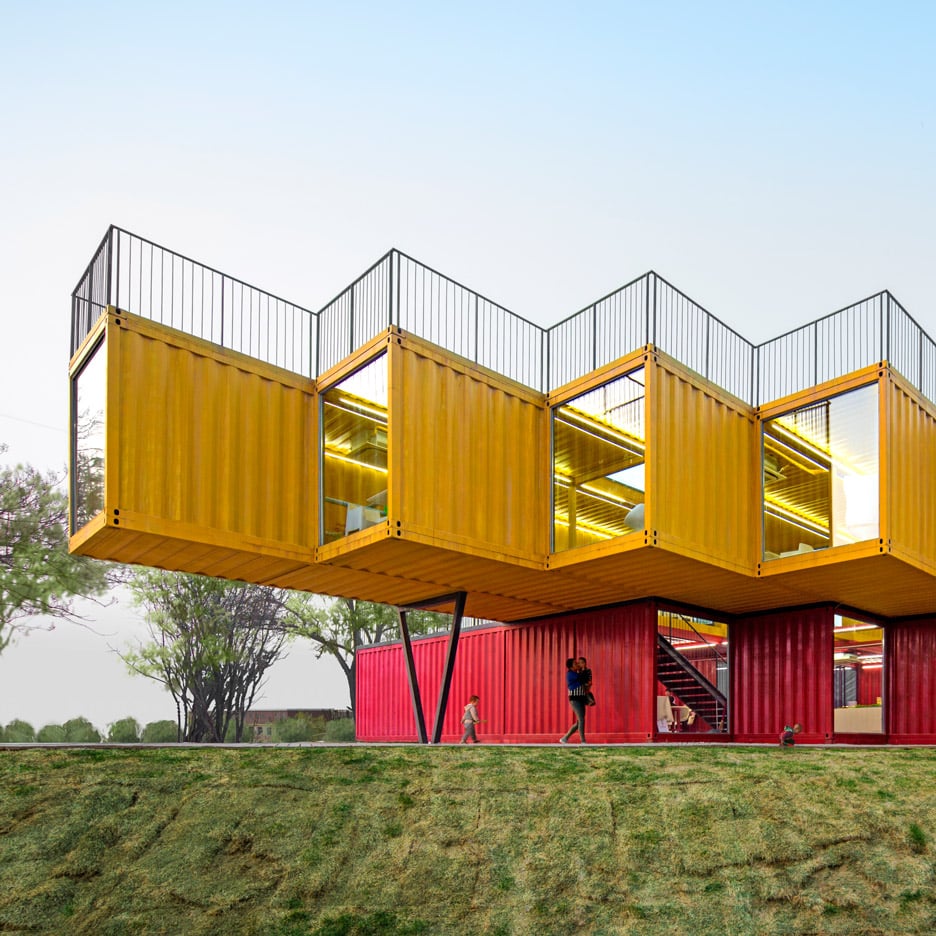
People’s Architecture Office has used 12 shipping containers to build a temporary, red and yellow pavilion in a fast-growing town in China’s Shanxi province (+ slideshow). (more…)
How to Keep Tabs on Your Competitors
Worried about what the competition is doing? Wish you could stay one step ahead of them? You can keep tabs on what your competitors are up to with these tips.
 Sig Nordal