Lake District, Englandphoto via carol

Lake District, England

photo via carol

Wengawa House / Katsutoshi Sasaki + Associates


Courtesy of Katsutoshi Sasaki + Associates

Courtesy of Katsutoshi Sasaki + Associates


Courtesy of Katsutoshi Sasaki + Associates


Courtesy of Katsutoshi Sasaki + Associates


Courtesy of Katsutoshi Sasaki + Associates


Courtesy of Katsutoshi Sasaki + Associates

  • Architects: Katsutoshi Sasaki + Associates
  • Location: Anjo, Aichi Prefecture, Japan
  • Area: 97.37 sqm
  • Project Year: 2015
  • Photographs: Courtesy of Katsutoshi Sasaki + Associates
  • Structure Company: Tatsumi Terado Structural Studio
  • Construction Company: Marucho home Ltd.
  • Site Area: 238.54 sqm
  • Built Area: 76.38 sqm

Courtesy of Katsutoshi Sasaki + Associates

Courtesy of Katsutoshi Sasaki + Associates

How will housing change as societal aging accelerates? This time our clients are a couple of retired husband and wife in their 60s. We planned a small house with a square roof for them, considering “the aging society” and “the way of housing” in the future.


Courtesy of Katsutoshi Sasaki + Associates

Courtesy of Katsutoshi Sasaki + Associates

The site is a newly-acquired lot conveniently located in a quiet residential area. The clients requested that we not just build a house but that we make a new place where we can interact with our neighbors and that we make a residence where they would be able to enjoy their hobbies indoors and outdoors. Upon this request, we planned an interaction space (a place open to the public) in front of the building facing the road, and we also planned a home garden behind the building (the location facing the neighbor’s agricultural field).


Plan 1

Plan 1

Four areas — “veranda,” “living space,” “light veranda,” and “visitors’ room” —constitute the plane.When we considered the life of the aged, we thought that non-daily lives and time such as tea parties at home or their adult daughters’ visits would be important while it is necessary to privide functions for daily lives such as eating and sleeping. So we planned so that each area would be connected with each other depending on the situation, while maintaining fuzzy borders among them, thus making it possible for daily lives and non-daily lives to be intertwined.


Courtesy of Katsutoshi Sasaki + Associates

Courtesy of Katsutoshi Sasaki + Associates

Courtesy of Katsutoshi Sasaki + Associates

Courtesy of Katsutoshi Sasaki + Associates

The veranda surrounding the building functions as a place of friendship with neighbors and neighborhood gathering on the east side, and as a resting place on the west side when the clients work in their home garden. It also functions as a traffic line from the entrance when they have a tea party. The veranda is a structure that creates a physical and temporal distance between the living space and the tea room, and it helps visitors to realize the end of their daily lives and the beginning of their non-daily lives.


Section

Section

The living space surrounds a square storeroom situated in the center. Located in the center on the second floor is the visitors’ room. It is expected to be used flexibly as a tea room, a guest room, a reading space, etc. Floated around that visitors’ room is the “light veranda,” whose soft light wraps the visitors’ room. On the “light veranda” light from the top lights on the four sides diffuses among sheets of translucent cloth and creates a pool of light. It also creates a scene in which light moves and fluctuates in intensity in response to the movement of natural wind.


Courtesy of Katsutoshi Sasaki + Associates

Courtesy of Katsutoshi Sasaki + Associates

For this house, after deciding on using the customary form such as a square roof, a veranda, etc., we focused on the relationship between daily and non-daily, and then by adding a “light veranda” as well as the normal “veranda,” it has become a house with various kinds of involvement with nature and unpredictable scenes under the roof. We always place an emphasis on the fact that simple configurations may create various kinds of involvement, and we feel possibilities in developing the already existing formats rather than architecture that expresses newness itself such as the discovery of a new scheme.


Courtesy of Katsutoshi Sasaki + Associates

Courtesy of Katsutoshi Sasaki + Associates

http://ift.tt/2aNbCAK

Alberta, Canadaphoto by chrisburkard

Alberta, Canada

photo by chrisburkard

Metal Hut / Robot 3 Studio


Courtesy of Robot 3 Studio

Courtesy of Robot 3 Studio


Courtesy of Robot 3 Studio


Courtesy of Robot 3 Studio


Courtesy of Robot 3 Studio


Courtesy of Robot 3 Studio

  • Architects: Robot 3 Studio
  • Location: Beijing, China
  • Architect In Charge: Fei Pan, Zhi Wang
  • Area: 52.0 sqm
  • Project Year: 2016
  • Photographs: Courtesy of Robot 3 Studio

Courtesy of Robot 3 Studio

Courtesy of Robot 3 Studio

From the architect. With the size of only 52 ㎡ (kitchen not included), the original ramen shop is adapted to a BBQ bar. Features of the project: narrow space, limited budget and poor location.


Courtesy of Robot 3 Studio

Courtesy of Robot 3 Studio

What we propose: switching perspective, ultralow price and wormhole.Squatting is a basic human instinct.Lower sitting position could get people closer.


Plan

Plan

Each ring road of Beijing is a rough division of social class. The invisible wall made up of power and wealth divides Beijing into pieces of fixed territories, some of which are inaccessible for majority of people in their whole life. Each territory has a stable hierarchical structure and complicated codes. Design is the way to overcome the obstacles and crack the code.


Courtesy of Robot 3 Studio

Courtesy of Robot 3 Studio

Huoying is located in the “margin” of Beijing. As the reference of it, Sanlitun area is the center of fashion and exchange of information in Beijing. It takes 1.5 hours to drive from Huoying to Sanlitun with the distance of 25 km. But we believe that the margin of Huoying correlates with the center of Sanlitun. There will be no center if there is no margin. We are designing a wormhole① in this spacetime to make the margin and the center overlapped. The wormhole is the Metal Hut.


Courtesy of Robot 3 Studio

Courtesy of Robot 3 Studio


Courtesy of Robot 3 Studio

Courtesy of Robot 3 Studio

The psychological change from our work to life could not be instantly changed like a switch. We may still continue to work after returning home. Therefore, we take the Metal Hut as a psychological switch. Squatting is a basic human instinct position on a picnic. This “informal” dining posture is relaxing and getting the diners more intimate. Squatting view also permits the diners to see the usually-neglected low dimension of the world.


Courtesy of Robot 3 Studio

Courtesy of Robot 3 Studio

http://ift.tt/2b5mHlG

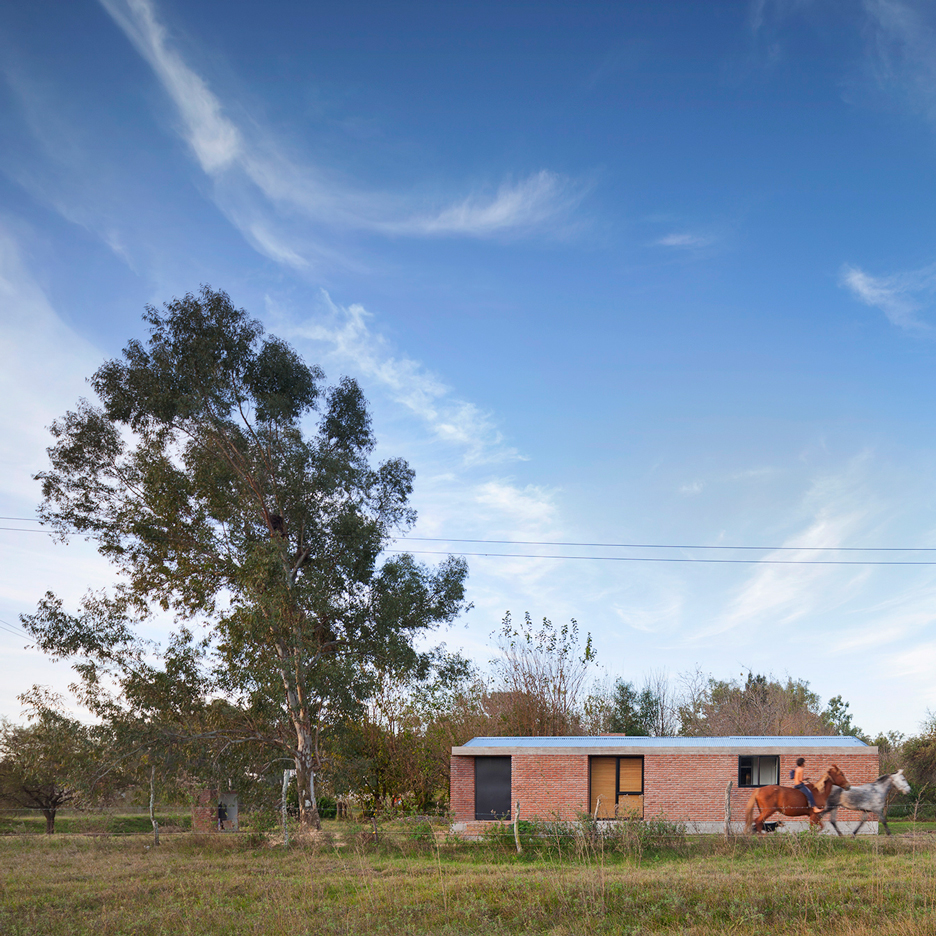
Casa Bovero by Germán Müller is a house among eucalyptus trees in rural Argentina


This simple brick house by architect Germán Müller features a series of large windows, offering generous views of the scenic setting in Santa Fe, Argentina (+ slideshow).  (more…)

http://ift.tt/2aZaNYI

Abandoned House by Anthony K. Different angle. In the middle of…

via Abandonedforgotten http://ift.tt/2axvqHw

Tollymore Forest Park, Northern Ireland photo via jarlath

Tollymore Forest Park, Northern Ireland

photo via jarlath

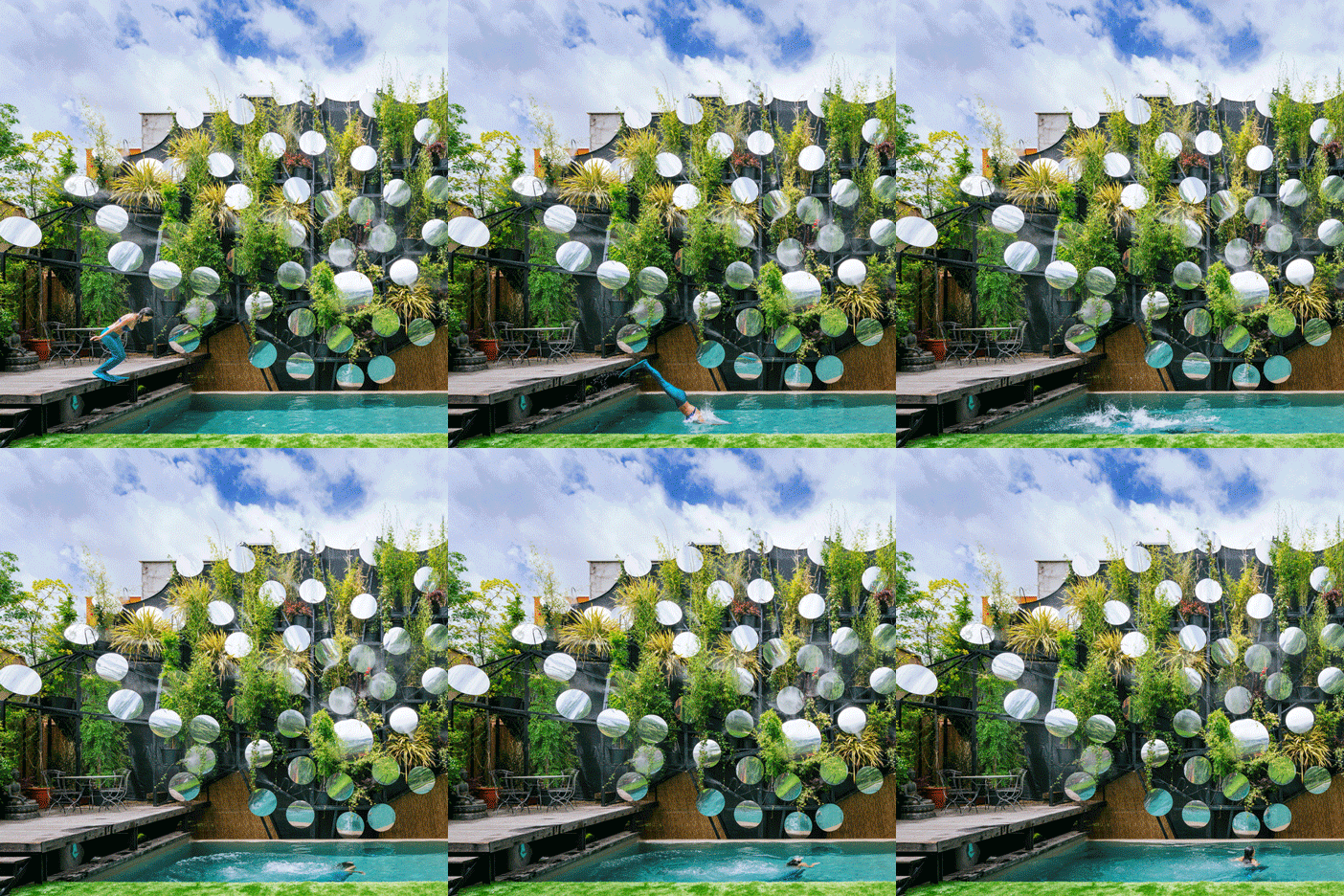
Madrid swimming pool updated by Manuel Ocaña with mist, mirrors and plants


Manuel Ocaña Architecture has added mirrors, mist clouds and overgrown vegetation to a private swimming pool in Madrid, which is depicted in this movie along with a splashing mermaid. (more…)

http://ift.tt/2aENZww

5 Top Weird Brain Facts

//pagead2.googlesyndication.com/pagead/js/adsbygoogle.js

(adsbygoogle = window.adsbygoogle || []).push({});

Research and exploration isn’t something which has much to do with our day to day life. I think it should. We tend to look elsewhere for our inspiration. Typically to the very, very big, to understand where we fit into the universe or the very, very small, to find out how everything fits together!

I, however, take continual delight in knowing that there is so much of our seemingly mundane daily life which remains largely unexplained. We know so little about us.

We are so strange. So much so that I’m pretty sure we just gave up trying to work ourselves out. A poorly paced evolution has left our brains wired up in weird ways.

We often do things which are totally illogical and counterintuitive things. We produce the unexpected from the seemingly mundane situations. What would you think if I told you that you don’t see, learn, feel or heal like you think you do?

//pagead2.googlesyndication.com/pagead/js/adsbygoogle.js

(adsbygoogle = window.adsbygoogle || []).push({});

Here is a list of the top weird things our brains do:

//c.amazon-adsystem.com/aax2/getads.js

//<![CDATA[
aax_getad_mpb({
"slot_uuid":"16dcbcd0-2124-4a85-9abe-c263dd9084e5"
});
//]]>

1. We don’t know ourselves like we think we know ourselves.

We’ve all done one of those personality tests. There are hundreds of fake ones floating around the internet.

You get that little booklet which sums you up… we tend do think “Wow! That’s me. So clever how they did that!” In truth, we are very likely to say the exact same thing we were handed a fluffy, vague description.

It’s called the Forer Effect – and it makes advertisers quite giddy.

//pagead2.googlesyndication.com/pagead/js/adsbygoogle.js

(adsbygoogle = window.adsbygoogle || []).push({});

2. We don’t learn like we think we learn.

brain learn

There is a strong relationship between our imagination and muscle memory. Imagining doing something successfully is just as good as, and sometimes even better than actually doing it.

//pagead2.googlesyndication.com/pagead/js/adsbygoogle.js

(adsbygoogle = window.adsbygoogle || []).push({});

If you are learning to play the piano, visualising the keys – seeing your hands move through the chords is just as good as sitting down in front of the piano. One can only hope the drummer next door reads this.

See Also: 5 Sneaky Tricks Your Left Brain is Playing on You

3. We don’t see like we think we see.

Our visual cortex forms a map of the world around us from the electrical signals form our eyes. No one has ever seen the world any other way.

The more you think about, the more unsettling the idea becomes. Optical illusions bring this idea home for us. Whenever there is a disparity between actual objective reality (lines on the page) and what we visually expect to see, we get all tied up in knot.

Do you remember the movie “The Matrix?” and the more we think about it, the more we realise what a horrible actor Keanu Reeves is.

4. We don’t feel like we think we feel.

We’ve heard of the stories of amputees who still experience their missing limb, like it’s still there. Google “The Phantom Limb Experiment” the same experience can be reproduced in non-amputees. Pretty strange.

//pagead2.googlesyndication.com/pagead/js/adsbygoogle.js

(adsbygoogle = window.adsbygoogle || []).push({});

If you hid your hand under the table and placed a fake plastic on the table in front of you next to your other hand. Then, have someone touch both in the same way for a while – then maybe hit the fake one with a large mallet. You’d feel the pain as if it was your real hand.

Don’t be creepy about the hand touching. This is science.

5. We don’t heal like we think we heal.

brain healing body

The reason pharmaceutics have to test their new drugs against sugar pills or saline solutions (salt water) is because sugar pills and salt water work to cure lots of things! Just the belief that something works, means that it does.

And here’s the rub. As the drugs get better, then more people are treated successfully, the more we believe in the drugs, the stronger the placebo effect gets – the harder it is to prove that they work better than sugar and salt!

See Also: 10 Tips to Develop Both Sides of Your Brain

Perhaps building a Hadron Collider and bouncing particles off each other was a far more productive pursuit, if not a necessary distraction from thinking about how weird our brains are.

//pagead2.googlesyndication.com/pagead/js/adsbygoogle.js

(adsbygoogle = window.adsbygoogle || []).push({});

(function(d) {
var params =
{
id: “cb4f919c-04fa-460c-b2ff-2c7f9ecf4472”,
d: “ZHVtYmxpdHRsZW1hbi5jb20=”,
wid: “165294”,
cb: (new Date()).getTime()
};

var qs=[];
for(var key in params) qs.push(key+’=’+encodeURIComponent(params[key]));
var s = d.createElement(‘script’);s.type=’text/javascript’;s.async=true;
var p = ‘https:’ == document.location.protocol ? ‘https’ : ‘http’;
s.src = p + “://api.content.ad/Scripts/widget2.aspx?” + qs.join(‘&’);
d.getElementById(“contentad165294”).appendChild(s);
})(document);

The post 5 Top Weird Brain Facts appeared first on Dumb Little Man.

http://ift.tt/2b4Vwr0

New York City – New York – USA (by Daniel Wehner) 

New York City – New York – USA (by Daniel Wehner