From the architect. Located in west China, Dazhou city has a population of around 580 thousand. Dazhou Public Library serves as the collection center of literature information resource, as well as the communicating/service center of the city. It is a significant symbol of Dazhou’s culture development.
The project site is quite narrow with a height difference of about 4 meters from north to south. The main volume consists of a 2-storey underground garage and a 5-storey building with an open layout aboveground. The building Includes exhibition, classroom, café at the first floor, main entry, lecture hall, kids’ reading room at the second, open reading space at level three to four and the curator office at level five.
Utilizing relative altitude of the site, the design placed main entry on the second level. Lecture hall was placed to the north of the main volume, separated from the south-part reading space. The reading space was composed around a skylight atrium, from which one can take in the whole reading room in a glance. Readers can reach each floor with the stair in the atrium. The changing direction and altitude of the stair expressed an image of ‘mountian road’, which indicated Dazhou’s mountainous geographical environment.
To avoid the bad influence of direct sunshine from both east and west, the long side wall of reading room consists of two layers of glasses, the outer Ceramic Fritted glass and the inner frosted glass. The double glazing provides a stable diffused light environment which meanwhile insulates noise from street, thus making a high-quality reading environment. The staircases and washrooms are placed to the west so as to insulate heating in the afternoon, saving energy for air conditioning. This kind of distribution also liberates whole floor space for arranging reading function freely.
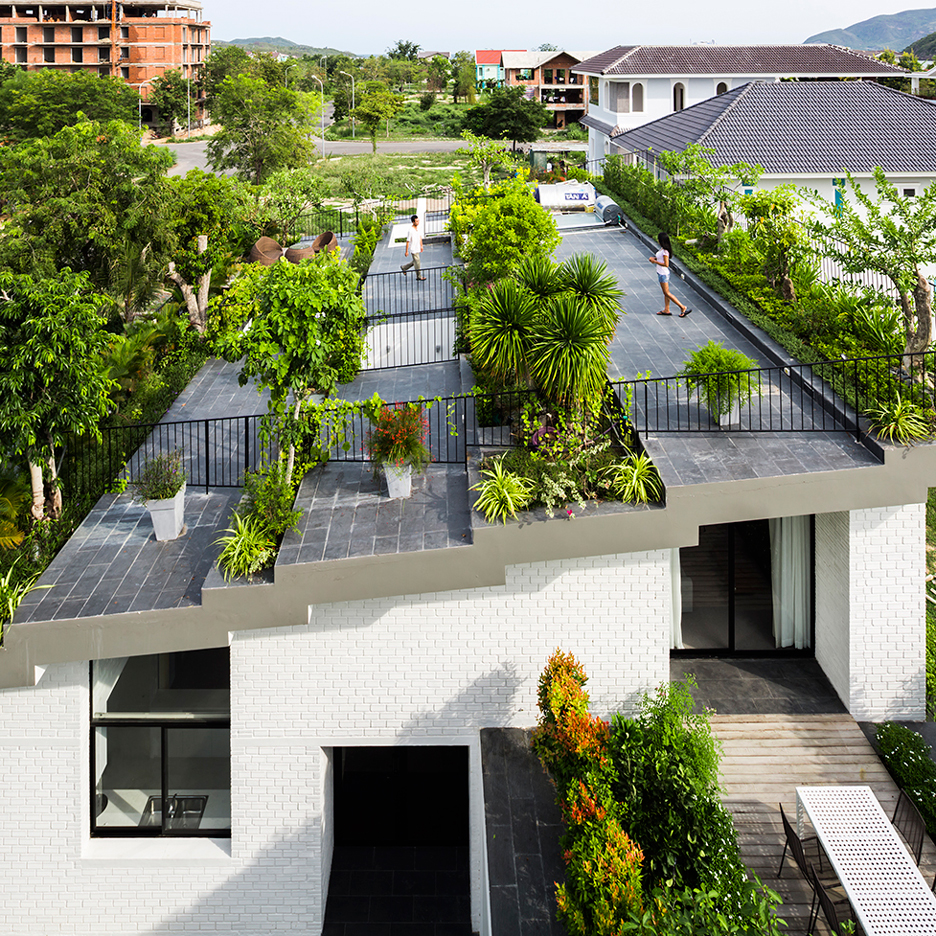
From the architect. The house is located in Nha Trang, a city in central Vietnam surrounded by the beautiful ocean and mountains. The client wanted a large house with a large garden. Answering to this request, a single roof is designed as a hanging garden to plant numerous trees and plants on it. The local building code, however, requires almost 50% of the roof area to be covered by gray or orange-color tilings and to be sloped. To obey this rule but maximize the green area atop, the roof is divided into parallel bands of greened roofs and tiled roofs in an alternating sequence.
The interior spaces of the house are structured by this system of parallel bands. Under the tiled roof are the living, dining and bed rooms, while service spaces, such as bathrooms, storages and circulation spaces, are located under the greened roof, where the ceiling height are limited because of the deep soil layers for trees atop. A void and three patios are designed within the system of bands to enhance natural lighting and ventilation.
Section
Section
The house is one of the latest variations of the serial house project called ‘house for trees’. The large single roof is departing from the scale of private house. It is more like an infrastructure or a pocket park open to the neighbors. Gently sloped, this roof-landscape is visually connected to the surrounded mountains. In the shadow of trees, the residents can enjoy the views and spend their life with full of greenery.
From the architect. Set in the dry and arid industrial context next to a busy state highway, the structure is a small and sole workspace of a young CEO at the threshold of his vast industrial estate. The proposed design is an attempt to represent the client’s aspiration to reach out to the world for his business expansion while marking his presence amongst his competitors. Key aspect here was to provide high standards of comfortable work environment to its main user and to his esteemed visitors.
The challenge was responded with a simple unified form floating above the ground housing a reception, a conference area, CEO cabin and private rest area. The workspace is designed to specifically suit the industrial functionality of the client’s nature of work with visual connectivity to his entire unit at all times. Built with a concrete frame structure the building is partially cladded with the yellow colored local stone – ‘Ita Gold’ to add a sense of vibrancy to the main recessed reflective double glazed façade. The dark colour on the exteriors and extended floating plinth helped to achieve an urban contemporary edge in the overall appearance of the building.
The plan organization driven by ‘Vastu’ (Indian Vedic Science of Buildings) is a linear arrangement of spaces connected by a corridor. The materials used for the interiors is a combination of traditional and contemporary materials. Contemporary finishes such as monolithic concrete MicroTopping Floor, rusty ironic paints, back painted glass and stainless steel compliments the natural materials like customized hexagonal pieces of Ghana teak as backdrop wall, Bidasar stone (local stone) mosaics and finger-joint wood (discarded residual wood) to create a juxtaposed collage of different materials.
A large tiered garden forms the roof of this house in the coastal Vietnamese city Nha Trang, which architect Vo Trong Nghia designed in partnership with former colleague Masaaki Iwamoto (+ slideshow). (more…)
The Metropolitan Museum of Art has released a 360° video of the recently renovated Met Breuer, the former home of the Whitney Museum designed by Marcel Breuer in 1966 that now houses sections of the Met’s modern and contemporary collections. The video takes you through several areas of the building including the entry, the lobby and the sunken garden courtyard. Orbit around the video to check out the unique apertures of the landmark facade and the finely detailed interiors, featuring the building’s iconic ceiling.
Rio 2016: German art director Björn Karnebogen has created a tongue-in-cheek alternative logo for the Olympic games after a swathe of Russian athletes were found guilty of doping. (more…)
From the architect. The High Trestle Trail Bridge, is the fifth longest pedestrian and bicycle bridge in the US. The bridge, over a half mile long, spans the Des Moines River Valley, and connects over 600 miles of trail in central Iowa. With design embracing local coal mining history and geology of the area, the site-specific installation utilizes a tunnel of steel cribs, mimicking the structure of an old mine shaft, and abstracting them in a manner which evokes a sense of whimsical travel through time and space.
The experience becomes even more surreal as night falls, and blue LED’s highlight the playful geometry of the cribs, drawing users in and gently releasing them through the other side. Not only has the installation been an experiential gift to the public, but it has also been recognized as a major contribution to regional economic development, with an additional 15 to 20 thousand people per month traveling to the local communities on both sides of the bridge.
Thanks to the collaboration between public artists, engineers, architects, lighting designers, owner and the public, this installation is now the keystone, uniting five distinct communities along the trail.






 Sig Nordal