
dennybitte: painted by nature by Denny Bittefor…

In the late 1970s, the Government of India launched an initiative to build in every state capital an institution to celebrate the cultural and creative output of the nation. Although the scheme was largely unsuccessful, one shining example remains: Bharat Bhavan (‘India House’), located in Bhopal.
Designed by Indian architectural luminary Charles Correa, this multi-arts center first opened its doors in 1982. More than thirty years later, it continues to house a variety of cultural facilities and play host to multitude of arts events. The design of the complex is a product of Correa’s mission to establish a modern architectural style specific to India and distinct from European Modernism. Drawing on the plentiful source material provided by the rich architectural heritage of his home country, at Bharat Bhavan Correa produced a building for the modern era which manages to also remain firmly rooted in the vernacular traditions of India’s past.
Built into a hillside which slopes down toward a lake, a series of terraces and courtyards comprise the complex. Upon entering, the visitor has the choice of following the path of terraces cascading down to the lake, or descending to the three courtyards which provide access to the majority of the cultural facilities. These include contemporary art galleries, a museum of tribal art, an auditorium, a library of Indian poetry, a print shop, and a studio for an artist-in-residence. From the courtyards, wide glass-paneled openings to the buildings ensure the arts program is both literally and figuratively accessible to all. At the bottom of the site sits an amphitheater, where open-air performances take place with the lake forming a natural backdrop.
The route through the terraces encourages movement down the site’s natural gradient, with the courtyards providing tranquil spaces for rest and relaxation. The dialogue between these two components creates an ebb and flow of energy around the complex, in what Correa described as a “Ritualistic Pathway”. The ritual of following a sacred pathway is, he claims, “a universal impulse, found in all cultures and religions.”[1] Correa emphasized the spirituality of his own pathways by drawing parallels with those found in religious architecture, including “the sun temples of Mexico” and the Hindu temples of Bali “with their ritualistic pathways up the hillside.”[2]
Correa also noted secular examples of the Ritualistic Pathway, such as the palace city of Fatehpur Sikri and Le Corbusier’s promenade architecturale, though he claimed the latter was merely “a ‘secular’ phrase to express what is in reality a deep and sacred instinct.”[3] At Bharat Bhavan, the flights of stairs between the terraces reference traditional Indian architecture while implying the sanctity of the pathway. The stairs are reminiscent of ghats; steps found in Indian cities which lead down to a body of holy water, just as Correa’s steps guide the pedestrian to the lakeside. Indeed, Correa cited the bathing ghats on the bank of the River Ganges at Varanasi as a stylistic influence.[4] At Bharat Bhavan the steps guide the pedestrian to the lakeside; the religious connotations emphasizing the sacred nature of this pathway.
European Modernism, and in particular that of Le Corbusier, had heavily influenced modern architecture in India for much of the 20th century. Correa was somewhat wary of this trend, and criticized Le Corbusier’s Palace of the Assembly at Chandigarh for being poorly ventilated, insufficiently lit, and wholly unsuitable for India’s hot and humid climate.[5] Correa’s architecture, conversely, is shaped by its environment, with climate control a primary concern in his design process. Indeed, this was often a necessity, as much of his early work consisted of projects for squatter housing, where inhabitants did not have the means to pay for air-conditioning and were forced to rely on the building itself to regulate temperature.
Rather than importing the “sealed boxes” of European architecture, necessitated by the colder Western climate, instead Correa created “open-to-sky spaces.”[6] He observed that “in a warm climate, the best place to be in the late evenings and in the early mornings is outdoors, under the open sky.”[7] The sunken courtyards at Bharat Bhavan provide shade from the scorching midday sun, while the raised terraces offer refreshing air and space at cooler times of day. This climate-control solution was lifted directly from India’s architectural history, inspired by the courtyards and terraces of the Red Fort at Agra.[8]
The sky held a spiritual power and mythical significance for Correa, who described it as “the abode of the gods” and “the source of light – which is the most primordial of stimuli acting on our senses.”[9] He aimed to harness the power of the sky to create a metaphysical experience through architecture, proclaiming that “there is nothing so profoundly moving as stepping out into an open-to-sky space and feeling the great arch of the sky above.”[10]
At Bharat Bhavan, the intention is that those emerging from the galleries to the courtyards undergo a similarly dramatic spatial experience. The sky is even incorporated into the interior spaces of the site, with concrete ‘shells’ atop the structure allowing light and air to pour in through their circular openings. From the exterior, these shells seem to reinterpret another feature of India’s architectural vocabulary: the decorative chattris (‘umbrellas’) which originally sat atop Rajasthani palaces.
The outdoor spaces at Bharat Bhavan are physical manifestations of the concept of “Empty Space,” a recurring theme both in India’s visual culture and, in particular, its philosophy.[11] Away from the activity within the buildings, the courtyards provide a contemplative void, enhanced by the placing of sculptures in their center. These act a meditative focal point for the viewer, much like the solitary tree often found in the center of Japanese courtyards. Correa’s characteristic use of the void as an architectural tool has been widely described as ‘non-building’. He marveled at the expressive potency of nothingness, reflecting that it is “strange indeed that since the beginning of time, Man has always used the most inert of materials, like brick and stone, steel and concrete, to express the invisibilia that so passionately move him.”[12]
The long-term success of Bharat Bhavan is largely due to its enduring popularity with local residents. The courtyards create communal public space, with the steps around their peripheries providing articulated seating for residents to meet and socialize. The terraces have proven popular with families, who spend their evenings promenading down to the water’s edge and enjoying the cultural offerings of the complex.[13] In creating a building well-suited to the needs of contemporary society while making use of familiar architectural motifs, Correa manages to reconcile modernity with tradition; a significant step towards his goal of establishing a distinctly Indian Modernism.
References
[1] Correa, Charles. “Snail Trail”. In Irena Murray. Charles Correa: India’s Greatest Architect. RIBA: London, 2013. P.6
[2] Correa, Charles. “A Place in the Sun”. In A Place in the Shade: The New Landscape and Other Essays. Hatje Cantz: Ostfildern, 2012. p.19
[3] Ibid. Correa. p.7
[4] Correa, Charles. “Blessings of the Sky”. In Kenneth Frampton. Charles Correa. Thames and Hudson: London, 1996. p.25
[5] Correa, Charles. “The Assembly at Chandigarh”. In A Place in the Shade: The New Landscape and Other Essays. Hatje Cantz: Ostfildern, 2012. p.13
[6] Ibid. Correa. “Blessings of the Sky”. p.25
[7] Ibid. p.18
[8] Ibid. Correa. “Snail Trail”. p.6
[9] Ibid. Correa. “Blessings of the Sky”. p.28
[10] Correa, Charles. Housing and Urbanisation. Thames and Hudson: London, 2000. p.7
[11] Murray, Irena. Charles Correa: India’s Greatest Architect. RIBA: London, 2013. p.22
[12] Ibid. Correa. “Blessings of the Sky”. p.27
[13] Frampton, Kenneth. Charles Correa. Thames and Hudson: London, 1996. p.45

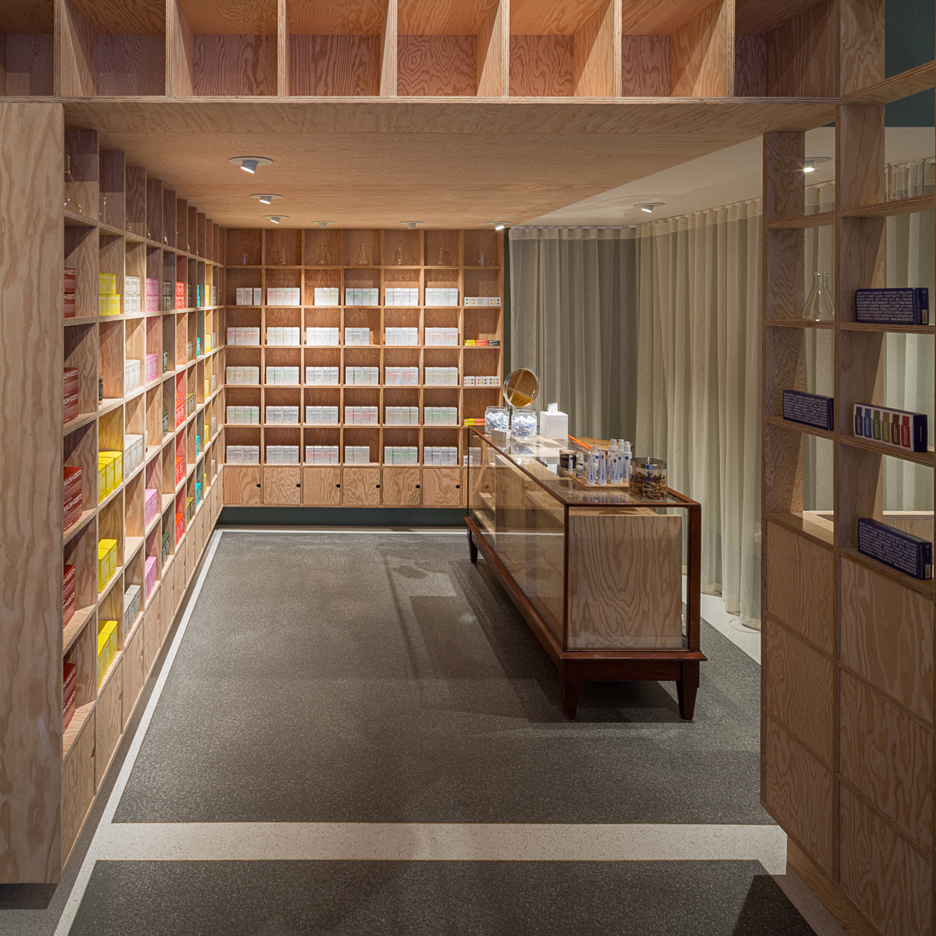
Jonathan Tuckey Design has completed two London shops for skincare brand Malin+Goetz – one filled with plywood boxes and the other featuring a reflective ceiling (+ slideshow). (more…)

868 Leonard Road is a residential project designed by Marmol Radziner. It is located in Los Angeles, California, USA. It is currently for sale for $6.5 million. Buy it now! 868 Leonard Road by Marmol Radziner: “Sited on an idyllic Brentwood cul-de-sac, this newly constructed California Modern splendor was beautifully conceived by Marmol Radziner to blend effortlessly into the hillside topography by way of native materials and flawless design. It..

From the architect. Stanbrook Abbey is a new home for the Conventus of Our Lady of Consolation, a Benedictine community of nuns who devote their lives to study, work and prayer. Relocating from their old Victorian home in Worcestershire, the nuns’ contemplative way of life required spaces that were simple, tranquil and beautiful, or as they put it in their monastic vision brief – a place where they could ‘pray always’.
Located in the North York Moors National Park the new site was chosen by the nuns for its “special quality of silence and light” providing them with a peaceful setting for their contemplative life and far-reaching views over the Vale of York.
The project was completed over two phases. Phase I, completed in 2009, included 26 new private cells for the nuns along the southern edge of the site, shared kitchen and dining facilities and work rooms. Phase II, completed in 2015, involved the construction of the new Community Church and Chapel, the Chapter House and guest spaces.
Using a delicate palette of materials and innovative structural solutions we have created a set of spaces that are both inspiring in their visual connections to the surrounding landscape, and simple in their practical details.
Taking full advantage of natural light and views, the monastery relates closely to the surrounding undulating landscape. The Nuns’ brief also requested a modern monastery which was economic to run and ecologically sensitive in design.

From the architect. The house is located in a residential neighborhood in Nova Oeiras in the Oeiras district, a neighborhood with a modernist urbanism, which is a great example of the concept called “garden city”. This neighborhood has an area of houses built in spacious plots, each with a leafy garden.
The house appeared a bit unbalanced in its design. On the main façade[AA1] we had an interesting equilibrium with a porch and a balcony, but the rear façade had no valuable elements.
The extension consists in building a new volume attached to the rear façade of the old house, extending the house through the garden redesigning its backyard façade.
In this new volume that extends the house, appears as a piece of contemporary architecture. To maintain the identity of the house, we reproduced from the porch, a hexagonal tile pattern to coat the new volume.
You can see the pattern also on the sliding grates of the existing windows; this unifies both old and new, parts of the house.
We planned this enlargement of the main house as an autonomous and distinct volume but, at the same time, with a common element to both the original and the new construction.
On the ground floor we created a spacious living room with a wide view to the garden. The kitchen contiguous but separated from the living room, enjoys the same great view as well through its large glass sliding doors.
From the lower step of the staircase to the right façade, we enlarged the window frame creating one single big glass screen. With this solution we gave natural light to the staircase, underlining its vertical amplitude.
On the first floor we have the private area, composed of one toilet, two bedrooms and a suite with a walk-in closet and a bathroom.
These last three compartments are placed on the rear of the house offering natural sunlight and a view to the backyard.

London Design Festival 2016: ten dyslexic designers from the worlds of illustration, homeware and fashion are showing work at this year’s designjunction exhibition in London (+ slideshow). (more…)

You’re reading The 6 Step Guide To Staying Present Every Single Day, originally posted on Pick the Brain | Motivation and Self Improvement. If you’re enjoying this, please visit our site for more inspirational articles.
Unfortunately, it’s common to wake up everyday with the anxiety of your long to-do list. With the amount of things we try to fit into one single day, it might include any one of a million tasks: work duties, school, kids, chores around the house, that weeknight dinner you promised your friend. It’s important to recognize that when you itemize these daily tasks and eventually start running on empty, checking things off the list, life around you is slipping by. It’s draining that positive energy from your body and mind that you need to in fact, be productive and creative throughout the day.
I felt like I was running on empty for 20-something years, waking up each day with the same routine and little variance on my to-do list—and trust me, lots of anxiety. It wasn’t until I truly started being mindful and present that I was able to take a stand for my life. Once I started waking up each day with clear thoughts, in lieu of an agonizing to-do list, my career of 30+ years did a 180-degree turn into something that I truly love to wake up to every day. I am full, clear and happy.
It’s time to take control of your life, start living in the moment, and approach each day with energetic mindfulness. Ask yourself: Will you allow fear or complacency to hold you back, or do you want to experience everything that life has to offer?
Here is a 6 step guide to help you get started:
Each morning when you mosey over to the bathroom mirror, greet yourself with a smile. Smile when you greet someone else. Your smile has the ability to not only help you feel better, but help others feel your positive energy around them. Hopefully, they’ll pay it forward, too.
Truly observe your surroundings, it doesn’t matter if the environment is urban, rural, ocean, mountain, or suburban. There is always something to notice and appreciate. Remember, most of the time the small details in life have the most to offer.
Perhaps you’ve always wanted to learn the tango, go horseback riding, or get creative in the kitchen… Free yourself up from the usual to-do list and put these at the top.
Appreciate those around you. We are often so caught up in our own world that we forget what it’s like to walk in someone else’s shoes. How does this fit into staying present? Being mindful of the people surrounding you directly affects your mood, energy and thoughts, in that moment.
Don’t sweat the small stuff. There’s so much we can’t control in our lives. What we can control is how we look at things. “You learn a lot about yourself, by the way you get out of something. It’s in the exit—where our growth lives.” –Danielle Doby
Breathing is an involuntary function we take for granted. Breathing detoxifies our bodies, which helps relieve tension, boost energy and increase stamina. There are a number of yogic breathing techniques that can be added to a meditation routine (or simply, morning routine) you might already have.
Wake up tomorrow and commit to living in the moment. Each day you vow to stop being complacent and live more mindfully, you are letting your true goals break through your (old) “to-do list.”
Debra Negrin is an integrative health coach and the founder of S.E.L.F. Integrative Health – a brand new destination for those looking to live a more fulfilled, healthy life. Visit her website for one-on-one coaching and follow her on Instagram!
You’ve read The 6 Step Guide To Staying Present Every Single Day, originally posted on Pick the Brain | Motivation and Self Improvement. If you’ve enjoyed this, please visit our site for more inspirational articles.
 Sig Nordal