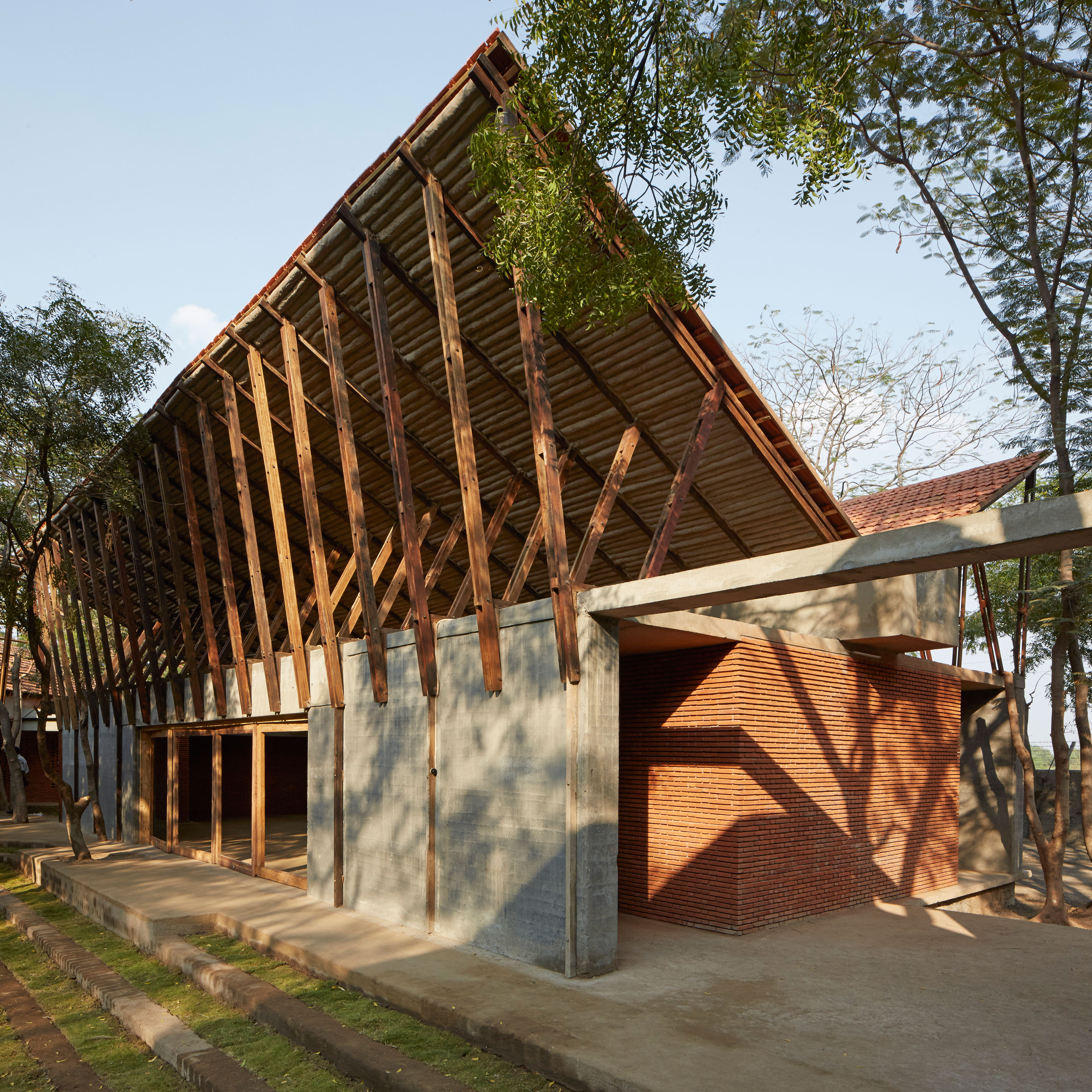
Volcanic stone dust was used to build the walls of this Buddhist education and meditation centre, designed by Sameep Padora & Associates for a woodland clearing in rural India (photos by Edmund Sumner + slideshow). (more…)
Volcanic stone dust was used to build the walls of this Buddhist education and meditation centre, designed by Sameep Padora & Associates for a woodland clearing in rural India (photos by Edmund Sumner + slideshow). (more…)

Chorus is a private home located in Taipei, Taiwan. Completed in 2016, it was designed by Ganna Design. Chorus by Ganna Design: “Advantage: The acreage of this project provides more flexibility to arrange rooms. Sufficient natural illumination in the house makes lighting design easier. Also, since it is in 11th floor in a high rise, the window view is one of superiority. Disadvantage: There were too many scattered corners in..

From the architect. This vacation beach house located near Cape Town, South Africa, is carefully crafted to respond directly to the brief from the client, a maverick businessman from Johannesburg. Primary requirements were to create an extraordinary living experience, conceptually capture the client’s brief to create a single space vacation house and fully embrace the remarkable seaside location.
Capitalizing on its unique context with panoramic views across the Atlantic Ocean, the house is thus conceived as a minimal steel framed glass box with a hull shaped hardwood clad roof to facilitate distant views to the surrounding mountains. All the external walls are frameless sliding folding glass doors and are filtered by slatted hardwood shutters which open hydraulically to become verandas when open and a continuous secure screen when closed. To ensure minimum environmental intrusion to the sensitive fynbos vegetation and dunes that form the site, the house is elevated to allow the fynbos to be extended under its footprint. All interior walls dividing living and sleeping spaces are sliding ash clad doors which slide away during daytime hours to create a single large living space which flows out on all four edges on to broad cantilevered decks made of Garapa hardwood.
The effect created is thus an umbrella, connecting isotropically to the amazing environment that cradles the house. This building significantly evolves the seaside vacation house typology by dematerializing the notion of cellular space, burring the traditional regime of private and semi-private space and offering variant connection and refuge. The house is counterpointed by a freestanding elevated pool and subterranean entry court and garage clad in unhewn beach stone and Garapa. The elongated pavilion with a floating curvilinear roof displays a minimal architectural language rendered in steel, glass, raw concrete and all powerfully juxtaposed with warm hardwoods deployed in the ceilings, furniture and all joinery to deliver an extraordinary outcome.

Dutch fashion designer Pauline van Dongen has created more clothing with integrated solar panels, designing a windbreaker that can charge wearers’ phones and GPS devices (+ slideshow). (more…)

You’re reading 9 Signs You’re Fooled by Arrogance, originally posted on Pick the Brain | Motivation and Self Improvement. If you’re enjoying this, please visit our site for more inspirational articles.
Do you remember the famous fable of the tortoise and the hare? They were having a race and the hare was obviously everybody’s favorite for champion. But because of silly arrogance, the hare ended up losing to the tortoise and became the laughing stock for everybody, including you.
Also, have you ever seen someone who is charming, likeable, and always surrounded by people as if he or she has a gravity that pulls people around him? Have you ever wondered what makes him or her so special? Let me tell you, one of the secrets is humility.
Humility is a trait that will be advantageous to you. People like being around humble people because they make them feel comfortable – they don’t need to worry about someone attempting to humiliate them or stealing their spotlight. They also make people feel good – because they don’t focus on themselves but on the people around them.
So do you possess this admirable quality or are you actually trapped in arrogance like the hare instead? Perform a personality check on yourself with the list below:
Even though you never outright say that you’re far more superior to everybody else, you constantly feel like that on the inside. You think you’re smarter, prettier, more competent, basically better than anybody else. No, not saying it doesn’t make you humble. It is the thought that counts (because, who are you kidding? You may think secretly but your attitude and behavior will give you away anyway).
To avoid this superiority complex, think about this: no matter how much better you are than everybody else right now, in the end there will always be someone that will be better than you. Think about everybody’s good points and accomplishments. They maybe aren’t as grand as yours, but still, it’s impossible for you to have all of everybody’s good point and accomplishment. Everybody has advantages as everybody has flaw, including you.
When you’re being arrogant, you want to make everything a competition, because you’re hungry for glory. Even something as warm and as mundane as greeting, you treat it like a competition. You think you’re better than everyone else, so they should greet you first and not the other way around. You feel like if you greet them first, you’re acknowledging that you’re inferior to them. So, you never acknowledge your colleagues except when they do it first
Well, surprise, you have it backward! In social interaction, the better person is always the one who greet first. It is because greeting other first makes the other feel respected and valued. In turn, they will reciprocate the respect. It also improves the likeability of someone.
Now, to get rid of this mindset, shift the direction of your competition. If before it was all about power play with the other, now it’s all about who can greet others first.
Of course, sometimes there are times when we feel like we’re surrounded by idiots all around and we need to ignore them to stay sane. The keyword in that sentence is “sometimes”. People don’t act idiot all the time although sometimes they look like they do. For example when they keep pestering you with question like “is it true the killer boss is actually afraid of his wife?” when said boss is waiting for you to finish your report in 15 minutes.
But, most of the time people are talking about small thing like the weather, their favorite food, or their children. It is normal and it is not stupid. Arrogant people think these kinds of conversation are beneath them and always ignore other people’s attempt to include them in the conversation.
Ask yourself: when did the last time you listen to people? You may say “oh, just several minutes ago”. But did you really listen to what the other person said? Did you wait until the other finish and then respond accordingly? Arrogant people tend to dismiss the importance of listening to other people until he or she finish their sentence. They think they’re so clever they can deduce the rest of the sentence themselves. That or they think the other person is unimportant so the less they talk the better.
Now every time you have a need to interrupt, hold yourself. Bite your tongue if you need, but train yourself to listen before you respond. People will feel like they were respected and in turn will trust you.
Ah, this is such a humanly trait. Everybody likes to talk about themselves, but if you like it a tad bit too much than other person, then you’re probably being arrogant. Try to notice how many times you mention the word “I”, “my”, and “me” in a conversation. Notice whether you automatically respond every story told by your conversation partner with a story about yourself like “oh so you went to Spain last summer? I went to Italy. Let me tell you what I’ve done there!”
Now, imagine you’re the other people conversing with yourself. Would you like to talk with yourself? Imagine how annoyed you’d be when you’re trying to talk about an important subject but your conversation partner keep talking about himself? Remember his story and start responding the story with inquiry about your partner, not with another story about yourself.
You think you are truth and therefore all the things coming out from your mouth are truth. When it is proven otherwise, you will go out of the way to prove that you are right, or at least partly right. You can never, never ever live in the reality where you’re proven wrong.
This kind of mindset is surely not good for your ego. Learn to admit that people make mistake and it’s completely normal. Understand that people won’t look down on you just because of a small mistake. The root of arrogance is actually your fear of not being the right one. You’re afraid people will shun you and humiliate you. But remember, making mistake is human and admitting mistake is what makes you a better human being.
What is criticism? You never hear that. All you ever hear is blame instead. Every single criticism, even the most constructive one, sounds like an attempt to destroy you instead of fix you because you’re perfect and you don’t think you’re in a need of any fixing.
So your reaction to criticism every time is either ignoring it or get angry with it, sometimes both. Think again, when your friends say you should consult an interior designer before you renovate your store instead of using your own design, did you ignore them? When your colleagues told you to use a translator instead of translating that document alone, did you told them to “go mind your own business!” instead?
If you do, start to accept that criticism is people’s way to show you that they care about you, or at least your work. Learn to distinguish constructive criticism from the junk one, and you’ll be surprised at how stupid you were all of this time!
Why would you? You’re perfect anyway. It is unthinkable to you to take a moment and look objectively on yourself because what can be wrong with you? Even when you were having an argument with someone and you’re told to reflect, did you actually do it? In fact, I’m sure you think about self reflection only just now because you’re reading this.
Everybody, not just you, should reflect once in a while. Take some time to be alone and look back at your attitude. Did you do something to other people that may hurt them? Did you do something you would never want other people to do to you? When you look back, you’ll notice your mistake and you can avoid the same thing to happen in the future.
Imagine yourself winning an award with your team. Do you see yourself receiving the award alone representing your team? Do you see you and your team go to the stage together to receive the award? Do you see yourself letting other team member receive the award? When you’re being arrogant you’ll find much difficulty imagining that you have to receive the glory with other people. You think they don’t deserve the award because the success is purely because of your existence in the team, right?
But actually, people don’t become arrogant because they think they’re superior to others. In fact, they’re only afraid people’s attention won’t be focused on them but on their other mates. That’s why they want to hog all the spotlight themselves.
If you’re feeling exactly like this, then you need to learn to be confident. Understand that when you’re working in a team, everybody has their strength amd weakness. You’re not superior or inferior to your mates, and then understand that people can recognize brilliance. Even if you’re not the one giving the speech, if you really contribute yourself in your project, people will recognize you signature in the project. And remember that the spotlight on the stage does not get shinier or dimmer depending on the number of people on the stage.
So, do you think you have either one of those signs? Or do you recognize someone with those signs? Carry on the conversation on Facebook!
You’ve read 9 Signs You’re Fooled by Arrogance, originally posted on Pick the Brain | Motivation and Self Improvement. If you’ve enjoyed this, please visit our site for more inspirational articles.


Before design:
An unsophisticated scene is needed to stage a gentle encounter. How to paddle a mood to allow you to feel shuttle-like light and shadow? How to weave a wave of forest to allow you to purposely sway with wind? How to brush the outline of water expressions to allow you to experience the lingering breath freely, as ripples but indescribable.
Qiandao Lake is a blessed place surrounded by myriad mountains. In the past few years, the developer has a crush at this place, and the buildings of this project – 12 soho-style villas designed by German GMP, have already been completed two years ago. However, by cherishing this landscape, the develop is very careful about this investment. Till the beginning of 2014, the developer finally decided to build a self-managed boutique resort hotel here after multiple considerations, which unveils the designer’s fate with it.
Architecture – the 12 buildings uphold the consistent German route of GMP, clean, simple and tidy. Each two-storey building covers an area of 300 m2 and rests firmly half way up the hill, half hidden, half revealed. Overlooking the water and sky, it seems to be both harmonious and independent. This premise, is more challenging than the limited time for design and construction that required by the developer.
Creation:
I am not talking about anything about the style of the hotel, but just imagine the feeling at the moment when it leaps to the eyes. I cannot define the elegance or grandeur of the external landscape, but turn my sight and sense to a microcosm into the space. As the space is a drawing board, and I am a painter to paint what I saw into the frame.
Frame and painting, stage and protagonist
As mentioned earlier, the architectural style is modern and simple, in combination with the limited time that requested by the developer, the designer proposed that the hard decoration should be simple. Therefore, the canvas and stage starts with the pure and clean base. The white floor and the simply whitewashed wall will straightforwardly bring out the interior and exterior dialogue to be staged here, an imaged landscape, and a play without words.
The focus of the design logic is to express the form of each set of furniture, and every detail of the expression. Furniture is the protagonist of the play. In the lobby, we have caved two leaf boats out of real wood. One of the boats is dangling and floating in the air with a support, like being filled up water here. Oars are artistically screen and ornaments, complemented with the “floating chair” as upright as lotus. Meanwhile, the suspended ceiling is made of the grid weaved with the locally produced thin bamboo. Trough the light, the bamboo shadow casts on the white wall. In such a way, create the artistic conception of boat floating on the water. In the restaurant, we embed the withered twig on the surface of the table, in combination with the interaction of light and shadow, to create the feeling of mountain forest.
In each guest room, the moment fluctuation of pebble touching water embodies in the form of sofa and spreads out several rounds of graceful arc as ripples, which achieves the dynamic and static state of water in the space. We selectively look for a tree, a vine, a pebble, and a creel and carefully put them to their due places as the destined emergence to fill out the primary and secondary roles of the entire composition.
The overall design is wood- and bamboo-based, to express an ecological sense. With dominate tone of pure white, it highlights the tranquility brought by wood, and also reveal a succinct and contemporary fashion.
Epilogue
The dynamic state is mixed and integrated with static state to indicate the mutual spread of dynamic line and static things. The primitive simplicity and the exquisite carve is crushed by each other. The native texture coexists with the artificial whitewash, to draw a fantasy landscape in the mind of the designer.


The collaboration of Selyong Kim, Yongwon Kwon, Seongyen Hwang, and Wonyang Architecture has won second place in the International Ideas Competition for Establishing Busan Station as The Cub of Creative Economy in Busan, Korea. The competition sought out proposals to revitalize the original downtown area, Busan Station is the starting point for a larger Busan North Port redevelopment project.
The second place proposal aims to reprogram the existing plaza of Busan Station Square with adaptive reuse, in order to create a new public space, including many activities centered on film.
By converting the existing structure into a film-based space, the proposal seeks to cultivate a place for culture and fun, which additionally creates jobs, all without compromising the existing plaza.
Learn more about the project here.
News via Selyong Kim, Yongwon Kwon, Seongyen Hwang, and Wonyang Architecture.
 Sig Nordal