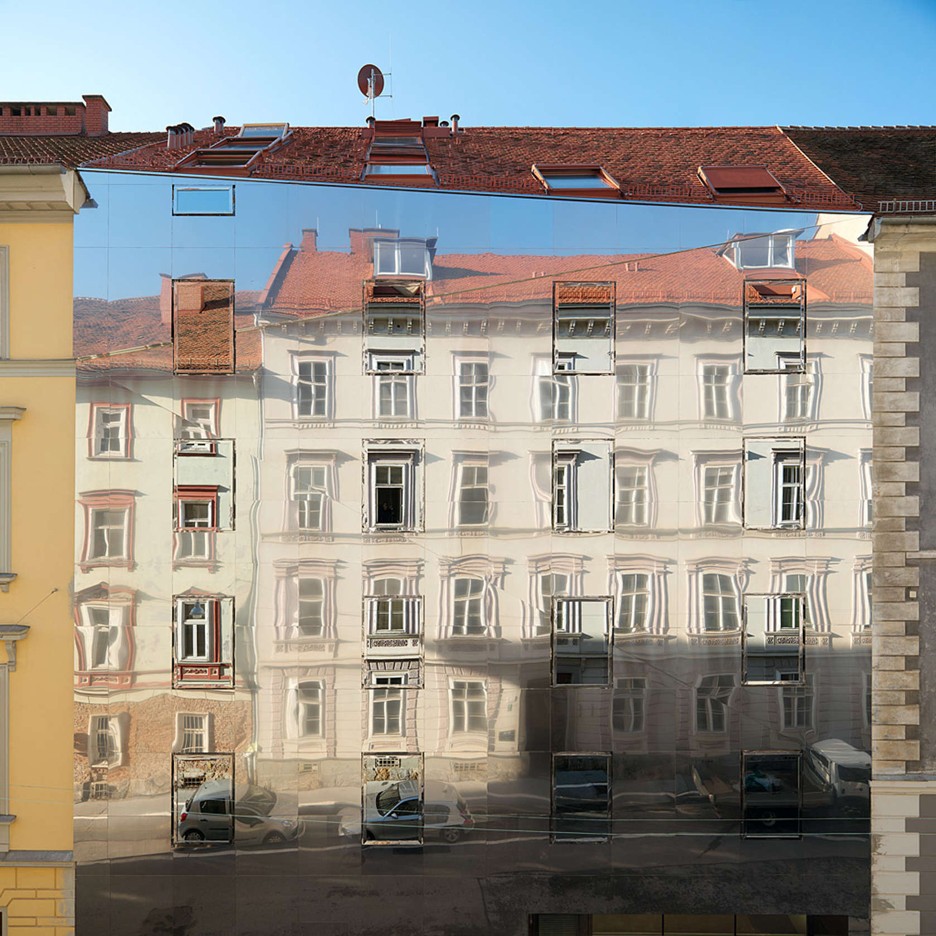
A+Awards: next up in our collaboration with Architizer‘s A+Awards is an apartment building in Austria that is covered in mirrors to reflect the facades of surrounding historic buildings. (more…)
A+Awards: next up in our collaboration with Architizer‘s A+Awards is an apartment building in Austria that is covered in mirrors to reflect the facades of surrounding historic buildings. (more…)


Urban Cabin is a residential project designed by Suyama Peterson Deguchi in 2012. It is located in Seattle, Washington, USA. Urban Cabin by Suyama Peterson Deguchi: “Urban Cabin was designed for a retired couple interested in downsizing and simplifying their lives. The couple lived on the site for 26 years, creating and nurturing their private yet urban sanctuary. The challenge was to design an appropriate response to the ideals of..

Te Oro is a creative facility for young people from the communities of Glen Innes and Panmure. Te Oro emerged from the community itself, supported and funded by Auckland Council. Its purpose is to encourage the creativity of local cultures, both as performers and to impart knowledge; and to create a sense of pride and identity as a catalyst for social renewal. The design process was open and collaborative, involving local artists, cultural advisors, mana whenua, environmental and landscape specialists and the community itself, empowered to make every design decision possible.
The site, a carpark adjoining Line Road, terminates a “finger park” following a traditional pathway from the Tamaki River to higher ground. The design enhances the public realm and built environment of Glen Innes. A Master Plan for the whole precinct was developed. The community advocated strongly for the new building to adjoin the Ruapotaka Marae, the Library and the Hall – this was characterised as a “body of buildings”.
The Master Plan ties these buildings together around a new public “shared space” (yet to be constructed) which facilitates both pedestrian and vehicular use, whilst enhancing the spatial experience with landscape and street furniture. The precinct is tied together graphically by a “manaia” imprinted on the land.
The architecture resonates with traditional south-west Pacific buildings. The cross-section of paired columns and superstructure responds on plan to the dynamic of the pathway, deferring to the marae, and is delineated by a series of facetted LVL timber portals. This rhythm of “ribs” is inclined northward, to maximise the efficiency of the roof-mounted PV panels and is clad in an abstracted canopy of foliage.
This layering of ideas means Te Oro is interpreted by the community in multiple ways – a traditional place of learning and tuition; a grove of trees; an adzed log, a modern “fale”; an anthropomorphic “creature”, a giant tree-house or a musical instrument. In all these interpretations, Te Oro retains its sense of being “New Zealand Pacific” and completely specific to its people, place and time.
Local artists were commissioned to create signage and “sound-sites” which combine traditional and contemporary music, visual art and space through an assemblage of “sound cones”, CNC carved column panels and kowhatu.
The 1485m2 building has a strong environmental agenda, with the roof surface covered in 256 PV panels, which make Te Oro “Net Zero Energy”; rainwater harvesting, above-code insulation, double glazing, heat pumps, and LED lighting; all reducing operational cost.


This past weekend, the Bauhaus in Dessau was animated by the Bauhaus Festival. Titled “Circus, Circus – from Black to White,” the event was intended to present all the fun of the fair with a monochrome twist–in opposition to the wild colors usually associated with circuses–and in the words of the Bauhaus was a “kinetic explorations of bodies, objects, media, space and sound.” The event was also an opportunity to tap into the legacy of Bauhaus legend László Moholy-Nagy, whose experiments in film and media blend well with the performative nature of the circus. The event featured a number of performances by artists, while “Cybernetic Circus” by Anhalt University of Applied Sciences and the Initiative Neuer Zirkus turned the grounds of the Bauhaus into an “architectural landscape” of performance modules inspired by Maholy-Nagy. Also featured were installations by students at Burg Giebichenstein University of Art and Design Halle titled “Neo Luna Park.” Photographer Laurian Ghinitoiu traveled to the event to capture the festivities, showing their interaction with Walter Gropius’ famous building.

The starting point in creating the interior was the investor’s collection of paintings, antique furniture and extensive library of books. The apartment was divided and furnished in order to expose these items, but in such a way that they do not compete and do not dominate the space. All the new furniture pieces are very minimalistic and free of any visible details. The books have been closed in double-sided bookcases, which also serve as separators of the communication area and they also contain a bio fireplace and a TV set. The kitchen was also designed in a minimalistic way and all the appliances have been hidden in closets.
The entire system of walls and furniture was designed in such a way that spectacular window view of nearby lake and park can be seen from every place in the apartment. For this purpose, we also decided to give up on traditional doors in favor of full-height sliding doors, hidden in the walls – so that we gained even more open space.
The openwork wooden ceiling was designed to direct attention towards the view outside the window, to improve the proportions of the rooms and to add warm atmosphere.
The starting point in creating the interior was the investor’s collection of paintings, antique furniture and extensive library of books. The apartment was divided and furnished in order to expose these items, but in such a way that they do not compete and do not dominate the space. All the new furniture pieces are very minimalistic and free of any visible details. The books have been closed in double-sided bookcases, which also serve as separators of the communication area and they also contain a bio fireplace and a TV set. The kitchen was also designed in a minimalistic way and all the appliances have been hidden in closets.
The entire system of walls and furniture was designed in such a way that spectacular window view of nearby lake and park can be seen from every place in the apartment. For this purpose, we also decided to give up on traditional doors in favor of full-height sliding doors, hidden in the walls – so that we gained even more open space.
The openwork wooden ceiling was designed to direct attention towards the view outside the window, to improve the proportions of the rooms and to add warm atmosphere.

(adsbygoogle = window.adsbygoogle || []).push({});
Catching people’s attention and making them listen to you can be a tough job, particularly if they don’t see you as an expert in their areas of concern. In case you’re wondering how you can make them recognize your expertise, here are six things you can do.
See Also: 7 Convincing Reasons for Working as a Freelancer
Before you can make people listen to you, you have to pay close attention to them first. Even if you know more than they do, it’s best to keep quiet and wait for the other person to finish his speech.
(adsbygoogle = window.adsbygoogle || []).push({});
As you sit quietly, it’s essential to build on your presence. Sit straight and focus on the person speaking. It’s also important that you maintain eye contact to make the other person feel that you’re paying close attention to what he’s saying.
//<![CDATA[
aax_getad_mpb({
"slot_uuid":"16dcbcd0-2124-4a85-9abe-c263dd9084e5"
});
//]]>
Even if you are just sitting, you have to make other people feel your presence.
Whether you are speaking to a small group or a large audience, you should make it a point to begin your talk with something of extreme interest. You can provide some amazing data or statistics or quote a revered expert in the field.
The first words that will come out of your mouth can greatly affect the impression you create to your audience. If you are able to catch their attention right from the start, there’s a good chance you can keep them engaged throughout your speech.
(adsbygoogle = window.adsbygoogle || []).push({});
As an expert, your audience will believe everything you say. Because of this, it’s critical that you only provide factual information to your listeners. It can also help if you can provide supporting data and documents to back up your claims. Aside from building credibility, using research, logic and analysis in your presentation can make your talks more understandable, too.
Given the huge amount of content on the web and the sheer numbers of blogs out there, you will easily be able to find people who have the same area of expertise as you. Building a connection and reaching out to these people can help you develop your reputation more.
(adsbygoogle = window.adsbygoogle || []).push({});
You can study and read their posts. You can also do your own research and establish your own writing style before you start submitting your work and name to their sites. It’s helpful if you can plan ahead and set specific goals, too.
Decide on the number of posts you can write within a certain period and plan your work schedule based on that time frame. Since rejections should be expected from time to time, you need to make sure your articles are of top quality before submitting them. Here are some tips to ensure your posts get published:
• Write a catchy title.
• Start with a “bang.”
• Use short sentences and break long paragraphs
• Cite experts and link to your sources
• Invite readers to comment on and share your post
• Use casual writing style
One of the best ways to promote yourself is to have your own brand. Creating your own website or blog can give you more chances of reaching out to people to share your expertise in your field. In maintaining your site, it’s best if you can keep it updated with current information. People are likely to follow experts that can keep them up to date.
Much like teachers who work hard to earn the respect of their students, you should also learn how to establish a relationship with your audience. Before these people can listen to you, they must first like you. Once you’ve established a good relationship with them, they’ll be more than willing to pay attention to what you have to say.
(adsbygoogle = window.adsbygoogle || []).push({});
See Also: 4 Motivational Triggers to Get You Started Right Now
No matter how knowledgeable you are, do not establish yourself as a self-righteous authority who has all of the answers. Instead, you should express genuine interest in establishing good relationships first. This is especially important in a work environment that is based on teamwork. In short, people listen to people they like.
(adsbygoogle = window.adsbygoogle || []).push({});
(function(d) {
var params =
{
id: “cb4f919c-04fa-460c-b2ff-2c7f9ecf4472”,
d: “ZHVtYmxpdHRsZW1hbi5jb20=”,
wid: “165294”,
cb: (new Date()).getTime()
};
var qs=[];
for(var key in params) qs.push(key+’=’+encodeURIComponent(params[key]));
var s = d.createElement(‘script’);s.type=’text/javascript’;s.async=true;
var p = ‘https:’ == document.location.protocol ? ‘https’ : ‘http’;
s.src = p + “://api.content.ad/Scripts/widget2.aspx?” + qs.join(‘&’);
d.getElementById(“contentad165294”).appendChild(s);
})(document);
The post 6 Things You Can Do To Get People To Listen To You appeared first on Dumb Little Man.