Batz sur Mer, Francephoto via valerie

Batz sur Mer, France

photo via valerie

OJI House / Kenta Eto Atelier Architects


© Toshiyuki Yano

© Toshiyuki Yano


© Toshiyuki Yano


© Toshiyuki Yano


© Toshiyuki Yano


© Toshiyuki Yano

  • Building: Hikari Sougou
  • Structure: Kuroiwa structure design

© Toshiyuki Yano

© Toshiyuki Yano

It is a house with its exterior wall cut off at an acute angle for the relationship with the surrounding environment. Plants gently define the boundary and link the house with its neighborhood.


© Toshiyuki Yano

© Toshiyuki Yano

The site is located in Oita prefecture, slightly away from the center of Oita city.  It is situated at a low ground area coming down from a rise in a dense residential area with many detached houses and public buildings.  In front of the site, there is a street in 4m wide, which diverges into the west and east directions and affects the shape of the site. It was necessary to think about the living in a valley-like condition with such surrounding conditions as the narrow yet heavy traffic streets, condensed houses and public buildings in the east and west sides of the site.  Considering owner’s privacy, we placed a living room and water section on the second floor as a public zone, while bedrooms and other private spaces were located on the first floor. Openings on the first floor level were minimized for security reason.  In addition to the basic plan configurations, we sorted out the conditions of those enriching external elements to be layered, such as openness, day lighting, natural ventilation, and borrowed scenery.


Plan 1

Plan 1

Tall west-side wall is built for privacy against the adjacent house across the street, to the height not to lose the sight of wild cherry tree on the rise.  On the east side—since cherry blossom trees line up at the boundary of the public building, and the street on the east is about 80cm lower along the site, opening is provided for the living room on the second floor level to enjoy the view of those cherry blossoms.  Daylight can be taken in from the corner of the site facing to the fork road on the south side because there is no adjacent house.  By creating a courtyard as a buffer zone, daylight and wind can come into the interior space.  We also planted trees at the boundary of the courtyard to connect the house gently with surrounding environment (neighborhood).  Those trees are rather a part of the building translated into the element for the expression of the house— in this case, it is a lattice-like element, or used as screen—than typical vegetation of a house


© Toshiyuki Yano

© Toshiyuki Yano

Section

Section

© Toshiyuki Yano

© Toshiyuki Yano

By doing so, this building, with acutely cut off expression, detaching itself from the surrounding environment, can still connect itself with the surrounding environment (neighborhood) in gentle manner, as the expression of the house changes when the trees move or grow.  Our aim for the interior space was to create rich spaces through the borrowed scenery with courtyard trees and cherry blossoms trees to be viewed beneath the living room on the second floor.


© Toshiyuki Yano

© Toshiyuki Yano

http://ift.tt/2bWp0Ey

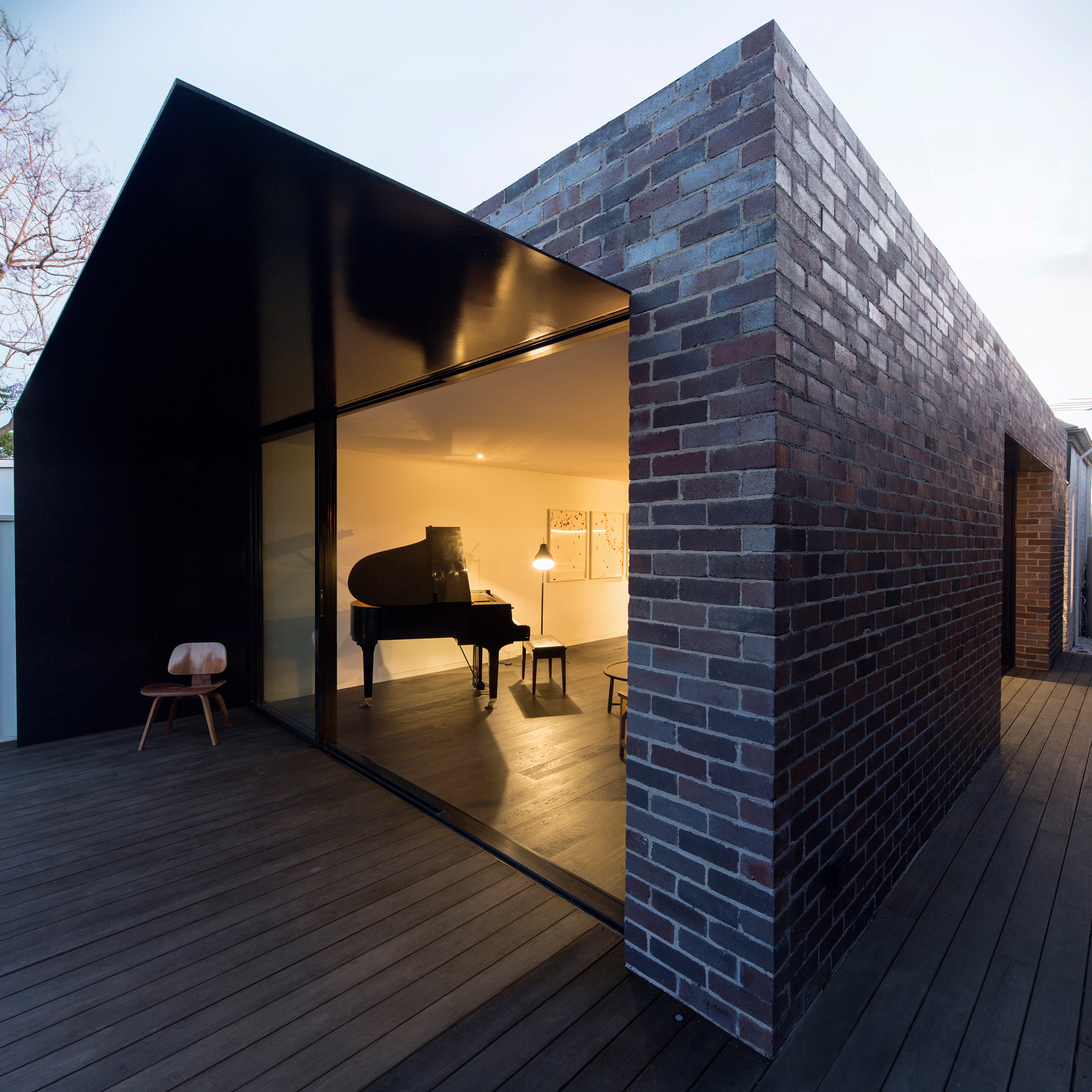
Dark-toned extension added to white Federation house in Sydney by Studioplusthree


Architects office Studioplusthree has overhauled a traditional house in Sydney for a pair of musicians, adding a recycled-brick extension that features a projecting black steel awning. (more…)

http://ift.tt/2cqUlif

Mælifell is a beautifully shaped mountain placed on in the…

Mælifell is a beautifully shaped mountain placed on in the Highland in Iceland. It is in a middle of a large black sand area behind Mýrdalsjökull, the glacier that houses the sleeping and scary volcano Katla. 

The altitude of the sand is approximately 600 meters, and Mælifell is about 200 meters, a bit less than 800 meters above sea-line. But despite the fact that the mountain is in the cold highland it is covered with vegetation that makes it unique when standing in the middle of the black sand

Abandoned buildings by PiotrekTM http://flic.kr/p/9twNww

via Abandonedforgotten http://ift.tt/2cfKWe6

Poetic Lab’s faceless Silo Clock shifts shape throughout the day


Maison&Objet 2016: London studio Poetic Lab has designed a clock with sculptural hands that form different shapes as they turn (+ movie). (more…)

http://ift.tt/2bP0lpq

Hassell Unveil Design for Geelong Performing Arts Center


Courtesy of HASSELL

Courtesy of HASSELL

HASSELL has unveiled a contemporary new addition to the Geelong Performing Arts Centre in Geelong, Australia. Just over an hour south-west of Melbourne, the complex is a significant hub for the growth and promotion of the arts in regional Victoria. Over its illustrious 35 year life, it has built a reputation as one of the premier performing arts spaces in the state, and the $38.5 million upgrade will cement its prominence.  

The redevelopment centers around a new entrance and facade, completely redefining the building’s street presence. Contemporary and sleek, the addition sits atop the current building at an angle parallel to the existing roof pitch. The new entrance also provides a crucial upgrade to the building’s accessibility and amenity. 


Courtesy of HASSELL

Courtesy of HASSELL

The expansion will also include rehearsal facilities, new dance studios and provision for creative industries offices. As the only state-owned arts centre outside Melbourne, Geelong Performing Arts Centre will not only be a landmark destination it will also service the needs of the growing creative and cultural community, said Mark Loughnan, HASSELL Principal and Head of Design in a press release.


Courtesy of HASSELL

Courtesy of HASSELL

Construction is scheduled to begin in mid-2017 and stage 2 is slated for completion in late 2018.

News via HASSELL.

  • Architects: HASSELL
  • Location: 50 Little Malop St, Geelong VIC 3220, Australia
  • Project Year: 2016
  • Photographs: Courtesy of HASSELL

http://ift.tt/2c4ppGu

The Marvellous Benefits of Mindfulness

You’re reading The Marvellous Benefits of Mindfulness, originally posted on Pick the Brain | Motivation and Self Improvement. If you’re enjoying this, please visit our site for more inspirational articles.

what is mindfulness

what is mindfulness

Over the last thirty years, mindfulness has become a popular part of medicine and psychology.  However, mindfulness has been around for much longer and has its roots in Buddhism.  It has come a long way from the remote corners of the world to being a wide spread practice today that is gaining in popularity every year.  Mindfulness is the practice of zoning in on oneself in order to become aware of being self-aware.

It is the clear realization of what you are doing in the current moment without any objective or judgment based on the thoughts that traverse your mind at the time.  It is simply a lucid awareness of what your mind and body are doing in the present moment that enables you to gauge the effects on your body caused by the current neural and physical conditions.  Once you have developed an understanding of the resulting impact on your body you can devise remedial actions to counter any negative effects.

Mindfulness has proven valuable in almost all forms of human activity where stress and other neural conditions have a negative affect on life and can also be beneficial to treating some physical conditions to ease pain and bodily discomfort.  Mindfulness is particularly being used within the workforce and has been adopted by many high profile global companies to counter and prevent the mental injuries of stress and anxiety of their employees.

It is particularly useful under distressing situations when self-control is critical to the success of an operation or activity.  The practice of mindfulness in a distressing situation allows the person to dislodge themselves mentally from the thoughts and stresses related to the situation and review their mental state from a higher plane; kind of like looking down on oneself from outside the body.  A good way to start is to focus on your breathing when you first sit down to work.  Use the first five to ten minutes of your day to calmly control your breathing and clear out your head; create a clean mental slate.

It is easy to get caught up in many work activities and most people naturally become embroiled in multi-tasking.  Some people believe that multi-tasking is a skill that strong employees should exhibit, however, the truth is that multi-tasking is inefficient and increases stress levels.

Multi-tasking also increases the risk of errors, which in turn heightens stress when having to set about rectifying the errors, usually to a deadline.  This is why mindfulness preaches focusing on just a single task at one time.

Learn to prioritize your workload and concentrate on accomplishing one task at time.  If an urgent issue arises which requires your attention, drop your current task and move onto solving the urgent issue first; don’t try to manage both.

Your mind will be lighter and will not have to shift frantically from one topic to another.

Be aware of what you are doing and your surrounding and focus on your breathing.  Try to do things in a slower pace when possible and concentrate on your posture.

Focus on the now and don’t consider the future.  This means focusing on the job at hand and not worrying about future tasks.  Again, this alleviates your mind of stress because it removes excess thoughts that can slow down your efficiency and also cause anxiety.

Creating a daily schedule that allows ample time to complete each daily task is key here.  Companies are constantly demanding more for less and the pressure on employees to deliver more is growing, however, you are in control of what you do and should plan your day in a manner to avoid high levels of stress, which in turn will decrease your productivity when it settles in.

Create expectations with your boss, which are reasonable and provide them with justification to support your schedule.

When to practice mindfulness?

Practice mindfulness whenever you have five to ten minutes free and if you have a busy daily schedule create time for yourself.  It can be in bed before getting up.  Lie there for five minutes and clear your thoughts and focus on your breathing.

Be aware of being awake and close your eyes.  Feel your body lying on the bed and how the bed feels on your body.

You can also practice mindfulness while in your car at a red light for a minute.  Breathing is key and basis for effective mindfulness.  Mindfulness can also be used while eating.  Eat slowly and taste your food.  Be aware of each gulp.  You’ll also digest the food better and eat less.

Try to practice mindfulness daily.  Detach yourself from the stresses of heavy thoughts that weigh down your mind and buzz through your body by zoning out of the river of raging thoughts and becoming self aware of how these thoughts are affecting your mind.  Remember to breath slowly when reflecting and go about things calmly.  Mindfulness takes practice and you’ll improve over time, but it will definitely make your life easier and give you a sense of control and inner peace.

You’ve read The Marvellous Benefits of Mindfulness, originally posted on Pick the Brain | Motivation and Self Improvement. If you’ve enjoyed this, please visit our site for more inspirational articles.

http://ift.tt/2czLm2o