New Orleans – Louisiana – USA (by walker.s) 

New Orleans – Louisiana – USA (by walker.s

7 Things Every Partnership Agreement Needs to Address

Businesses set up as partnerships, legal entities where two or more people own and run a business, enable companies to benefit from multiple owners’ diverse knowledge, skills, and resources. A partnership is similar to a sole proprietorship, and each partner owns a portion of the business’s assets and liabilities.

With more than one person making decisions and affecting outcomes, different aspects of starting and running the business need to be addressed up front. Although not required, I strongly recommend that partnerships have a partnership agreement in place to detail the business ownership and responsibilities of partners. The clearer and more complete the agreement, the less that is up for debate or disagreement when partners don’t quite see eye to eye.

So, what should your partnership agreement include? Here’s a list of some key items you should definitely think about addressing in yours:

1. Contributions

Make sure you clearly lay out each partner’s stake in the formation and ongoing finances of the business. How much will each partner contribute to start the business and what will each partner’s responsibilities be for future needs? In your agreement, define what each partner will put forth—not only in the amount of money, but also with regard to time, effort, customers, equipment, etc.

2. Distributions

You’re all in the business to make some money and create and sustain a comfortable life, right? Your partnership agreement should detail how the partners will split your business profits? How much will each partner get paid and who will get paid first? Outline not only how profits will be distributed, but also define if each partner will be paid a salary (and of course how much that salary will be).

3. Ownership

What if something changes with regard to ownership of the business? If you sell it, which partners will get what? What is your partnership’s position on taking on new partners? If one partner wants to withdraw from your business, what happens then? What are the options for buying out another partner? Your agreement should carefully describe how ownership interests would be handled in various scenarios like those and others, such as in the event of any partner’s death, a retirement, or bankruptcy. And to protect your business from a partner leaving, setting up a new company, and stealing your customers, you should also consider adding in a non-compete clause. Better safe than sorry!

4. Decision Making

I can’t emphasize enough how important this is! Trust me, you and your partner(s) will not agree wholeheartedly about everything. You need to define how day-to-day management and long-term decisions will be made. Who gets the last say? Identify what types of decisions require a unanimous vote by partners, and what decisions can be made by a single partner. By setting up a decision-making structure that everyone understands and has agreed to, you’ll have the foundation for a more friction-free business.

5. Dispute Resolution

Ugh! No one wants to think about this, but you should. If things get ugly between partners, how will disputes be handled? Your partnership agreement should define the resolution process. Should mediation be the initial step? Will you require arbitration to settle differences? Keep in mind that if a dispute goes to court, lawsuits become part of public record. Setting up how you’ll handle disputes will take the guesswork out of navigating dissention.

6. Critical Developments

Sometimes, the unexpected happens. It’s what makes business so exciting—and unnerving at times. Your partnership agreement should address possible scenarios and concerns, such as:

  • A partner getting sick or dying—What happens then?
  • A buyout—How will the business be evaluated (and what is the split) if an offer is laid on the table?
  • Retirement provisions.
  • Circumstances under which you can modify your partnership agreement—and the process for making changes.

These are the most common issues. And there are numerous others you should think about.

7. Dissolution

Your agreement should also include what steps should be taken to legally end your partnership. You might opt to do this if you and your partners can’t agree on the future of your business. Also research what your state requires to dissolve partnerships. State law governs dissolution and your state’s website should define the process and provide the forms you need to complete.

How to Craft a Partnership Agreement

If you do an Internet search for “partner agreement template,” you’ll find a number of samples you might use as a starting point. I suggest getting professional legal help when drawing up your partnership agreement. That will ensure it’s as complete as possible. You’ll want a very detailed agreement that leaves no shades of gray, so each party understands the conditions and requirements.

Well Worth the Time and Effort

Yes, developing a partnership agreement takes some time and some money, but it’s well worth the peace of mind to know you and your partners are on the same page and have the same expectations and understanding about how your business will operate. After several discussions and just a little paperwork, you’ll have a contract that can spare you from potential legal battles and significant hassle in the future.

The post 7 Things Every Partnership Agreement Needs to Address appeared first on AllBusiness.com

The post 7 Things Every Partnership Agreement Needs to Address appeared first on AllBusiness.com. Click for more information about Nellie Akalp.

http://ift.tt/2cLCq5b

The Catalyst to Innovation: 3 Ways Data Changes Your Life

You’re reading The Catalyst to Innovation: 3 Ways Data Changes Your Life, originally posted on Pick the Brain | Motivation and Self Improvement. If you’re enjoying this, please visit our site for more inspirational articles.

The Catalyst To Innovation: 3 Ways Data Changes Your Life

the importance of data

Imagine someone invents a new, highly improved mousetrap and approaches several mousetrap companies with his invention. Companies love the product, but there are some problems. To produce this new model, a company would have to undergo an overhaul of its tools, production processes, marketing campaigns, and more.

But current mousetraps work just fine, and there’s no crisis of having to catch more mice, so as innovating as the new trap is, it doesn’t satisfy any unfulfilled need.

That doesn’t just apply to business and the economy. In their personal lives, many people prefer not to have to climb any hills if everything’s good and they’re comfortable in their current situation.

The problem is, for many people, things aren’t as good as they seem. It’s not always easy, but recognizing that is often the push people need to improve their lives through innovation. A person first has to identify what needs to change before changing it. Having spent most of my career working with patients and families who struggle with addiction, I’ve witnessed and understand how difficult such a realization can be.

People rarely have enough data to know something needs to change. Or rather, we rarely access that data until life circumstances force us to.

When Your Situation Could Use a Boost

In addiction treatment, it’s a common belief that addiction is hard to see, but it really isn’t. It’s just hard to see it in oneself. The person struggling with addiction may see no reason to change until others stop paying for that person’s decisions. Then, the patient is suddenly faced with the consequences of their actions, and they realize it’s time to make a change.

Not every need for personal innovation stems from something as drastic as addiction. But regardless of the reason, the steps to making effective life changes are typically similar, including:

1. Recognize that something needs improving. The first step for anyone who wants to make an effective change in his or her life is to get data. In addiction recovery, the 12 steps of recovery revolve around making a personal inventory to assess life situations. In mindfulness communities, it’s done by watching the reactions of the mind. In CrossFit, it’s done by keeping track of your reps and times. Regardless of the method, obtaining data is key.

It’s true that getting enough data to make a change can take time, and you might not think you can afford the time, given your busy life. The truth, though, is that we can’t afford not to know what’s going on in our lives. Otherwise, our lives would just get busier and our tasks more time-consuming, and we’d receive less for our investment.

2. Resolve to innovate because you want to. Using the data you’ve gathered, you should be able to see what changes need to be made. And if something can be made better, that means there are consequences to not making it better. If it’s a sunny day, enjoy it, but let yourself prepare for the hurricane that’s only three days away, too.

Will innovation make you happier and healthier? Personal innovation requires a certain amount of behavioral change, which is one of the biggest challenges in self-improvement (as well as healthcare, addiction treatment, and other life improvement programs). But health and happiness are more powerful motivators for change than fear and despair; make the decision to innovate because you want to, not just because you’re scared not to.

3. Use data to track your changes, too. You need to keep using data to track your improvement and maintain your focus. Outside of any program or supportive community, you can keep a journal to mark the changes that are too small to keep track of mentally. If you want to be more productive, write down how much time you’ve spent not working each day, and focus on closing that gap. If you want to eat healthier, make note of everything you consume throughout the day, and use the data to craft a healthier eating plan.

When helping people improve their lives, I often think of the man who fell off the Empire State Building. As he passed the 50th floor, he thought, “Well, so far, so good.” But, like in his situation, sometimes you have to ask yourself, “Are things really going that well, or is the floor rushing up to meet me soon?”

As humans, we’re inherent innovators, and there’s no problem we can’t make better if we recognize the need for change and the catalysts for innovation.

You’ve read The Catalyst to Innovation: 3 Ways Data Changes Your Life, originally posted on Pick the Brain | Motivation and Self Improvement. If you’ve enjoyed this, please visit our site for more inspirational articles.

http://ift.tt/2cZBewv

Here are the injuries most likely to keep football players out…

Sam Jacob Studio “Resurrects” Unrealized Adolf Loos Mausoleum in London Cemetery


© Sarah Duncan

© Sarah Duncan

Sam Jacob Studio has created a replica of Adolf Loos’ unrealized 1921 mausoleum in Highgate Cemetary, London, which is home to the graves of Karl Marx and Malcolm McLaren, amongst other notable figures.


© Harry Mitchell


© Sarah Duncan


© Sarah Duncan


© Harry Mitchell


© Harry Mitchell

© Harry Mitchell

Commissioned by the Architecture Foundation, the project—entitled A Very Small Part of Architecture—“resurrects” the Austrian Modernist architect’s radically simple mausoleum design for art historian Max Dvorák.

The project is recreated at a 1:1 scale using a lightweight timber frame and scaffold net, creating “a ghostly reenactment of an unrealized architectural idea.”


© Sarah Duncan

© Sarah Duncan

The title of the project is taken from Loos’ 1910 essay Architecture, in which he asserts that “only a very small part of architecture belongs to the realm of art: the tomb and the monument.”


© Harry Mitchell

© Harry Mitchell

Built within Highgate Cemetery, amongst the many monuments and memorials to the dead, A Very Small Part Of Architecture makes a different kind of memorial. Not one dedicated to a person, an event or a moment in time, not designed to remember the past but instead to imagine other possibilities, altered presents and alternative futures.

Learn more about the project here.

News via Sam Jacob Studio

http://ift.tt/2csRnIA

The terrifying Dettifoss waterfall – Iceland by GarethA …

The terrifying Dettifoss waterfall – Iceland by GarethA http://flic.kr/p/oaf2jh

http://ift.tt/2deQGbt

5 Initiatives That Show the Rise of Open Source Architecture


In architecture, perhaps the most remarkable change heralded by the 20th was the radical rethinking of housing provision which it brought, driven by a worldwide population explosion and the devastation of two world wars. Of course, Modernism’s reappraisal of the design and construction of housing was one part of this trajectory, but still Modernism was underpinned by a traditional process, needing clients, designers and contractors. Arguably more radical were a small number of fringe developments, such as mail-order houses in the US and Walter Segal’s DIY home designs in the UK. These initiatives sought to turn the traditional construction process on its head, empowering people to construct their own homes by providing materials and designs as cheaply as possible.

In the 21st century, the spirit of these fringe movements is alive and well, but the parameters have changed somewhat: with a rise in individualism, and new technologies sparking the “maker movement,” the focus has shifted away from providing people with the materials to construct a fixed design, and towards improving access to intellectual property, allowing more people to take advantage of cheap and effective designs. The past decade has seen a number of initiatives aimed at spreading open source architectural design–read on to find out about five of them.

ELEMENTAL Releases Social Housing Designs into the Public Domain


The 4 designs which ELEMENTAL released to the public in 2016

The 4 designs which ELEMENTAL released to the public in 2016

When he was awarded the Pritzker Prize earlier this year, Alejandro Aravena was praised by the jury for his part in the construction of over 2,500 units of social housing. However, for Aravena this number was clearly not enough to solve the housing crises taking place worldwide, and he used the platform of the award ceremony to announce that his firm ELEMENTAL was releasing four of its signature “half a house” designs to the public via its website, allowing people to use and adapt their ideas for other contexts around the world. This unprecedented move for a Pritzker Laureate undoubtedly raised the profile of open source architecture.

Cameron Sinclair’s Open Architecture Network


Design for a Sustainable Portable Classroom originally shared on the Open Architecture Network. Image © Drexel University Design Charrette <a href='http://ift.tt/2di93Z5 Wikimedia</a> licensed under <a href='http://ift.tt/2cVj3fA BY 3.0</a>

Design for a Sustainable Portable Classroom originally shared on the Open Architecture Network. Image © Drexel University Design Charrette <a href='http://ift.tt/2di93Z5 Wikimedia</a> licensed under <a href='http://ift.tt/2cVj3fA BY 3.0</a>

After winning the prestigious TED Prize in 2006, Cameron Sinclair, of Architecture for Humanity fame, got the chance to realize his wish of an online network for humanitarian architecture, where those involved in bringing architecture to the world’s most disadvantaged communities would be able to share their work, strategies and designs. The initiative was the first major attempt to bring open source principles to architectural design, and while the idea unfortunately didn’t gain the momentum required to sustain itself after Sinclair moved on to other ideas–the website is now defunct–the initiative was unquestionably a huge, high profile step forward for open source architecture which inspired many to follow in Sinclair’s footsteps.

WikiHouse


A 2-story WikiHouse design constructed in 2014 for the London Design Festival. Image © Margaux Carron http://ift.tt/1wZJEcG

A 2-story WikiHouse design constructed in 2014 for the London Design Festival. Image © Margaux Carron http://ift.tt/1wZJEcG

The concept behind WikiHouse taps in deeply to the recent advances made in digital manufacture. Using a construction system that requires only a CNC machine and timber sheets such as plywood or OSB, buildings can be constructed by just about anybody. With this construction system, WikiHouse pairs a website on which users can share and adapt designs for a variety of purposes. Since it was founded, the concept of WikiHouse has expanded, with co-founder Alistair Parvin taking to the TED stage to explain how the concept could become a “Wikipedia for stuff,” offering blueprints for everything from off-grid energy solutions right down to a mallet constructed from plywood to build WikiHouse structures.

Paperhouses


Tatiana Bilbao S.C.'s design for Paperhouses, The Module House. Image Courtesy of Paperhouses

Tatiana Bilbao S.C.'s design for Paperhouses, The Module House. Image Courtesy of Paperhouses

While many developments in open source architecture have focused on designs for people at the low end of the economic spectrum, Paperhouses focuses on a slightly different mission. Central to its mission is bringing world-class design to middle-class people who would otherwise probably end up with mediocre houses. In a result that would surprise some, Paperhouses has found a number of internationally-renowned architects willing to release their work via the platform; as founder Joana Pacheco has said, while some architects consider their designs as irreproducible works of art, there are many others who “embrace this idea of the participation of the people, of a collaboration between user and architect that can bring about different and interesting results.”

Bricksource


Sstudiomm's parametric patterned brick facade, which inspired their open source initiative. Image Courtesy of Sstudiomm

Sstudiomm's parametric patterned brick facade, which inspired their open source initiative. Image Courtesy of Sstudiomm

But the greatest sign of the rise of open source architecture will not be in a small number of high-profile programs, but in a groundswell of hundreds, perhaps even thousands of grassroots operations, of architects sharing their work simply for the benefit of humanity. Such is the case with Sstudiomm. After designing a low-tech way to construct a parametric patterned brick facade in Iran, they initially released the templates they used to create that facade to the public. Now, recognizing that their simple parametric process could be used to create all manner of other patterns, they have released details of the design process and founded a blog known as Bricksource, where they hope other like-minded designers will share variations on their original design. Announced without the fanfare of a Pritzker Prize ceremony or a TED Talk, this low-key approach to sharing design ideas may be where the future of open source architecture.

http://ift.tt/2cZEkRc

400 Grove / Fougeron Architecture


© William Timmerman

© William Timmerman


© William Timmerman


© Joe Fletcher


© William Timmerman


© William Timmerman

  • Client: Grove Street Hayes Valley LLC
  • Contractor: Cannon Constructors North, Inc.
  • Structural Engineer: Dolmen Structural Engineers Inc.
  • Landscape Architect: Marta Fry Landscape Associates
  • Civil/Geotechnical Engineer: KPFF Consulting Engineers
  • Mep Engineer: ACIES Engineering
  • Acoustical Engineer: Wilson Ihring & Associates

© William Timmerman

© William Timmerman

400 Grove introduces 34 residences in the heart of Hayes Valley, continuing the neighborhood’s rise as a vital, walkable neighborhood. Its prominent site at the corner of Grove and Gough streets, is one of several sites created by the removal of the Central Freeway in 2003, as part of a bold initiative to reconnect Hayes Valley with surrounding neighborhoods.


© William Timmerman

© William Timmerman

Plan 1

Plan 1

© William Timmerman

© William Timmerman

400 Grove’s design references the central mews typology, which set row houses around an internal alley that provided car access as well as a place where neighbors meet. This contemporary take replaces the alley with a landscaped common area accessible only to bicycles and pedestrians, strengthening the community focus of the open space.


© William Timmerman

© William Timmerman

Its faceted facades echo an earlier tradition: the classic San Francisco bay windows prevalent in the area. The facets angle windows capturing views of Hayes Valley’s bustling street scene and surrounding hillside neighborhoods. Most of the studio, one-bedroom and two-bedroom residences have light from two sides and an individual expression from the street, with the amenities associated with urban living.


© William Timmerman

© William Timmerman

Completed in early 2016, 400 Grove residents enjoy the advantages of Hayes Valley’s central location and easy access to major public transit stops, Civic Center arts venues, and other neighborhoods including the Mission District, the Castro, and the Mid-Market district.


© Joe Fletcher

© Joe Fletcher

Plan 2

Plan 2

© Joe Fletcher

© Joe Fletcher

400 Grove employs a variety of sustainable strategies. All units are designed with window son more than one façade providing adequate light and ventilation thereby reducing energy loads. Wood dowels on the façade …


© William Timmerman

© William Timmerman

http://ift.tt/2ds5SRP

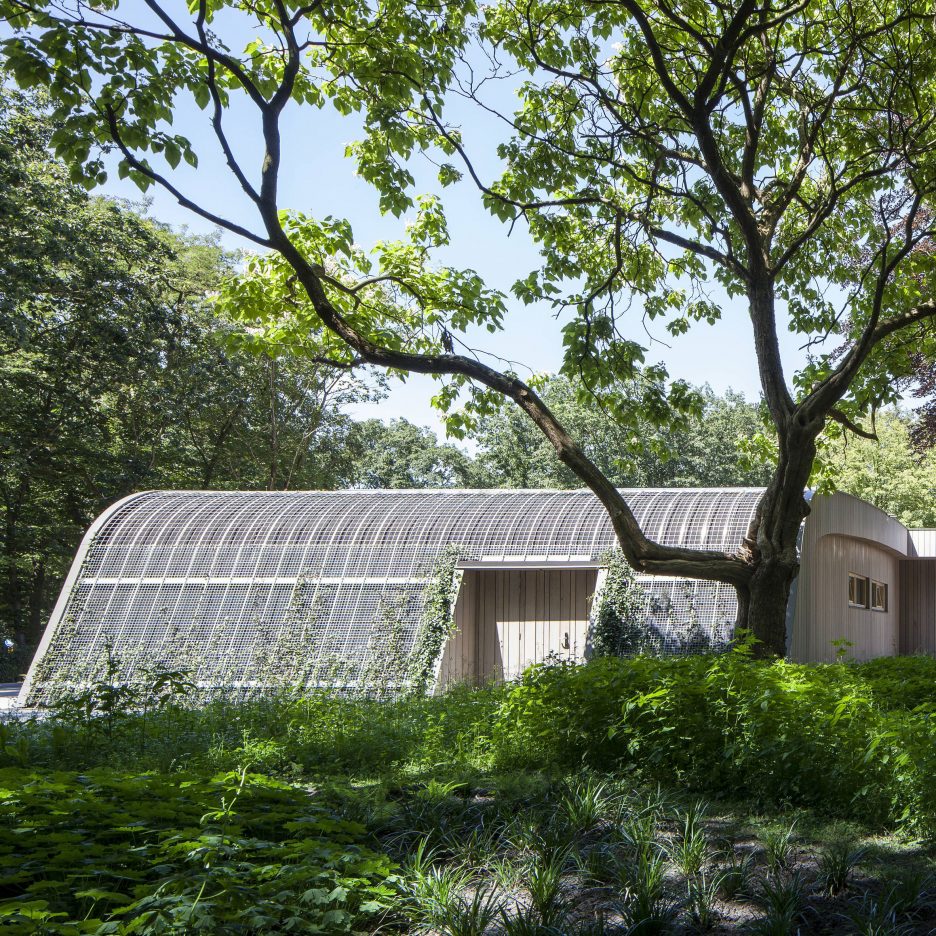
Ambulance station by Architectenforum features plant-covered walls and a curved roof


This ambulance station in the Dutch town of Zeist features a curved wooden framework and sloping walls covered with climbing plants to help it blend into its woodland setting (+ slideshow). (more…)

http://ift.tt/2csMZZX