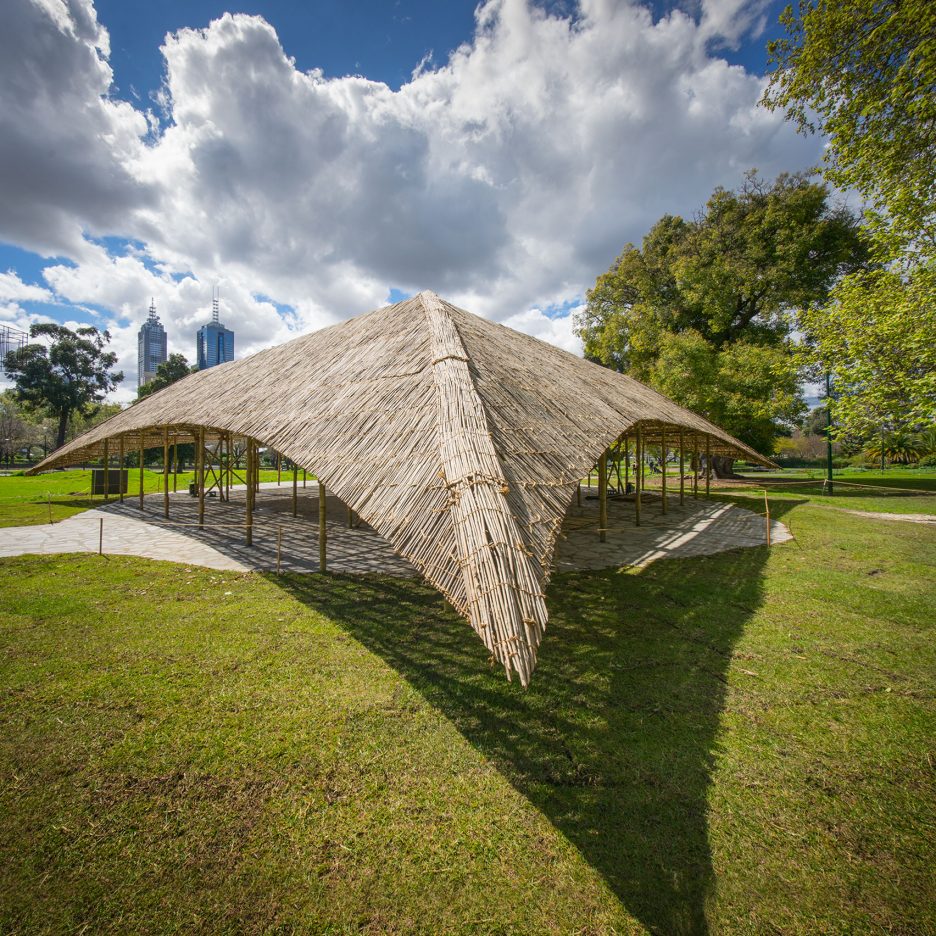
Studio Mumbai founder Bijoy Jain has unveiled his completed MPavilion in Melbourne – a square structure built from bamboo and wood, but not the cow dung originally planned (+ slideshow). (more…)
The 2016 MPavilion, designed by Indian architect Bijoy Jain of Studio Mumbai, has opened in Melbourne’s Queen Victoria Gardens. Over the next four months, the bamboo structure will play host to a free public program of over 400 talks, workshops, performances and installations.
Bijoy Jain’s design joins the growing international trend of “handmade architecture” as it becomes the largest bamboo structure in Australia, utilizing 7 kilometers of Indian bamboo, 50,000 kilograms of Australian bluestone, 5,000 wooden pins and 26 kilometers of rope to cover a 16.8 square meter area. The slatted roof panels are constructed from sticks of the Karvi plant and were woven together by craftspeople in India over a four month period.
“MPavilion is a space for the people of Melbourne to gather, talk, think and to reflect,” said Bijoy Jain. “My objective has not just been to create a new building, but to capture the spirit of the place by choosing the right materials, respecting the surrounding nature and working collaboratively with local craftspeople to share design and construction ideas.”
An large opening at the center of the roof provides a connection between earth and sky, with a golden well placed below to symbolize the importance of water to place and community. Adjacent to the pavilion, a traditional Indian ‘Tazia’ tower welcomes and directs visitors toward the shelter. At night, the pavilion will feature a lighting design by Ben Cobham of Bluebottle, coordinated with a specially commissioned soundscape by artists Geoff Nees and J David Franzke.
“Bijoy’s handcrafted MPavilion is a calming and thoughtful space which will inspire the people of Melbourne. As a utopian space for the creative industry and community, MPavilion continues to challenge the way we see and engage with the world by encouraging design debate and cultural exchange,” commented Naomi Milgrom AO, Chair of the Naomi Milgrom Foundation and project commissioner.
MPavilion’s 2016 program will include an opening public forum hosted by architect Peter Maddison along with MPavilion creator Naomi Milgrom and architect Bijoy Jain on Thursday October 6 at 6.15pm. The trio will discuss MPavilion 2016’s vision for cultural exchange and the collective construction process. A special exhibition of Jain’s work and design process will also be displayed at the RMIT Gallery from September 9 to October 22.
To learn more about the 2016 MPavilion, check out our post on the design, here. For more about this year’s programming, visit the MPavilion website, here.
Blue Bottle Coffee opened the fourth shop in Japan in Roppoingi, Tokyo. The shop is located on a back street at a distance from the busy avenue, facing a small sunken public plaza like a park where people can freely enter.
Main interior finish material is basswood plywood, and the entire walls are composed of regular repetition of wall cabinets with doors, while the strict regularity is moderated by inserting irregular grids of frames encasing several doors.
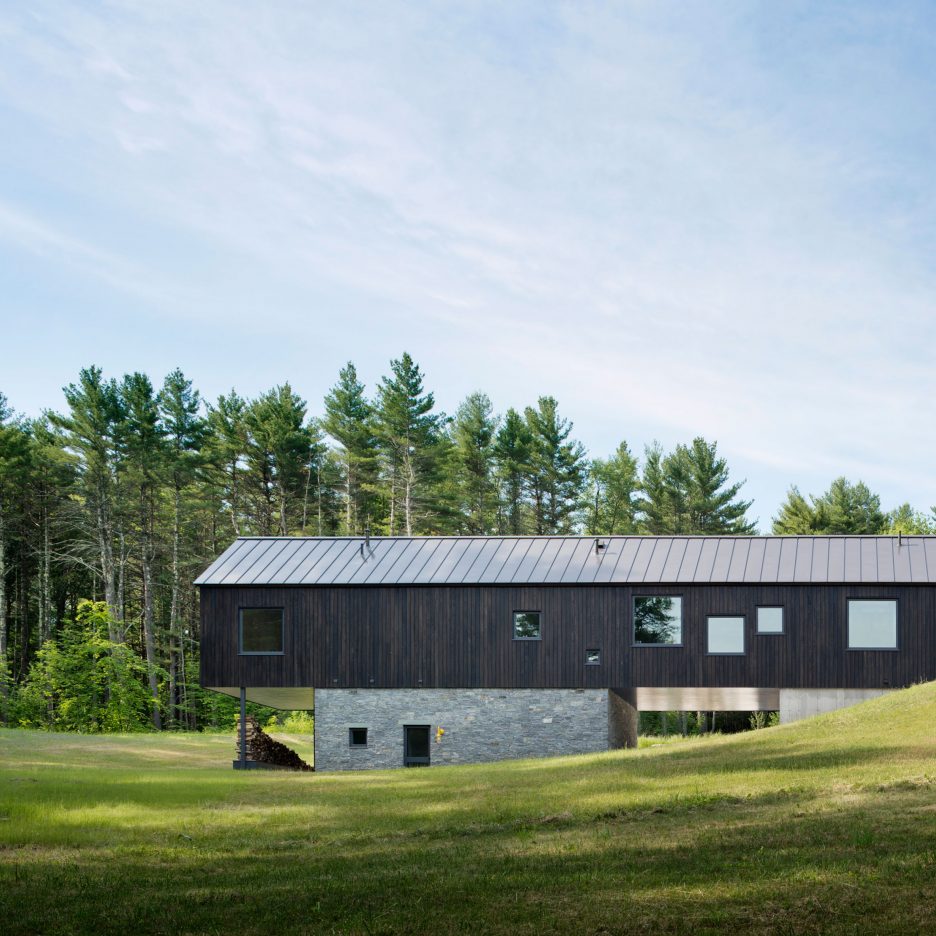
A long cypress-clad volume that projects from a hillside in rural Massachusetts forms this home, designed by US studio O’Neill Rose Architects for a nature-loving couple (+ slideshow). (more…)
From the architect. A key conceptual driver of the project was the relationship of the new to the old. It was important that the extension both complement and contrast with the original house. As a result, we clad the extension in Silvertop Ash, an Australian hardwood timber, to complement the weatherboard cladding of the original house. But, whereas, the weatherboard was painted white, we stained the new cladding in a black stain as a contrast.
This project involved the re-configuration and extension of an Edwardian weatherboard house in the Melbourne suburb of Balaclava to provide for the evolving needs of a young family.
Located on a prominent corner within the neighbourhood, the design leverages the opportunities of its multiple frontages and its condition of being experienced ‘in the round’ to animate and engage with the streetscape. The organisation of the house is expressed in ‘black and white’ on the west elevation which faces the side street, with its didactic expression of the relationship of new and old. The new extension is a deformed box, clad in timber and stained black to contrast with the original, white weatherboard Edwardian cottage at the front. A plywood canopy folds into the side of the original house to carve out a carport: serving to conjoin the two main volumes of the house. The north façade registers the sectional profile of the spaces behind, expressed by a pink fascia ribbon that frames the life within.
The massing of the extension responds to various parameters. Rather than a dumb box at the back of the house, it seeks to complement the original house by drawing on the form and geometry of the bay window and the roof-form. The extension is pushed down on the south to minimise its visual impact on the original house. The form on the northern face is shaped to incorporate solar control – effectively forming a self-shading facade without the need for applied sun shading.
Section
The internal planning of the house has been structured around a series of separate zones. The original house at the front comprises a parents’ zone including the master bedroom with WIR and en suite bathroom as well as a generous study / home office. The ground floor of the extension comprises a living and dining zone connected to the kitchen and laundry, oriented to the north and opening out to the garden. The third key zone occupies the first floor of the extension and comprises the children’s bedrooms which are oriented to the north and open out onto a shared balcony overlooking the garden. Off street parking has been located within the footprint of the original house which creates a highly efficient floor plan that maximises the size of the back garden.
The house has also been designed to incorporate passive design principles. Key rooms and spaces are oriented to the north with effective solar shading, with a minimisation of windows facing east and west. Windows have been strategically located to encourage cross-ventilation. Reverse brick veneer construction has also been adopted in the living space to incorporate thermal mass into the house
Installation art collective Limelight has transformed the Parliament Building of Romania into a eye-popping, psychedelic light show for the iMapp Bucharest International Video Mapping Competition. Titled “Interconnection,” the video utilized projection mapping (also known as spatial augmented reality) techniques to render the world’s third largest building in a blaze of shape-shifting, technicolor graphics and animations. Taking home top honors at the event, the projection required the use of 104 video projectors to cast the 23,000 square meter surface of the Parliament’s front facade in over 1 million ANSI lumens.
According to its creators, “the projection mapping shows the interconnectedness of all things from micro to macro as well as the outer and the inner universe. Conjuring emotions and feelings, the amazing display of color, light and sound aims to reopen the dialogue between the internal and the external, through a cinematic journey from the state of separation to the state of eternal openness.”
Check out animation stills and the full video performance after the break.
ArchDaily is looking for a motivated and skilled architecture-lover to join our team of interns for Winter 2016/2017! An ArchDaily internship is a great opportunity to learn about our site and write articles about historically significant architecture projects.
Interested? Then check out the requirements below.
Applicants must be fluent English speakers with excellent writing skills.
Applicants must have completed their first year of university/college.
Applicants must be able to work from home (or school/workplace).
Applicants must be able to dedicate 15 hours per week; the schedule is flexible, but you must be reachable Monday through Friday.
Writing experience is a huge plus. If you have a blog or used to write for the school paper, tell us about it on the form below.
Basic experience with online blogging platforms, Facebook, Twitter, or Photoshop are a plus. Please indicate this in the form below.
The internship will run from October to January 2016.
If you think that you have what it takes, please fill out the following form by Friday, October 14th 9:00 AM EST. We will contact potential candidates (and only potential candidates) for follow-ups during the following week. Late submissions will not be accepted!