Late last year the New York Times published a thought-provoking article about the importance of workplace culture. Adam Grant, professor of management and psychology at the Wharton School of the University of Pennsylvania, explains
When it comes to landing a good job, many people focus on the role. Although finding the right title, position and salary is important, there’s another consideration that matters just as much: culture. The culture of a workplace — an organization’s values, norms and practices — has a huge impact on our happiness and success.
What aspects of workplace culture do our readers most value? What are the elements of office culture that are important to you and push you to be more creative and efficient?
We would be thrilled to include your answers and feedback in an upcoming article.
The Forbidden City, Beijing. Image Courtesy of Wikimedia user pixelflake (licensed under CC BY-SA 3.0)
As the heart of Imperial China from 1421 until 1912, the Forbidden City—a palatial complex in the center of Beijing—represented the divine authority of the Emperors of China for over five hundred years. Built by the Ming Emperor Zhu Di as the centerpiece of his ideal capital city, the palace would host twenty-four different emperors and two dynasties over the course of its history. Even after the subsequent democratic and communist revolutions that transformed China in the early 20th Century, it remains as the most prominent built relic of a cosmopolitan empire.[1]
For a millennium, the city of Beijing has served as the capital several empires and dynasties.[2] At the beginning of the 15th Century, however, it was a comparatively unimportant “backwater,” and one which had fallen into ignoble disrepair. Emperor Zhu Yuanzhang, known as the Hongwu Emperor, had made his capital at Nanjing – a city situated on the Yangtze River, a little further south.[3] When Zhu Yuanzhang’s fourth son, Zhu Di, began his reign as the Yongle Emperor in 1403, he did so in Nanjing. However, Zhu Di had spent many years in the plains of northern China and had therefore built his power there; having instigated a civil war in order to take control of the empire from his nephew, it is perhaps unsurprising that he sought to center his government in a region more comfortably in his grasp. At the time, his chosen capital was named Beiping (“Northern Peace”); under Zhu Di, the city would, for the first time in its history, be named Beijing (“Northern Capital”).[4]
A scale model of the Forbidden City, viewed facing south. ImageCourtesy of Flickr user Can Pac Swire (licensed under CC BY-NC 2.0)
The new name was only the beginning of Zhu Di’s grand vision for Beijing. Starting in August of 1406, Zhu Di ordered a massive collection of building materials from across his empire to be brought to the capital: some of his envoys oversaw the harvesting of timber and stone, while others supervised the production of bricks and tiles. The palace he had in mind would require enormous logs and vast amounts of marble, the former of which were delivered from forests 1,500 kilometers away from Beijing. All other materials, from clay to gold, were sourced from virtually every province in China. From 1417 to 1420, 100,000 craftsmen would produce the elements which over a million laborers—many of whom were convicted criminals or conscripted workers—would assemble into the glorious capital envisioned by their emperor.[5]
The Gate of Heavenly Peace, entryway to the Forbidden City, as it appears today, with its entrance topped by a portrait of Mao Zedong. ImageCourtesy of Wikimedia user Ekrem Canli (licensed under CC BY-SA 3.0)
The new Beijing was to be a city of districts within districts. Approximately twelve square miles (thirty square kilometers) in area, the Inner City was a rectangular area enclosed by walls standing forty feet (12 meters) high. At its center, covering only two square miles (roughly five square kilometers) and surrounded by another wall, was the Imperial City – a district comprising the homes of the Emperor’s relatives, the offices of the Imperial bureaucracy, two temples, and a spacious pleasure park decorated with artificial lakes. At the heart of the Imperial City, surrounded by a moat and a third set of walls, lay the Forbidden City itself.[6]
The Meridian Gate, through which visitors would pass on their way to an audience with the emperor. ImageCourtesy of Wikimedia user Jorge Lascar (licensed under CC BY 2.0)
As its name implies, the Forbidden City was closed to all but a select few. Its Outer Court, occupying the southern portion of the palace complex, was used for public audiences and ceremonies and comprises expansive courtyards and monumental pavilions designed to intimidate those who were allowed to enter. To the north lay the Inner Court, which housed the residences of the royal family, their servants, and the Emperor himself. The complex, like all of Beijing, was aligned to the points of the compass, with gates at all four cardinal points. As such, the most important structures of the Forbidden City were situated on a north-south axis that ran from the city’s southern entrance.[7]
One of the five marble bridges crossing the Golden River. ImageCourtesy of Wikimedia user Dennis Jarvis (licensed under CC BY-SA 2.0)
Those visiting the Forbidden City for an audience entered by the southern portal, known as the Meridian Gate. Here, they were required to dismount horses and proceed on foot into a vast courtyard. Five marble bridges led over a curved canal (named the Golden River); after traversing one of these bridges, visitors passed through a gatehouse into another courtyard at the foot of the palace’s largest building: the Hall of Supreme Harmony. It was in this enormous space that the Emperor would hold audiences, while supplicants were required to show their respect by a ritual of kneeling and bowing known as the kowtow.[8,9]
The Hall of Supreme Harmony viewed from the south. ImageCourtesy of Wikimedia user Daniel Case (licensed under CC BY-SA 3.0)
The Hall of Supreme Harmony, flanked to the north by the Halls of Central Harmony and Preserving Harmony, formed the climax of procession through both the Forbidden City and, on a larger scale, through Beijing itself. The Three Front Halls, as they are known, stand upon a three-tiered marble platform named the Dragon Pavement. Rising from the gleaming stones are the wooden pillars that support the Halls; despite the profusion of elaborately carved wooden brackets underneath the rooflines, it is these pillars that form the primary structural members of the palace buildings.[10]
The golden tiles of the roof, the ends of which were adorned with auspicious icons and characters, were a key symbol of the Forbidden City’s imperial status. ImageCourtesy of Flickr user See-ming Lee (licensed under CC BY-NC 2.0)
While scale alone is not the only indication of power in the Forbidden City, the unique height and breadth of structures (such as the Hall of Supreme Harmony) stood as unmistakable symbols of authority. The form of the roofs—with one horizontal and four sloping ridges, and two eaves—were traditionally reserved for the most important imperial buildings. The form was further accentuated by lustrous yellow tiles (the imperial color). At the time of the Forbidden City’s initial construction, a viewer standing atop the Dragon Pavement would have seen nothing but the marble of the courtyard, the rusty red clay of the walls, the golden tiles of the palace rooftops, and the expanse of the sky above.[11]
The Palace of Heavenly Purity served as the primary residence of 13 Ming emperors. ImageCourtesy of Wikimedia user Dennis Jarvis (licensed under CC BY-SA 2.0)
Situated behind the monumental pavilions of the Outer Court, the Inner Court was built at a relatively intimate scale. A network of walled passageways leads to the various residences, kitchens, studios, tearooms, libraries, and other living spaces required by the Emperor, his family, his concubines, and their horde of servitors. The Three Palaces of the Inner Court stand in a similar arrangement to the Three Front Halls of the Outer Court, albeit at a smaller scale in keeping with their surroundings. The Palace of Heavenly Purity, the counterpart to the Hall of Supreme Harmony, was built as the primary residence of the Emperor himself, though it was supplanted in this function by the smaller Hall of Mental Cultivation by the time of the Qing Dynasty.[12]
Upon its completion, the Forbidden City was the crown jewel of the Ming Dynasty’s new capital. It was soon after deemed Zijincheng, or “Purple Forbidden City.” This name alluded not to the color of the palace itself, but to the North Star, implying that the world revolved around the Emperor and his Forbidden City in the same way that the heavens revolved about the North Star.[13]
Now thronged with tourists, the Hall of Mental Cultivation once served as the secluded residence of later Ming and Qing emperors. ImageCourtesy of Wikimedia user Clay Gilliland (licensed under CC BY-SA 2.0)
A succession of weak rulers followed Zhu Di’s reign and, by 1644, the gradual collapse of the Ming Dynasty allowed for the subsequent conquest and reign of the Qing Dynasty. While the Qing emperors were Manchu, as opposed to their Han Chinese forebears in the Ming Dynasty, they maintained the Forbidden City largely in its original style. Fires regularly destroyed the palace’s wooden pavilions, but the only structures notably exhibiting Qing instead of Ming design sensibilities were those added to the original complex: Emperor Kangxi, in particular, embarked on an ambitious construction project in the eastern and western portions of the Forbidden City.[14.15]
A pavilion in the Six Western Palaces, one of the sections of the Forbidden City built for Qing Emperor Kangxi. ImageCourtesy of Wikimedia user Clay Gilliland (licensed under CC BY-SA 2.0)
The Forbidden City outlasted not only the Ming and Qing Dynasties, but Imperial China more widely. The nascent Republic of China declared the former palace as a museum in 1925; in conjunction with a later Qing palace, the 600-year old complex was afforded UNESCO World Heritage status in 1987. Its elaborate, symmetrical arrangement of courtyards, gardens, and pavilions stands as the largest and most elaborate example of ancient Chinese urban ideals, and both its architecture and the thousands of relics housed within showcase the variegated cultural history of China and its neighbors.[16] No longer forbidden, the Forbidden City is a silent monument to a bygone age of imperial splendor – a time when the world was thought to revolve around its faded red walls and golden rooftops.
References
[1] “Imperial Palaces of the Ming and Qing Dynasties in Beijing and Shenyang.” UNESCO World Heritage Centre. Accessed September 21, 2016. [access]. [2] Li, Lillian M., Alison J. Dray-Novey, and Haili Kong. Beijing: From Imperial Capital to Olympic City. New York: Palgrave Macmillan, 2007. p7. [3] Dorn, Frank. The Forbidden City; the Biography of a Palace. New York: Scribner, 1970. p10-11. [4] Holdsworth, May. The Forbidden City. Hong Kong: Oxford University Press, 1998. p5. [5] Wood, Frances. The Forbidden City. London: British Museum Press, 2005. p11-14. [6] Holdsworth, p18-19. [7] Li, Dray-Novey, and Kong, p43. [8] Li, Dray-Novey, and Kong, p43-44. [9] Cowan, Henry J., and Trevor Howells. A Guide to the World’s Greatest Buildings: Masterpieces of Architecture & Engineering. San Francisco, 2000: Fog City Press. p93. [10] Holdsworth, p23. [11] Holdsworth, p23-24. [12] Barmé, Geremie. The Forbidden City. Cambridge, MA: Harvard University Press, 2008. p40. [13] Holdsworth, p20. [14] Dorn, p16. [15] Barmé, p47-55. [16] “Imperial Palaces of the Ming and Qing Dynasties in Beijing and Shenyang.”
Location: 4 Jingshan Front St. Dongcheng, Beijing, China
Architect, Engineer: Kuai Xiang
Area: 720000.0 sqm
Project Year: 1421
Photographs: Courtesy of Wikimedia user pixelflake (licensed under CC BY-SA 3.0), Courtesy of Flickr user Can Pac Swire, Courtesy of Flickr user See-ming Lee, Courtesy of Wikimedia user Jorge Lascar, Courtesy of Wikimedia user Daniel Case, Courtesy of Wikimedia user Clay Gilliland, Courtesy of Wikimedia user Dennis Jarvis, Courtesy of Wikimedia user Ekrem Canli
From the architect. This project was for the renovation and expansion of a school originally designed by architect Maria do Carmo Matos. The renovation was part of the governmental program for the renewal of the public secondary schools promoted by Parque Escolar, E.P.E.
Diagram
The original project, a multi detached modular building school, pioneered a larger governmental program designed during the 60/7o’s decades to respond to the scarce public school network offer. Those were very pragmatic and cost-effective projects to apply in a very large scale in different sites all over the Portuguese territory.
Given the limited size of the land and the school’s great need to increase indoor area – to about twice the existing capacity – it was decided to densify the set by demolishing only the single-storey buildings and creating new two-story ones, maintaining and renovating all other preexisting buildings. This densification and the construction of a large concrete canopy articulating and connecting every building, helped to transform the interstitial space between buildings in a sequence of patios promoting outdoor use and activities.
The preserved buildings contain mainly classrooms. The old gym is now the canteen and cafeteria. New buildings were designed for the library, auditorium, labs, and sports facilities. The new reception and library building was designed facing the street creating a new urban front that didn’t exist.
The most interesting features of the existing buildings were preserved – the stairs, the exotic wood window frames, the entrance doors and the precast concrete grids – updating their performance but preserving their character and authenticity. The architectural language and materials used in the new constructions were inspired by the school’s original project and existing buildings, promoting great unity to the whole.
On existing and new buildings, roofs were redesigned enabling the integration of the large technical areas required nowadays. Each roof has an overhead natural light entrance in the centre of the building serving also as a maintenance access to the machines on top.
Those wooden structure “hats”, crowned with wooden window skylights are waterproofed with a “skin” of large squared asphalt shingles/scales. These very expressive elements, discrete from the ground level, proved themselves essential for the definition of a coherent and unified image of the set and for the control of the views towards the school from the hillsides of Serra de Sintra, where it is located.
Talented students of design & architecture – now it’s time to think, rethink and innovate! Honour, glory and 5,000 Euros are at stake. Registration deadline for the Troldtekt Award 2016 is October 24.
For the fourth time, Troldtekt A/S is challenging young talents to suggest new ways of using the classic Danish-produced Troldtekt acoustic panels.
Troldtekt is a strong and sustainable material made from only two natural ingredients: Wood and cement. It is also a flexible product. You can cut it, paint it, print on it and much more.
Cement-bonded wood wool absorbs sound very well. That is why Troldtekt acoustic panels ensure good acoustics in any room.
What is Troldtekt Award?
Troldtekt Award 2016 is a biennial concept competition for students of design & architecture from all over the world. Your task is to explore Troldtekt and find new uses that are not only creative but also possible to realise in practice.
The best idea is awarded 5,000 Euros!
How to participate?
Register for the Troldtekt Award now (before October 24) here at ArchDaily.
Your competition proposal must be submitted electronically no later than November 6, 2016.
A jury, comprising Troldtekt and two internationally renowned architects, will award a winner.
Now, it is up to you to think, rethink and innovate. Good luck!
Penthouse Ecopark is a residential project designed by ihouse in 2016. It is located in Hung Yen Province, Vietnam. Penthouse Ecopark by ihouse: “Optimizing the home owner’s aesthetic personality and bringing more green and most relaxing space are the criteria set out for the architects. Based on a current land-site that is cramped and limited in size (90sqm (969sqft)/floor), the architects have used a variety of solutions from creating floor-through..
Life always begins one step outside your comfort zone
Sometimes it seems like all your friends have done it – they’ve moved cities, changed jobs, got divorces, hiked across the country, went skydiving, started new sports…they’ve broken out of their comfort zone!
What is a “comfort zone” anyways? It’s that comfortable routine that we enjoy everyday – it’s what we eat in the morning, our commute to work, the people we talk to and jokes we make, and the snacks we eat before bed. It’s the creature comforts we work to live for, to give us a sense of security and accomplishment.
Sounds great! But doesn’t it get a little bit boring after a while? We go on vacations, take weekends off to leave the city and date different people. But there are those people out there that really leave the comfort zone stratosphere. They make travel videos, take puzzling career paths and make spontaneous decisions. Although we enjoy our creature comforts, we have an admiration for these kinds of people, a tickling curiosity of what it would be like to live a day in their life.
Well, why haven’t we? These are the things people say when they are asked why they haven’t left their comfort zone yet. You could call them “excuses”…
1. “I don’t know what to do”
A lot of people live heavily scripted into their comfort zone. They are happy to say that they haven’t left because they just don’t know what to do. Well, there are a lot of things to do! Thankfully the internet is chock full of guides, advice and professional opinions from people who have been leaving their comfort zone for a long time.
Breaking out of your comfort zone doesn’t mean hitchhiking through Nepal for two months. It could be as easy as joining a dance club or going on an unmapped road trip. It’s an opportunity to explore new feelings and conquer new fears.
2. “Maybe next time”
A popular excuse for people who may be prone to laziness. The “maybe next time” vernacular has been stopping people from exploring their full potential for years. In the world of comfort zones, there is no “next time.” There is here, now, start preparing for it, and go for it. If we waited for the “right time” or the “right feeling,” nothing might ever get done. That is the magic of the comfort zone. It is to be left during moments of spontaneity and bravery – or else there will be no next time.
3. “I don’t have any money”
This may be true, but it may be confused as well. You might think that it takes $20,000 to exit the comfort zone for a bit, but it certainly does not.
Having some extra savings is nice and comfortable. When you have a steady job and income, it feels good to save for the future. But if you do have a bit of savings and are feeling adventurous, I implore you to explore the outer bounds of your comfort zone by doing something you’ve always wanted to do. The best thing about money, is that it always comes back as long as you’re working.
Alternatively, if lack of money is an issue, recall that it does not take much to have some fun. A short trip to the big city or a road trip with friends to the countryside is a great time to do something different on a dime.
4. “If I wasn’t so worried I could do it”
It’s true, we are scared of a lot of things. The reason it’s called a comfort zone is because it feels good. We’re happy to be there. Doing anything for our first time is a scary thing, but we do it, we practice and continue to do it, and eventually it feels natural to us.
Same goes with escaping our creature comforts. Fear and uncertainty keeps us in it. We fear rejection, failure and “not doing it right,” all of which are fabricated in our heads. We worry about what people will think of us if we fail, even though we don’t even know those people. We’re afraid to not impress people that don’t matter to us. The point is, it is silly to let our anxieties control the quality of our life, and we need to control that. Do it in small steps. Of course everyone was nervous the first time they went overseas, but without doing it they were never able to see their reaction to it and see how easy it was to overcome. We know you’re worried, but we believe in you too. Try it out and see what happens.
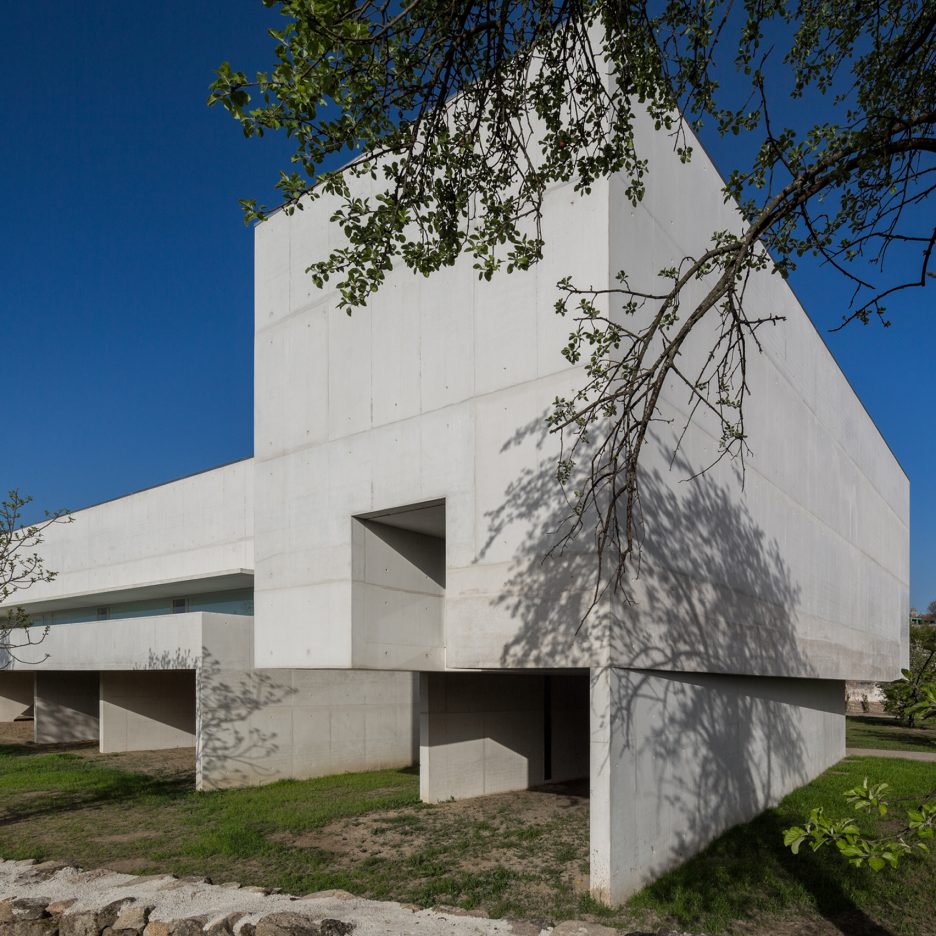
Architect Álvaro Siza Vieira has built a linear, white concrete art museum that runs parallel to the Tâmega river in Chaves, Portugal (+ slideshow). (more…)
From the architect. The Museum of Modern Literature is located in Marbach, on a rock plateau overlooking the Neckar River valley. As the birthplace of Friedrich Schiller, the town’s park already held the Schiller-National Museum, built in 1903, and the Archive for German Literature, built in the 1970s. Displaying artefacts from the extensive Twentieth Century collection from the Archive for German Literature, notably the original manuscripts of Franz Kafka’s ‘The Trial’ and Alfred Döblin’s ‘Berlin Alexanderplatz’, the new museum also provides panoramic views across the landscape.
Embedded in the topography, the museum reveals different elevations, reacting to its immediate context. The steep slope of the site creates an intimate, shaded entrance on the brow of the hill facing the Schiller-National Museum with its forecourt and park, and a grander, more open series of tiered spaces facing the valley below. On the highest terrace the building appears as a pavilion, providing the entrance to the museum. Slender concrete supports articulate the façade and enclose the entrance. The route through the entrance pavilion and down towards the introverted exhibition galleries gradually adjusts from daylight to the arti cial light, necessary for the fragile exhibits displayed. These timber-panelled exhibition spaces are connected to naturally lit, glazed loggias, contrasting the internalised world of texts and manuscripts with the valley beyond.
The walls and ceilings are fair-faced, in-situ cast concrete. Limestone is used internally for the oors, and is also used as an aggregate in the pre-cast, sandblasted concrete elements of the façade. The use of enduring, solid materials gives the architecture a strong, physical presence and supports the notion of preserving the collection for future generations.