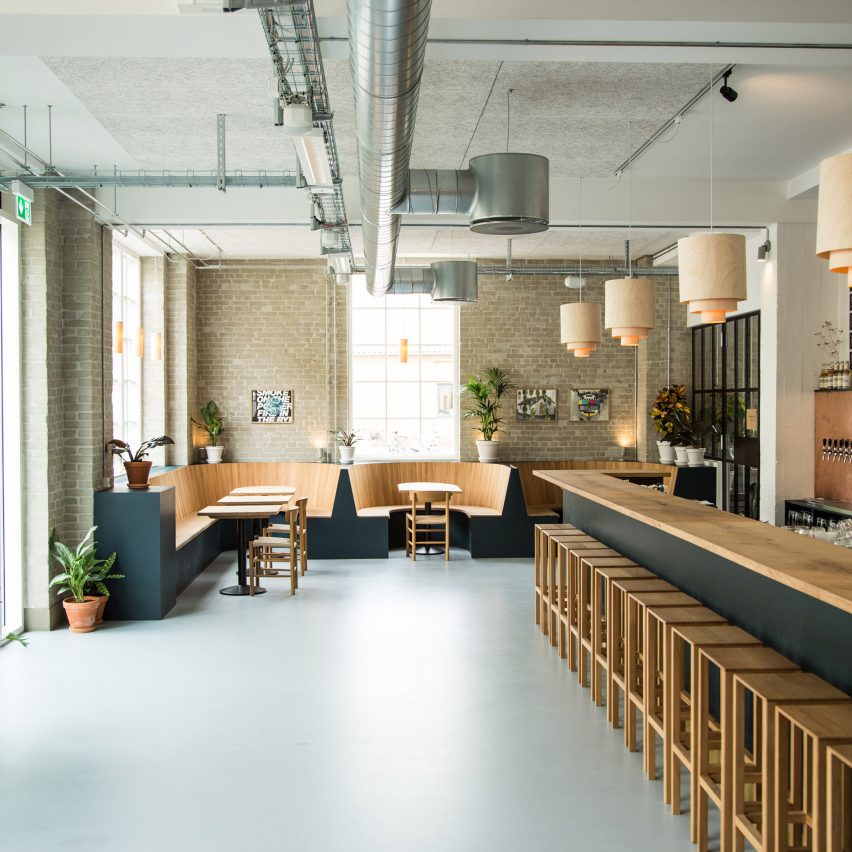
A disused iron factory in Copenhagen‘s Nørrebro neighbourhood provides the new home for the Brus Brewery, which features a bar, shop and restaurant, all dominated by oak. Read more
A disused iron factory in Copenhagen‘s Nørrebro neighbourhood provides the new home for the Brus Brewery, which features a bar, shop and restaurant, all dominated by oak. Read more
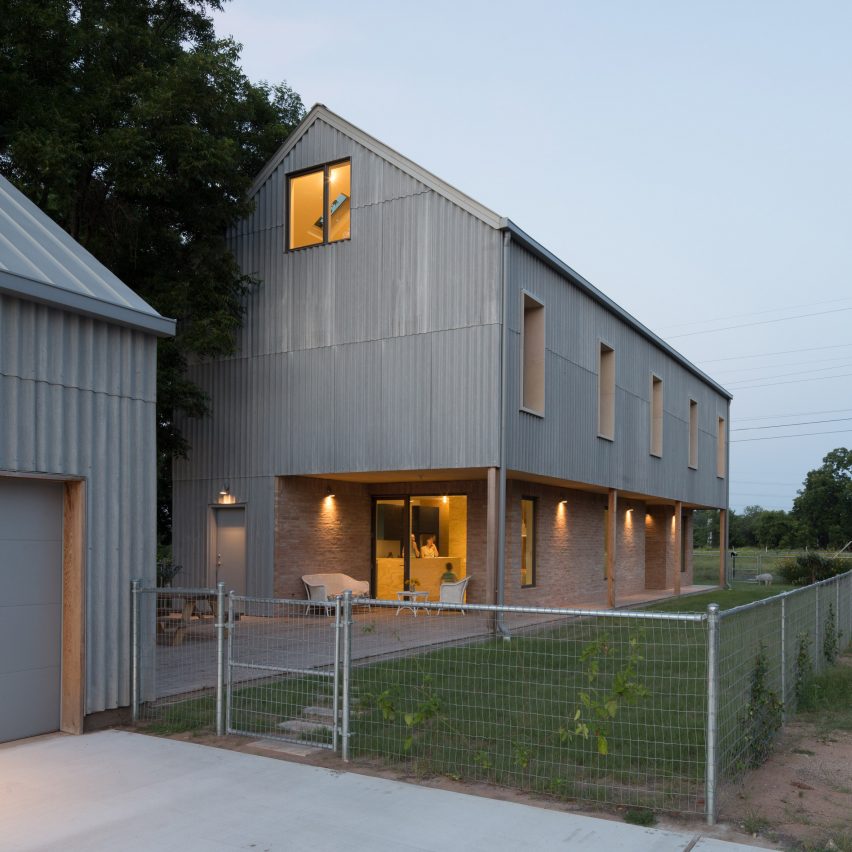
Cement-fibre panels that appear to have the same texture as an elephant’s skin clad the exterior of this home that architect Sean Guess built for himself in Austin, Texas. Read more

From the architect. The Dr. Miriam and Sheldon G. Adelson School of Entrepreneurship at the IDC Herzliya is situated in the northeast corner of campus on a flat site in a small Mediterranean coastal city near Tel Aviv. The upper floors are open and transparent, looking directly out and over the university foliage while the lower floors relate more intimately to the scale of the immediate campus gardens. Students enter the building through an 8 meter high arcade.
The building is home to a first-of-its-kind institution in Israel dedicated to the study and support of entrepreneurship.
At the ground floor, a public lobby and student lounge doubles as a gallery space for exhibitions highlighting the “Startup Nation”, a term coined to describe Israel’s disproportionately high number of entrepreneurship ventures. Directly accessible from this double-height space are a 165-seat lecture hall, a refreshment kiosk, the school’s administrative offices and a glass-encased conference room for the most important meetings and presentations.
Above the more public lower floors are 3 floors of specialized classrooms, accelerator spaces, staff offices, meeting rooms and support facilities.
The architecture of the Adelson School of Entrepreneurship embodies the spirit of innovation and transformative thinking, central to its mission. The plan is efficient and modular with tall spaces designed to be conveniently reconfigured to support a variety of teaching environments. The building is an extended metaphor for the entrepreneurial mindset – clear, straightforward, no frills while simultaneously assertive, dynamic, passionately creative and humane.
The design of the building promotes an idea that the school can be read as both a conceptual and literal factory for the production of creativity and collaborative pursuits. However, unlike a actual factory that deals strictly with the efficient processing of materials into useful objects, the raw materials of this school are people who want to work together collaboratively, efficiently and in a spirit of opportunity and inspiration.
The factory is conceptual in the use of:
–The modular re-configurable 4.5 meter wide bays
-Long-span beams stretching between the east core along the building length across to the west façade that frees up the floor plan underneath
-The tall spaces that permit both the fabrication of large objects and radical changes to the floor section to permit new uses
– The encasement of all of core building systems (vertical transportation, plumbing/HVAC/electrical and communication services, restrooms, support rooms and security rooms) within a narrow volume aligning one side of the floor plan
The factory is literal in the use of:
-Exposed building services
-Industrial lighting systems
-Simple, durable, industrial materials including architectural birch plywood furniture, polished concrete flooring, exposed concrete beams and columns, painted steel staircases, stainless-steel mesh guardrail infills, expanded metal-mesh [XPM] dropped ceiling panels and sun shading protecting the west façade
-Large fenestration to allow ample natural light to penetrate deep into the floorplate
The conceptual heart of the building is a continuous network of social spaces designed to encourage collaboration, networking and student-faculty interactions. These spaces are tied together by a suspended steel central staircase detailed with thin stainless steel cable mesh to maximize translucency.
Product Description. Western Façade Shading – Italfim EXA 12 Expanded Metal Mesh [XPM]
The glazed west façade is protected with a series of vertical sun louvers that baffle the strong afternoon sun while both promoting views of the campus landscapes and allowing natural light to penetrate deep into the building. The design uses 50 identical vertical louver units made from painted steel and aluminum XPM mesh. Each unit is 16.5 meters high and 1.35 meters deep, spaced 75 cm apart. The architects strategically selected the appropriate mesh pattern and orientation thereby creating a simple smart filter for the sun light with the blades of the mesh turning slightly to the north. The mesh blocks the light coming from the southwest while permitting views straight on and to the northwest. A small amount of diffuse and reflected light still penetrates from the southwest giving the louver system a lightness and airiness.


From the architect. Easter Island has almost been erased from history as it has no clear documentation of its past. Mysterious Moai statues are the only evidence of civilization. I gained a similar impression of Samjeon-dong, Seoul. Modern Moai at Samjeon-dong began with the consideration of a symbiotic structure for a city, including housing created by stacking commercial facilities and residential units on the everyday cultural ground.
The site is located at the corner of a village largely populated by four to five-story multiplex housing developments, all of similar size on uniformly planned sites.
Even though the size and volume of the rectangular sites, each divided by a gridlike urban planning, is similar, each site has different conditions. Instead of concentrating on a more glossy form to maximize a building°Øs profile, as found in the many villages of multiplex housing, it is assumed that making facade flexible in responding to the condition of all four sides would create a flexible architecture and resolve the relationship with its surrounding features.
As architectural practice must overcome the mismatch and limitations caused by heterogeneity in retail facilities and multiplex housing. I hope it will begin to propose downtown residential areas of new promenades, enabling °Æcultural production and consumption°Æ combined with the lightness of an everyday program. It can become a village that encourages families to stroll and allow for everyday, smaller-scale culture to flourish, rather than existing as commercial spaces purely for consumption in another generic commercial/residential building.


BAD.Built by Associative Data has released its designs for BARCELONA, a new mixed-use development on the Mediterranean coast of Beirut, Lebanon at the Ramlet El Bayda waterfront.
Spanning 18,000 square meters, the project will serve as “a new gastronomic experience, embracing the Mediterranean from a remarkable vantage point,” through a clustered development featuring restaurants, coffee shops, lounges, and event spaces.
“The project derives inspiration from Barcelona city, in its materiality, tactility, and the relationship between space and gastronomical experiences,” explained the architects, and it will stretch across the waterfront in terraced layers.
As a “creative interpretation of a social venue,” the project will showcase varying restaurant identities in customized lobby spaces.
News via: BAD.Built by Associative Data

You’re reading What I Learned about Politeness at a Korean Flower Shop, originally posted on Pick the Brain | Motivation and Self Improvement. If you’re enjoying this, please visit our site for more inspirational articles.
We take it for granted that people should know how to be polite. It seems like something universal: You say please and thank you, you smile, and you tell people you’re doing well when they ask how you are, even if your life is in turmoil. At least that’s how it works in the West.
I’ve been living in Korea for the past year and a bit and it’s a little different over here.
Koreans have a distinct way of saying “Yes” to each other that sounds like a dismissive grunt to the native English speaker.
When my girlfriend and I first started dating, for example, I’d ask if she wanted to have pizza for dinner. “Uh,” she’d reply, and it took me a while to learn that this meant yes.
Naturally, as we spent more time together, I began using “Uh” myself. Eventually it became unconscious; without noticing I would grunt “Uh” whenever I wanted to say yes to something.
I’m used to expressing politeness by using the word, “Please,” or excessively apologizing like the good Canadian boy I am. But in Korea I’m often at a loss because there’s no real word for “Please” in Korean, and if you say “Sorry” without having actually done anything to apologize for, you just seem strange and silly.
Instead, politeness in Korean is expressed using different word endings. There are essentially three levels—casual, everyday formal, and super formal—and in each level you would end the last word of your sentence in a different way.
It’s a little confusing, but for the sake of this story all you need to know is that using “Uh” to say “Yes” is something you would do only when speaking to someone younger than you or someone who you know very well. You would use a different word to say “Yes” in more formal situations.
There was an old Korean couple inside sitting behind the register. They were eating noodles together silently. I smiled, said hello, and began browsing the flower display.
The old lady rose from her seat and asked me in Korean if I’d like to buy the bouqet that I was looking at. “Uh,” I said, without noticing.
She began preparing the flowers. As she did I noticed a sour look on her husband’s face as he sucked up a few noodles from his bowl.
“Would you like to pay by card?” she asked me.
“Uh.” I smiled and handed her my card. Now her face looked sour too. I tried making small talk with them in Korean—something I’ve found usually delights the elderly couples here as they watch me struggle to form sentences. This time, however, I barely received a response.
I sensed something was wrong. “Would you like a receipt?” she asked in a tone that seemed rather harsh. “Uh,” I said.
She gave me the receipt and sat back down without thanking me or saying goodbye. I eventually figured it out as I replayed the scene in my head on the walk home.
Worst of all was that I had no idea how many times I’d done the same thing to others; I imagined the number to be high. I consider myself to be a reasonably polite person, yet here I was in Korea, walking around grunting “Uh” at elders like an asshole.
So the next time you see a foreigner acting in a way that seems rude in your own country, perhaps they’ve just misunderstood some of the dos and don’ts of your culture. Maybe they really do mean well and are just confused about how to express their good intentions. Maybe they aren’t accustomed to all of the strange things we do that seem normal to us.
…Or maybe that particular person really just is a dick. Who knows. 😉
My name is Jacob. I’m fascinated by all of the strange things we often tell ourselves that prevent us from doing what we want to do in life. Soon-to-be blogger at pooroldme.com Check me out here.
You’ve read What I Learned about Politeness at a Korean Flower Shop, originally posted on Pick the Brain | Motivation and Self Improvement. If you’ve enjoyed this, please visit our site for more inspirational articles.


