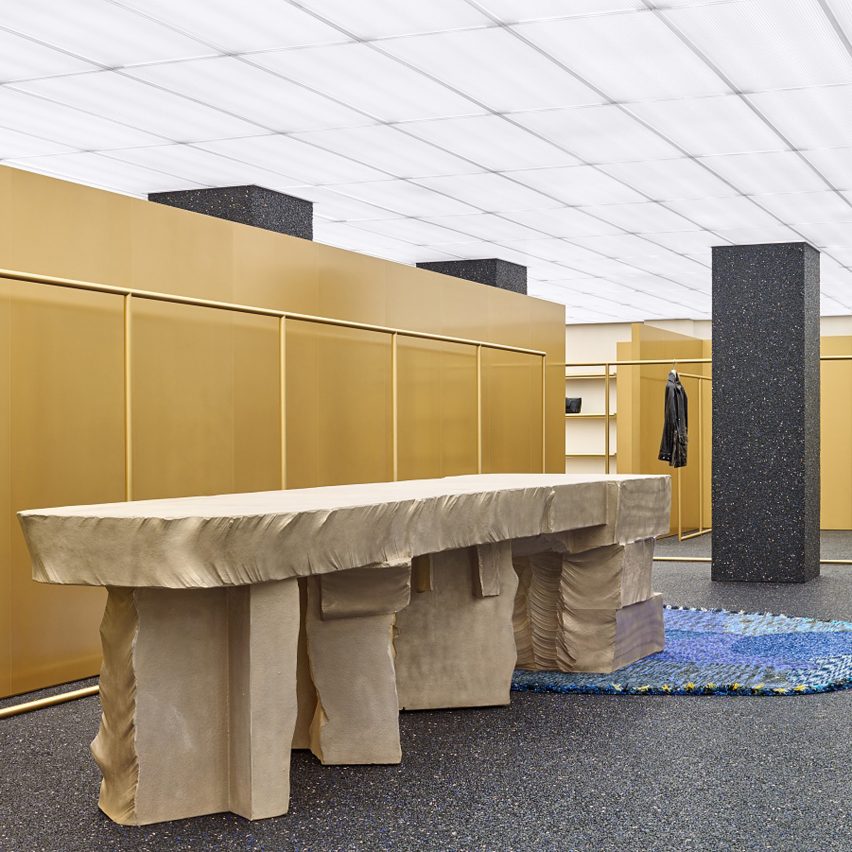
British designer Max Lamb has created sculptural furniture and colourful rugs for Acne’s new store in New York City – the brand’s largest opening yet. Read more
British designer Max Lamb has created sculptural furniture and colourful rugs for Acne’s new store in New York City – the brand’s largest opening yet. Read more

This custom designed private Residence is situated within the Santa Lucia Preserve of Carmel Valley, California.
The Architect’s overriding intention for this modern 2-story family home centered on achieving an intimate connection between the ‘L’ shaped residence and its setting within a rolling hillside clearing.
Siting the home carefully amidst old growth oaks and framing views architecturally, the connection to nature is reflected by an abundance of vistas that capture the rolling hills, wild life, and broad valley views from almost every aspect of the house, connecting the inner and outer environments seamlessly.
Entrance to the home is achieved beneath an enclosed 2nd-story bridge that connects the Main Living areas to the Master Suite. The compressed stair sequence travels under the “bridge” upward revealing a sunny courtyard adjacent to the Main Residence, separate Guest Wing, and outdoor living spaces.
Materials such as concrete, weathered steel, and natural cedar mirror the site’s native textural and color palette while floor-to-ceiling glass completes the building envelope, connecting the tree canopy to the landscape.
Details include: Solar roof, High efficiency plumbing, LED lighting throughout and Operable window coverings for cooling management.
Product Description. In order to create the desired “Indoor/Outdoor Living experience” within the home, floor to ceiling glass required special production, installation and engineering. Fleetwood provided an excellent product.

UNStudio, in collaboration with Korean firm Heerim Architects & Planners, has won the competition to design the 32 tower masterplan of Eunma Housing Development in the neighborhood of Daechi-Dong, Seoul. The unique project commission is being led by the residents of the Eunma Housing Development themselves, who have tasked the architects with redeveloping their current homes into a new, future-orientated eco-design that can be used as a blueprint for other resident-driven development projects.
“Designing a scheme for a resident-driven development is particularly interesting because you are responding directly to the needs of an established community,” said UNStudio founder Ben van Berkel. “They know the strengths and requirements of the area and how they want to see their community develop. This local knowledge is invaluable to the design.”
The winning scheme has been designed around the philosophy of “Live, Work and Play” to cater to a wide-variety of tenants, ranging from families to young professionals. The project will transform an area of over a million square meters, adding over 1,500 new apartments to the 4,424 currently on site. This will be achieved by replacing existing 35 story towers with 50 story towers and pushing parking facilities below ground, freeing up space for a new shared eco landscape surrounding the towers.
The master plan has been divided into 4 circular zones and 6 landscape quadrants that react to the condition of the site boundaries, resulting into 24 “bespoke neighborhoods.” The site is accessible to the surrounding neighborhood and greater city through two lively street fronts and two nearby metro station entrances. Retail, food, beverage and leisure spaces will also contribute to the neighborhood’s urban presence.
Each of the 32 towers can be viewed as its own stacked neighborhood featuring sky-gardens and elevated semi-public spaces, but rather than all reaching the same dimensions, the heights of the buildings are tapered to improve visual connection to surroundings. A multi-level ground floor links the 6 tallest “iconic” central towers into one integrated development.
The “Live, Work and Play” concept can also be seen in the project’s six themed gardens, designed to choreograph movement through the site, define each neighborhood block and inspire education: Curiosity Forest, Excitement Garden, Alluring Urban-ground, Contemplation Cloud, Playfulness Park and Longevity Fields.
Above all, the Eunma Housing Development seeks to create comfortable living conditions for its residents, offering cross-ventilation, natural light and a healthy living environment in each unit. Add in spacious building entrances and semi-private elevators servicing 2 apartments per floor, and the resulting community will be one where residents can feel safe and welcome.
News via UNStudio.

With the aim of supporting the design work of our readers, the company UrbanPlay has shared with us a series of files in .DWG format for different models of children’s games, playgrounds, and equipment for public space. Files can be downloaded directly in this article and include 2D and 3D files.
See all 15 below.

Floating House is a residential project completed by Hyunjoon Yoo Architects in 2009. It is located in Gyeonggi, South Korea. Floating House by Hyunjoon Yoo Architects: “Site The given land has beautiful scenery of South Han-River from the north. Meanwhile, the site is also visually polluted by bunch of restaurants and motels lining the street, especially the decadent neon signs of those shops at night. Client The clients are a..

Bedford Gardens is a private home located in Notting Hill, London, England. It was designed by Nash Baker Architects in 2014. Bedford Gardens by Nash Baker Architects: “This property was one of 14 semi-detached houses dating from the early 19th Century. The properties were some of the earliest to be built on the street and historically had large gardens backing onto Campden Street to the North. Over time, mews houses..

Residencial III is a private home located in Pozuelo de Alarcón, Madrid, Spain. Completed in 2014, it was designed by Marisa Gonzalez LLanos. Photography courtesy of Marisa Gonzalez-Llanos

From the architect. Designed by Henning Larsen Architects and GPP Architects Danish School Building of the Year, Frederiksbjerg School, is the first school in Denmark to meet the demands of the Danish school reform of 2013. The law focuses on learning through movement and sensation as well as openness and community creation. Part of the reform is a demand of a minimum of 45 minutes of movement and activity throughout school hours.
The school is situated in the district of Frederiksbjerg in Aarhus city centre. It is already a gathering point for the children and youth of the local society. Inside the building offers a great variety in space, light and materiality, thus creating an adaptable and sentient learning environment with a focus on health and fellowship. Outside the school adapts to its historical surroundings by means of heights and materiality.
The school houses 900 students, a daycare facility and a youth club, and after school hours the premises can be used for evening classes, courses and sports arranged by local associations and societies. Large terraces and outdoor teaching facilities contribute to the area by bringing the teaching and school life into the cityscape. The outdoor facilities are open around the clock.
Frederiksberg School is organized around a center atrium where the building’s four clusters meet and join together. The clusters are built around a shared center-room encouraging various activities and/or quite studies. The 40 activity areas focus on learning through movement and play. These areas are specifically fitted to different age groups and their levels of understanding and motion. The study areas are small niches that create quiet space for individual study.
The school shares public playgrounds and outside areas with the surrounding houses and institutions. The playgrounds are supplemented by big terraces on each floor which work as both learning and playing areas. On the rooftop you find playing fields and areas with furniture where you can sit, relax and enjoy the view. Some of the terraces can in addition be used as outside workshops for the classes. All the terraces are open for the public outside of school opening hours.
Frederiksbjerg School was recently awarded Danish School Building of the Year 2016.
Product Description:
Ad. 1: The facades are made from reused brick of which a large part stem from historical buildings of the neighborhood. Some of the oldest bricks used to form the regional hospital of Aarhus, which was built in the 1880s. Others stem from the former Sct. Annagade School, which was built in 1953 and torn down in 2014 to make space for the new Frederiksbjerg School.
”It takes more for the bricklayers to work with reused brick because of the stone’s variety in shape and color. But the extra effort increases by far the value of the building. The façade appears warm and glowing unlike other new-built brick houses,” architect Margrete Grøn, Henning Larsen Architects explains.
It is yet rather rare to build projects of such a great scale in reused brick in Denmark, and the construction at Frederiksbjerg did challenge the capacity of the manufacturer “Gamle Mursten” (meaning “Old Bricks”) in the process of cleaning the total of 400,000 bricks.
Ad. 3: The graphic design concept has been developed in line with the architectural intention. Graphic designers at Henning Larsen Architects have created the visual identity of the building with the keywords openness, kindness, motion, diversity, play, and learning as a common objective.
The typography, Deyinyl, is the initial key for the remaining parts of all graphics and signs, repeated both in- and outdoors.
The typeface exists in seven selections, with their own unique definition, creating a distinct and clear geometrical expression throughout the building.
By varying all seven typographic selections, the designers have created an expression which is both playful, dynamic and fluid. The colors correspond with the additional elements in the new building, where the color red acts as the primary color. The graphics also supports the main maps, maps of orientation, floorplans and glass markings, lockers and signs on meeting rooms and facades.
Quotes and inspirational words, adapted to the specific course and age level, are likewise implemented on classroom walls and glass. Here the graphics underline and clarify the spatial traits of the different rooms, while communicating academic useful information equal for students and teachers.
Ad. 4: The artistic decorations at Frederiksbjerg School is just as diverse as the school. Sculptures, paintings and artistic installations have been integrated in the building design and placed around the school.
Rosen Eken, the Danish artist who have created most of the art pieces at the school, explains her thoughts about her creations:
“The task was to create both big extensive creations and small almost invisible pieces. I especially loved the idea about creating pieces that you might not notice at first sight.”
She has created small goggle-boxes in the walls that you can look through and into a miniature parallel world. The miniature worlds show everyday situations, a birthday party and a motorcycle repair shop.
“I work with everyday objects. It has been important to me that the children can relate to the situations and objects that the pieces present,” Rosen Eken states.
Besides the goggle-boxes, Rosen Eken has created some big wall paintings and bronze sculptures, which pictures everyday furniture and elements. E.g. one of the sculptures are an abandoned school bag. The idea is that the art is hard to separate from the reality.