The idea seeks a shelter in this climate that is very austere, extreme, with strong, cold winds. The project achieved three climates: inside it is 100% closed, another intermediate and another open.
It is a waterfront retreat generating a backyard connected to the front thanks to the skeleton-like structure which allows shelter. Allowing to have a space for people who accompany and do not participate in the wind sport.
The dock like circulation achieves the travel between the sea (wind) and the backyard, which is protected from the wind (outdoor shelter), allowing to have a fire pit area outside.
It was designed in a 3m x 3m wood module where the structure (pillars and beams) are exposed. The structure was impregnated on the outside with carbolineum (black color) and wall linings in dark brown. The ceiling is made with eucalyptus poles, exposing the wooden beams in black.
Clément Blanchet Architecture has released its bid for the international Nice Station Extension competition, which also received entries from Marc Mimram, Jean Duthilleul, and winner Daniel Libeskind. The proposal integrates buildings in the city center of Nice—which is surrounded by railways, a ring road, and the city—including a new mixed-use public complex, retail and office spaces, and a boutique hotel.
The architects observed the original site as isolated and without a strong public center. Therefore the design team proposed a simple design to negotiate between infrastructural and metropolitan issues. First, the new mixed-use complex will extend from the existing station, organizing these programs along with a united walkway. The ground-floor retail space connects the building to its site, while mixed-use areas are formed by an undulating three-dimensional facade that connects the project to the northern part of the city. Overall, the exterior view of the complex is aimed at interfacing with residents and travelers alike, bolstering the relationships between interior, exterior, and site.
The proposed design includes new entrance points that welcome visitors inside. A primary ambition of the project is to cultivate a rich local architectural history in Nice’s city center. The design is also meant to reflect and promote public life by fostering free social interaction.
Launched in 2007, The Buckminster Fuller Challenge has quickly gained a reputation for being what Metropolis Magazine once called “Socially-Responsible Design’s Highest Award.” This year, for the first time, a Student Category was reviewed separately from the general applications, however still based upon the same criteria: comprehensiveness, feasibility, replicability, ecological responsibility, and how verifiable and anticipatory the project is. Students from the Centre for Human Habitat and Alternative Technology (CHHAT) claimed the prize with their adaptable and lightweight modular domes, made from natural, local or recycled materials.
CHHAT is a student-led initiative founded at Vadodara Design Academy in Gujarat, India. Participants of their projects span all five years of the academy’s architecture program, as well as academic and professional mentors, led by Professor Nirav Hipara. Co-founder Sapan Hirpara, currently a student at CEPT University in Ahmedabad, India, submitted the program to the challenge in the hopes that their designs for rapidly deployable shelters could help to make inadvertent human habitation more functional and economical.
Courtesy of CHHAT
Currently, the domes are being used to meet immediate needs on the Vadodara Academy Campus, but are envisioned to serve as temporary spaces for rural and agrarian activities, as well as shelters for homeless migrant workers and people living in informal urban areas. Their short construction time also makes them ideal for emergency shelters after natural disasters, such as floods or earthquakes. In addition to this, the bamboo structures can then continue to be used as communal areas in schools, or as exhibition spaces or medical camps.
Courtesy of CHHAT
Steel joints link the bamboo structures, which are then covered in bamboo mats and an insulating Styrofoam layer, and finally covered in a waterproof PVC flex sheet. Spanning the entire perimeter of the dome is a gap nearly the height of a person, providing a well-ventilated environment and open atmosphere. The bamboo skeleton of the larger design can be constructed in about five and a half hours, taking another four hours to be completely covered and ready for habitation. CHHAT has also developed a tent for fewer inhabitants, in addition to the communal dome, that takes only ten minutes to assemble. However, circular canopies remain their focus and expertise, having studied and constructed various dome alternatives over the past six years, culminating in their Fuller Challenge submission.
Courtesy of CHHAT
Courtesy of CHHAT
The locally sourced materials and easy-to-use tools have made it possible for the students to involve regional craftsmen that can contribute to the program, demonstrating how good design can bring communities together and give back to society. Hopefully these advantages of the geodesic domes will allow the temporary structures to succeed in areas where craftsmen may not be readily available, widening the possibilities for anyone lacking some of our most basic human needs: safety, protection and shelter. As Buckminster Fuller put it: “All of humanity now has the option to ‘make it’ successfully and sustainably, by virtue of us having minds, discovering principles and being able to employ these principles to do more with less.”
The main objective was to project a comfortable and functional home for one family. The house had to be designed without unnecessary decoration with the use of “clean” natural and beautifully-aging materials, such as wood, concrete, glass. Later, the owner of the house has formulated the title of this style as “functional minimalism”.
The house is a cube, embedded into the hillside. Wall materials are reinforced concrete (the outer walls of the 1st floor) and a brick. Floor slabs are monolithic reinforced concrete. Vertical surfaces between the windows and wooden facades are made of cement-fiber panels with concealed fastening. The main material of the facade finishing is larch saturated with a substance, which protects from ultraviolet radiation, but does not prevent natural aging. This allows the house to appear differently in each of the seasons.
Second Floor Plan
In the western part of the site, from the side of the road, there is a guest parking and entrance to the house. On the ground floor is a garage, hallway, storage room, boiler room, exit the sauna room to an outdoor terrace with a swimming pool, which is adjacent to the house on the east side. On the second floor are two bedrooms, living room and kitchen-dining room. Fireplace in the living room with a bar is designed according to the proportions of the facade of the house. The lower part of the fireplace is a sheet of stainless steel, hovering above the floor.
On the east side of the house, a living room and a kitchen-dining room have access to an outdoor terrace with swimming pool and barbecue area. Cover terrace made of larch. The sculpture, which combines the functions of a barbecue and a table, was made of stainless steel with a thickness of 10mm with inserts in teak.
On the third floor there are two bedrooms and an open library with living room view. Above the third floor is a terrace with a magnificent view of the surrounding area.
Product Description. With Schüco Structural Glazing I wanted to create the effect of a solid glass cube held on all four sides with massive wooden surfaces.
Serie Architects has released its proposal for the Royal College of Art’s (RCA) campus in Battersea, London. Designed for the campus’ competition—which was won by Herzog & de Meuron—the 15,000-square-meter project would house the schools of architecture, material, and fine art, as well as specialist research centers and entrepreneurial incubators.
In an effort to create a spatial model that encourages collaboration across academic disciplines, the proposal centers on the idea of stacked planes, or “tables,” each of which defines a particular space, but which is not enclosed. The resulting space, through the overlapping of tables and double- and triple-height ceilings, creates an open and highly visible environment.
Courtesy of Serie Architects
A single, five-story volume spanning the length of the site contains individual school programs, and research programs are stacked in a ten-story tower. Between these two spaces is a narrow set of spine-like “shelves,” which contain all shared programs like classrooms, faculty rooms, and small workshops.
Courtesy of Serie Architects
All elements of the project are flexible and reconfigurable, allowing for accommodation of future changes in the school. For instance, table structures can be added and removed, and partitions in the shelves can be adjusted.
Courtesy of Serie Architects
The entrance to the campus is marked along Battersea Bridge Road, in order to integrate the campus into the neighborhood and form a center for the wider community.
Courtesy of Serie Architects
[The project] encapsulates the two challenges that were given to us by the RCA, said Christopher Lee, principal at Aerie Architects. Firstly, the challenge to think of an architecture whereby when a student encounters it, she will be inspired by the incredible possibilities and resources that RCA has to offer and secondly the challenge to be inventive in finding an appropriate and yet radical spatial model that will meet the demands of learning, making and researching today and the future.
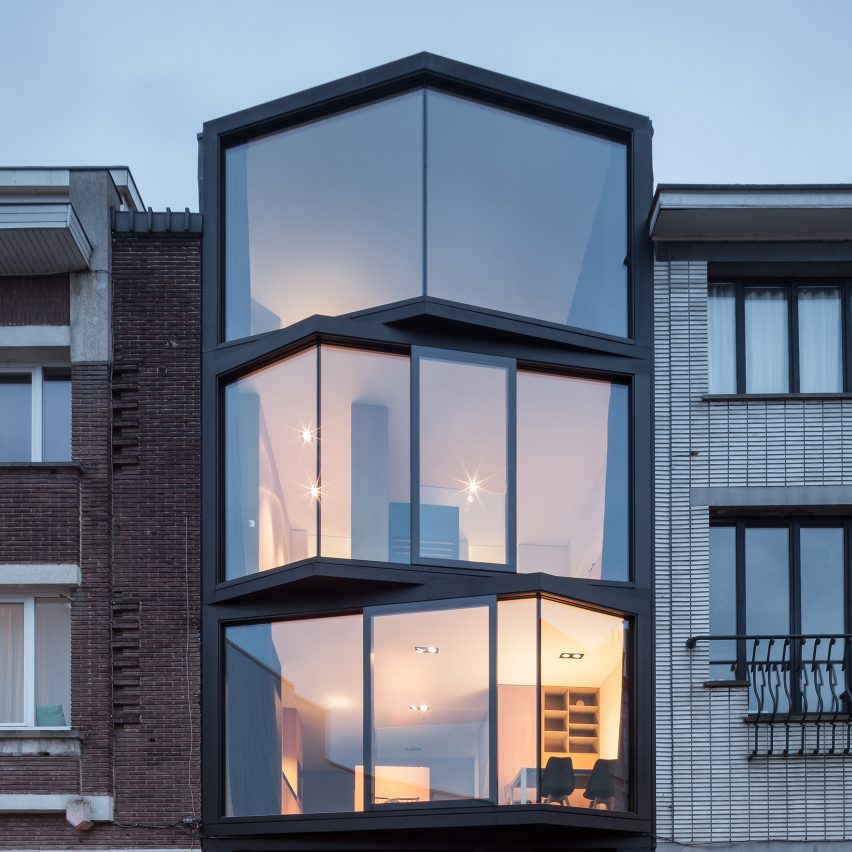
Windows angle out from the front of this family home in Ghent by Belgian architects Steven Vandenborre and Mias Sys, giving multiple perspectives on the street and city below. Read more
Tara Theatre in London, UK, designed by Aedas Arts Team, has won the ‘Project Design of the Year’ award at this year’s London Construction Awards.
Section
Recently reopened, Tara Theatre is the new state-of-the-art home for the acclaimed Tara Arts, the oldest multicultural theatre company in the UK. The new incarnation of Tara Theatre fuses the global and the local, creating an inspirational space for the country’s first cross-cultural theatre to create art from the dialogue between East and West.
Oriental elements were integrated into the design to pay homage to the history of the theatre being Asian-led and owned – and to express the unique identity of Tara Arts in the English theatre landscape. The motif of the Banyan Tree refers to India’s ‘tree of life’ – and the shade it offers a place to meet as a focus of community life. ‘Tara’s Tree’ wraps around the façade and is pargeted, a traditional English craft, which resonates with Indian decorative techniques. It invites audiences into the theatre to hear and share stories, whilst externally providing a lively and engaging urban marker.
Plan
Tara Theatre features a superbly equipped and flexible auditorium with a doubled capacity of 100 seats, a new fully soundproof rehearsal room and other supporting facilities to fulfil the contemporary needs of performances and audiences. The performance space features an adaptable earth floor to offer an original, alternative surface as well as to give a tangible expression of Asian culture in London.
7,500 original bricks from the demolition were reclaimed and reused in the new auditorium, whilst materials were sourced locally wherever possible. The ‘Tara’s Tree’ on the façade is composed of 96% recycled ash. The internal spaces enjoy plentiful natural light with glare control by colourful window blinds. Unusual for a performance space, the main auditorium can be naturally lit through the high level windows.
Elevation
The Project Design of the Year award celebrates projects that have been designed in such a way to be sympathetic to the environment and surroundings, functional for purpose and innovative in style.