From the architect. An awkward distribution, typical of speculative architecture in 1950s Madrid, constituted the point of departure in this renovation, as much as an opportunity to re-think domestic inner space. The commission aimed at the thorough transformation of a 95-square-meter apartment in the central district of Argüelles, which was very much conditioned by the dwelling’s unusual depth, i.e. a considerable distance between the entrance and the main, exterior rooms. The design responded by introducing unexpected relationships while valuing uncommon spaces, often deemed residual. Such a strategy results, in the first place, in a careful articulation between the entrance, the kitchen plus office, and the hallway. The latter’s spinal role within the flat made it worthy of a special treatment through geometry, so reflecting the layout’s irregularity, as well as by a play of quivering textures integrated in the continuous panelling of the surrounding walls and lattices, all in lacquered wood.
Sketch
Isometric
In second place, the renovation seeks to preserve the flat’s identity by the modulation of light, the use of warm tones in wooden overlays and hydraulic tiling, or the restoration of the traditional, hard-wood floors, in a herringbone pattern with edgings.
In the main rooms, the ampleness of the original height is emphasized by lowering the hallway and server spaces, as well as by particularizing the ceilings at different places: entrance (pyramid), office (pitched roof) and dining room (gilded, with a curved moulding). The combination of different textures and tones in wood, along with the variation among stances result in a spatial interplay of surprise and familiarity.
Including demolitions, the work had to be ready in barely three months, so leading to the use of dry solutions for the partition walls and their facing. Speed was thus made compatible with the high quality of detailing and materials in the final result.
Geography and climate are two important conditions that determine how people can live in a certain environment. When we add to this the cultural characteristics of a region, what appears, as Carl Sauer would say, is a “cultural landscape,” a result of humankind’s settlement and adaptation to the territory. When architecture adopts a sensitivity to these conditions, and concerns itself with what the environment offers, living conditions take on a quality of lasting comfort.
The project’s site seems like a very powerful location. We would like to know more about how you translated the cultural context of the area into the design—what comfort strategies did you use in the face of the extreme climate?
Courtesy of Turner Arquitectos
Courtesy of Jadue Livingstone
On the numerous trips that we made during the process of design and construction of the project, from Santiago to the Limarí Valley, we went North via Route 5. On this 400-kilometer journey, you can observe how the landscape of Mediterranean climate in the central zone becomes more and more arid and radical as one moves towards the North. Turning eastwards towards Ovalle, the geographical features are accentuated, forming impressive arid plateaus and gorges, where human beings have sought shelter for centuries.
Courtesy of Turner Arquitectos
The geographical and cultural context that characterizes the Limarí Valley is so powerful that, however commercial the program included the commission, the design should communicate with its surroundings and form a “settlement”—where its visitors are protected from the arid climate and Northern landscape, but at the same time where they can understand the local culture and topography while inside the building.
Courtesy of Turner Arquitectos
Courtesy of Turner Arquitectos
The description of the building in formal terms is simple because it imitates the geographical location of the city of Ovalle and the surrounding villages. Just as water, by means of erosion, once formed the ravines and gullies of the place, we wanted to propose a large regular volume, into which we carved a diagonal gully which the building’s functional spaces open toward. The openings in the outer faces of this volume, on the other hand, are small and precise, thus protecting the inhabitant from the extreme climate.
Courtesy of Jadue Livingstone
Courtesy of Jadue Livingstone
Is this proposed hermeticism a response to the programmatic requirements of security and traffic control within the complex? What were the requirements and restrictions regarding the hotel and casino program?
Courtesy of Turner Arquitectos
A casino by definition needs high standards of security to improve its games, so the volume that housed this program had to be quite closed. To design the hotel, spa and the rest of the enclosures we had complete freedom when proposing orientation, degrees of openness and materials. Despite this we repeated the concept of closedness for the rest of the programs, although to a lesser extent, because we believed it was the best way to guard visitors and make them feel as if they are inside a series of caves carved into the edges of the main ravine.
The way to unify the multiplicity of programs was, on the one hand, to choose common materials for all volumes; the stone, concrete and metal seen are present in all the buildings, in both the facades and the interiors. On the other hand, there is the central ravine that constitutes the main pedestrian walkway and meeting point of the project.
Courtesy of Turner Arquitectos
Respect for the surrounding material environment seems to be an important part of your formal approach. Could you delve deeper into how the indigenous culture influenced the realization of the envelope and how the building was constructed?
Looking at the palette of colors and materials present in the surroundings, we decided to use the most characteristic ones. The predominant use of low stone walls to delimit plantations, stables and other terrains led us to think of a large stony base from which the different volumes emerged. On the other hand, we wanted to recover the positive side of the aridity and coarseness of the northern landscape, using materials and coatings with thick textures and ocher and gray tones which, used correctly, give warmth to the spaces. That’s why we kept all the concrete visible and textured it using rough wood moldings.
Courtesy of Turner Arquitectos
We also did some research on the geometric patterns present in the impressive ceramics of the Diaguita indigenous population. We did several facade studies looking for a way of imprinting these patterns on the envelope, trying not to fall into exact reproduction but instead to use these patterns to deconstruct and to disorganize the openings resulting from the hotel rooms, which generally produce motionless, monotonous facades. Therefore, the zigzag shapes of the chosen Diaguita pattern allow the reading of an entire volume, which is not marked externally by walls or slabs.
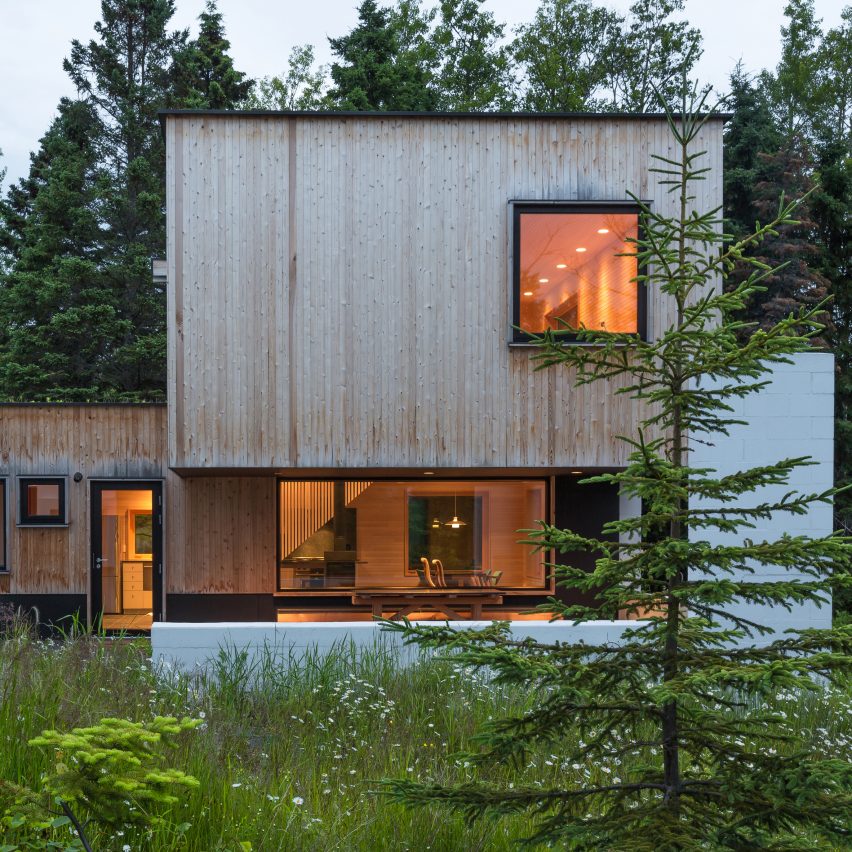
Minnesota firm Salmela Architect has completed a cabin with a courtyard framed by a whitewashed sauna adjacent to the main house (+ slideshow). Read more
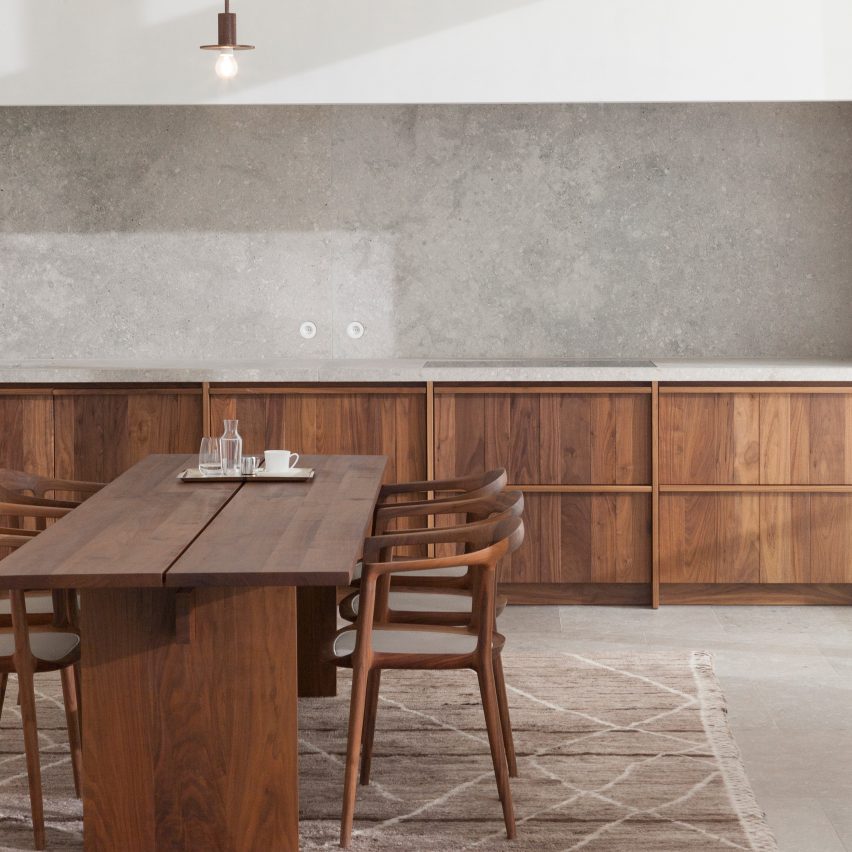
Belgian practice Hans Verstuyft Architects has restructured the plan and provided minimalist finishes for this penthouse apartment, located in a David Chipperfield-designed building in Antwerp. Read more
From the architect. Ccasa Hostel is the first hostel which was built from shipping containers in Nha Trang, Vietnam. The location of the hostel is on the north of the city, about 3km from the center, 3 minutes walking from the beach. It is close to famous sights in Nha Trang: Hon Chong – Hon Vo (huge rocky headland in associate with fascinating local myth), Khmer’s temple of goddess Ponaga, natural mineral water spring resort I-resort, etc.
This is a hostel for backpackers created on the motto that everyone around the world can be connected into a big family. Ccasa is built to function like a family house with cabin beds inside containers as bedrooms, shared area as kitchen and living room, terrace roof as play room, washing area as toilet and bathrooms. Therefore, the bed space was reduced to the minimum just enough to sleep, in contrast, the shared space was expanded to the maximum to increase the connection between travelers, the washing area is shared as well.
The hostel consists of three functional blocks: serving block, sleeping block and washing block. Of which, the serving block was made of steel frames and black panted metal sheets, the sleeping block was set in three old shipping containers that was painted three colors symbolize three type of bedrooms, the washing block was built in normal way with white painted rustic bricks and concrete.These three blocks was connected by the common space that is shared space as well as traffic space that is opened to the maximum to nature.This is the main feature that makes the project become soft and harmonic.
Section
Some other features of this project are the entrances to the bedrooms which are no longer stuffy corridors, but instead are open luminous bridges which is covered by green trees and pergola, the travelers will feel very relaxed and comfortable when coming out or in of bedroom. Beside, the terrace roof also took a bold approach with the large hammocks are hung across the void to bring the feeling of floating amongst the nature.
By using old shipping containers, steel frame and the green trees, pergola, Ccasa hostel has brought both strong, industrial yet both harmonic, natural feeling. In addition, encaustic cement tiles, old wood windows, flat winnowing baskets, rustic cement were used cleverly to attract attention and recall some Vietnam old architecture images. The pergola covering around the hostel not only makes it look greener but also acts as a second skin to protect from direct sunlight and cooling the air inside.
After finished, Ccasa hostel has become an attractive destination for the travelers ,it also contributes more green space to the city and reduces negative impact on the environment.
Socrates Sculpture Park and The Architectural League invite designers and architects to help shape the physical setting in which the park fulfills its mission as a venue for art, creative expression, public programming, and education. Socrates Sculpture Park, located in Long Island City, Queens, is one of the most distinctive cultural organizations in the country with its combination of waterfront setting, accessibility, and community-based programming. As a venue for the presentation of public art, a New York City park, and an active social space, Socrates has for 30 years harnessed the power of creative minds to transform the urban landscape.
In previous years the Folly program investigated the intersection between sculpture and architecture with temporary structures that intentionally served no utilitarian purpose. More recently the competition has shifted emphasis, asking entrants to fuse form with utility, creating designs that explore the intersection of art and architecture while addressing and improving the conditions of the Park. Continuing this trend, the 2017 competition asks architects and designers to design and fabricate four portable, demountable structures to replace four standard tent structures that are deployed, as needed, throughout the Park.
The structure should provide shelter from rain, shade from sun, and be secure enough to withstand wind in a waterfront environment. The structure must be able to be assembled in no more than 10–15 minutes by two people, preferably one person, and disassembled in the same amount of time. These criteria will be strictly applied when reviewing submissions. A submission will not be selected if this project, in the judgment of the jury, does not convincingly demonstrate this capability.
Site This year, for the first time, the project is not confined to a single site within the Park. Instead, entrants should design an easily portable, demountable system measuring approximately 8′ x 8′ in plan with a minimum height of 7′ to allow for standing and suitable for a variety of uses. It should be adaptable for multiple locations, which will include areas adjacent to the Park entrance, to its education area, and throughout the landscape.
Eligibility Architects and designers are invited to apply. Applications will be accepted from individuals and firms; entrants need not be licensed. Architects and designers outside of New York City are eligible to apply, but housing and transportation are not provided as part of the award. If selected, non-residents will have to make their own living and travel arrangements. Students are not eligible to apply.
Jury Tatiana Bilbao, Principal, Tatiana Bilbao ESTUDIO Eric Bunge, Principal, nARCHITECTS John Hatfield, Executive Director, Socrates Sculpture Park Mary Miss, Artist and Artistic Director, City as Living Laboratory Craig Schwitter, Partner, BuroHappold Engineering
Call for Proposals: Folly/Function 2017
A design/build competition organized by The Architectural League and Socrates Sculpture Park
Submission Deadline Monday, January 9, 2017 11:59 p.m. EST