Collaborators: Carine Pimenta, Catarina Campos, João Pereira de Sousa, Pedro Resende
Render: Gil Soares
Engineering: Isabel Teles (structure), João Cunha (waters), António Pelaez (termic/energy), Susana Sousa (acoustic), Fernando Ferreira (electricity), Carlos Mirra (security plan)
Specifications, Measurements And Budgets : DIMSCALE
From the architect. We propose a building with a unique image for the campus. A building that breaks the existing gray monotony – referring not only about the pictorial issue of the Campus, but also about the “global crisis without end” – and that, at the same time, is able to captivate.
The search for future technology themes, was the genesis of the selected image for the building. The facade skin, happened through an architectural reinterpretation, it retracts the symbolic power of the ERI purpose.
We used as reference the titanium nanotubes. Associated with recent discoveries, the titanium nanotubes have, among others, capacities for reuse and cheap production, becoming, this way, an inspiration for an architecture that seeks sustainability as an ideal.
Nowadays, at the offices of UM (Minho University), researching processes are occurring in what concerns to materials development, one possible example is what’s happening in the civil engineering laboratory.
This material reinforced with micro-fibers, has no conventional reinforcement, which could cause corrosion problems, among other features, is a very ductile material, plastic, fluid, self-compatible and allows to control the crack and therefore doesn’t crack. This skin allows the inclusion of pigmentation/oxides doesn’t need constant maintenance and lasts longer than common materials. To finish, it also allows a wide range of the architectural freedom.
From the architect. Sales pavilion, generally considered as a temporary building type, is always demolished or renovated as long as developers have achieved their commercial goals. These costly buildings therefore become huge waste of resources and energy. To minimize the unnecessary waste and keep the building for further use is our starting point. We try to introduce a community library into the building as a sustainable solution, in which not only can a library increase people flow, but also it can offer public facilities when the sales process comes to the end.
Courtesy of Van Wang Architects
The design is inspired by a toy, building block. We build bookcases in a way as we play the building blocks. They re-define the whole space by stacking and overlapping in two atriums, from the ground to the ceiling. The gap between the “blocks” naturally becomes a path for people to go through. In the atriums, the staircases cantilevered from the “blocks” connects groundfloor and first floor with a new mezzanine corridor.
Axonometric
The mezzanine corridor which connects the two clusters of “blocks”, not only increases reading area but also produces a dramatic and coherent space.It is cantilevered with independent steel structures hidden in the bookcases with no column exposed. The structures will not interrupt views or activities and even be hardly noticed, which signify the corridor as a foremost feature in this project.
Located on a 15-acre corporate campus in Silicon Valley, the Moffett Gateway Club is a vertically-elevated recreation and activity center. The Club fronts the campus’ central green space and is integrated into a three-story parking structure.
Positioned between the two office towers, the front facade creates a focal point for the campus, defines the edge of the ground-level greenspace, and screens the parking structure. The facade’s curvilinear form and materials — blue-tinted glass and grey metal panels — relates the Club to the office towers on campus. An open glass stairwell and a cylindrical elevator shaft connects the three-stories while a deep, semi-translucent canopy unifies the building and external vertical circulation.
The elevated location lifts tech employees and visitors above the adjacent sub-urban office parks and their plethora of surface parking. Raised thirty-feet, users enjoy much improved views of tree-tops and mountain ranges off in the distance. Thirteen-foot ceilings and full-height windows make the open-plan fitness space an expansive volume with strong visual connectivity to the garden.
Floor Plan
Accessed through the Club’s interiors, the garden provides employees with a new setting to gather and connect outside the workplace. The program includes a full-suite of social spaces: bocce ball courts, fire pits, an outdoor kitchen, herb gardens, and seating areas. The background landscape provides a layered experience where users are separated from the workplace, but connected to the surrounding environment. With views of Moffett Field’s Hangar One—a Silicon Valley landmark—the rooftop incorporates a series of planter boxes made with reclaimed redwood from the Hanger. The redwood brings warmth to the material palette and creates a relaxed environment.
The garden also connects to the local environment with native and drought tolerant landscaping: Fox Tail Agave, Berkley Sedge, and Feather Read Glass. Adjacent to the outdoor kitchen, six types of edible plants — strawberry, pomegranate, rosemary, thyme, lavender, and lemon bushes — provide herbs and fruits.
The Club is the region’s first elevated recreation center that combines indoor and outdoor facilities. With creative positioning, contextual design, and a mix of destination activities, this campus centerpiece will provide long-term value to its new workplace community. The project is targeting LEED NC Gold.
From the architect. Inherent as genre, symbol, element, is meaningless but drift apart people and the space.Thus, we logically concern about the relationship between people and what they might sense in the space as usual.
The working space is transformed by dormitory of old Nanxing Glass Manufactory, which was built in 1986. Exposed red bricks, concrete ceiling combine with brand-new glass and epoxy floor paint to remain vivid and long-lasting contrast between history and renewal for passerby.
Divided into three zones, the space is connected by two raw iron tunnels, while integrated by a corridor by the window. It’s meant to effervesce unexpected pleasure when people exploring the space.The blank window frame is reserved deliberately and well protected by close glass to completely record the changes during the process of reconstruction.
To emphasize the difference between areas, the whole white restroom makes strong distinction to rough industrial atmosphere. The hollywood dressing table mirror is designed to convey the importance of elegance for ladies.
AXONOMETRIC
Flahalo Creative, the owner of the space, is a dynamic and innovative corporation in culture creative field. The concept “space of flow” brings up the project. For human resources system, departments would not exist so that people are encouraged to follow their moods to work around, facing the desktop setup in the long table or sitting cross-legged on the carpet with laptop. Alsono drawer is installed in the space. Instead, staffs are provided personal lockers to keep the belongings.
From the architect. The Monastère des Augustines, site of the first hospital in America north of Mexico, offers visitors a unique holistic wellness experience and direct contact with the rich heritage of the Augustinian Sisters. The new reception hall, playing with transparency, showcases the ancient building wings that have been completely restored and refurbished to accommodate the new proposed activities.
The project includes a museum visitor’s path describing the legacy of the Augustinian Sisters and their contribution to the development of health care in Quebec, as well as archives, an exhibition space, a restaurant, areas reserved for retreats, and a guest room section focusing on holistic health. An entire floor has been added above the sisters’ residence to house a conservation facility for the collections of all the twelve Augustinian monasteries in Quebec.
The new reception hall, a structurally separate interstitial building, is located where the circulation zones from the various wings intersect. This glassed-in section is designed to reflect the community’s openness, house the reception areas, clearly define the circulation zones, and showcase the historic buildings’ façades. Conceptually, this new building consists of a central hall bordered by a screen wall (an analogy to the grid of the grand parlor – the nuns were cloistered until 1960) and a completely transparent connector, which deploys in gateways in front of the Sisters’ Choir.
The project also includes the restoration of the historic buildings’ roofs and facades, the repair of all the layered windows, the addition of a new staircase, the integration of mechanical services to the old buildings, normative and safety adjustments, structural repairs, restoration and refurbishment of interiors from the ancient vaults to the attic, new contemporary rooms, the restoration of all finishes and built-in furniture, landscaping, as well as the demolition of outdated tunnels, the existing entry building and other accessory constructions.
Product Description. Parklex real wood stratified louvers were used in the main hall (wall and ceiling) instead of massive wood planks to comply with code restrictions, allowing us to keep the warm visual feel of real wood. The louvers were used to include black insulation boards underneath to upgrade the acoustic of the hall. It was also possible to install them inside and out, which was conceptually required.
Just the weekend before I had been thinking that I should write something about BIG. For weeks, one spectacular and interesting project after another had been popping up on Bjarke’s, Kai-Uwe Bergmann’s and a couple of others’ Facebook pages.
It was photographed fabulously from above by Iwan Baan, as the building is just catching the day’s last sunbeams. We have just seen in the Aspekte movie how the building stands out among the structures of the Manhattan Skyline.
BIG produces images that are instantly imprinted in the brain—which is not to say that the projects are simple. Besides the fact that the activity that takes place in these buildings is complex in itself, BIG is keen to ensure that the projects are equipped with a complexity of their own. However clear the concepts may be, one always finds deviations and exceptions that enrich the Whole and make room for the Individual.
BIG is not only Bjarke Ingels. By now the office has a couple hundred employees and interesting, independently acting partners such as Kai-Uwe Bergmann and Jakob Lange. The office regularly seeks collaborations with others, including architects and artists whose way of working is completely different from their own.
For Superkilen they worked with the landscape architects of Topotek 1, the art collective Superflex, and not least with residents of the neighboring area; for Google they worked with Thomas Heatherwick, for Hyperloop among others with Elon Musk and Ove Arup, and so on.
I’m going to venture a guess—that I was invited to deliver this laudation because I wrote SuperDutch, an international bestseller on architecture in the Netherlands in the 90s, 15 years ago. As it happens, there are indeed a couple of ties that connect BIG to the pragmatic taking-the-bull-by-the-horns and the affirmation of a second modernity by the Dutch people at the time. Bjarke Ingels worked for Rem Koolhaas at OMA, for example, on the library in Seattle.
In the meantime, Bjarke and BIG have long developed further and work on projects all over the planet. Unlike architectural practices in the past, BIG has been an international practice from the beginning. They work on the big issues, challenges and possibilities of our time: globalization, sustainability, social coherence, technology and innovation.
Bjarke Ingels himself is listed among the 100 most influential individuals in Time Magazine this year. Regarding this, Rem Koolhaas contributes a text in which he identifies himself as a friend. Even more important though, is that he emphasizes that Bjarke represents a completely new type of architect that is a perfect fit for the current Zeitgeist. “He is the first architect,” Koolhaas writes, “who has separated the profession completely from fear.” I have never heard Rem speak so generously of another architect.
With this characterization, it is remarkable that Bjarke Ingels is awarded the International Highrise Award here in Germany. Because here, theory purports, Zeitgeist and fear produced the utopian projects of Expressionism. Today, however, large-scale projects are sometimes considered utopian in Germany and Europe, and they produce a fear that defines the Zeitgeist.
Bjarke Ingels and BIG show that we can enter the universe of great ideas once again—actually, that maybe we have to—and that it is indeed possible that such imaginations are realized.
They shamelessly have a department called BIG Ideas.
This department, among other projects, works on the Hyperloop connection between Dubai and Abu Dhabi, where in 2020 small pods will stop for us when we want them to, and then cover the distance at a speed of 700 kilometers per hour in no time.
The quality of the projects by Bjarke Ingels and BIG in large parts does not stem from the way they look, but rather from how they are created and what they achieve.
Bjarke likes to use the term “Bigamy” for a method employed by BIG, because two sometimes well-known but entirely different phenomena are regularly brought together in order to produce something new and unknown—such as perimeter development and highrise in Via 57 West.
And this does not only consider the thing, the object, but rather essentially a form of social engineering which is kick-started by the building. This social engineering has no pre-defined ending.
It is a creative process that in some ways coincides with Byung-Chul Han’s approach of interpreting a form of innovation that emerges from Shanzhai, meaning from the act of copying well-known products, whereby a sort of evolutionary process with lots of participants occurs due to misunderstandings or small improvements.
The exceptional thing about Bjarke Ingels and BIG is that one never feels like they are losing ground. Sometimes their work reminds one of Otto Neurath’s dictum that we are like boatmen who have to remodel their ship on the open sea without ever having the possibility of disassembling it in a dock and rebuilding it from the best parts.
Kai-Uwe Bergmann describes BIG and Bjarke as a “mixture of Scandinavian ‘being social’, Mediterranean verve and American Can-Do-Spirit. (…) On one hand, we are shaped by a social responsibility that is not felt in the same way in the USA,” he says, “and at the same time, on the other hand, by a ‘Can-Do-ness’ that is lacking a bit in Europe.”
Thus, we see that in Via 57 West, 20% of the apartments, 142 units, are auctioned off as affordable rental units to people who earn a maximum of 30-50,000 dollars.
These low rents at Via 57 West did not diminish, as we have just seen, the large investment in facilities that enable a communal life of which one can only dream, even in Vienna.
This is more than amazing in a city where, not far away in Hudson Yards, the starting bid for a one bedroom apartment is 1.95 million dollars.
From the architect. Invited by Walk&Talk festival to participate in its 6th edition on the island of São Miguel in the Azores, Moradavaga took inspiration from the rich sea life that exists in and around the atlantic archipelago to produce a site specific piece of interactive art.
Influenced by the stunning landscapes and the mystic aura related to all that concerns whale hunting (in the past) and observation (in the present) our mind wandered through old tales like Moby Dick, by Herman Melville, and 20.000 Leagues Under the Sea, by Jules Verne, and the presence of sperm-whales along the Azores coasts led us to devise a character, “Vernie” the giant squid, that came from the depths of the ocean to serve as a communicative playful tool for passersby of all ages at Portas do Mar in the city of Ponta Delgada.
BIG has completed their second building on U.S. soil, a 92,000-square-foot office building at 1200 Intrepid Avenue in Philadelphia, Pennsylvania that also marks the firm’s first realized office building design. Located within the revitalized Philadelphia Navy Yard master plan (designed by Robert Stern), the four-story building features a bowing, double-curved facade and a supersized “periscope” inspired by the historic battleships docked a few blocks away.
Located adjacent to the James Corner-designed Central Green Park, the building volume responds to its setting in its curving front façade, constructed through the stacking of High Concrete precast panels of varying sizes in a basket-weave pattern and bowing inwards to create “a generous urban canopy” over the front sidewalk. The other three sides of the building relate to the rigid city grid, remaining perpendicular to the ground and showing off the structure’s signature paneling.
“The ‘shock wave’ of the public space spreads like rings in the water, invading the footprint of the building to create a generous urban canopy at the entrance,” explains Bjarke Ingels. “The resultant double-curved facade echoes the complex yet rational geometries of maritime architecture. Inside, the elevator lobby forms an actual periscope, allowing people to admire the mothballed ships at the adjacent docks.”
In reference to the site’s maritime history, a functioning periscope penetrates into the building lobby, providing both natural light and projected views of ships docked in the nearby Navy Yard basin. The central atrium is open to all floors and allows for maximum light exposure for bordering offices.
“In many cases, architects design big, boxy buildings that could be placed anywhere and don’t connect directly to the site. You would really be hard-pressed to place 1200 Intrepid anywhere else, due to how it connects with its surroundings. Our commission involved creating a speculative office building, for which no tenants were committed. The key challenge here was to create a reason for tenants to be here with the constraint of a stringent budget,” said BIG partner Kai-Uwe Bergmann.
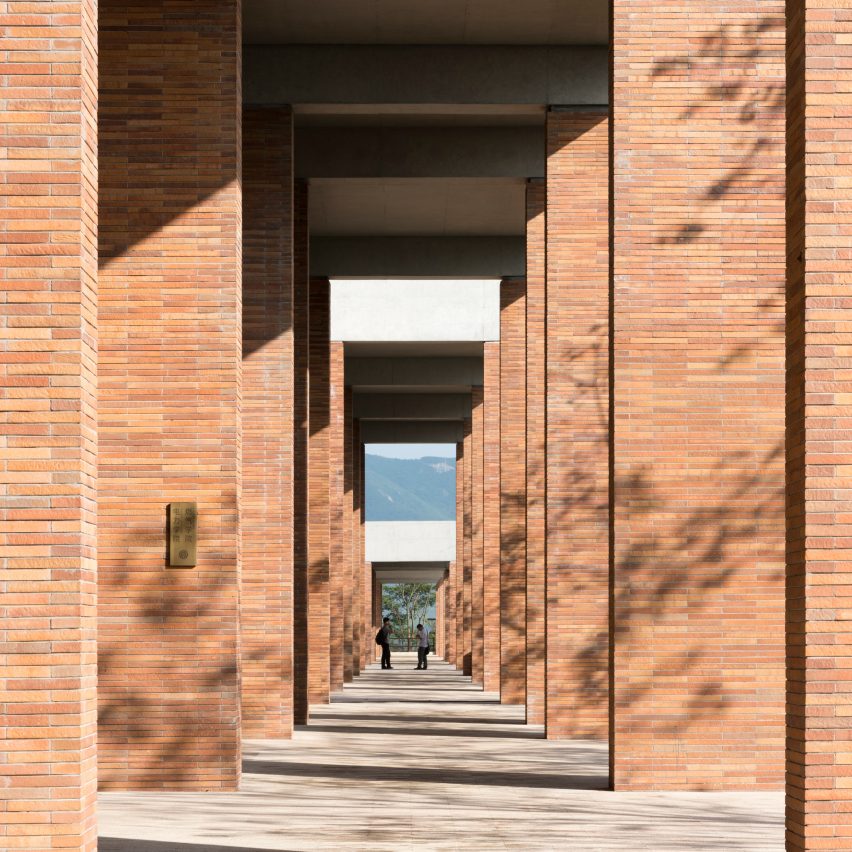
Foster + Partners has used custom-made bricks to build a campus near Shenzhen, encompassing a university, a hotel and housing that all take in views of the South China Sea. Read more


 Sig Nordal