
Apartment ST is a private home located in Jūrmala, Latvia. Completed in 2015, it was designed by OPEN AD – Architecture and Design. Apartment ST by OPEN AD – Architecture and Design: “A flat near the seaside which the owner only uses during the summer. The interior is bright, inconspicuous and well lit, with high-quality furniture and considered functionality. Valuable materials have been used in a simple way and with..
Traditional Moroccan cosmetics updated for smartphone generation

Industrial designer Kim Ramain-Colomb’s brightly packaged Habibi cosmetics range is based on traditional Moroccan makeup. Read more
AOIZ Nedim Uysal Private High School / M artı D Mimarlık

© ZM YASA
- Architects: M artı D Mimarlık
- Location: Izmir, İzmir, Turkey
- Architectural Design: Metin Kılıç, Dürrin Süer
- Area: 13697.0 sqm
- Project Year: 2016
- Photographs: ZM YASA
- Project Team: Merih Feza Yıldırım, Serdar Uslubaş, Ali Can Helvacıoğlu, Damla Duru, Gizem Yazıcı
- Consultant : Deniz Güner
- Statical Project : Cemal Coşak, Mustafa Şahin
- Mechanical Project: Ekrem Evren
- Electrical Project : Namık Onmuş
- Client : Izmir Atatürk Organized Industrial Zone Management
© ZM YASA
Technical and Industrial High School building is located on one of typical parcels of grid-planned İzmir Atatürk Organised Industrial Zone. Rectangular, introverted boxes placed on rectangular parcels define settlement characteristic of organised industrial zone. Monotonuos character on third dimension is the result of introverted and uniform settlement of buildings located on a flat terrain. This industrial layout provides an introverted and an isolated life. Modern education vision requires interactive and motivating interior spaces. However, social and dynamic experience can’t be provided in this zone.
© ZM YASA
As a result of restricted references of topography and urban layout, 2 design strategies are accepted for building to reflect its existence by contrasting with urban context. First of all, technical ateliers and social units are distrubuted to 5 blocks located around an atrium. Educational block is located at upper floors. Secondly, green topography is continued to differentiate public block and educational block.
© ZM YASA
Floor Plan
© ZM YASA
Building mass is composed of spaces surrounding a large atrium which provide dynamic interiors and continious visual perception. Atrium, defined by permeable wall surface is a public space, reflecting institional identity. Spaces, arrayed on corridor surrounding the gallery are merged to it by niches containig different programs such as club rooms.
© ZM YASA
Niches with different properties between different blocks , enables interaction of exterior space with dynamic interior spaces. They have different identities due to different programs such as ceremony areas, entrance plazas, recess and sports areas.
© ZM YASA
A new level is created for providing a different contextual perception and for breaking monotonuos layout of the context on third dimension. The new level where green landscape sustains, not only offers an alternative interaction spaces but also, creates a new horizon for users.
© ZM YASA
Building program is distributed to 5 floors. Large areas such as conference hall, sports hall, ateliers and socializing areas like canteen, dining hall are located on ground floor, 1. floor. Classrooms, adminstrative offices, teacher’s lounges, library are located on 2., 3., 4. floors.
© ZM YASA
Bricklaying robots create bulging brick facade for Shanghai arts centre
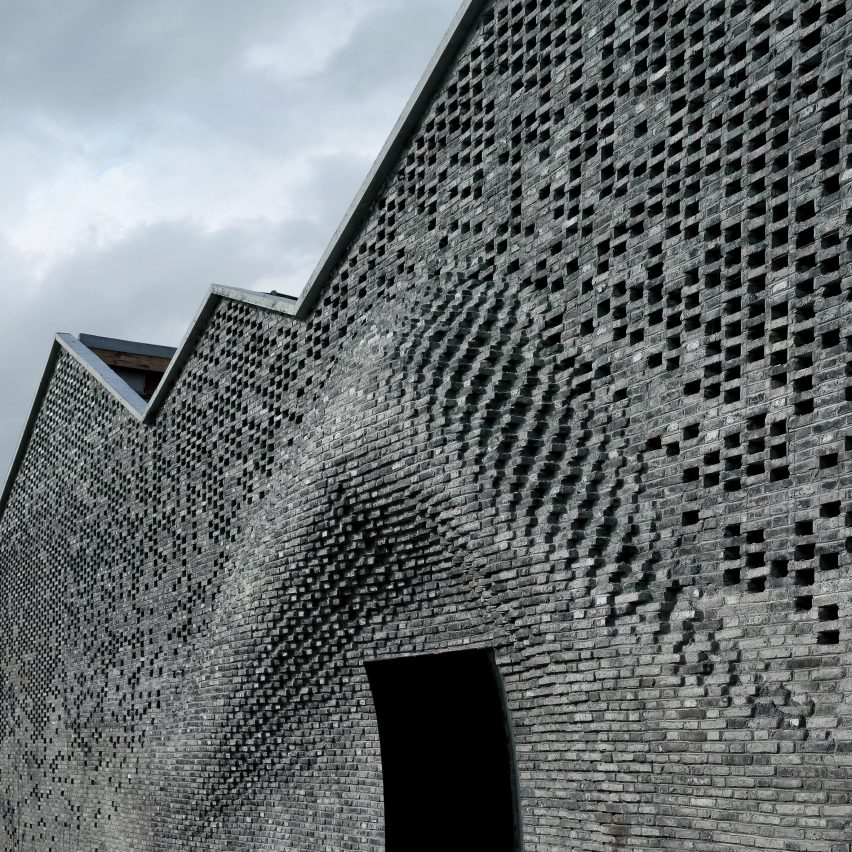
Chinese studio Archi-Union Architects programmed robots to construct the undulating brick facade of this art gallery in Shanghai’s West Bund district. Read more
Carbon-fibre orb marks entrance to Detroit academic building by Morphosis
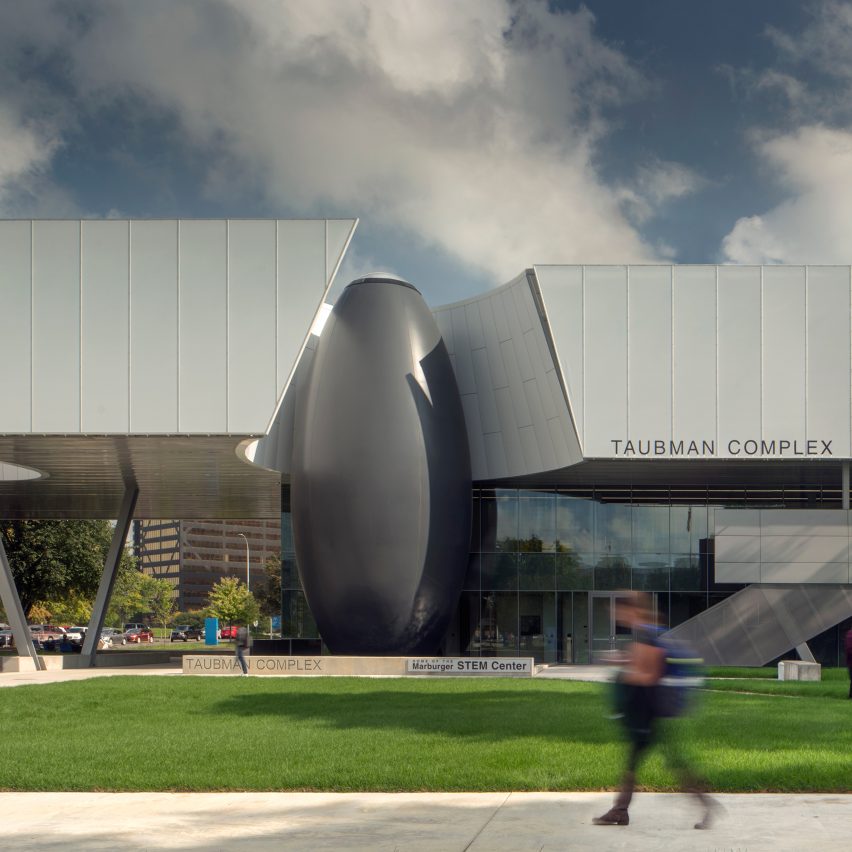
US studio Morphosis has completed a science, design and engineering facility in Michigan, which features a scrim made of ETFE plastic and an entrance stairwell contained within a black orb made of carbon fibre. Read more
SkunkLock bicycle lock causes thieves to vomit

Castle Town Orthodontic Bruno / TSC Architects

© Masato Kawano / Nacasa & Partners
- Architects: TSC Architects
- Location: Aichi Prefecture, Japan
- Architect In Charge: Yoshiaki Tanaka/TSC Architects
- Area: 240.58 sqm
- Project Year: 2014
- Photographs: Masato Kawano / Nacasa & Partners
- Site Area: 674.15 sqm
- Total Floor Area: 259.05 sqm
© Masato Kawano / Nacasa & Partners
From the architect. This building is located in Nishio-shi, Aichi where the taste of the castle town remains, Japan.
We provided the open space such as the park to the cityscape on planning a dental clinic on this ground and wanted to contribute to local people.
Plan
And we read the historic background of the town and planned an adjoining building using a local tile from the open space.
This building leads eyes from the open space to trees and the sky of the Shinto shrine and provides the place of peace to the cityscape. We hope that people feel healing and the history.
© Masato Kawano / Nacasa & Partners
Sections
In addition, the tile along with the orderliness images beautiful alignment of teeth. We assume it the symbol of the thought of the dentist to think to want to do the help of the smile by treatment.
In addition, We planned it to locate an inner garden in the waiting room, and to become the extension of the scenery from the outside.
© Masato Kawano / Nacasa & Partners
Sinsa-dong Office Complex / JMY architects

© Joonhwan Yoon
- Architects: JMY architects
- Location: Sinsa-dong, Gangnam-gu, Seoul, South Korea
- Architect In Charge: Jaemin Yoon
- Design Team: Kwangjae Ryu (Team Manager), Hyukhyu Shin, Hyejin PARK, Jinsoo Kim, Seongmin Lee, Yeonjung Lee, Eunji Choi, Wihwan Choi
- Area: 64.36 sqm
- Project Year: 2015
- Photographs: Joonhwan Yoon
- Collaborator : MOA Structure Engineers, M:HL Consulting, Daewon Pobis
- Construction: Jarchiv Construction
- Client: MEDIA EN MESSE
© Joonhwan Yoon
1. Ugly-looking Ground
The trapezoid shaped, irregularly pentagonal ground located in an urban residential district is a commercial lot in a small area (282m2). With road reduction and difficulties of parking and entry due to the restricted diagonal line (Due North Slant Line for Daylight and Diagonal Plane Control by Street Width) and narrow entrance (3m width), its application for any purpose other than a house will be difficult.
Site Plan
Floor Plans
2. Poor Residential Environment in an Exclusive Residential District
Despite the proliferation of small scale qualitative development of nearby Garosu-gil, which is the leading shopping district in Seoul, the urban development and architectural status of the area is slow and poor. With narrow and irregular road and ground formation, increasing land price and old houses, unclear type of housing, parking difficulty and awkward skyline, the area looks like other decaying old downtown area, and the land is surrounded by houses.
© Joonhwan Yoon
3. Limited Development Potential
– Legal restriction: The ground is restricted by Due North Slant Line for Daylight on two sides and Diagonal Plane Control by Street Width on two sides, and thus it will be difficult to secure road reduction and parking space.
– Limitation of construction cost: Unreasonable demand by the owner, limitation of construction cost and limitation of technology make the development difficult.
– Difficulty of construction: Complaints by nearby households and narrow road of 3m width make construction difficult.
Diagram
4. New Alternative Plan as the Composite Residential/Commercial/ Business Space
To resolve the limitations, three factors are suggested as the direction of this project: extremeness, compositeness and connectivity.
Extremeness: Attainment of maximum space with minimum construction cost, maximum opening with minimum opening, simpleness and complexity, roughness and neatness, reversal of legal restriction (attainment of external space on each floor), and deep basement space (6m ceiling height)
© Joonhwan Yoon
Sections
Complexity: Composite residential, commercial and business plan
Connectivity: Vertical connectivity with sky and horizontal connectivity with surrounding context. Since the main function is the business facility, the concrete double skin will be installed in the low part (up to the third floor) to be horizontally isolated from the neighbor, and the space between the concrete and door/window skin is used for vertical connectivity (light, wind and rain penetration) with sky. The top part (4th ~ 6th floor) without the alternative is opened as much as possible so that it is horizontally connected to the distant view while the external space of the floor side, which becomes narrower due to the slant line restriction as it goes upward, is vertically connected. The programmed connectivity is connected or separated in the order of commercial, business and residential function from bottom to top.
© Joonhwan Yoon
Warehouse Renovation / Yabashi architects & associates

© Tohru Yabashi
- Architects: Yabashi architects & associates
- Location: Saga, Saga Prefecture, Japan
- Architect In Charge: Tohru Yabashi
- Area: 224.0 sqm
- Project Year: 2016
- Photographs: Tohru Yabashi
Using the Saga Prefecture Karatsu steel frame within the structure of the warehouse, which has been used as a material storage in, primarily space, such as a gallery that allows the exhibitions in conjunction with the display and the Marche in the Marche which is carried out once in two months Guests were asked.
Floor Plan
So, it envisions a large patio with a gallery in the warehouse, hoping to be the intimate space to the corresponding space, such as the alley born around that in Marche, is composed of a shelf wall, which is arranged in a nested It was proposed a tubular structure.
© Tohru Yabashi
Is the inner shelf wall patio is surrounded by a white wall, and has a abstract space by comparison with the presence that was ingrained the existing warehouse. Here exhibition invited writers, workshops, concerts, continue to function as a venue for events to be held in conjunction with the Marche of the extra touches that make such talk events.
© Tohru Yabashi
On the other hand, the alley around patio has become an elongated space with intimate scale. Shake the angle to put the distance from the existing exact grid ShelfWall, it has transformed the space of the alley to the richer ones by creating a deep perspective to this place. Other Marche in alley, display shelf of goods belonging to the event in the patio, can be utilized as a bookshelf library space.
© Tohru Yabashi
Shelf wall on the border of mutually different space has created a new table / back of the relationship. The contrasting events that location is performed in parallel with each other is complemented each other while repeating the reversal of the front and back like a vortex in the boundary ShelfWall, function as a place of rich regional exchange that lead the way in the various events we hope that they would.
#5 / Studio Wills + Architects

© Beton Brut
- Architects: Studio Wills + Architects
- Location: 70 Frankel Ave, Freeport, NY 11520, United States
- Architect In Charge: Ng William
- Design Team: Ng William, Wu Shan Yat
- Area: 489.96 sqm
- Project Year: 2016
- Photographs: Beton Brut
- C&S Engineer: Civil and Geotechnical Associates
- Quantity Surveyor : BKG Consultants Pte Ltd
- Builder: TIM Contracts Pte Ltd
- Carpenter: Sin Hiap Chuan Wood Works
© Beton Brut
The site faces a major thoroughfare, is flat and non-descript. Maximized to its permissible building volume, this can be a potentially over-sized house for a family of 4 (parents and teenage daughters) and their 2 helpers. The strategy of fragmentation was thus adopted to fragmentize the volume into comprehensible parts.
Floor Plan
In order to accommodate a sizeable lap pool of 3 meter width along the side garden, the building had to be set-back by an additional 1 meter beyond the 2m building set-back line. This was considered to be undesirable due to the reduced building foot-print. Resolution was found by a shift of 1 meter back to the 2m building set-back line, in the upper levels, to regain the otherwise reduced building footprint.
© Beton Brut
This strategy was adopted in the making of the PLANS, SECTIONS and ELEVATIONS resulting in multiple ‘gaps’, between wall and roof planes, for light and ventilation. Roof planes were further tilted away from the western sun in order to shelter the interior spaces from the tropical heat and look to the distant whilst escaping the prying eyes of its immediate neighbors.
Section
Shades of grey, contrasting materials and textures and lighting quality were appointed across the entire section of the building to accentuate the fragments and heightens one’s experience of the entire house which oscillates between light and shade, open and enclosed, expansive and compressive spatial qualities.
© Beton Brut
Diagrams
#5 was a study in the making of tropical living spaces, in a dense urban environment, that is at once open yet private.
Product Brief:
Reinforced concrete (RC) – The roofs constructed in reinforced concrete and finished with a coat of paint, similar to the walls, give expression to a series of ‘shells’ that defines the enclosure and ‘one-ness’ to the entire house.
© Beton Brut

