After two years of intensive planning, Trinity ChurchWall Street revealed the design for its new building at 74 Trinity Place, in the Financial District of New York City. New York-based firm Pelli Clarke Pelli Architects designed the building to serve as both a ministry and community center for the church. Using open public spaces and multipurpose rooms, the structure will connect neighbors, workers, and families — reflecting the church’s aim for community engagement.
Our building is a statement of Trinity’s dedication to serving the people of this community, this neighborhood, and the city of New York for a fourth century, said Reverend Dr. William Lupfter of Trinity Church.
With 26 floors located directly behind Trinity Church, the project reconciles the churchyard and church by forming a larger public setting. Its design is also reminiscent of the original church —glazed panels within metal framework resonate with Trinity’s ancient stonework. Although the base will be reserved for the Parish Center, the rest of the 160,000 square foot office tower is devoted to commercial space.
The Parish Center will have two lobbies: Trinity Place Lobby, a large space for congregating and art exhibits, and Greenwich Street Lobby, an amphitheater type space where smaller performances could be held.
Seating up to 300 people, the Parish Hall will be designed for banquets and theatrical performances. In addition, the structure will include a parlor Library with full-height windows facing Trinity Church, and educational spaces for Sunday school and seminars. A gymnasium with 22′ ceilings and terraces outside of the Parish Hall add to the building’s amenities.
In their press release, the architects write – The addition of office space reaffirms Trinity’s commitment to Lower Manhattan, which the Church views as an investment in continued economic development and job creation in the Financial District.
Near Pondicherry in Southern Indian is Auroville, an experimental township devoted to the teachings of mystic philosopher Sri Aurobindo. The 20 square kilometer site was founded in 1968 by Aurobindo’s spiritual collaborator, Mirra Alfassa. Otherwise known as “The Mother,” she saw Auroville as a place “where men of all countries would be at home”.
Today, Auroville has roughly 2,500 residents and continues to sustain itself, albeit to mixed results. On one hand, the Mother’s utopian vision has somewhat fallen short, with murders, suicides, visitors warned not to go out alone at night, and the questionable control of money in a theoretically “money-less” society.
On the other hand, Auroville is a hotbed of creative eco-experimentation, with the transformation of once-desert land into forest, solar panels powering much of the town, organic farming, and sustainable construction. This experimentation fits under Auroville’s charter as a “site of material and spiritual researches.” [1]
It’s not surprising then, that the architecture of Auroville is too, is an experimentally mixed bag. There are modern Kahn-like standalone houses, vernacular huts with thatched roofs, homogeneous clusters with names like “Aspiration” or “Solitude” and eco-friendly public centers dedicated to earth building, all around a central, gold, monumental building.
Below are just some of the buildings that make up Auroville’s unique built environment:
1. The Matrimandir Temple, designed by Roger Anger
Quite literally the heart of Auroville is Matrimandir, a golden temple that sits at the centre of a galaxy-inspired master plan. Although Anger designed alongside the Mother upon his commission in 1965, the temple was not complete until 2008, taking a total of 37 years to build. Anger noted Le Corbusier as inspiration, for “genius in his use of form” and how he was “single-minded, bold in his conceptions.” [2] The contradiction between this top-down design inspiration and the Aurovillean ideals of equality is yet another paradox of the town.
2. The Auroville Visitor Center, designed by Suhasini Iyer-Guigan
Departing from Anger’s sculptural dictation, Iyer-Guigan is an architect drawn to self-building, prefabrication and alternative building technologies. Her Auroville Visitor Center is an expression of this, built in 1998 from compacted earth bricks and prefabricated ferrocement. It doubles as both a reception center and a demonstration complex where villagers can learn and hone their earth building techniques. [3]
3. The Vikas Settlement, designed by Satprem Maïni
Specializing in compressed stabilized earth blocks (CSEB), Maini headed the design of the Vikas Settlement, a four-story building built using CSEB. The blocks can be said to be more sustainable as they can be fired at 700-900 degrees Celsius instead of the 1,200 degrees required by concrete. The building’s incorporation of renewable energy sources and wastewater management system earned it a place as a finalist for the World Habitat Award in 2000.
A resident of Auroville for the last 25 years, Doctor-Pingel considers sustainability as “a way of life and not an add-on.” Central to her design philosophy is Bauibiology, or Building Biology. This considers electromagnetic fields, natural materials and earth energies in a design process that seeks planetary harmony. The Temple Tree Retreat is reflective of these respects, fusing greenery into its structure of terracotta blocks and cuddapah floor.
References:
1. Kundoo, Anupama. (2007), Auroville: An Architectural Laboratory. Archit Design, 77: 50–55. doi:10.1002/ad.557 2. Desai, Madhavi. Women Architects and Modernism in India: Narratives and contemporary practices. Routledge, 2016. 3. Miles, Malcolm. Urban Utopias: The Built and Social Architectures of Alternative Settlements. Chippenham: Routledge, 2008.
The Longcave is a residential project designed by 23o5 studio in 2015. It is located in Vĩnh Long, Vietnam. The Longcave by 23o5 studio: “Urbanization process in Vietnam that is seen as the development, but in our opinion it is the disorder and vandalism. People are driven to the house where they are not inherently subject to change and adapt to his way of life and the environment. Tra On..
Chile and Cuba’s contributions to the London Design Biennale suggest that, while the Global South is expected to copy the design of the north, it could offer a more radical future, argues Owen Hatherley in his latest Opinion column. Read more
The Museum of Contemporary Art San Diego (MCASD) first opened in 1941 in the oceanfront La Jolla home of philanthropist Ellen Browning Scripps. In the half century that followed, the museum saw three distinct expansions; now, as it turns 75, MCASD anticipates its latest addition, a flexible new multipurpose design by Selldorf Architects that will quadruple the current gallery space.
Courtesy of Selldorf Architects
There is a spirit that is made up of all different things, from the collection and the location to all the people that make it a very special place, there is work to do and I think the rewards are going to be tremendous said Annabelle Selldorf, founding principal of the New York-based, 65-person firm. Inspired by San Diego‘s diverse cultural influences, Selldorf hopes to make the original Scripps house, designed by Irving Gill, the centerpiece of the area.
Courtesy of Selldorf Architects
The addition, which is conceived as a series of smaller volumes, aims to create a more welcoming entry to the museum and blend it more cohesively to its coastal site. In a harmonious contrast with the stucco finish of the current building, the addition will be composed of cast concrete, travertine panels, and aluminum brise-soleils. The new buildings will provide spaces for both the permanent MCASD collection and changing exhibitions, as well as public programs, performance art, and other educational activities.
The museum will close next January to prepare for construction, which is projected to begin in the second half of 2017. The building is expected to reopen in late 2019.
The Klinker Cultural Centre was given a lively exterior to reflect the expressive nature of its programs. Its central location in Winschoten makes it easily accessible to the residents who can enjoy the cultural offerings of the theatre, arts centre, radio studio and library, or savour a coffee in the theatre café. In this way, residents themselves actively contribute to their city’s cultural life.
Site Plan
Cultural icon in Groningen region The striking carved exterior of the centre is designed without front or back facades in order to better engage its surroundings on all sides. This also maximises and accentuates its footprint on the site, while the gentle angles of the continuous facade play with the laws of perspective and shorten visual distances. The horizontal sections, curved edges and overhangs recall 1920s Expressionist architecture in Groningen. The building anchors itself in Winschoten by echoing the morphology of its surroundings. It functions as a juncture between the small-scale buildings of the historic inner city and the larger scale of post-war developments and renovations. The adjacent city centre is characterised by double-storey masonry houses made of local Groningen clay. The reduced scale is emphasized by the horizontal bands that split and join as they move around the building. Major characteristics of the building are its richly detailed vertical masonry and deep, sloping window recesses which lend the building a strong and bold appearance. Different types of bricks were specially designed for the project and produced in traditional orange Groningen clay. The technical zones in the plinth also reflect a connection to the surroundings. The raw, brown/orange ends of the building feature CorTen steel surfaces perforated with the contours of Groningen’s landscape.
Façade The main innovation is the fact that the facade is entirely sculpted from brickwork. A very specific production process enabled the use of deep reveals around the window frames. These are composed of six separate elements poured into one single structure in the factory and installed as one piece on site in front of the windows.
Courtesy of Atelier Pro
The prefab facade is completely constructed without traditional sills or eaves/overhangs. Water that runs over the window frame is discharged through the drainage cavity. In principle no additional drain is necessary. In case of excessive leakage it was decided to implement gutters under every frame to reduce the risk of damage and make maintenance easier. For extra reassurance, the gutters catch excess water and drain it away through the sewage system.
F | A Interior is a digital residential project created by ZROBYM Architects in 2016. It consists of a stylish contemporary apartment in Minsk, Belarus. Renderings courtesy of ZROBYM Architects
For Casa Cor Rio 2016, the most important architectural and interior design event in Brazil, Gisele Taranto Arquitetura was challenged to create six different designs for a dining room. The 26th edition of the event takes place in a house surrounded by Burle Marx gardens in Gávea, an affluent residential neighborhood located in the South Zone of the city of Rio de Janeiro. Ovoo Dining Room by Gisele Taranto – Casa..
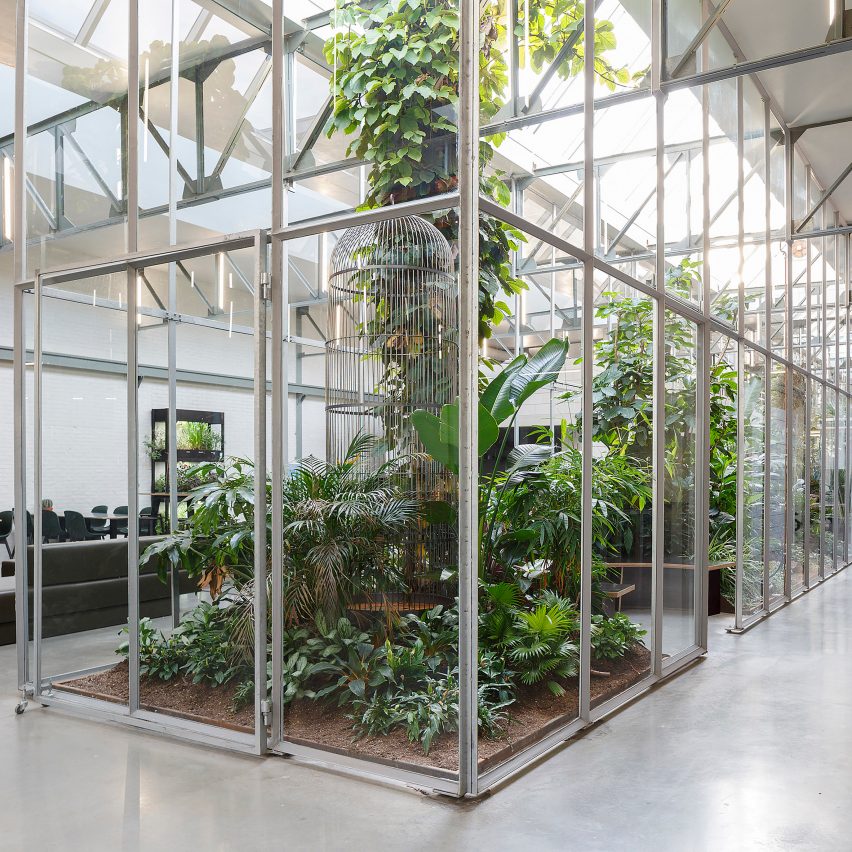
Glasshouses double as informal meeting spots inside this former warehouse in Amsterdam, which has been converted into offices for a pushchair company by Dutch studio Space Encounters. Read more