Tokyo Vertical Cemetery Competition Winners Announced


Courtesy of Arch Out Loud

Courtesy of Arch Out Loud

Architectural research initiative arch out loud has announced the winners of Tokyo Vertical Cemetery, its international open ideas competition that sought solutions to Tokyo’s rising issue of burial space. 

Sited in the Shinjuku district of Tokyo, the competition challenged architects and designers to develop proposals for a vertical cemetery that explores the relationship between life and death in the city while taking into account the cultural identity that is tied to death.

From 460 proposals representing 54 countries and six continents, one winner and three runners-up were selected by a jury including David Adjaye, Tom Wiscombe, Alison Killing, and more.

The winners of the Tokyo Vertical Cemetery competition are:

Runner Up: In-Between / Moises Roro Marquez, Carlos Orbea Martinez, Gonzalo Garcia-Robeldo, Piotr Panczyk; Spain


Courtesy of Arch Out Loud

Courtesy of Arch Out Loud

The concept is based on a dialogue between volumes made of two drastically different materials and the empty space in the middle. Apart from generating interesting spaces with three different ambiances, this could be considered a metaphor for cemetery, a place between two worlds: dead and living. Our project recognizes them both as different and bonds them together within one structure by finding a place for utilities and public spaces. All this is concealed in modular grid that sorts out space dedicated for each grave in an economic and respectful manner that does not contradict Japanese traditions nor customs.


Courtesy of Arch Out Loud


Courtesy of Arch Out Loud


Courtesy of Arch Out Loud


Courtesy of Arch Out Loud

Runner-Up: Beyond the Horizon of Consciousness / Anna Eckes, Olaf Mitka; Krakow, Poland


Courtesy of Arch Out Loud

Courtesy of Arch Out Loud

BEYOND THE HORIZON OF CONSCIOUSNESS questions about our current concept of the consciousness and its relation to death. The project is an ‘uncanny’ negation of Tokyo – the city which floods every ‘dark space’ with light and noise, the city that leads to shatter myth and irrationality. Space express itself through mimicry of cave, architecture that doesn’t have a plan or rooms. The site is a meadow interacting with users. The surface of rocks serves as a columbarium, a storage for modern ‘urns’ created from the separation of DNA. The bottom of cave consists of a main reflection space. Smaller, personal ones are located all the way from entrance to lake.


Courtesy of Arch Out Loud


Courtesy of Arch Out Loud


Courtesy of Arch Out Loud


Courtesy of Arch Out Loud

Runner-Up: Inner Landscape / Niccolo Brovelli; Italy


Courtesy of Arch Out Loud

Courtesy of Arch Out Loud

Inner Landscape is a boundary between the frantic rhythm of the city and the timeless interior space. Inner Landscape is a vertical path, hybrid interpretation of multi-storied pagoda and Japanese shrine. Inner Landscape symbolizes the Buddhist tripartition into three lands: a land of roots, a land of the middle and a plain of high heaven. Inner Landscape is death and life: a cryptic place to feel close with loved departed and a spiritual route between “artificial” pieces of Japanese landscape, that leads to the perception of the Shinto’s reverence for natural artifacts.


Courtesy of Arch Out Loud


Courtesy of Arch Out Loud


Courtesy of Arch Out Loud


Courtesy of Arch Out Loud

Winner: Death Is Not The End. Being Forgotten Is. / Wei Li He, Wu Jing Ting Zeng, Zhi Ruo Ma, Kui Yu Gong; China


Courtesy of Arch Out Loud

Courtesy of Arch Out Loud

This project explores a new way of dealing with the spatial constraint for urban cemeteries while expressing a unique approach to life and death. By having the balloons as a medium for coffin storage, we utilize the vertical space by having balloons that gradually rise up and eventually fly off. The appearing and disappearing of balloons resonate with the temporality of life. Departing from the depressing silence in traditional cemetery design, we propose a new space of tranquility created by a tower of rising balloons.


Courtesy of Arch Out Loud


Courtesy of Arch Out Loud


Courtesy of Arch Out Loud


Courtesy of Arch Out Loud

The winners of the competition will be featured in the first issue of the out lous journal, “DEATH + ARCHITECTURE,” which will be released in early 2017.

Learn more about the winners, as well as honorable mentions, here

News and project descriptions via arch out loud.
http://ift.tt/2edW4rf

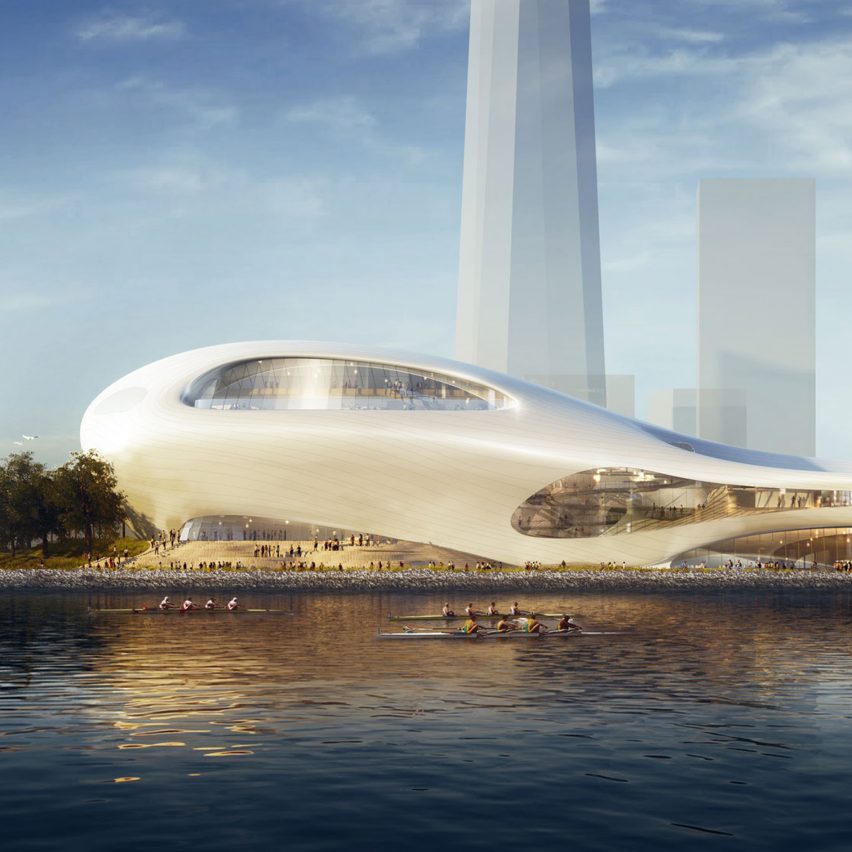
MAD unveils competing Lucas Museum designs for San Francisco and Los Angeles

sq-01-lucas-museum-architecture-san-francisco

After abandoning plans in Chicago, Beijing studio MAD has now revealed two new designs for its George Lucas Museum of Narrative Art – one for San Francisco, and a different one for Los Angeles. Read more

http://ift.tt/2f9XSGV

David Chipperfield and Zaha Hadid among shortlist for inaugural RIBA International Prize

OURCQ / Karawitz


© Schnepp + Renou

© Schnepp + Renou


© Schnepp + Renou


© Schnepp + Renou


© Schnepp + Renou


© Schnepp + Renou

  • Architects: Karawitz
  • Location: 45 Rue de l’Ourcq, 75019 Paris, France
  • Area: 1580.3 sqm
  • Project Year: 2016
  • Photographs: Schnepp + Renou
  • Bet Structure: A.I.A.
  • Bet Fluids, Thermal, Environnement: AMOES
  • Economist: Tohier
  • Bet Acoustic: Acoustique & Conseil

© Schnepp + Renou

© Schnepp + Renou

How an intermediate housing project inherited the ambitions of a cohousing project.
The intermediate housing project developed by the KARAWITZ agency now comprises 23 flats, a restaurant, a garden and a parking lot. It was built for OGIF, a property developer specialising in intermediate housing. One of the particularities of this project is that it had inherited the ambitions of a prior cohousing project by the name of “Diapason project”. It originally scheduled 14 homes, a common studio and shops. This first project did not use up all the floor area ratio given by the local masterplan… or the potential for the architects to provide supplementary homes in the final project.


© Schnepp + Renou

© Schnepp + Renou

The lot is well known to Parisians, especially those prone to stroll beside the Ourcq canal. A few hundred meters before the Parc de la Villette, on the quay de Marne, it overlooks the water and slides between the streets of the Meurthe and the Ourcq on each side of which it draws a triangle. Amplifying its singularity, this plot is served by an upper level of rue de l’Ourcq, at the opening of a pedestrian bridge over the canal, while it leans down to street level in rue de Meurthe. Finally it offers the rare opportunity to Paris, to develop an autonomous building without adjoining or neighboring properties, and generate both a garden to the south and exceptional views to the north.


© Schnepp + Renou

© Schnepp + Renou

Section

Section

© Schnepp + Renou

© Schnepp + Renou

The building permit obtained in October 2011 as part of the project developed at the time by KARAWITZ was kept to scale with two modifications. The imbrication between the Z shaped duplex apartments and the L shaped flats were dropped from the current project, but it inherits the spine of the project and a connecting channel to the garden offering transparency. It houses a staircase which allows for the serving of four apartments with generous sized landings and high levels of bioclimatic spaces illuminated naturally. On the front side, or the one overlooking the canal oriel windows on both large and small apartments from the old project have evolved into balconies in the new one.


© Schnepp + Renou

© Schnepp + Renou

The former common-room has been transformed into independent living. The proposed typologies are one bedroom and two bedrooms overlooking the canal or the garden plus attic flats offering a more singular variation. All of them are doubly oriented and benefit from a balcony. On the canal side some windows are fitted with glass spandrels to perpetuate the idea of its inherent diversity to the initial project and to provide the living rooms plunging views over the water.

A brewery and a shop opened there in 2016.


© Schnepp + Renou

© Schnepp + Renou

The structural choices focused on a concrete structure and exterior insulation. The fault is covered in reflective coatings while the remainder of the coating is made of darken wood. This exterior moldings contrast with inner window frames made of wood or aluminum. Finally the “dancing” sloping roofs coated with zinc generate a very sculptural form. This project meets the requirements of the Climate Plan.


© Schnepp + Renou

© Schnepp + Renou

Product Description. The timber cladding of Piveteau is a major element of the project. The strict regulations of fire protection left a significantly reduced range of wood products for the facade. On one hand, in order to maintain a certain lightness, we sought a product similar to the perforated cladding originally planned, but forbidden by regulations. On the other side, the city expected a timber cladding that would not stain on the long term under the weather influence. The darkened wood and the “faux-perforated” shaped profile enabled us to find solutions to these two constraints.


© Schnepp + Renou

© Schnepp + Renou

http://ift.tt/2edQntv

Luciano Kruk Designs a Home in the Seashore Town of Mar Azul, Argentina

H3 House by Luciano Kruk (24)

H3 House is a private home located in Mar Azul, Argentina. It was designed by Luciano Kruk in 2015. H3 House by Luciano Kruk: “Mar Azul, a seashore town in Villa Gesell Department, neighboring Mar de las Pampas, had its sand dunes terrain divided into a grid pattern. Its dense aged pinewood grants Mar Azul’s atmosphere pleasant quietness and tranquility. In a modest, 210 square meter (2,260 square foot) plot..

More…

The Fictive Architecture of European Banknotes Sculpted From Sugar


© Gustav Almestâl

© Gustav Almestâl

One of the key challenges faced by the European currency union, the Euro, was that of their design. In 2002, when the banknotes entered circulation across large parts of the European Union, the imagery that they possessed had to represent a continent of cultures. The answer: to create fictitious illustrations or, as the European Central Bank states, “stylised illustrations [of windows, doorways and bridges], not images of, or from, actual constructions.” In a recent exhibition architect Anna Pang, in collaboration with Johan Holkers and Rolf Stålberg, have attemped to present the “fictive architecture” of the Euro as sugar sculpture.


European Banknotes: €5 – Classical; €10 – Romanesque; €20 – Gothic; €50 – Renaissance; €100 – Baroque; €200 – Art Nouveau; €500 – Modernism

European Banknotes: €5 – Classical; €10 – Romanesque; €20 – Gothic; €50 – Renaissance; €100 – Baroque; €200 – Art Nouveau; €500 – Modernism

“For hundreds of years,” Pang states, “sugar sculptures [have been] common in Europe.” They were presented at official dinners and ceremonies and, although edible, their primary task was to display incredible wealth and power. In 1669 Pope Clement IX commissioned a copy of Bramante’s Tempietto (Rome) in sugar, while in the 19th Century the famous chef Carême decorated the Emporer Napoelon’s dinner table with imaginary sugar buildings. Sugar, being a luxury good, also demanded a specific and complex craft in the act of sculpting it. According to Pang, a number of well-known artists and architects were commissioned for their design, and a recurring motif was that of architecture.


Historic image by Theodor Graminaeus (showing a 16th century table with sugar sculptures). Image © Getty Research Institute, Getty's Open Content Program

Historic image by Theodor Graminaeus (showing a 16th century table with sugar sculptures). Image © Getty Research Institute, Getty's Open Content Program

Confiction, which has been on display at Stockholm’s Hallwylska museet, “explores the symbolic function of the euro architecture by giving it form and context in sugar.” The name itself is a combination of the Latin word confectio, meaning an arrangement and used to describe the sugar craft in different languages, and the word ‘fiction’ – something imaginary, but also “a vehicle through which to discuss reality”


Hallwylska museet, Stockholm. Image © Jens Mohr / Hallwylska museet

Hallwylska museet, Stockholm. Image © Jens Mohr / Hallwylska museet

Hallwylska museet, Stockholm. Image © Jens Mohr / Hallwylska museet

Hallwylska museet, Stockholm. Image © Jens Mohr / Hallwylska museet

© Gustav Almestâl

© Gustav Almestâl

Confiction has been created with support from the Swedish Arts Council and Fondazione Famiglia Rausing / The Swedish Institute in Rome.

Fictional Euro Banknote Bridges Brought to Life in the Netherlands
//cdn.embedly.com/widgets/platform.js

http://ift.tt/2eIQalB

A Home With Stunning Views in Netanya, Israel

Netanya Penthouse 3.0 by Dori Interior Design (8)

Netanya Penthouse 3.0 is a private residence designed by Dori Interior Design. It is located in Netanya, Israel and was completed in 2016. Netanya Penthouse 3.0 by Dori Interior Design: “This urban project is a 146 m2 (1,571 sf2) penthouse apartment with 4 bedrooms and 2 bathrooms + 130 (1,400) more of 3 balconies. It’s located on the 7th floor out of 8 in new building in Netanya, Israel and..

More…

Charles Tashima creates cabinet of curiosities inside school science laboratory

q-science-lab-yerbury-primary-school-charles-tashima-architecture-london-uk_dezeen_sq

A wooden ladder leads up to a set of white cabinets filled with animal bones, plants and a preserved tarantula in this science laboratory designed by Charles Tashima Architects for a London primary school. Read more

http://ift.tt/2eIAWwL

Villa KDP / Govaert & Vanhoutte Architects


© Tim Van De Velde

© Tim Van De Velde


© Tim Van De Velde


© Tim Van De Velde


© Tim Van De Velde


© Hendrik Biegs


© Hendrik Biegs

© Hendrik Biegs

The villa is situated not far from the Belgian Coast near the French border, in an area plenty of dunes and trees. The site itself embodies a big natural dune that ascends towards the main street. A secondary road descends on the left side of the terrain, up till the entrance of the house.


© Tim Van De Velde

© Tim Van De Velde

The site is entered on the left upper side of the dune, along a closed concrete façade. The level of the house is the same as the entry point. By consequence this implies that the rest of the house floats above the natural dune, towards the lower part of the terrain. All rooms are on the same level. By placing the entrance to the back of the terrain, allows the natural dune to embody the front garden.


© Tim Van De Velde

© Tim Van De Velde

Plan

Plan

© Tim Van De Velde

© Tim Van De Velde

The house is entered underneath a concrete canopy through the wooden front door. The front door & garage gate are perceived as one abstract wooden plane on the right side of the back façade. The remaining part of the back façade, made out of glass, allows maximum view and light for 2 bedrooms towards the back yard.


© Hendrik Biegs

© Hendrik Biegs

By the elevation towards the front, the living rooms, kitchen and master bedroom overlook the trees opposite to the main road. A hedge, made out of local natural vegetation  allow privacy. To enjoy the scenery outside, a terrace, partly covered by a secondary canopy, is cutout within the glass volume. All rooms at the front are centered around the terrace. They are all interconnected. 


Section

Section

Structurally the elevated volume is balanced on a cellar. This underground concrete mass serves as a counterweight, bearing the entire ground floor. This allows the front of the house to float above ground.

http://ift.tt/2dNeSMV

DTR_studio Architects Designs a Stunning Single-Family Home for a Painter in Málaga

A Single Family House For a Painter by DTR_studio Arch (11)

A Single Family House For a Painter is a residential project completed by DTR_studio Architects. The home is located in Gaucín, Málaga, Spain and was finished in 2015. A Single Family House For a Painter by DTR_studio Architects: “This house has three elements very importants: 1. The developers: Joseba and María . 2. The situation, Gaucín and 3. The position, linked with the land and the amazing views. 1. Joseba..

More…