Architecture
Bijoy Jain: “Architecture Is Not About an Image, It Is About Sensibility”

MPavilion, Melbourne, Australia (2016). Image © John Gollings
Bijoy Jain, the founder of Indian practice Studio Mumbai, has long been well-known for his earth-bound material sensibilities, and an approach to architecture that bridges the gap between Modernism and vernacular construction. The recent opening of the third annual MPavilion in Melbourne, this year designed by Jain, offered an opportunity to present this architectural approach on a global stage. In this interview as part of his “City of Ideas” series, Vladimir Belogolovsky speaks with Bijoy Jain about his design for the MPavilion and his architecture of “gravity, equilibrium, light, air and water.”
561/63 Saat Rasta, Byculla West, Mumbai, India (2015). Image Courtesy of Studio Mumbai
Vladimir Belogolovsky: Let’s start with your MPavilion design here in Melbourne. You said about this project, “I want it to be a symbol of the elemental nature of communal structures. I see MPavilion as a place of engagement: a space to discover the essentials of the world – and of oneself.” How do you think architecture can help to discover the essentials of the world and of oneself?
Bijoy Jain: Let me start with the premise here. Fundamentally, we are all mythical beings. And the idea of a building that we call architecture is as close as it can be to this idea of mythical being and the fact that it is really an extension to the human body, not that different from the cloth that we wear. So for me, architecture is a physical and material manifestation and precise representation of what it means to be human. Architecture is all about negotiating with the immediate landscape and our environment, but also on another level, it is about how we can incorporate into our world this idea of a mythical being or a beast… For me, that’s the potential of architecture. The act of architecture is about making space, not a building or an object. Yes, it requires a form; a form is important. But for me, it is more important to discover how each place reverberates. I don’t believe architecture can save the world but it can resonate with the essence of a particular space.
Ganga Maki Textile Studio, Bhogpur Village, Dehradun, India (2015). Image Courtesy of Studio Mumbai
VB: Do you mean that architecture works on a more personal level; meaning, it responds to those who are open to receive certain signs and messages?
BJ: Well, personal and universal at the same time. If we get rid of all the clutter, what fundamentally makes me also fundamentally makes you. We are all connected. We are all driven toward the center [of the pavilion] manifested in the well of water. Without the well, it would be just another building floating in the landscape. The well makes it anchored.
MPavilion, Melbourne, Australia (2016). Image © John Gollings
VB: You said, “Architecture is an interface between ground and sky.” What do you mean by that? You also said, “Architecture emerges from the ground and returns to the ground.” Could you elaborate?
BJ: I was referring to gravity. This is what we are all confronted with. And it is all about how we negotiate gravity that gives architecture its form. For me, architecture is a moment in time. That’s why I call it an interface, a communication between ground and sky. I believe that if we want to see what the Earth looks like, we have to look up to see it in the sky. Another question is – why do we look up? Somewhere in the sky, there is a mirrored reflection of the Earth.
I once was told a story by an Australian architect, Peter Wilson, who now lives in Germany. He explained to me that when an aboriginal man prepares to go to sleep he would drive a stick into the ground. The symbolism behind that is to “slow down” the rotation of the Earth, to slow down time during the sleep.
Palmyra House, Nandgaon, Maharashtra, India (2007). Image Courtesy of Studio Mumbai
VB: Gravity is the most direct challenge to all architects. What is it for you? Do you try to accentuate it in your work? As you know, some architects fight it hard. They don’t want to accept it.
BJ: I think we all strive for a certain lightness, but in recognition that there is weight too. There is a beautiful posture in yoga where half of the body is rooted into the ground, while the other half strives to go into the sky, like a rocket. So you can propel yourself up into the sky and deep into the ground at the same time. That state of equilibrium is very important.
MPavilion, Melbourne, Australia (2016). Image © John Gollings
VB: And what about dynamism? For example, Wolf Prix said: “I want my architecture to change like clouds.” You are not interested in that kind of dynamism, right?
BJ: I would like to remain within what is my capacity. Nature is nature. Yes, I am nature too, but in my physical constructs, I have limits and it is within those limits that I need to find ways to extend myself. For me, it is not equilibrium itself that’s important but the idea of working towards equilibrium and the idea of center. For me, what’s important is reverberation of resonance. Just like in mathematics, if something is zero, then we have minus something and plus something. It is about the rate of change. If I reverberate closer to the center, I remain closer to the center. To remain purely in the center, that’s status quo. Change is important, but it is all about how to negotiate each moment in time.
Ganga Maki Textile Studio, Bhogpur Village, Dehradun, India (2015). Image Courtesy of Studio Mumbai
VB: Gravity, equilibrium, lightness, what other words would you pick that describe your architecture best?
BJ: Transparency. I also hope that it is open. Porous is also important, so things can go through – light, air, water…
VB: You mentioned that to you, air, light, and water are building blocks. They are the elements that create an atmosphere. Could you elaborate?
BJ: Our body needs three main ingredients to survive – air, light, and water. So if architecture can be as close to what the human body’s needs are, then these three natural ingredients become very important in the construct of our environment.
I was in Bahrain this week and it was an interesting experience… I prefer to be out in the 40-degree heat than to be stuck in the air-conditioned hotel. The minute you land there, you spend the entire time in a sealed, air-conditioned environment. So when I was there I spent most of my time at the roof’s terrace and swimming pool because I needed to be in full contact with open environment. Yes, it was very hot, but the human body has a great tenacity and capacity. And if we can provide a space that is four degrees cooler, the perception of such temperature shift is significant. I understand there are colder climates and we need to provide heat as well, but I believe in simpler ways to make us comfortable. Such new technological innovations have been demonstrated to us and it is all about our ability or inability as architects to find ways to use them.
561/63 Saat Rasta, Byculla West, Mumbai, India (2015). Image Courtesy of Studio Mumbai
VB: An atmosphere or an ambient environment is always very specific. What are your ways of achieving something unique?
BJ: One important distinction is that in my studio there are no catalogs.
VB: Does this mean that everything you design is invented specifically for each project by you?
BJ: Of course. And we discover architecture through making things.
VB: Do you ever recycle your own details?
BJ: Sure.
561/63 Saat Rasta, Byculla West, Mumbai, India (2015). Image Courtesy of Studio Mumbai
VB: So you have your own catalogs, in a way.
BJ: Yes. What I am saying is that if I want to have a particular self-expression I need to be self-reliant, and what I can do or can’t do should not be conditioned by how things are typically done by the industry. My architecture has nothing to do with assembling different technological solutions. My goal is to be in a situation in which things that one can imagine are possible. I don’t want to be restricted because of an industry or economy, within which I have to operate. In a way, each problem is mine; each solution is mine.
For example, in one of my houses, I used marble to construct a roof, which is the evidence of such freethinking. Strictly relying on standard solutions would never even allow such thought to enter into one’s ambit.
Ahmedabad Residence, Ahmedabad, India (2014). Image Courtesy of Studio Mumbai
VB: Using your own details and not relying on standard solutions leads to producing a very distinctive and personalized architecture. Are you interested in developing your own voice and style in architecture? And what do you think about signature architecture in general, as it now loses its relevance?
BJ: I think for me the greatest part of why we go to school or why we need to receive an education is the ability to question what exists. And self-expression is very important. My self-expression is not limited; it can remain unlimited and filled with possibilities. I am interested in anything that will allow me to remain in that discourse.
Do I want to have a signature style? No. I am interested in the anonymity of architecture and in finding new ways. I don’t need to accept what was developed by Le Corbusier or Kahn. I want to keep searching for what is important for me here and today. Yes, they were the great masters, but they were as human as I am. If I can nurture a plant and do it with the greatest amount of affection and empathy that’s for me a construction of architecture. Again, my work is about understanding my own limits and from that focus on how those limits can be extended. My practice is about this and not about being unique. It is important to question what has been done before and how relevant it is today, and not just repeat the same thing just because it has become a habit.
Ahmedabad Residence, Ahmedabad, India (2014). Image Courtesy of Studio Mumbai
VB: I heard that the marble-made roof you mentioned earlier was actually cheaper to build than if you were to use mass-produced engineered wood. Could you explain how this is possible?
BJ: That’s the result of the way industry operates, the machines…
VB: Don’t machines make things cheaper?
BJ: Not necessarily. Think of the cost of the machines, their maintenance, the manpower that’s required to operate them, transportation, and so on. So in economies such as India’s, things made of marble can be achieved at a cheaper cost than the most banal prefabricated pressed wood panels. Therefore, an informal industry can produce much richer results at a cheaper cost than highly organized one.
For example, this year, we presented one of our installations at the current Venice Architecture Biennale called “Immediate Landscapes,” in which we tested various traditional materials and their possible applications. We demonstrated techniques that have been practised in India for over one thousand years. Yet, some architects could not even recognize the materials. We used earth and fiber composites, wood constructions, and bamboo frame structures reinforced with mud. These primitive structures used to be built in the times when we were still nomadic and just turning to becoming agrarian. What I want to say is that three hundred million people in my country still live like that today. These people live with a great amount of dignity, self-reliance, and they are self-governed. They are seemingly poor, but that is only because of the measurement of what money can buy… All I am saying is that there is a lot to learn there and that’s why I ask if Modernism is the right answer for modernizing India. I have a great deal of affection for Modernism, but I also want to test and find various ways to connect it to many regional techniques used in India to this day; that is the real focus of my practice. Nothing is right or wrong; the question is – what are other things that we value? How do we mitigate the influx of ideas and products? How do we keep the balance of modernization on the one hand and maintain traditions on the other?
Tara House, Kashid, Maharashtra, India (2005). Image Courtesy of Studio Mumbai
VB: Could you talk about your idea of an architect being a conductor?
BJ: It is all about the manner of doing work by trying to bring people together. There is this idea of shared values, empathies, and the will to connect despite a broad diversity of interests. So for me an architect is a sort of a bridge, a conduit for communication.
VB: You are currently working on projects all over the world. Do they present opportunities for you to discover something new in your ways of making architecture?
BJ: We are working on several projects overseas, including a community center near Hiroshima in Japan, which is about instigating a regeneration of a small town with the idea of bringing young people back to their small hometown. Then there is a luxury hotel in France. This hotel could have been a convent or university. What’s important is that this new building will have a capacity to transcend its initial function and expand its program. If the core structure is in place, the potential for buildings could be endless. Houses can become museums, hotels turned into hospitals, and places for storage, industry, or worship could be transformed into houses. Then we are working on four houses for a family in Zurich, Switzerland. There we use local stone, as opposed to concrete; the displacement of land is very minimal. We are involving many interesting artisans there. So to me, the process is the same, and it is all about what’s being embedded in architecture itself.
Bridge by the Canal, Triennale Brugge (2015). Image Courtesy of Studio Mumbai
VB: You said that you are not interested in discovering what Indian architecture may be. For example, Glenn Murcutt expressed a similar idea to me by saying that he is simply interested in doing “ordinary things extraordinary well.” Do you agree?
BJ: Sure. For me, architecture is universal. There may be different symbolism or traditions, but too often, we are caught up in the world of a particular image. Architecture is not about an image, it is about sensibility.
Copper House II, Chondi, Maharashtra, India (2012). Image Courtesy of Studio Mumbai
VLADIMIR BELOGOLOVSKY is the founder of the New York-based non-profit Curatorial Project. Trained as an architect at Cooper Union in New York, he has written five books, including Conversations with Architects in the Age of Celebrity (DOM, 2015), Harry Seidler: LIFEWORK (Rizzoli, 2014), and Soviet Modernism: 1955-1985 (TATLIN, 2010). Among his numerous exhibitions: Anthony Ames: Object-Type Landscapes at Casa Curutchet, La Plata, Argentina (2015); Colombia: Transformed (American Tour, 2013-15); Harry Seidler: Painting Toward Architecture (world tour since 2012); and Chess Game for Russian Pavilion at the 11th Venice Architecture Biennale (2008). Belogolovsky is the American correspondent for Berlin-based architectural journal SPEECH and he has lectured at universities and museums in more than 20 countries.
Belogolovsky’s column, City of Ideas, introduces ArchDaily’s readers to his latest and ongoing conversations with the most innovative architects from around the world. These intimate discussions are a part of the curator’s upcoming exhibition with the same title which premiered at the University of Sydney in June 2016. The City of Ideas exhibition will travel to venues around the world to explore ever-evolving content and design.
Taubman Complex at Lawrence Tech / Morphosis Architects

© Nic Lehoux
- Architects: Morphosis
- Location: 21000 W 10 Mile Rd, Southfield, MI 48075, United States
- Design Director: Thom Mayne
- Project Principal: Brandon Welling
- Project Architects: Aleksander Tamm-Seitz
- Project Team: Chris Eskew, Michael Nesbit, Atsushi Sugiuchi
- Area: 11613.0 sqm
- Project Year: 2016
- Photographs: Nic Lehoux
- Advanced Technology: Cory Brugger
- Project Assistants: Natalie Abbott, Carmelia Chiang, Sam Clovis, Tom Day, Ryan Docken, Bart Gillespie, Mauricio Gomez, Parham Hakimi, Jonathan Kaminsky, Hunter Knight, Sarah Kott, Katie MacDonald, Nicole Meyer, Derrick Whitmire, Pablo Zunzunegui
- Visualization: Jasmine Park, Nathan Skrepcinski, Sam Tannenbaum
- Architect Of Record: Albert Kahn Associates
- Landscape Architect: Albert Kahn Associates
- Civil Engineer: Professional Engineering Association, PEA
- Structural Engineer: Albert Kahn Associates
- Mep Engineer: Albert Kahn Associates
- Geotechnical Engineer: The Mannick & Smith Group, Inc.
- Fire Protection: Albert Kahn Associates
- Cost Estimator: Kirk Value Planners
© Nic Lehoux
From the architect. The A. Alfred Taubman Engineering, Architecture, and Life Sciences Complex is a new 36,700 SF academic laboratory building for Lawrence Technological University in Southfield, Michigan, that provides advanced facilities for robotics engineering, biomedical engineering, life sciences and related programs. The design of the building evolved around opportunities to enhance connectivity at multiple scales – between the school’s various engineering and design disciplines, previously housed in separate buildings, as well as within existing and future regions of the campus.
© Morphosis – Diagram
The Taubman Complex is among the first buildings constructed in LTU’s major expansion and renovation effort, which will add new campus regions, buildings, and amenities to serve the university’s growing student population. To support this effort, the Complex is designed as an “extrudable section:” an occupiable bar that can be extended in phases to accommodate growth while maintaining the function and design integrity of the building. The spine of the bar is formed by two floors of laboratories, which look out into an open flex-space that runs the length of the building. This flex space is the collaborative heart of the Taubman Complex, providing an expansive and re-configurable hall for informal discussions, pin-up critique sessions, and lectures. Clerestory glazing fills the flex-space with light diffused through an ETFE (ethylene tetrafluoroethylene) scrim along the east facade; in the evening, this scrim becomes illuminated by light from within the building.
© Nic Lehoux
© Nic Lehoux
Beyond adding flexible collaborative spaces and laboratory facilities, we identified opportunities to use the form of the building to establish a new axis for the school that would enhance links between existing buildings and act as a bridge to future regions of the campus. The bridge-like form of the building defines the periphery of the campus and enhances the presence and view of the University from the adjacent major roadway. The Complex is linked to neighboring buildings by lifted bridges, framing a new grand entrance and gateway to the University. Breaching the linear form of the building, a carbon-fiber circulation “orb” contains the main staircase and marks entry to the building, while creating a focal point for the University quad.
© Nic Lehoux
© Morphosis – Section
© Nic Lehoux
The precedent for a light-filled, extendable building design is rooted in the history of our teaming architect and engineering firm, Albert Kahn Associates, and of Detroit as the center for American innovation in engineering. Albert Kahn was the primary architect for an emerging automobile industry; his commissions included numerous state-of-the-art factories for Henry Ford, which employed a revolutionary structural system engineered by Kahn and his brother Julius to allow for the creation of open span, brightly lit assembly floors. The success of these buildings depended on a repeated system of structural ribs and clerestory windows – an efficient, modular formula that could be expanded and extended to whatever size necessary to accommodate the program within. A century later, Kahn’s innovations are revived in a new expansion for Lawrence Technological University designed to offer flexible laboratory facilities for evolving research and disciplines.
© Nic Lehoux
10 Fashion Collections Inspired by Mexican Architect Luis Barragán

Wall thickness, color, scale, solar dynamic, spaces built with a subtle metaphor immersed around the meaning of life, seem to be elements immersed in all of Luis Barragán’s architecture. Elements of an enduring legacy, away from the ephemeral world of fashion, textiles and haute couture; however, it’s the search for the heightening of the senses, present in the architecture of Barragán, that inspired designers to put the name of the architect on catwalks and the world of apparel.
Transcending his architecture to a particular line of design, major firms in the textile industry have used the mystical language of Barragán. A language in which fashion manages to live a furtive beauty in geometry, color, texture, but especially a totally emotional search.
Check out 10 labels whose collections have been partially inspired by Barragán’s work and ideas .
1. LOUIS VUITTON
//assets.pinterest.com/js/pinit.js
© Flickr User: Steve Silverman, licensed under CC BY-NC-ND 2.0
The recent 2016 Spring – Summer campaign by Louis Vuitton, directed by Nicolas Ghesquiere, acquired a particular monochromatic and futuristic clothing collection. With high ceilings, solid and colorful walls in pink and purple shades mimicking the vibrant colors for the Pre-fall collection, originating from Barragán’s “Cuadra San Cristobal,” and inspired by the exaltation of the senses.
As a result of the photography of Patrick Demarchelier, the campaign starring the artist Léa Seydoux captures the iconic work of Barragán, playing with scale and color to reproduce the mystical goal of the season, where the architect’s horses, a recurring presence in his work , make up a landscape of strength, excitement, and movement.
2. Daniel Espinosa
//assets.pinterest.com/js/pinit.js
© Flickr User: Forgemind ArchiMedia, licensed under CC BY 2.0
The Mexican designer Daniel Espinosa’s ‘Mexican Geometry‘ collection, inspired by Barragán’s love of the tradition of Mexican culture, synthesizes clean lines and vibrant colors through a singular minimalism seek to capture the essence of Mexican mysticism through geometry present in the architect’s work.
3. Kris Goyri
//assets.pinterest.com/js/pinit.js
© Flickr User: Estudio Campo Baeza, licensed under CC BY-NC 2.0
Kris Goyri’s 2015 Autumn – Winter collection, entitled “Barragán” is as its name suggests, inspired by the career of Luis Barragán. Clean cuts, geometric patterns, and a palette of colors ranging from hot pink to royal blue, by way of red and yellow, are a tribute to the architect’s most representative work and chosen by Goyri to create a collection of Mexican roots.
4. Thomas Pink
//assets.pinterest.com/js/pinit.js
© Flickr User: Júbica Haku, licensed under CC BY-NC-ND 2.0
Using the themes of romance, countryside, vernacular architecture and the environment, the British firm Thomas Pink found the inspiration for its 2016 Fall – Winter collection in Luis Barragan’s latest work.
By playing with blocks and colorful geometric shapes, the recent PINK collection is an interpretation of the architect’s buildings and designs. Like Barragán did in his works, the collection seeks to integrate the function, nature, architecture and emotions present in British culture, with the starting point for the design of their pieces being the Mexican architect’s work.
5. Jesús Ibarra & Bertholdo Espinoza
//assets.pinterest.com/js/pinit.js
© Flickr User: Tania Ortiz, licensed under CC BY-NC-ND 2.0
The 2010 Spring-Summer collection is a tribute to the architecture of Luis Barragán inspired by the monumentality and symbolism of color. The collection, led by 5 column style dresses, is a tribute to the Torres de Satélite, taking Mexican culture’s scale and identification as its inspiration.
6. Del Pozo
//assets.pinterest.com/js/pinit.js
© Flickr User: Omar Bárcena, licensed under CC BY-NC 2.0
Font uses Barragán as a starting point to create such a strong collection. Barragán’s creations are known for possessing an “emotional” style, his buildings were more about the feelings than function and that is exactly what Del Pozo has brought to fashion. A house that values tradition, its roots, details and excellent finishes that celebrate the life and emotions. They call themselves Pret-à-couture, that is the best of both worlds, designs for every day that seem couture.
7. LongChamp
//assets.pinterest.com/js/pinit.js
© Flickr User: Forgemind ArchiMedia, licensed under CC BY 2.0
Long Champ’s limited Spring – Summer collection from 2013, designed by Luisa Villa, is inspired by the architect’s Guadalajara houses. Pieces with Mediterranean influence and a specific portrait of Mexican culture in the early twentieth century are printed on bags, scarves and other garments of linen in cotton, and blend into geometric shapes and colors that reference Barragán’s style.
8. Fred Allard for Nine West
//assets.pinterest.com/js/pinit.js
© Flickr User: Šarūnas Burdulis, licensed under CC BY-SA 2.0
As part of a cultural approach via fashion, the new 2016 Spring- Summer Campaign by Fred Allard for Nine West is titled “Into the Sun”, inspired by Mexico’s creative heritage of textiles, festivals, and architecture.
In the search for a symbol of the elements that define Mexican culture over time and with a particular contemporary touch, Allard chose Cuadra San Cristobal. More than an inspiration for the collection, the particular work of Luis Barragán served as a backdrop for the campaign this season, making clear that this icon of Mexican architecture is a symbol of culture and creative heritage of the country.
9. Alfredo Martínez
//assets.pinterest.com/js/pinit.js
The Mexican designer who won ELLE Mexico’s 2011 design contest, Alfredo Martinez breaks the barrier between different design disciplines in his latest season. A thorough intersection between architecture and fashion are part of his collection, also inspired by Luis Barragan.
Martinez’s collection is intended to be an ode to the philosophical legacy of Guadalajara called “After Barragán”, basing his entire collection on the architect’s career. Vibrant colors used by Barragán aim to capture his essence and mysticism, replicating his iconic geometric compositions, shadows, lines, and volumes, opting for black canvas to contrast orange, blue and red colors in homage to the architect’s ideas.
10. Akris
//assets.pinterest.com/js/pinit.js
Again, the five Torres de Satélite serve as inspiration; in this case the fashion house Akris replicated this work as its leitmotif while creating their 2014 Spring-Summer collection. It’s awesomeness, geometry, and color lead the start of the season, however, a replica of La Cuadra San Cristobal where horses, geometries, and colors seem to present a deep inspiration of feelings caused by Barragán’s architecture.
//assets.pinterest.com/js/pinit.js
© Flickr User: Steve Silverman, licensed under CC BY-NC-ND 2.0
The creations showcased by the French model Anais Mali are a clear tribute to Luis Barragán’s architecture, seeking to integrate snapshots of his work in different outfits from the collection.
Wavy red ribbons form Lucky Knot bridge by NEXT Architects
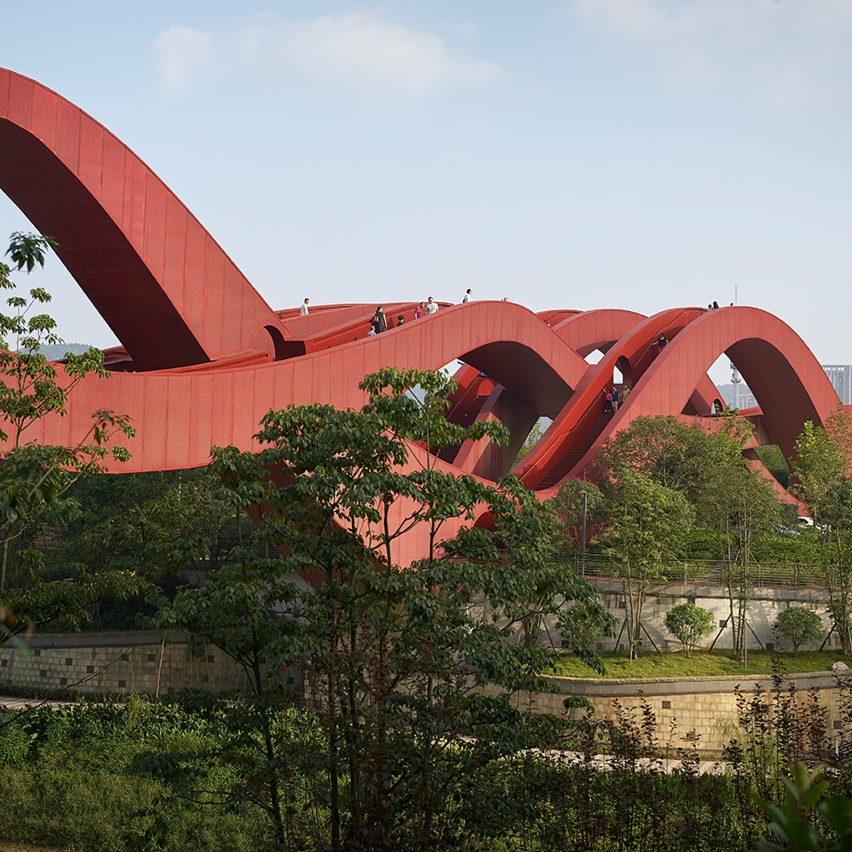
NEXT Architects has completed an undulating red footbridge in Changsha, China, that offers pedestrians a variety of different routes across the Dragon King Harbour River. Read more
Job of the day: store designer at Nike
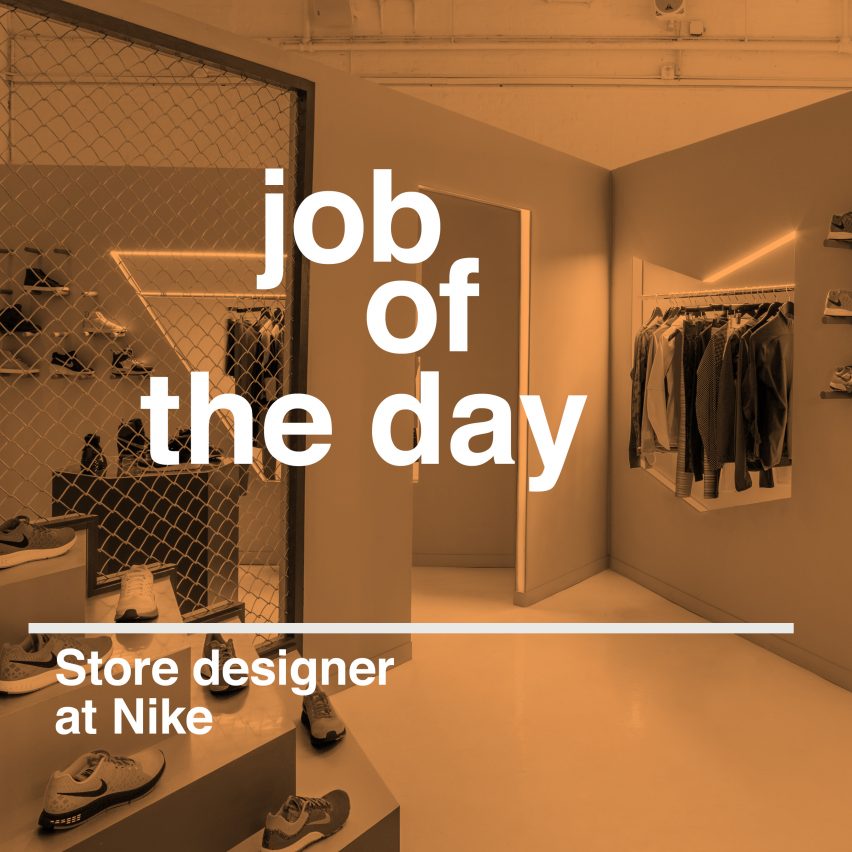
Our job of the day from Dezeen Jobs is for a store designer at Nike, whose past interior design projects include a temporary New York space illuminated in lurid colours by Robert Storey Studio (pictured). Read more stories on Nike or browse more architecture and design opportunities on Dezeen Jobs.
Thiti Ophatsodsa Designs a Contemporary Home in Bangkok

Kradoan House is a residential project designed by Thiti Ophatsodsa in 2015. It is located in Bangkok, Thailand. Photos by: Krisada Boonchaleow
Arkitema Architects Unveils New University of Bergen Energy and Technology Building

Courtesy of Unknown
Danish firm Arkitema Architects, in collaboration with Arkitektgruppen Cubus, has won the competition to design a new Life Science building—called EnTek—at the University of Bergen (UiB) in Norway. As an Energy and Technology building, the project is designed to ensure collaboration between UiB’s faculty and the energy and technology industry.
The 17,500-square-meter building will become a southern gateway to the university, connecting the school to the city via a new street that will also become a central meeting point for both researchers and citizens.
Courtesy of Arkitema Architects
Inside the building, a new public space called “Science City” will be created, where professionals can develop community and bring new thoughts to fruition. The architects claim that “the vision of Science City Bergen is to support even more research and development between companies and faculties, with the ambition to become an international portal for innovation within energy, climate, and technology.”
Courtesy of Arkitema Architects
Courtesy of Arkitema Architects
With our proposal for the EnTek building, we have created a new and dynamic research and study environment, with high aesthetic qualities and thought through functionality, said Arkitema Architects senior partner Per Fischer. Hopefully this will underline UiB’s position in Bergen. EnTek is situated right next to the oldest building on campus, the Meteorological Institute, so the building will mark a new and modern arrival to the university, but at the same time, symbolically linking future and past.
Courtesy of Arkitema Architects
The EnTek building is scheduled to open in 2019.
Learn more about the project here.
News via Arkitema Architects.
How a Group of “Partners in Crime” Restored Yekaterinburg’s Constructivist-Era White Tower

© Fedor Telkov. Courtesy of Strelka Magazine
In August of this year the White Tower, one of Yekaterinburg’s signature Constructivist-era buildings, opened its doors to the public for the first time. Polina Ivanova, Director of the Podelniki Architecture Group gave Strelka Magazine insight into how the practice got its hands on the tower, and launched it as the city’s latest cultural venue.
The White Tower is located in Uralmash, Yekaterinburg’s (now absorbed) satellite town built adjacent to a major factory. Constructed in the 1930s under the auspices of a project developed by Moisei Reischer, the tower was the cherry atop the cake of the ultra-modern—at the time, that is—Constructivist town and a symbol of a new, Soviet era. In the late 1960s, however, the tower was stripped of its primary function and abandoned. The building stood empty until 2010 when a group of newly graduated Ural State University of Architecture and Art graduates took it upon themselves to reanimate the tower for the benefit of the city. Following several years of intense work, this August the building opened to the public. Inside, a media screen narrates the story of the construction of the tower, the Uralmash factory, and the nearby district. And this is just the start of the public program within a large project being implemented by Podelniki Architecture Group.
Podelniki team. Image Courtesy of podelniki.com. Courtesy of Strelka Magazine
Who are Podelniki?
It all started when I was still a student at architecture academy. I and several other students in my year formed a small group of like-minded individuals who sought additional education. It should be said that Arch (short for Ural State University of Architecture and Art) had a serious lack of extracurricular activities. There was barely anything to engage in apart from various sports activities, the sketch comedy club, and guitar lessons. So we formed a club for those interested in architecture. We started receiving invitations to participate at workshops at various city events. By the way, that is how our name, Podelniki (Partners in Crime) was born. I or some other person from our team would arrive to a workshop and proclaim: “We are going to build a giant 6-by-6 meter city!” People would often react: “And who’s going to build it? You, maybe?” And our response was “Me and my partners in crime will.” That is how our moniker stuck.
We soon became engaged with research: we didn’t feel satisfied with limiting our education to studying Moscow and European experiences. We polled our tutors for their opinion on the most interesting buildings in Yekaterinburg and ended up with a list of buildings which we presented in the form of an analytical map and a photo exhibition. Following that event, Podelniki became really inspired with Yekaterinburg architecture. We lamented the lack of attention it received and decided to make it the focus of the group’s activities.
We got in contact with the organizers of Architecture Days (an internet project uniting independent architecture festivals across Russia) and held the very first Architecture Days event in Yekaterinburg. The hype around it was so large that we received a call from a very upscale Yekaterinburg hotel with an offer to accommodate our guests there in exchange for free city-wide taxi services. It appeared, to our surprise, that people were quite interested in Yekaterinburg architecture and history.
During this period several important events took place. Firstly, we graduated from Arch. We realized that the being an Arch student provided us with a lot of options: all our projects were done under the brand of the Academy in one way or another, and we relied heavily on its support so after graduation we felt a little bit stranded. Secondly, we realized that we needed a home for our group. We officially registered our club as a public organization with a long name, Group of Architectural Initiatives, Events and Communications, or Podelniki Architecture Group for short.
© Moisey Reysher. Courtesy of Strelka Magazine
How did you find the Tower?
After we completed registration we immediately started receiving calls from people offering various services. That is how Podelniki met Nikolay Smirnov, a lawyer who provided us with his services pro bono. We soon discovered that according to Yekaterinburg’s city code, public non-commercial organizations were entitled to request city-provided office space. Nikolay helped us gather a huge pile of required documents which we filed to the city administration to support our case.
We actually knew exactly what building we wanted for our office. It was a red brick one-story building at 20 Gorkogo Street. At that point in time it had just been cleared of squatters. The building was three windows wide and disproportionately long; it had windows and doors but no floor – only bare ground below. The roof was almost collapsing. Nevertheless, we had little doubt that we would easily adjust it to our needs, so we submitted our case together with numerous recommendation letters we gathered from organizations large and small. We had even already developed a concept called “Arch Cottage.”
Thirty days later, within the standard answering time, we received a response that the building was sold literally one day before our submission arrived. Two days after that they began its demolition. We came to the conclusion that the building had slipped the minds of the city administration until we came in and rang the bell, so they had decided to sell it off as soon as possible. We were understandably depressed by the news… but Nikolay wasn’t. He said: “Wow, the system really works!”
The same summer he found out that the Red Cross was leaving the White Tower. The Red Cross gained rights over it in 2006 after many years of complete abandonment. Its director was apparently interested in the large adjacent area, which was also listed as for sale. When the Red Cross replaced its top management, any ideas the previous director had were lost. I got in contact with the new person in charge and found out that they were unaware that their organization was still managing the building. Anyway, they decided to abandon it some time later.
At that very moment, Nikolay proposed to make another submission, and we did just that. At first, people at the ministry called us and said: “You do realize that you registered your organization just six months ago, right? There is no chance you will be granted this building.” Then we got another call: “You guys, we are telling you: you are not getting the tower! Do you understand?” One month later we got one final call: “Come get your tower.”
The whole story unfolded amid great fuss around the tower. At that moment the building stood deserted, apart from a public toilet inside. Some unknown artist, whom I would like to thank here, put a sign over the door, saying “The Museum of Shit.” His act was so successful that it got a response from basically every imaginable group: press, architects, city activists. The official city website published an article urging the demolition of the tower to rid the city of that taint. On the back of all this commotion we joined forces with Tatlin publishing house editor Eduard Kubensky and held a roundtable discussion on what should be done with the building.
White Tower (December 14th, 1931). Image Courtesy of Strelka Magazine (Archive Photo)
Help from the Archives
We realized that in spite of all the talk and articles about the tower, there was very little substantial historic data available to us. We got in contact with the relatives of Moisei Reischer, the White Tower architect, who had kept a giant archive of all his work. We also used some workarounds to get our hands on the building’s blueprints. We became good friends with the Uralmash Museum where we managed to obtain some photographs. We found out that several restoration projects existed at different points in time. Built in the 1930s, the tower stopped functioning already in the 1960s. In 1971 Reischer himself created a project for converting the building into a 50-seat café 24 meters above ground. Other projects proposed full renovation; however, most of them offered no solutions for vital upkeep issues.
We decided to start small. First things first, we held a cleanup day at the tower, so people could enter without risking stepping in crap, you know. Our next move was to study the frame of the building to make sure it was even worth restoring and that our efforts would not be in vain. After that the building was conserved, stopping the deterioration process in it’s tracks. And only after we had done that, we were be able sit and think about whether we wanted to turn the tower into an Oceanarium or an ice-cream café.
Loft versus Revamping
Today we receive a great deal of support from residents of Yekaterinburg, the city administration, and our commercial partners. We feel their attention and understand that our efforts were not in vain. For us, that is very important. We do our best to fulfil our promises and prove worthy of their trust. It is crucial that everyone understands that part of the funding is being used for organizational purposes. For instance, some of the money is spent to secure accounting services; now, as the tower gains popularity, we face additional expenses in the alarm system, electricity and other things.
Electricity was in fact a very big issue. The tower was originally connected to the city grid via an overhead line, which is no longer allowed. As the tower was to be reconnected to the city grid, the city would install underground connection free of charge. It turned to be one of those “cheap but takes forever” stories. Plugging the tower back into the city grid took two and a half, maybe even three years.
Our project is non-profit and each of us has a full-time job. This is what we do in our free time. In some way, we are the pioneers. We were the first ones in our city, in some ways even in our country, to do some of the things we have done. We blew away some restorers and builders by affirming: “This is conservation, and this is what is going to happen. This is a loft.” The majority imagined the restoration of the tower as some sort of revamping. Truth be told, we had a source of inspiration: the Ruin wing at the Shchusev Museum of Architecture. We met some of the museum employees working in that wing and learned a lot of useful things from them. They actually encountered the same problems as we did.
We are working with a monument listed on the state level, and the amount of documentation we have to deal with is through the roof. We got lucky to get Rozhdestvenka bureau to help us: Rozhdestvenka created the conservation project for the tower almost free of charge, and all we had to do was to bring it to the supervision sessions. Overall, the success of the project was defined by our timely realization that it could never be implemented if we continued to consider the tower our private space. We had to attract people, promote the tower: to invite, show and interact.
Launching White Tower (the Starting Point media screen). Image Courtesy of Strelka Magazine
White Tower Labs
Another big and important part of our project is White Tower Labs, which we created together with a branch of the National Centre for Contemporary Arts. During autumn 2014 we arranged a number of tower promotion events at the Uralmash. We studied the tower as a site, learning what could be done in it and what could not. The project received some criticism from the locals and public activists that we met during our work. We were told that nobody would go to the Uralmash, yet we managed to gather crowds even when it was blistering cold. The Labs helped us get acquainted with the territory and conduct research that resulted in an exhibition we named How to stop being afraid and open your own cultural venue. In Yekaterinburg there are several cultural venues which do indeed affect the city landscape. We interviewed the owners of these places and learned about their success stories. Most of them stated that in order to keep up popularity they had to constantly attract people interested in filling the venue.
All of us at Podelniki are architects trying our hands at event-management for the first time. We will have to nurture life in that tower, keep it filled with people and projects and make sure that something is happening there at each moment in time. When we arrive at a realization of how that should work, we will be finally be able to think about a proper restoration and gain a clear vision of what we want the tower to turn into. The cost of the restoration project, calculated by our friends at Rozhdestvenka bureau, will amount to nearly six million rubles.
Additionally, we plan to write down the methodology of working with objects like this, record our experience and look into its potential applications to work with other monuments. We hope that our example will inspire others, although we haven’t seen any followers just yet. We are often being told: “Why waste your time on the tower? Why won’t you work with Temp movie theater instead?” To this, we would like to respond: “We dare you to take it upon yourselves and turn it into the project of your dreams!”