The driving idea behind the project was to generate semi-buried volumes placed at the start of a steep cliff, to achieve a sense of vertigo on the terraces. The visual focus and orientation to the west lies on the same axis as the cliff, with views framed by the surrounding hills.
The idea was to ensure that the views of the neighbors behind the house were not interrupted, allowing a connection between the natural terrain and the roof of the main house.
Elevation / Section
The modulation of the wooden structure in two-meter modules embodies the economy of the project. The predominantly used materials are local pine and glass, which create a light, easily constructible structure.
The official opening date for Caen’s new public library, designed by Rotterdam-based practice OMA, has been slated for January 13, 2017. The Bibliothèque Alexis de Tocqueville will serve as the main library for the metropolitan region of Caen la Mer (in Normandy, France), with 12,000sqm of freely accessible multimedia space. Positioned on the tip of a peninsula that extends from the city to the English Channel, the site is part of a larger area of redevelopment. The ambition is for the library to become “a new civic center” for the city.
According to the architects, “the design of the [library] is defined by an opposition between mass and void, its main library space carved out of the center of the solid cross.” This “urban belvedere” therefore provides views in all four directions from the site, and connects four types of library spaces (human sciences, science and technology, literature, and arts) into one “intimate reading room.”
Chris van Duijn, Partner at OMA, has said: “This completion marks the beginning of a larger transformation within Caen. The library pivots from the historical center to the new urban master plan, stretching from city to sea. The cross-shaped building marks this central location between the old city and the new, and is a symbol for an institution deeply invested in the future of Caen.”
Axonometric
About the Design
Bibliothèque Alexis de Tocqueville is a public library for the metropolitan region Caen la Mer in Normandy, France. The 12,000 m2 multimedia library is located at the tip of the peninsula that extends out from the city of Caen to the English Channel. Its key position – between the city’s historic core and an area of Caen that is being developed – supports the city’s ambition for the library to become a new civic center. The library’s glass facade visually connects the adjacent park, pedestrian pathway and waterfront plaza to the interior and together with two large ground floor entrances at both sides of the building, enables a fluid interaction of the library with its surroundings. On the upper floors, the urban belvedere provides unobstructed views in all four directions.
Axonometric
The building’s cross-shaped design responds to the urban context, with each of the four protruding planes of the cross pointing to a landmark point in Caen: to the historical sites of the Abbaye-aux-Dames in the north and the Abbaye- aux-Hommes in the west, to the central train station in the south, and to the area of new construction in the east. At the same time, the geometry of two intersecting axes is informed by the library’s programmatic logic. The four planes, each housing a pedagogic discipline—human sciences, science and technology, literature, and the arts—meet in a large reading room on the first floor, to encourage maximum flow between the departments. This main library space is carved out of the center of the solid cross, defining the building’s design as an opposition between mass and void.
Axonometric
As a civic center where people meet and share knowledge and information, public space is at the core of the library’s design. At the entrance level on the ground floor, there is a large open space with a press kiosk and access points to an auditorium with 150 seats, an exhibition space and a restaurant with an outdoor terrace on the waterfront. The first floor contains a large variety of work and reading spaces and 120,000 documents, with physical and digital books placed side-by-side in the bookshelves. The digital extension of the physical collections, integrated within the bookshelves, is one of the new multimedia features of the library. The top floor of the library is occupied by a space for children, as well as offices and logistics. The archive and special historical collections are stored in safe and dry conditions in the concrete basement, protected from the surrounding water by an innovative waterproof membrane applied on the inner side of the concrete walls.
UNESCO world heritage sites of Diriyah and the surrounding Wadi Hanifah valley.
Courtesy of Zaha Hadid Architects
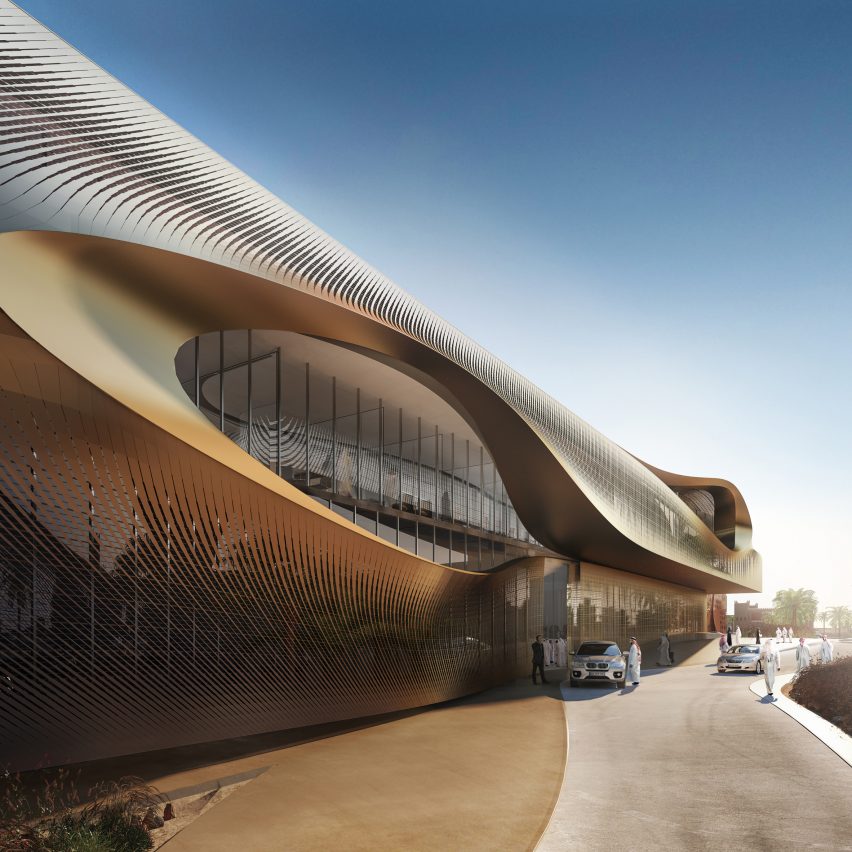
The 8,780 square meter (95,000 square foot) building will contain a permanent exhibition gallery, library, lecture hall, and student/adult educational spaces, and will also serve as the home of a new scientific institution aimed at conducting field research and documentation of the many archaeological sites in Diriyah.
Courtesy of Zaha Hadid Architects
The project design draws inspiration from Diriyah’s status as a natural oasis within the harsh Wadi Hanifah valley and greater Najd central plateau. This context is translated architecturally by organizing facilities around a central atrium containing a prominent water feature, and the intrusion of four “scooped green oases” into the otherwise solid-seeming building volume.
The building envelope itself will consist of a double-facade inspired by the thickness of the rammed-earth construction of Diriyah’s historic buildings: an outer perforated skin that shields the building from the sun and an inner curtain wall to preserve views out to the natural surroundings.
Courtesy of Zaha Hadid Architects
“The design relates to Diriyah’s local vernacular, not through mimicry or a limiting adherence to references of the past, but by developing a deeper understanding of its traditions and composition – expressed in a contemporary interpretation informed by the same natural forces that defined Diryah’s historical architecture,” explain the architects in a press release.
“True authenticity resides in the balance between tradition and ever-evolving innovation. This has been integral throughout the project’s design process.”
Courtesy of Zaha Hadid Architects
The Centre hopes to become a new piece of the nation’s evolving cultural heritage initiative, as it becomes both a new tourist and educational destination as well as a hub for research programs than can be taken on by scientists and academics from all over the world.
The small house is situated by a lake in the Stockholm archipelago, on a site that in the early 1900s was inhabited by a gardener. Plants and paved walls that were then organised still remain to a large extent today. For the last 25 years another garden interested family have used the old existing house as a summer home. The family, consisting of mother and two daughters, has grown in recent years when the two daughters have formed families on their own. That in turn has made more space necessary. One sister has renovated an existing guest house, while the other sister decided to build a new small house, Summerhouse T, for her family consisting of two adults and two children. The family formulated a program that included a kitchen, bathroom, dining area, living room, four beds and room for storage. While municipal constraints did not allow a building that exceeded 40 m2.
A large open square room with a standalone volume containing the beds, kitchen and storage was proposed. Along the buildings southern side is a dining area and a living area. Roof, floor and walls have a dark colour to enhance the building’s intimate character and direct the eye towards the surrounding view. The house’s only (trap) door leads to the bathroom, a separate volume which design was adapted to fit into an existing gap in the nearby rock. The open organization with ceiling high windows create a surprisingly large number of different spatial experiences. Freedom of movement along the entire facade gives a feeling that the house is larger and more spacious than it in reality is. The parents’ sleeping area has a view towards the countryside and the lake while the children’s more enclosed sleeping alcove directs the view towards the grandmother ́s house. The storage passage at the back of the house opens up to the greenery outside at one end while the parallel kitchen has contrasting views in opposit directions. The living room with dining area and lounge, in turn, have a 180 degree view towards the surrounding. Two of the walls are sliding windows that on hot summer days easily opens and allow for a pleasant breeze through the house and at the same time extend the living area to the exterior, where the roof overhang provides protection against the sun. On rainy days, water runs along the eaves almost as physically present curtain and the house suddenly closes inward.
Product Description. The façade of Summerhouse T is painted with the traditional Swedish color Falu Rödfärg. The black color and the matt finish adds to the project´s discrete character.
Villa Verde in Constitución, Chile by Elemental. Image via 99 Percent Invisible
In Chile, a middle-class family may inhabit a house of around 80 square meters, whereas a low-income family might be lucky enough to inhabit 40 square meters. They can’t afford a large “good” house, and are henceforth often left with smaller homes or building blocks; but why not give them half a “good” house, instead of a finished small house? In the 1970s a professor by the name John F.C. Turner, teaching at a new masters program at MIT called “Urban Settlement Design In Developing Countries”, developed an idea surrounding the concept that people can build for themselves. 99% Invisible has covered a story, produced by Sam Greenspan, on how this idea has evolved, and what it has turned into: Half A House.
Turner’s premise was that housing should be conceived of as an on-going project. This eventually turned into incremental building, inspiring architect and incremental housing expert, George Gattoni. Gattoni was attempting to solve the problem of urban migration, resulting in squatting and huge housing deficits. Gattoni’s struggle laid in making low-income houses affordable, and incremental building was the answer. He has been involved in spreading incremental building projects all over the world, raising awareness of its existence in the architectural world.
Villa Verde build-out in progress. Image via 99 Percent Invisible
Elemental, led by Alejandro Aravena, evolved this idea when commissioned to draw up a new master plan for Constitución, Chile, after it was hit by an earthquake of magnitude 8.8; the second largest in the world during the last 50 years, killing over 500 people and destroying 80% of the buildings in the city. Elemental had already experimented with unfinished low-income houses in Iquique, Chile, which were to be built at $7,500 per unit, for 100 families. The future inhabitants threatened even the proposal of a housing block with a hunger strike, but building individual houses would simply cost too much. Instead, Elemental provided the residents with just enough to meet the Chilean legal requirements for low-income housing, allowing them to expand the rest.
Quinta Monroy project in Iquique, Chile by Elemental. Image via 99 Percent Invisible
In Constitución, the plans for Villa Verde, an entire area populated by two-storey half houses, the visual design of the buildings are different, but the concept is the same; half of the houses are identical and the other halves are completely unique. The first floor of the finished half is made up of unfinished concrete floors, and the second is covered in unfinished plywood. There is only one sink in the kitchen, with no other appliances, but the house is cheap, practical and well insulated. Everything that families wouldn’t have an easy time building alone, such as concrete foundations, plumbing, and electricity, has been finished for them. The Chilean government pays for roads, drainage, sewage, garbage collection, busses and any other necessary infrastructure, to focus on building a good community. Residents just have to provide their time, labor and any extra materials.
Dronve view of Villa Verde in Constitución, Chile by Elemental. Image via 99 Percent Invisible
Residents can take part in building workshops facilitated by Elemental, and every house comes with a manual covering possible ways to expand using standard building materials, avoiding the need for anyone to buy expensive custom resources. The vision is that residents end up with a much more pleasant house than what they could have built completely on their own or received from ordinary state funding. Juan Ignacio Cerda, one of Elemental’s principal architects, said that even if money were not an issue, the firm would build the same homes. Any extra funding would go into improving the surrounding space and uplifting the neighborhood, embodying the firm’s social approach.
Villa Verde expansion under construction. Image via 99 Percent Invisible
Born from the scarcity of resources in Chile, Elemental has produced low-income houses that are won’t be destroyed in an earthquake or flood, and feel safe for the people who live there. Of course, not everyone is so enthusiastic about building their own house, and some are not so satisfied with Elemental’s contractors, but on the whole, the concept seems to be succeeding in using “scarcity as a tool”. This has also been recognized by the architectural community; Alejandro Aravena won the Pritzker Prize in 2016, for epitomizing “the revival of a more socially engaged architect…fighting for a better urban environment for all.” Contrary to what our intuition may tell us, the podcast ends by summarizing that “building half a house might just be the best way to make a community whole.” Oddly enough, this appears to be true.
To listen to the podcast on Half A House, visit 99% Invisible, here.
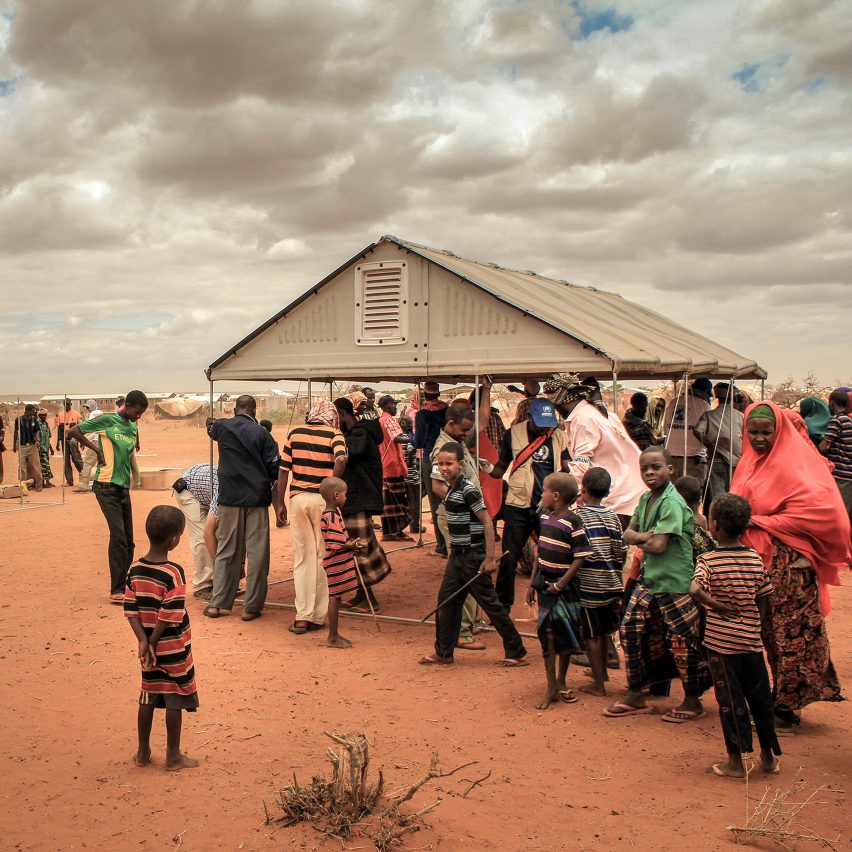
Better Shelter is the latest IKEA product to be hacked, according to the head of the company’s charitable foundation, who told Dezeen the modular refugee cabin is now being used to create doctors’ surgeries and schools. Read more
Today, a majority of architects work solely on the design end of the development process. It is common knowledge that the net value of architectural services in a projects’ total value amounts to a very small percentage (it’s usually in single digits), which puts architects near the bottom of the financial structure in the AEC industry.
Stuck between developers, clients, contractors, and subcontractors, architects are usually in a role that implies great responsibility but proportionally low compensation for it. When we add to that the grievance of not having full control of a project, it becomes clear as to why an increasing number of architects either transition to real estate development or transform their design offices into design-builds.
Though still in its infancy, this transition seems indicative of an emancipatory trend that’s taking place, where architects take matters into their own hands and thus claim their rightful position within the industry.
However, with this newfound ambition comes a new set of challenges. Developing a project from drawing board to building site requires business skills that are not taught in architecture schools. Can architects bridge this gap and compete with seasoned developers? Are there advantages to being a designer when it comes to the nitty-gritty of actually building a project?
Let’s take a look the major pros and cons of architects working as developers.
Pros
#1 – Architects Understand the Process of Building
As architects come to learn about the different aspects of project development in the course of their education and throughout their career in the industry, most know what it takes to design and construct a building. They often have project management experience and understand the process of site and project analysis, construction techniques, acquiring building permits and controlling budgets.
This is particularly the case in smaller offices where project managers are often required to perform various roles, from leading the project team and administering construction contracts, through negotiating with clients and contractors, to scheduling and monitoring processes. Due to this versatility in their experience, architects can make sure that construction is completed on schedule and under budget.
In addition to these general skills and competencies, architects often become experts in various niches. Over the course of their careers, many practicing architects specialize in specific typologies, which can be a huge advantage when going into development in these specific areas.
#2 – Great Design Increases Market Value
The expertise that architects bring to the table can have a significant impact on the financial bottom line of a project. For example, sustainable design features can significantly increase the value of a property. Or, as Tyler Stonebreaker puts it in his interview on Archipreneur Insights: “At the end of the day, the market is placing the highest premium on things that are unique and special.”
People are becoming increasingly interested in energy efficient or high performance properties, which is why green design certification programs like LEED and NGBS can raise the selling price of a house. In addition to sustainability, experienced architects also know how to use designs to create quality spaces on limited budgets.
They can also reconcile profitmaking with a broader strategy for social change and an increased quality of life over a longer period of time. Architects that are working as property developers are more likely to consider innovative and creative solutions; solutions that ordinary developers might either overlook or reject.
#3 – Architects Know How Cities Work
Architects are trained to think in terms of place making instead of creating objects that are detached from their surroundings. An architect-developer is trained to consider how a project might sit within and relate to its context, ensuring long-term benefits for themselves, their clients and the relevant neighborhoods. Architects are taught to understand urbanism and recognize areas with development potential. They may, for example, see real opportunity in a vacant lot that doesn’t seem to offer any value to the untrained eye.
For example, San Diego-based architect-developer Jonathan Segal built many of his residential projects as suburban infill developments located on undesirable and oddly shaped lots. Over the years, Jonathan has created a profitable business and accumulated a wealth of architectural accolades in this area of his business.
Cons
#1 – Lack of Business Experience
Many architects know how to design, draw, write, interpret specifications and monitor construction processes, but know little about real estate finances, viable cash flow models, and how to understand a project from a business perspective. Those working in large architectural firms are restricted to the drawing board, receiving little on-the-job training when it comes to the particulars of business.
In addition to a general lack of business skills, most architects don’t know about the financial and business structures that developing properties entail. Understanding real estate finance and the metrics used to calculate and rate a development, along with the importance of overhead factors, are just as important as understanding building codes, zoning regulations and program. The majority of architects have yet to learn that cost is a principal parameter for their designs.
#2 – Getting Caught up in Design
With all their knowledge about the different aspects of getting a project built, architects are often stuck in a closed mindset, focused solely on design. They get overexcited about the design possibilities, and fail to acknowledge the importance of the business side of project development. There is still a general disregard for the financial part of building in architecture schools.
This attitude often continues into architects’ careers, as most continue to work solely as designers. Once they get into developing their own projects, they are forced to become more flexible and let various technical, logistical and financial factors inform their design decisions. This is often a hard pill to swallow for an architect.
#3 – Not Being Familiar with Market Trends
Shifts in market demand determine the properties that will be the most profitable to build. In order to know whether to focus on apartments, condos, mid-rise, mixed-use buildings, or other typologies, seasoned developers read the market and set about targeting the right demographic. There is a significant difference in returns between Build to Rent and Build for Sale.
The key to deciding on the type of structure to build – and where – is in accurately predicting if the asset will either increase or decrease in value over time. Developers also need to know how to read real estate trends and cycles to predict the best time for development, buying and selling. This can be a huge challenge for architects with no experience in property development.
***
Combining skills ranging from design to finance and marketing is definitely a daunting task. Still, an increasing number of architecture firms are broadening their reach to include designing, developing and even constructing their own projects. Architecture firms like SHoP, Alloy, BRH Architects, and EM2N Architects are proving that it is possible to strike a balance between good designs and making a profit.
More than 35 haute couture pieces from the archive of Dutch fashion designers Viktor & Rolf feature in an exhibition at Melbourne’s National Gallery of Victoria. Read more