
House to the Beach is a residential project completed by Gluck+. The home is located in North Shore, an affluent suburban area north of Chicago, Illinois, USA. House to the Beach by Gluck+: “Located in the northern suburbs of Chicago, this house sits opposite a unique object: a monumental temple, 135 ft. high of white stone, symmetrically spherical, and monumental. The street-side face of the house must negotiate not only..
Job of the day: animator/visualiser at PriestmanGoode

Our job of the day from Dezeen Jobs is for an animator/visualiser at London design studio PriestmanGoode, which recently revealed a design to tackle train overcrowding. Read more stories on PriestmanGoode or browse more architecture and design opportunities on Dezeen Jobs.
AA Summer DLAB Program Applies Computational Design to Concrete

© Architectural Association
This year’s Architectural Association (AA) Summer DLAB program culminated in Weave.X, the final working prototype of three-dimensionally interwoven concrete structures. Designed and fabricated by 21 participants from 11 countries in July and August, the prototype explores computational design, geometry rationalization, material behavior, and robotic fabrication as applied to concrete and robotic rod-bending techniques. The result is a network of self-supporting concrete branches that envelop an amorphous enclosure.
© Architectural Association
The preliminary phase of the research involved using Grasshopper to generate a network of interwoven elements and developing an automated fabrication process to bend steel reinforcement bars to custom shapes. Participants analyzed established rod bending strategies to develop an approach that would reduce the mechanical parts necessary to control the process, ultimately arriving at a systematic coordination of a bending jig system and an intelligent robotic toolpath programmed with Python. The robotic bending protocols enabled more than 80 steel rods 1500 mm long and 16 mm in diameter to be bent within the program’s short time frame.
© Architectural Association
The rebar defined the form initial interwoven models, which were analyzed via finite element analysis. The resulting triangulated mesh was CNC-milled from Polypropylene sheets, which were then folded to match the rebar skeleton. Finally, a mix of concrete and fiberglass additives was poured into the steel and Polypropylene formwork, and could be cast and cured within several hours. The Polypropylene could then be removed, leaving the concrete with a reflective surface.
© Architectural Association
In past years, AA Summer DLAB has investigated the potential for computational design and concrete in a concrete dome shell and a doubly-curved wall element. In keeping with the objective of expanding the architectural possibilities of concrete with computational design and robotic fabrication, the continued research looks toward exploration with simple mechanical tools and cost-effective fabrication methods.
News via: Architectural Association
ID College and ROC Leiden / Mecanoo

Courtesy of Mecanoo
- Architects: Mecanoo
- Location: Leiden, The Netherlands
- Area: 10000.0 sqm
- Project Year: 2016
- Photographs: Courtesy of Mecanoo
- Development Partner And Contractor: GiesbersGroep, Wijchen
- Client: ID College, Leiden
- Structural Engineer: Croes Bouwtechnisch Ingenieursbureau, Nijmegen
- Mechanical And Electrical Engineer: K&R Consultants, Apeldoorn
- Advisor Acoustics, Building Physics, Sustainability And Fire Safety: LBP Sight, Nieuwegein
Courtesy of Mecanoo
ID College and ROC Leiden offer secondary vocational training and education. The new build location in the historic city centre of Leiden accommodates the vocational education for students in healthcare. The complexity and historical nature of the inner city site required a thorough analysis in order to developed a design vision which reconciled these aspects within the brief. The integrated approach in which architecture, urban planning, landscape, interior design and engineering converge results in a unique design.
Courtesy of Mecanoo
Strengthening structure and identity
The design reflects the character of the site, whilst strengthening the structure and identity of Leiden’s historical centre. The new building for ID College and ROC Leiden has a modest appearance, befitting its context. Varying volumes and functions are unified behind a coherent brick facade. The former post office building has been integrated into the new facility and remains recognisable as an independent building. The various departments are connected by alleys and three courtyards, each with their own unique identity. There is a courtyard for the teaching staff, one for the students and a public courtyard in the form of an atrium.
Ground Floor Plan
Courtesy of Mecanoo
Part of the city
The new building is part of the economic and social fabric of the city of Leiden. A central alley runs through the complex, connecting the Breestraat to Boommarkt and passing through the atrium. During school hours, this alley is publicly accessible. The transparent facades allow passers-by to view practice rooms and other public functions from the street and the atrium. This orientation of views from public to private provides a safe atmosphere for the students and staff.
Courtesy of Mecanoo
Anticipating changing needs
The ID College facilities are designed with flexibility in mind and facilitate the latest developments in teaching methods. The building has been arranged to anticipate new forms of education and changing needs for space and layouts. The multifunctional layout can accommodate different individual and collective uses and includes workspaces for data collection, group work spaces, and common rooms for social interaction.
Courtesy of Mecanoo
Second Floor Plan
Courtesy of Mecanoo
MORI Design Creates a Contemporary Home in Yun-Lin County, Taiwan

Quiet Home is a private home located in Yun-Lin County, Taiwan. Completed in 2016, it was designed by MORI design. Photos by: Moooten
Henri Bredenkamp converts derelict university building into family home
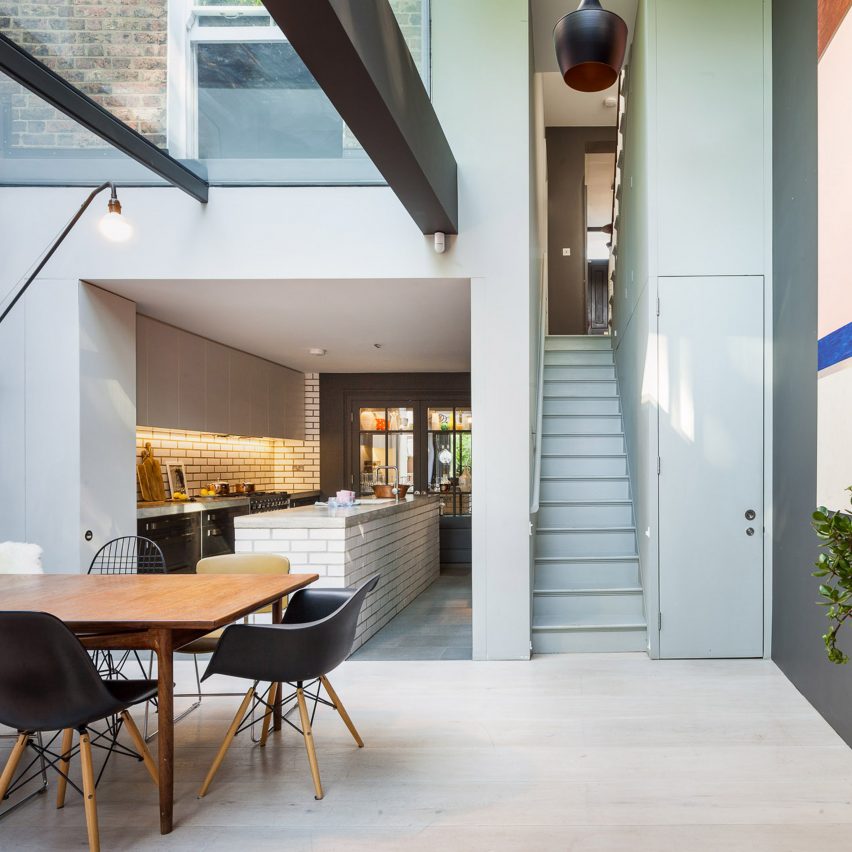
Residence DBB / Govaert & Vanhoutte Architects

© Tim Van De Velde
- Architects: Govaert & Vanhoutte Architects
- Location: Knokke, 8300 Knokke-Heist, Belgium
- Architect In Charge: Benny Govaert, Damiaan Vanhoutte
- Area: 566.0 sqm
- Project Year: 2015
- Photographs: Tim Van De Velde
© Tim Van De Velde
“A place is a space which has a distinct character,” Norberg-Schulz postulates in Genius Loci: Towards a Phenomenology of Architecture. Scanning the natural and built environment in search of hidden visual patterns and translating these elegantly into a contemporary architecture project is the mission he spreads. An empathy which is not unfamiliar to Govaert & Vanhoutte Architects. Owing to about five sensitive heritage sites on its curriculum, the Bruges situated architecture office already developed such an affinity with the historical architecture and atmosphere of West-Flanders that the approach for fortress Hazegras and its surroundings feels like a second nature.
© Tim Van De Velde
A listed monument such as fortress Hazegras can carry several heritage values in its DNA. Just as the cords of the DNA-molecule can be considered as the spine holding all genetic data, Govaert & Vanhoutte Architects reads military, social, cultural, natural, infrastructural and technical information from the traces in and around farmhouse Burkeldijk. It concerns more than a sum of relicts from ancient times. Where formerly heritage particularly affected the safeguard of objects, the focus of heritage care today lies on preserving the ‘memory’ that heritage material bears. The broadening towards heritage ‘care’ means valorizing the intrinsic heritage value of our surroundings and creating possibilities to allow new positive developments.
© Tim Van De Velde
For the transformation of the farmhouse into a residence, Govaert & Vanhoutte accurately cuts away non-valuable traces. Valuable historical constructions are thus brought into equilibrium with the scarcely added volumes. One wing of the U-shaped plan of the reduit of the Leopold fort is extruded to the north with office spaces which continue the building not only in plan, but also in sectional proportions. Out of this respectful continuation results the choice of material. Afrormosia baulks of 7 by 3 cm with an intermediate distance of 4 cm clearly and yet discretely pursue the rhythm of the gun-ports still visible in the reduit walls. Likewise, the tenor of the previous conversion from reduit to farmhouse is maintained. The meticulously chosen incisions of the façade openings explicitely amplify the scar between the red and the yellow brickwork. Simultaneously, the elegant sections of the metal window lining and the triple glazing stitch up the brick and wooden volumes.
© Tim Van De Velde
Not only the materials of the outer skin but also the enfilade of spaces of the new volume reflect the local architecture of long farmhouses. Following the same theme, the rough scrubbed concrete and the softly rounded plastering is in subtle contrast with the exposed, restored timber roof frames and the newly added, but equally wooden interior volumes. Just as a fortress introverts itself for protection, the reading and working spaces are equally oriented towards the inner yard. The border between inside and outside fades because of the perpetuation of the washed concrete flooring reminiscent of cannon bases. As antithesis of a bastion the living spaces open up to the polders outside the former bulwark.
© Tim Van De Velde
A new, subterranean passageway connects the transformed farmhouse with the enlarged barn. In this expansion a similar signature is recognisable. The sectional proportions are maintained, the choice of materials is the same, but both buildings with guest rooms are slightly shifted and slid apart. Here a glass weld around a part of the indoor swimming pool and the guest kitchen sews the volumes in brick and wood. Just like the shutters of the old barn, the sliding facades of the expansion offer the opportunity to seal off the guest complex entirely.
© Tim Van De Velde
Not only the functional transformation of farmhouse and barn, but also the liberation, restoration and redevelopment of the relicts on site breathe an atmosphere of respect and distinct military poetry. In particular the artificial lighting around the four nearly identical concrete and brick WWI-bunkers southeast of the barn, lift the monoliths beyond banality.
© Tim Van De Velde
© Tim Van De Velde
By providing considerate attention to the buildings and their extremely charged surrounding, Govaert & Vanhoutte not only succeeds in reviving the character of the site in the farmhouse. The architects position this restauration and renovation with so much dignity and poetry in the polders that the project attains the original meaning of ‘Genius Loci’: the deity of the place.
Floor Plan
Floor Plan
History of fortress Hazegras
Fortress Hazegras is an exceptional site inbetween Knokke and Westkapelle near the Netherlands. The robust construction is not only one of the rare remnants of the Austrian reign in Flanders, moreover it is situated in an almost untouched cultural landscape. As the ultimate structure in a long sequence of fortifications, it has been raised to defend the zwin border and the drainage sluices of the reclaimed polders. The 1784 lock Hazegras is part of a bigger Austrian project including two other important locks alongside the Belgian coast. During an inspection visit Joseph II decides to secure the sluice with a fort. Within the fortification a stone watchhouse and jail have been built; in the western part a sluicehouse has been erected. These constructions have been transformed into farmhouses in 1839, after the tensions between Belgium and the Netherlands. Still the outline of the rampart is read out of the plot structure. The course of the defence wall is visible as a slight elevation.
© Tim Van De Velde
Little is known of this fortress, situated at the east of the 1622 Isabella and Teresia forts which were already dismantled at the end of the 18th century. The Hazegras fortification remained operational for a short period only, any form of blueprint is scarce and written sources equally rare. The reason hereof is probably the loss of the archives of the military cabinet (caisse de guerre, 1718-1794) duing a conflagration in the residence of the commander-in-chief during the Brabant revolution of 1789. The scarcity of resources hindered the research significantly. ‘Secondary’ sources such as De procesbundels van het Brugse Vrije have rendered assistance since the engineering corps made appeal to labour workers, provided by the local authority. The main resource however are the ruins on site, which had some surprises in store: the reduit of fortress Leopold –the in 1830 converted and restored Hazegras fort– appeared to be preserved as the farm Burkeldijk.
© Tim Van De Velde
The entirety, enclosed by the streets Retranchement, Burkeldijk and Hazegras, is listed since October 15th 2003. The protected area thus includes the site of the fortresses Isabella and Hazegras with the new Hazegras sluice, bunkers from both world wars, meadows, farmland, dikes, ditches and roads with traces of plot structures, height differences and subterranean remnants of historical fortifications and locks. On the grounds of the former fortress three farms are situated: two in the street Retranchement (n° 17 and 19) and one on Burkeldijk – now converted into a family dwelling with guest rooms. The two latter contain structures going back to the period of fortress Hazegras.
© Tim Van De Velde
Neely Prodan Design a Contemporary Apartment in Kiev, Ukraine

Wood and Steel is a residential project designed by Neely Prodan. It is located in Kiev, Ukraine. Wood and Steel by Neely Prodan: “Flat was designed for extraordinary man. He is a very bright, kind and opens to everything new. He is engaged in business at the same time he likes traveling, reading and cooking. The main goal was is to show to every coming person that this is a..
A House in Trees / Nguyen Khac Phuoc Architects

© Trieu Chien
- Architects: Nguyen Khac Phuoc Architects
- Location: Từ Sơn, Bắc Ninh, Vietnam
- Architect In Charge: Nguyễn Khắc Phước
- Area: 75.0 sqm
- Project Year: 2016
- Photographs: Trieu Chien
© Trieu Chien
“A House in Trees” locates in a small narrow land, which was divided with the area of 5×15(m) in Tu Son town, Bac Ninh, Vietnam. This area is facing rapid industrialization and urbanization. There are several problems with the site such as noise and smog from traffic; and negative effects from industrial zone. The main façade is faced west.
© Trieu Chien
The house is designed for a couple and their teenage daughter and son. The functions include 3 bedrooms with toilets, a living room, a kitchen, a garage and store and an entertainment room, worship, laundry. The owners want a house that could improve their living condition.
Plans
In this project, we propose 2 voids inside the house in order to solve the problems. The first void is placed at the entrance, which creates a padding to avoid the smug; shapes are created to avoid direct natural light.
© Trieu Chien
The second void is placed at the center of the house, which plays as a point to balance the nature. At this space, nature is appeared with its elements such as trees, natural light,the wind, and rains.
Section
Stairs and lobbies are in the center connecting spaces. People may feel that they walk on the top of trees when moving in the space.
© Trieu Chien
A garden is opened to the central void, connecting living room, kitchen and dining room. The owners can feel natural light, trees, wind and rain in their bedrooms. At any space inside the house, the owner still could get in touch with nature directly.
© Trieu Chien
“A house in trees “was born with its unique context. Through this project, we want to balance the nature in order to make better living condition for people while urbanization and industrialization are impacting badly to the environment.
Sheng-Hung Lee’s TetraPOT is a greener alternative to concrete coastal defences
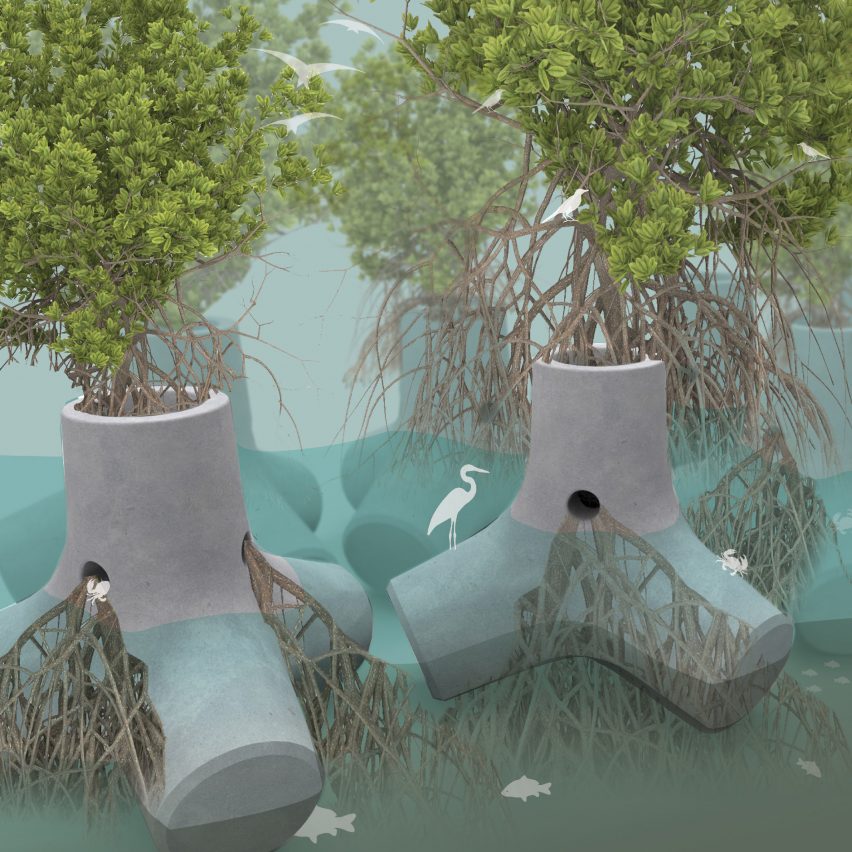
Chinese designer Sheng-Hung Lee has created a concept for a new kind of sea defence that functions like a set of giant plant pots. Read more

