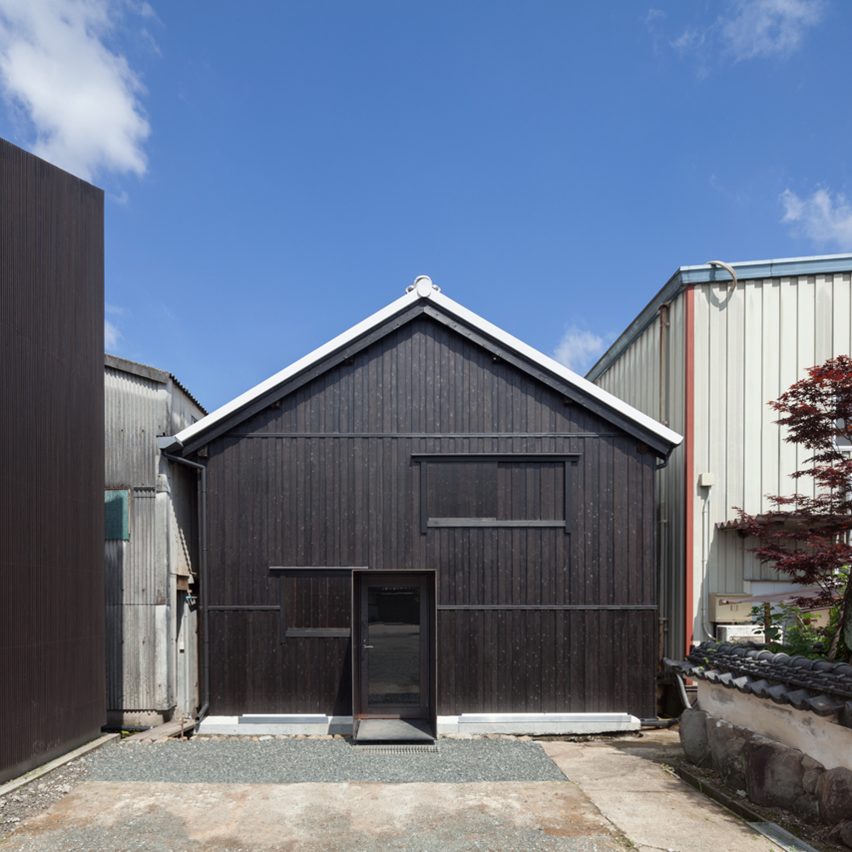
Japanese studio yHa Architects has inserted a steel cuboid, wall and stairs inside this former rice mill in Saga Prefecture to create a sake tasting and exhibition space. Read more
Japanese studio yHa Architects has inserted a steel cuboid, wall and stairs inside this former rice mill in Saga Prefecture to create a sake tasting and exhibition space. Read more

SANAA’s Grace Farms has been announced as the winner of the 2014/2015 Mies Crown Hall Americas Prize (MCHAP), recognizing the most distinguished architectural works built on the North and South American continents.
The project was selected from a shortlist of seven finalists, joining Alvaro Siza’s Iberê Camargo Foundation and Herzog & de Meuron’s 1111 Lincoln Road as winners of the highly-regarded prize.
“Among a strong group of projects Grace Farms emerged as a clear winner for the clarity and consistency of its architectural solution,” said Stan Allen, MCHAP Jury President.
“The jury was struck by the radical way in which the line between architecture and landscape is blurred by the ‘River’ building. The firsthand experience of the building reveals a confident realization and the immediacy of its detailing. Finally, the Grace Farms project uniquely demonstrates architecture’s capacity to make a place for an innovative new institution.”
Learn more about the project after the break.
Grace Farms’ building, which spreads beneath a long, undulating roof, follows the landscape and floats in the center of the site. Winding and crossing the hills freely, this wood-frame structure, now known as the River, creates numerous covered outdoor spaces while also forming courtyards. Since opening to the public in October 2015, Grace Farms has functioned as both a peaceful respite and a place of vibrant activity. The River building draws people in to engage with the site’s natural landscape and serves as the springboard for Grace Farms’ mission and programs. Within the first six months, approximately 50,000 people visited Grace Farms to participate in architectural tours, community dinners, lectures and discussions, concerts, athletics, and worship services—or to explore the 80-acre site on an individual basis.
New Canaan provided a context in which Eliot Noyes, Marcel Breuer, Philip Johnson, and others helped to rethink residential modernism in the United States. Mies was a direct influence in New Canaan through his influence on Johnson, and the architectural design for Grace Farms builds in part on Mies’s legacy, including his 1928 vision of a skyscraper with curved glass. Although Mies and Johnson were not direct models, they helped set the aspiration for transcendent lightness: a structure that would float on the landscape while also being fully integrated with it.
SANNA Founders Kazuko Sejima and Ryue Nishizawa were recognized with the MCHAP Award, the MCHAP Chair at IIT Architecture Chicago for the following academic year, and $50,000 in funding toward research and publication.
Also announced was the winner of the newly established student award, MCHAP.student. The award, given to “the most outstanding project by a 2015/2016 graduating student that addresses the metropolis through an architectural proposal,” was presented to “(a)typical office” by Tommy Kyung-Tae Nam and Yun Yun from the Taubman College of Architecture and Urban Planning at the University of Michigan.
You can see more about (a)typical office, here.
The full jury for the 2014-2015 MCHAP Americas Prize composed of Wiel Arets, Dean of the College of Architecture and Rowe Family College of Architecture Dean Endowed Chair at Illinois Institute of Technology, Chicago Florencia Rodriguez, architect, critic, and Founder and Editorial Director of Piedra, Papel y Tijera publishers in Buenos Aires, Argentina Ila Berman, Dean and Edward E. Elson Professor, University of Virginia School of Architecture, Charlottesville, Virginia, USA Jean Pierre Crousse, Principal of Barclay & Crousse Architecture, co-founded with Sandra Barclay in France in 1994 Associate Professor of the Pontificia Universidad Católica del Perú, Lima, Peru and Stan Allen, registered architect in New York, New Jersey, and Pennsylvania and former Dean of the School of Architecture at Princeton University.
In making their decision, the jury travelled to each of the finalist sites to experience the projects firsthand.
“There may be a global architecture culture today, but each place we visited had its own identity and every project responded to a specific context. As a jury we also observed common themes: All of the projects, even those in urban areas, engage with landscape they all embrace architecture as a force for change and finally, all of them find a delicate balance between innovation and the history of the discipline,” remarked Allen.
You can learn more about the MCHAP Americas Prize at the IIT website, here.
News via MCHAP.
Grace Farms / SANAA
//cdn.embedly.com/widgets/platform.js

Stories have a way of clinging to places, charging buildings and spaces with an effect only perceptible to those who know what they once staged. Film is the most visual storytelling medium, and their environments often play memorable and vital roles in creating the movie’s character and identity. The popularity of film tourism is testament to this phenomena. While the bulk of film tourism stems from blockbuster movies and their exposure and celebrity, the blog Filmap takes a more humble approach in highlighting the stories of everyday places.
For the past three years, the blog has laboriously tracked the locations of hundreds of movie scenes using Google Streetview, pairing stripped-back street views right next to their cinematographic counterparts. The resulting contrast elevates the everyday while also grounding fiction to our very streets, a reminder of the built environment’s role as a vessel of imagination.
A selection of Filmap’s posts are shared below – how many movies can you recognize from their real-life settings alone?
An easy one to start with – Alnwick Castle is the familiar backdrop of where Harry and his friends had their first flying lesson, and also where many Oliver Wood childhood crushes first developed.
Tatooine is a place on earth – in the Tunisian desert at least, where the original Lars Homestead can still be found. When filming wrapped up, the economy boost lingered on as a newfound tourist attraction. However, changes in political climate and dropping visitor numbers have caused the neglected set relics to begin to decay.
Not all McDonald’s are exactly the same, and definitely not all were graced by a wig-donning Karen Mok in a classic Wong Kar Wai scene. Though the interior has now been modernized, the entranceway remains almost the same as in the iconic 1995 scene.
Add a few flying animated birds, Hall & Oates background music and a crew of choreographed dancers and you’ll recognize this fountain as the backdrop to fictional architect Tom Hansen’s post-coital parade.
The modular blockwork of Aries Mateu’s Marker Hotel and Daniel Libeskind’s shard-like Bord Gáiis Energy Theatre created the perfect backdrop to mark the protagonist’s return to the city, following time with a guerrilla gang of loners in the woods.
Before Pirates of the Caribbean, Keira Knightley played out an earlier love triangle alongside football, with Parminder Nagra and Jonathan Rhys Meyers at the unassuming Yeading Football Club.
Another unassuming location, this drycleaner once had a customer who was definitely not unassuming – that customer being Patrick Bateman and his “cranberry juice” stained sheets.
This superbly soundtracked movie made use of the Pontsticill Reservoir in Wales as one its many scenes that featured semi-abandoned locations, letting the movie’s central couple indulge in their own company alone.
The island in question may appear familiar as the same island that appeared on the maps of a doomed Japanese class of high school children in the 2000 dystopian thriller. The fact that the island, Hachijō-kojima, is volcanic and uninhabited makes it unnerving not just in fiction but also reality.
One of the most recognizable posts on Filmap is the Parisian Pont de Bir-Hakeim bridge. It was here that Ellen Page, as a fictional architecture student, practiced her dream-designing abilities alongside Leonardo DiCaprio.
It was on a bench in this park square that we all learned that “life is like a box of chocolates.” Visitors to the park hoping to share the same bum-print as Tom Hanks however, should be aware that it is not original bench from the movie, which has since been moved to the Savannah History museum.
Check out many more iconic film settings at Filmap’s website, here.

From the architect. The Zhuhai National Park is located in the region of Chishui, in Guizhou province, in South-West China. The 10,000 hectares park is characterized by the unique presence of the so-called Bamboo Sea .
The park gateway has been designed by West-line studio architects as a dense assembly of vertical lines. The gate is hidden in the Bamboo Sea and interacts with the particular weather conditions of the area (sun, thick fog, rain, wind and snow) which make the architecture unstable and flexible. The gate aims to ‘activate’ the bamboo being at the same time hidden into the forest but also creating an iconic entrance for the park.
The support system is made of concrete with bamboo (10cm diameter – 11m length) hung on the roof. Even with the presence of the glass roof, which protects the bamboo from rain, architects had to deal with problems of high humidity and fluctuations in temperature, which characterize the area of Chishui. Because of the presence of oil inside, a mixture of water and sugar, the bamboo has been steam-treated to take out the oil and avoid decay. Since the local equipment only allows the bamboo to be steamed to a maximum length of 6m, it must be divided in two parts, 5.5m each.
A water pond, built under the gate, helps create fog due to the differing temperatures, especially in the early morning and sunset or during winter and rainy days. When sun and fog happen at the same time the gate looks completely embedded into the Bamboo Sea. The architecture is based on a full understanding of the character of the Bamboo Sea and aims to play with weather elements.

From the architect. This house in the upscale neighborhood of Jubilee Hills in Hyderabad is characterized by its accentuated and cantilevered timber clad trapezoidal roof forms that hover above the main spaces. A series of staggered rooms with slopes in different directions orient towards the privacy of an internal garden.
The spatial layout maximizes the use of the linear site by dispersing the built form and greenery in equal measure along its length. The family required a segregation of public and private spaces and that was achieved in the vertical section of the house. Public spaces such as living, study, dining, puja, kitchen, guest room and home theatre are housed on the ground floor while the first floor has a master bedroom, two children’s rooms and a family area.
Entrance is via a sun drenched tropical court, which extends into a light filled foyer and then flows into the living room. The living room is a glass pavilion with a hovering timber clad sloping room orienting itself into a tropical garden. The living extends into an ample L-shaped wooden deck that overlooks the central garden.
Experiments were carried out with the roof forms in this project. In order to create the vast cantilevers and shapes for each of the roofs, we had to create an elaborate tubular space frame truss structure, clad it with cement boards from the underside and then apply a final layer of thin slatted timber to it. Insulated white metal deck sheets that help reflect the fierce sun in the region protect the tops of the roofs. We worked with inverted trapezoidal forms for the study, living, master bedroom and kids room roofs, manipulated their angles, as well as playfully staggered their heights.
The Materials used in the house were an intentional departure from the luxe and bling textures that are typically the preference of people from Hyderabad. A natural earthy palette of local Kota stone was juxtaposed with polished cement, grey sadharhalli granite and teakwood. A bright use of colour on the furniture in hues of reds, yellows and blues contrasts with greys of cement and kota and the warmth of timber.
The furniture and lighting are a judicious mix of locally crafted custom design pieces interspersed with big brands such as Moroso, B&B Italia, Poliform, Moooi and Dedon. Artwork is by Contemporary indian artists Tauseef Khan, Om Surya and Paribantana Mohanty amongst others and vibrant tribal Kilim rugs sourced from Turkey and Morocco.

Chinese automaker Geely has launched a new car brand with sharable locks and an open platform designed to make its vehicles “the most connected in the world”. Read more

From the architect. Ibis Styles Hotel Macpherson- Giving new life to a forgotten building.
Built in the 1970s, the former Windsor Hotel underwent its fair share of changes and renovations that did little to engage its surroundings and the community. Located at the prominent intersection of MacPherson and Aljunied Roads, the hotel anchors the MacPherson Industrial Estate and landed residential estate. The existing 3-storey introverted and opaque shopping podium was unfriendly to its neighbours. Above this podium was a 6 storey 200-key hotel, with an inefficient H-shaped plan on a 7.2m grid with 2 room bays per grid. We were presented with the extremely challenging task of making this property relevant, with a fresh lease on life. For the project to be economically viable for international operators, the hotel had to be reconfigured to increase the room count to 300 keys.
Rebuilding was an obvious option, but an A&A to the existing building was an overall leaner solution with a shorter execution period. However, that meant that the increase in the hotel rooms had to be done within the same foot print with the constraints of the existing structure, since the 3-storey podium floor areas needed to be fully used for strata shops. This resulted in a very narrow room bay of 2.8m which was incompatible to the structural grid, creating many different small room layouts and situations where existing columns appear in the rooms. We overcame this challenge by making the hotel guest rooms open plan and with a system of multi-functional modular furniture adaptable to all 28 room configurations.
The new ground level frontage is more welcoming and accessible to the pubic with a large entrance, F&B spaces and more porous pedestrian connections to the external walkways. The façade was designed as a porous veil stretched over the existing building. Openings were cut out for views and entrances as well as a large opening on the 4th level to frame the lush pool garden terrace.
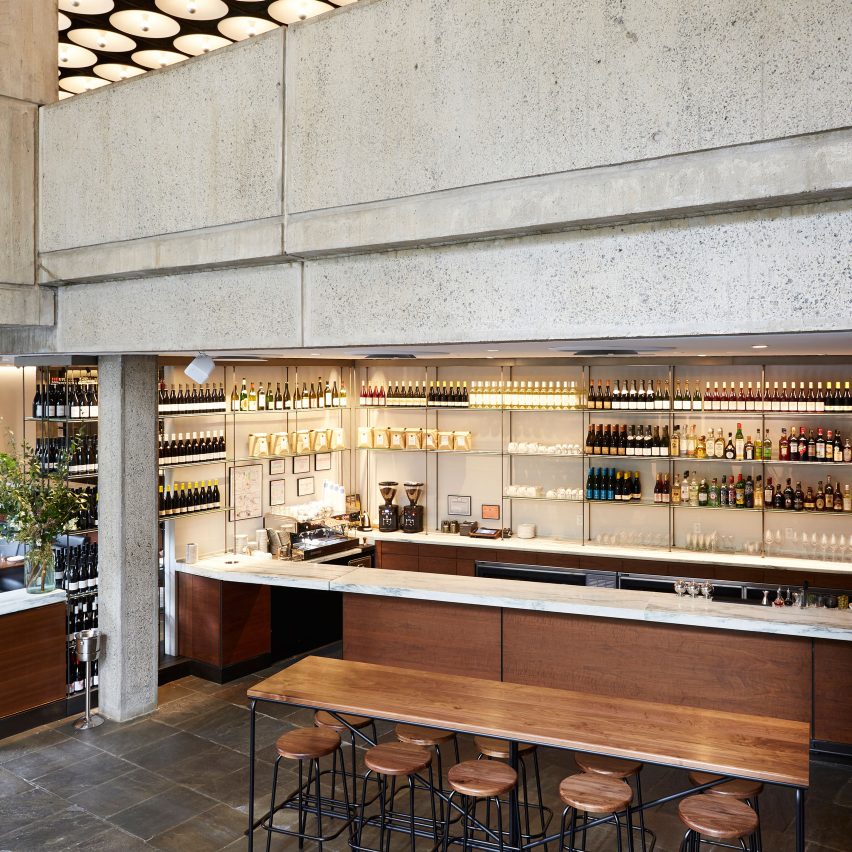
The lower level of The Met Breuer museum in New York now houses a space for visitors to dine and drink in the surrounds of the brutalist-style building. Read more

From the architect. Wilson Architects has designed a new Learning Hub for St Andrew’s Anglican College – a rapidly-growing school on the Sunshine Coast.
The Learning Hub incorporates primary and secondary school libraries, multiple collaborative teaching spaces, staff offices, professional development care, several student lounges and an expansive outdoor learning area.
St Andrew’s Anglican College Principal Chris Ivey says the Learning Hub has seamlessly integrated with the school, and students are taking full advantage of the learning opportunities it presents. “I have spent chunks of time each day in the Hub, observing the way our students are using the facility, and it is wonderful to see them using it as if it has always been there,” Chris says.
Wilson Architects’ design intent was to give the school a learning heart, and provide a highly-flexible space that could be used for a full spectrum of activity.
From concerts and large gatherings to small group meetings and quiet study sessions. Internally, contemporary materials such as glass and metal are balanced with wood to add warmth and richness to the learning space. Meanwhile, a covered outdoor gathering area supports large numbers of students in an open-air learning setting.
Wilson Architects Managing Director Hamilton Wilson says the Hub brings the learning community together, giving the students a dynamic place to collaborate and share knowledge.
“It’s shifted the focus towards student-centred learning, as opposed to concentrating on teachers and their classrooms. The Hub has given students a real sense of ownership of the space and their learning,” Hamilton says.
He says it was amazing to see the school’s centre of gravity change so dramatically. “The school has transformed from being very disparate, to extremely cohesive, with a pulsing heart of activity at its centre,” he says.
The university-like facility (as described by students) raises the profile of learning, which is now on display on major routes of the campus and no longer hidden away.
Product Description. St Andrew’s displays a predominantly brick palette on campus buildings, with steel roof and cladding highlighting school colours. For the academic centre a more abstract and contemporary materiality was sought that would still acknowledge the existing campus aesthetic. A smooth-faced PGH white brick (Crevole) references the white brick banding in the original buildings, albeit with a crisply-contemporary edge. Plexiglas highlights in the building sunshading draw out the reds and blues of the school uniform, subtly reflecting the campus colourway without directly emulating it.

Stanton Williams has released new and updated visualizations of their design for the renovation of the Royal Opera House in London. The project, titled ‘Open Up,’ aims to transform the public experience of the Royal Opera House at its Covent Garden Home through a series of “legible and flexible” spaces.
The design will increase connection to the city through two reimagined entrances: a new glazed extension on Bow Street that will offer pedestrians a view into the activities taking place within, and an improvement entrance onto the Covent Garden Piazza that will provide additional foyer space and an exhibition area to display the work of the Royal Opera House.
The project also includes a second theater within the shell of the Linbury Studio Theater that will serve as an “artistic laboratory” for the Royal Ballet and Royal Opera Companies. The theater space will be adaptable to various performance formats, and will provide a warm, comfortable atmosphere with a distinct character.
Stanton Williams was selected for the project in 2013 as part of competition including Amanda Levete Architects, Heatherwick Studio and Diller Scofidio + Renfro. Construction on the project is currently underway, while the building remains operational. Phase 1 of the project (conversion of basement into restrooms) opens to the public tomorrow, with the full project expected to be completed in 2018.
News via Stanton Williams.

