Shanghai Hongqiao Performing Arts Center / BAU


Courtesy of BAU

Courtesy of BAU


Courtesy of BAU


Courtesy of BAU


Courtesy of BAU


Courtesy of BAU

  • Architects: BAU
  • Location: No.888 Tianshan Road, Changning District, Shanghai, China
  • Design Team: James Brearley, Steve Whitford, Jiang Han, Luo Huaili, Liu Shuai, Song Hui, Yang Qing’an, Xia Wen, Rong Yu, Li Fuming
  • Area: 14300.0 sqm
  • Project Year: 2016
  • Photographs: Courtesy of BAU
  • Landscape Team: Huang Fang, Robin Armstrong, Luo Li, Liang Yongqing, Chen Qi
  • Interior Architect: BAU + Shanghai Jianke Architectural Design Institute Co., Ltd
  • 3 D Rendering: BAU
  • Contractor: Jiangsu Guangyu Construction Group
  • Documenting Architect And Engineer: Qingdao Times Architectural Design Co., Ltd
  • Client: Shanghai Changning Cultural Bureau

Courtesy of BAU

Courtesy of BAU

Highly visible

The project is located in Tianshan Road, the new commercial boulevard in Hongqiao, one of Shanghai’s high activity districts. It is surrounded by brightly lit shopping malls built this century. This development replaces and expands on the existing state run cinema center on the site. The project was the subject of three rounds of invited competition over 5 years before BAU was contracted to design the project.


Courtesy of BAU

Courtesy of BAU

Exposure to difference

This project includes both traditional and modern programs of mass entertainment: theater (1000 seats) and cinema (seven of various capacities). Usually seen as separate programs and increasingly supported by distinctly different user groups, this project presents the opportunity for the two different programs and variable patrons to engage. Articulating the programs as separate objects and linking them via an enclosed plaza creates an in-between-space in which the differences between the programs are enhanced, the potential for cross-patronage is maximized, and cross-fertilization between the performing arts is encouraged.


Courtesy of BAU

Courtesy of BAU

A-A Section

A-A Section

Courtesy of BAU

Courtesy of BAU

An assemblage of difference

The theater is developed as a stone monolith (a traditional material for a traditional program) with rounded articulation and a theatrical staircase. The cinemas are an ensemble of stacked metal boxes (a 20th Century material for a 20th Century program), the largest of which is suspended above the street corner. The enclosed plaza or mixing-lobby has ticket offices, café, flexible exhibition and event space, and open views to the external plaza and streetscape, also designed by BAU.


Courtesy of BAU

Courtesy of BAU

Diagram

Diagram

Courtesy of BAU

Courtesy of BAU

http://ift.tt/2dyI3GN

Katzden Architec Factory / NISHIZAWAARCHITECTS


© Hiroyuki Oki

© Hiroyuki Oki


© Hiroyuki Oki


© Hiroyuki Oki


© Hiroyuki Oki


© Hiroyuki Oki

  • Architects: NISHIZAWAARCHITECTS
  • Location: Căn hộ City Tower, Bình Dương, Hưng Định, tx. Thuận An, Bình Dương, Vietnam
  • Architects In Charge: Shunri Nishizawa, Vu Ngoc Tam Nhi
  • Area: 5753.87 sqm
  • Project Year: 2016
  • Photographs: Hiroyuki Oki
  • Landscape: Shunri Nishizawa, Vu Ngoc Tam Nhi
  • Client: Katzden Architec Vietnam co., ltd
  • Building Construction: Daiwa House Vietnam co., ltd
  • Landscape Construction: I Fit Home Co., Ltd

© Hiroyuki Oki

© Hiroyuki Oki

Located in the heart of a new industrial park in Binh Duong, the factory was considered to be an iconic construction which is “simple but must-be-impressive” enough to be the face of this park. 


© Hiroyuki Oki

© Hiroyuki Oki

Plan

Plan

© Hiroyuki Oki

© Hiroyuki Oki

The client is a steel manufacturing company with the architectural products including staircases, handrails, bicycle stands,… Although factories are usually figured by purely pragmatic boxes for its efficiency and flexibility, we were strongly asked to design this factory to be an aesthetic object while functionality means everything with a limited budget but on the other hand, could offer a fresh working environment for human activities in a tropical climate.


© Hiroyuki Oki

© Hiroyuki Oki

Initially, to meet the demand of the standard budget for normal built-in factories, cubic simple form with 8m-span grid system was chosen as the dominant mass so as to match the neighborhood while reducing the expenditures. Using bricks for the exterior of the building would provide the opportunities to let the building itself work as a landmark with natural clay color contrast to the unobstructed neighborhood. Old bricks were collected from abandoned colonial buildings in the Mekong Delta area and recycled for the exterior layer. In order to decrease the weightiness of the massive brick cube as well as provide the air ventilation for the whole building, an enormous roof made by galvanized corrugated metal is lifted up with 3-meter-cantilivered-canopy in order to protect the indoor working areas from harsh sunlight, gusts and squalls.


© Hiroyuki Oki

© Hiroyuki Oki

Right at the centerof this man-made construction, 16m x 16m open-air garden celebrates a serene fragment of the tropical garden and refreshes the working spaces with the natural elements. When all the rotating doors are opened, the air flows could go through and refresh the environment inside the building. The courtyard itself, along with the water feature could functionally build up its own tropical diverse ecology with sensual connection to changing light and seasonal qualitative.


© Hiroyuki Oki

© Hiroyuki Oki

The landscape concept that we mostly desire for approach should provide as much as possible the tropical scenario for the factory. By that meaning, many kinds of tropical plants and fruit plants were installed such as Papayas, Bananas, Tamarinds, Malpighi glabras, Coconut trees, and especially dragon fruit ones which could be considered as one of our first-time attempt. We were inspired by the image of a field with countless rows of poles covered by dragon fruits triangular stems, which would be considered as common sceneries in the middle Vietnam. The in-order pole system made by old bricks intentionally becomes the important landscape element, and tightly connects with the architecture itself.


Diagram

Diagram

via nishizawaarchitects

via nishizawaarchitects

The design, which could preserve a large amount of greenery in order to serves as a “working environment closed to nature” for the employees as well as interacts the landscape and the building itself, could obtain the new tropical approach of designing factory.


© Hiroyuki Oki

© Hiroyuki Oki

http://ift.tt/2eiIraV

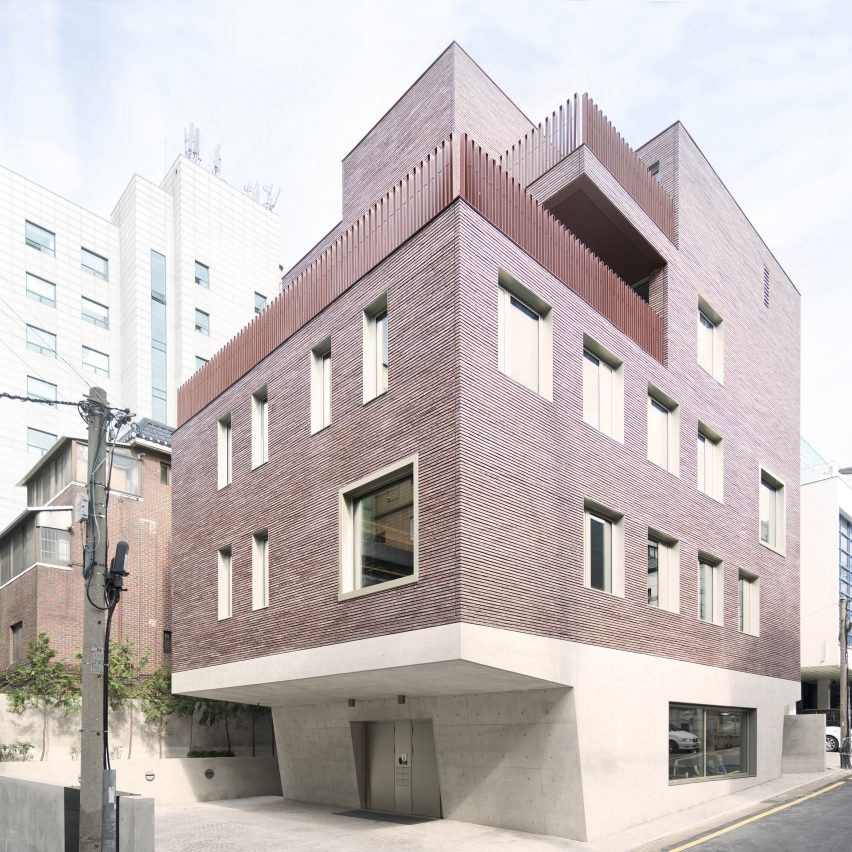
Top-heavy block in Seoul features red brick top and concrete base

Nonhyeon by Stocker Lee Architetti

Four floors clad in slim red bricks sit above the concrete base of this office and apartment block in the South Korean city Seoul, which was designed by local firm Stocker Lee Architetti. Read more

http://ift.tt/2efLqCl

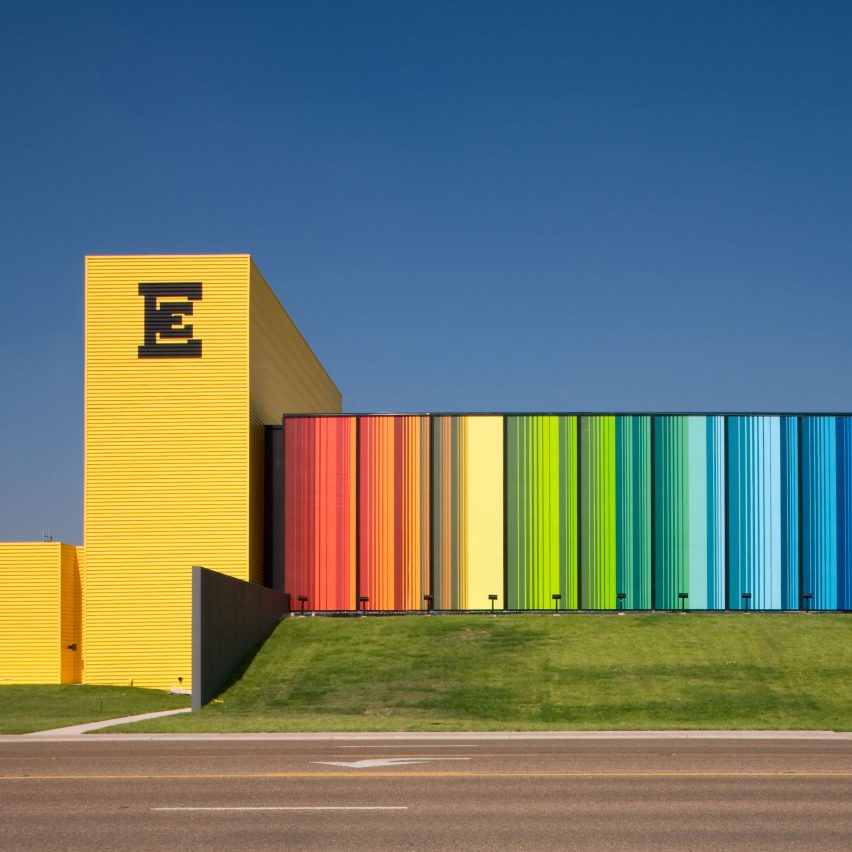
Socially responsible design in America presented in Cooper Hewitt exhibition

Edcouch-Elsa ISD Fine Arts Center by Kell Muñoz Architects

Design solutions for a wide range of social concerns, from rapid-recovery housing to drinking water access for migrants, are featured in a new show at the Cooper Hewitt Smithsonian Design Museum in New York. Read more

http://ift.tt/2dlBRn1

Chaimiduo Farm Restaurant and Bazaar / Zhaoyang Architects


© Pengfei Wang

© Pengfei Wang


© Pengfei Wang


© Pengfei Wang


© Pengfei Wang


© Pengfei Wang

  • Architects: Zhaoyang Architects
  • Location: Dali, Yunnan, China
  • Design Team: Yang Zhao, Peigen Shang
  • Interior Designer For The Restaurant:: XuCai
  • Area: 631.0 sqm
  • Project Year: 2015
  • Photographs: Pengfei Wang
  • Client: Chaimiduo Team

© Pengfei Wang

© Pengfei Wang

From the architect. This is a renovation project. The property was originally an abandoned office facility located at the center of Dali old town, including a traditional Bai style timber building, a bungalow made of brick and concrete and a 200 sqm courtyard. The property has been rented by a local lifestyle brand “Chaimiduo” and renovated into a farm restaurant, a farmer’s supermarket, a gallery for local handicraft and space for “Chaimiduo Bazaar” that opens once a week. 


Axnometrical drawing with program arrangement

Axnometrical drawing with program arrangement

The idea of the renovation is mainly about redefining the courtyard’s four different sides using ad-hoc strategies. A second floor is added to the bungalow at the north side of the courtyard, with a traditional Bai style tiled roof (responding to the design code of Dali old town). An irregular shaped steel pavilion extrudes into the courtyard, connecting the restaurant interior with the courtyard space. The pavilion is wrapped with bamboo to emphasize its volume and to filter sunlight for its interior. The bamboo façade is operable towards the courtyard, allowing more interaction during bazaar hours. The bamboo facade also extends upward and becomes the banister for the terrace. The profile of the banister is tilted, directing the spatial orientation towards the preserved upper floor facade and tiled roof of the neighboring timber building.


© Pengfei Wang

© Pengfei Wang

The timber building was constructed according to traditional methods. We demolished the partition wall on the ground floor and also the timber doors with wood lattice. The space of the ground floor therefore opens up to the outside. We also added to the facade a system of bamboo sliding doors and then the openness can be adjusted. The bamboo system hides the original timber columns and introduces a new appearance responding to the transformed open spatiality. While canceling the reading of the traditional image on the ground floor, this new façade also highlights the more refined details of the preserved facade of the upper floor and tiled roof. 


© Pengfei Wang

© Pengfei Wang

The southern side of the courtyard is the main entrance to the whole property. We added a wedge shaped pavilion to redefine the entrance space. It provides shelter and also transforms the spatial sequence. Bamboo is used here as the ceiling and can be visually related to other bamboo facades and create a more unified impression.


© Pengfei Wang

© Pengfei Wang

First floor plan

First floor plan

© Pengfei Wang

© Pengfei Wang

The west side of the courtyard has an iron fence with lush local ivy that provides the property with a soft and semi-transparent protection. We simply added a wide timber platform that covers the flowerbed and can be used as a long bench and a place for children to play during bazaar hours. 


© Pengfei Wang

© Pengfei Wang

http://ift.tt/2eiGaNJ

Agence d’Architecture A. Bechu & Associés Wins Competition for New University Campus in Moroccan Oceanside Town


Courtesy of Agence d’Architecture A. Bechu & Associés

Courtesy of Agence d’Architecture A. Bechu & Associés

Agence d’Architecture A. Bechu & Associés has won a competition to design a new campus for the University of Laâyoune to be located in the oceanside town of Foum el Oued, Morocco (Western Sahara). Launched by King Mohammed VI last February, the competition was named a national priority project supported by Office Chérifien des Phosphates (OCP), a Moroccan company and the world’s leading producer of phosphate. The project was aimed at contributing to the economic and social boom of the region by creating a new platform for innovation and research & development.


Courtesy of Agence d’Architecture A. Bechu & Associés


Courtesy of Agence d’Architecture A. Bechu & Associés


Courtesy of Agence d’Architecture A. Bechu & Associés


Courtesy of Agence d’Architecture A. Bechu & Associés


Courtesy of Agence d’Architecture A. Bechu & Associés

Courtesy of Agence d’Architecture A. Bechu & Associés

AAAB & Associés’ design responds to this call by envisioning a campus integrated with the natural desert site to create a dialogue between building and its environment. Responding to the local climate, and taking inspiration from the lines of nearby sand dunes, the buildings come together via a central, canopied artery that creates shaded, public space for meeting and interaction. This interior street takes the form of a large crack in the dried desert earth, but will instead be filled with vegetation to contribute to cooling and atmosphere.


Courtesy of Agence d’Architecture A. Bechu & Associés

Courtesy of Agence d’Architecture A. Bechu & Associés

Courtesy of Agence d’Architecture A. Bechu & Associés

Courtesy of Agence d’Architecture A. Bechu & Associés

The campus will also follow the dual objectives given by the OCP. First, to make the University of Laayoune a ground for experimental teaching methods in fields such as water, energy and desert agriculture through the installation of living laboratories dedicated to new environmental technologies and biomimicry; and secondly, to develop a building capable of exemplary energetic passivity.


Courtesy of Agence d’Architecture A. Bechu & Associés

Courtesy of Agence d’Architecture A. Bechu & Associés

Courtesy of Agence d’Architecture A. Bechu & Associés

Courtesy of Agence d’Architecture A. Bechu & Associés

Teaming with structural engineers DVVD, environmental consultant Ennesys and planning consultants EMBIX, the architects developed a sustainable strategy that will allow the campus to obtain 80% of its energy from passive sources, as well as recycle dust, water and organic waste into reusable water and high-value bio fertilizer. The approach will mix traditional and modern technologies to create an intelligent grid inspired by the local environment. These techniques will allow the complex to approximate zero-waste metrics.


Courtesy of Agence d’Architecture A. Bechu & Associés

Courtesy of Agence d’Architecture A. Bechu & Associés

Courtesy of Agence d’Architecture A. Bechu & Associés

Courtesy of Agence d’Architecture A. Bechu & Associés

The project hopes to set an example of how to design sustainable cities in the harsh African desert – by 2050, the African population is predicted to double to 2.5 billion inhabitants, for whom new architecture will need to be developed to accommodate.

The University of Laâyoune will be completed in 2018 and will hold its grand opening in September of that year.

News via Agence d’Architecture A. Bechu & Associés.


Courtesy of Agence d’Architecture A. Bechu & Associés

Courtesy of Agence d’Architecture A. Bechu & Associés
  • Architects: Agence d’Architecture A. Bechu & Associés
  • Location: Foum el-Oued, Morocco
  • Architect: AgenceArchitecture A. Bechu & Associés
  • Client: OCP
  • Associate Architect: Benounna
  • Structural Engineer: DVVD
  • Environmental Consultant: Ennesys
  • Planning Consultatn: EMBIX
  • Area: 100000.0 sqm
  • Project Year: 2016
  • Photographs: Courtesy of Agence d’Architecture A. Bechu & Associés

http://ift.tt/2eir6i3

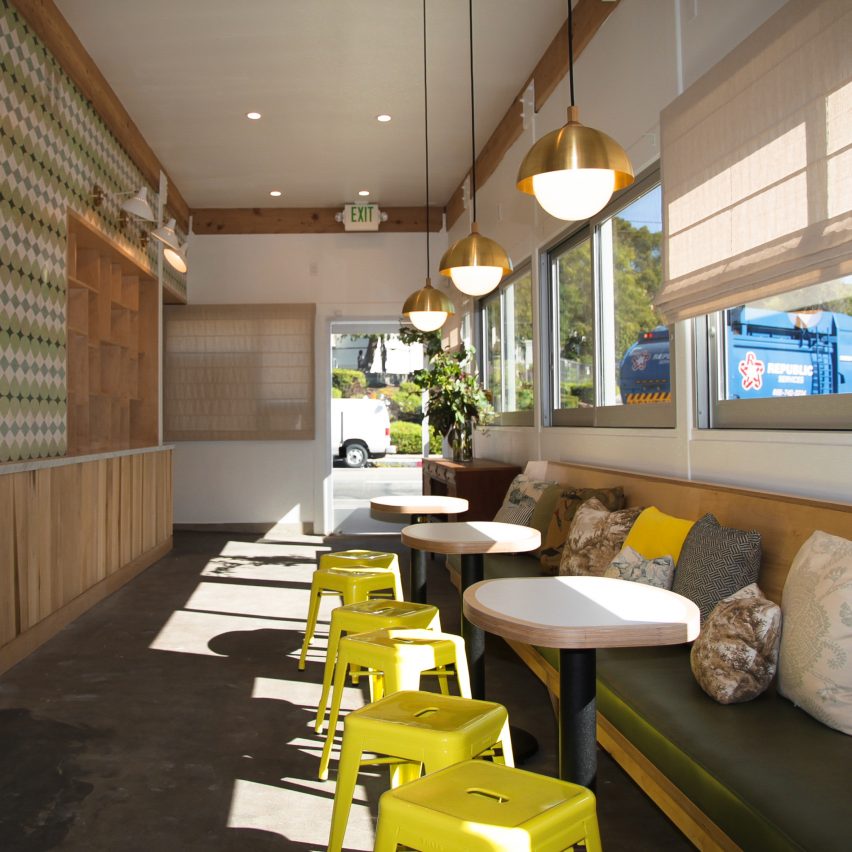
Moby’s Little Pine vegan cafe features modernism-influenced interior by Studio Hus

Little Pine by Studio Hus

This cafe owned by Moby in Los Angeles was designed by local firm Studio Hus to reflect the musician’s love of the mid-century modern style. Read more

http://ift.tt/2eijTPT

Tangram / Architecten de Vylder Vinck Taillieu


© Filip Dujardin

© Filip Dujardin


© Filip Dujardin


© Filip Dujardin


© Filip Dujardin


© Filip Dujardin


© Filip Dujardin

© Filip Dujardin

A sharp line makes two houses out of one. A sharp line makes one house out of two houses. One of those houses will be dealt with. The other will not – not really. One of the houses will become a shop. The other will not. The other will become not a store.


© Filip Dujardin

© Filip Dujardin

But together one house.

Two houses which together form one will look towards each other through that sharp line. The sharp line will be a wall of glass. Along the wall visitors will walk into one of the houses to the back. On the other side visitors will walk through the shop to the front. Or to the back again.


© Filip Dujardin

© Filip Dujardin

Plan

Plan

© Filip Dujardin

© Filip Dujardin

A long shop – along the shop. Following the sharp line that is a wall of glass. From front façade to garden at the back.


© Filip Dujardin

© Filip Dujardin

The garden at the back is just so a house. Half of a house, without a roof. An old stable. A new garden.


Section

Section

And upstairs. Another house. Behind the front face. Just so a house, to live in.


© Filip Dujardin

© Filip Dujardin

How many houses can a house be?
While being a shop as well. A walk through the house as shop. 

http://ift.tt/2dlmI5b

New York’s Future Second Tallest Tower Breaks Ground

The Kohn Pedersen Fox-designed One Vanderbilt Avenue broke ground today, beginning construction on what will stand as the second tallest tower in New York City upon completion. Located adjacent to Grand Central Terminal on 42nd Street, the tower will be integrated into the its neighbor through a series of underground connections and $220 million in improvements to Grand Central’s infrastructure.


Courtesy of SL Green Realty Corp


Courtesy of SL Green Realty Corp


Courtesy of SL Green Realty Corp


Courtesy of SL Green Realty Corp


Courtesy of SL Green Realty Corp

Courtesy of SL Green Realty Corp

Courtesy of SL Green Realty Corp

Courtesy of SL Green Realty Corp

Developed by SL Green Realty Corp, One Vanderbilt will encompass an entire city block between Madison and Vanderbilt Avenues and will rise to a pinnacle at 1,401 feet, five feet taller than the city’s current second tallest building, 432 Park Avenue. At the building base along 42nd Street, the facade will be pulled back at an angle to reveal Grand Central’s majestic Vanderbilt cornice, which had been obscured for nearly a century.


Courtesy of SL Green Realty Corp

Courtesy of SL Green Realty Corp

Courtesy of SL Green Realty Corp

Courtesy of SL Green Realty Corp

Courtesy of SL Green Realty Corp

Courtesy of SL Green Realty Corp

The tower will contain 1.7 million square feet of office space on 58 column-free floors that feature fully glazed walls and higher than standard ceiling heights, while a 30,000 square-foot amenity floor will feature world-class dining. The building is expected to obtain the highest possible LEED certification.


Courtesy of SL Green Realty Corp

Courtesy of SL Green Realty Corp

Courtesy of SL Green Realty Corp

Courtesy of SL Green Realty Corp

“One Vanderbilt will not only emerge as an elegant, tapered new icon on the New York skyline, but will also serve as a leading example of a global trend of connecting train stations to tall towers, said James von Klemperer, FAIA, RIBA, President of Kohn Pedersen Fox Associates.

“This building will change its neighborhood for the better. It will provide a new gateway to the city made possible only through the unusually harmonious partnership between architect, developer, and the City of New York.”


Courtesy of SL Green Realty Corp

Courtesy of SL Green Realty Corp

Courtesy of SL Green Realty Corp

Courtesy of SL Green Realty Corp

Included in SL Green’s $220 million public infrastructure upgrades will be a new “jewel box” transit hall in the base of One Vanderbilt, a public plaza on Vanderbilt Avenue, and improved circulation into the Grand Central Terminal complex.

Construction will be managed by Tishman Construction, and is expected to be completed in 2020.

News via SL Green.

http://ift.tt/2eCmZC1

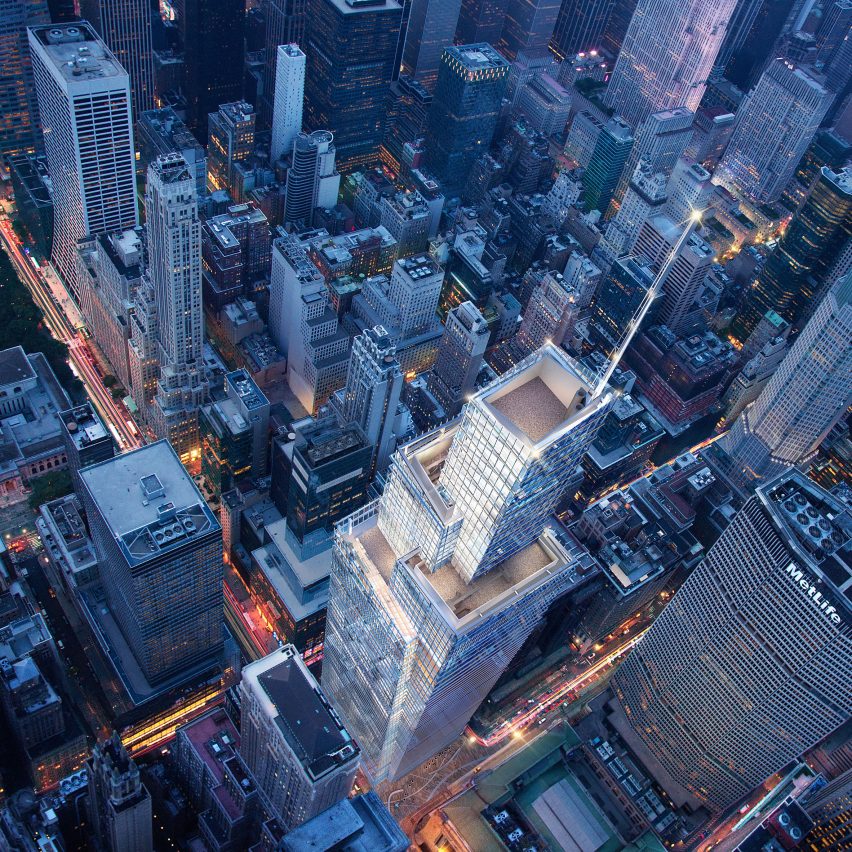
New York’s future second tallest skyscraper breaks ground

One Vanderbilt by Kohn Pedersen Fox

Construction has begun on the One Vanderbilt tower in Midtown Manhattan, which will overtake 432 Park Avenue as the second tallest structure in New York City. Read more

http://ift.tt/2dM39iE