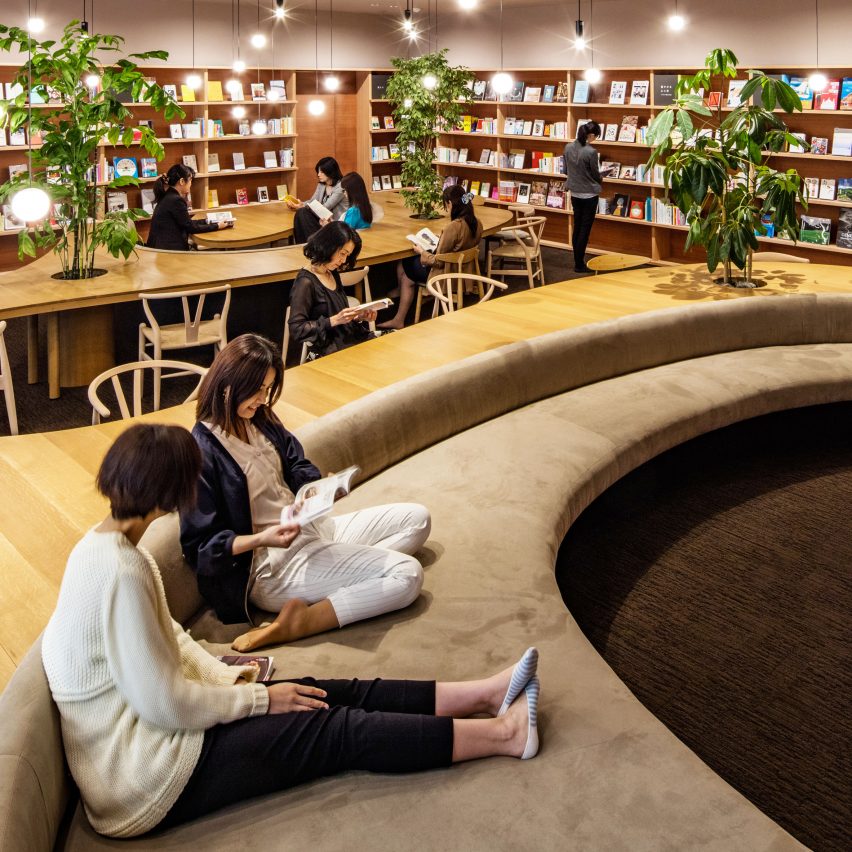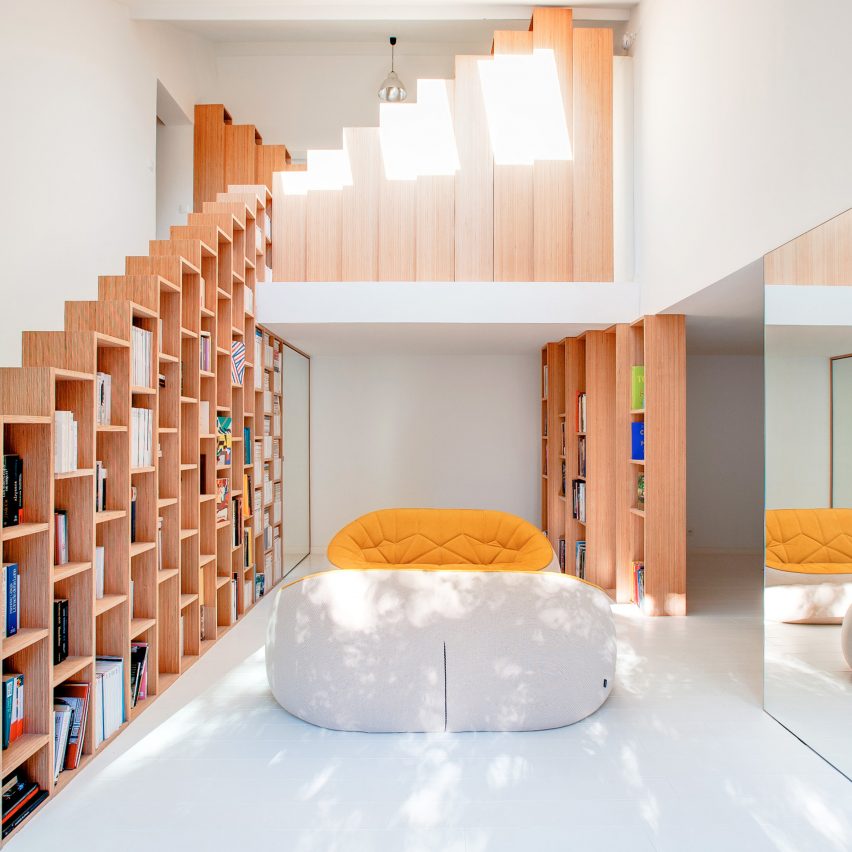
Stepped bookshelves help to divide and characterise this house just outside of Paris, renovated by Italian architect Andrea Mosca. Read more
Stepped bookshelves help to divide and characterise this house just outside of Paris, renovated by Italian architect Andrea Mosca. Read more

Behnisch Architekten has announced the groundbreaking of the AGORA—Cancer Research Center located in Lausanne, Switzerland within sight of Lake Geneva. As the new home of the Swiss Institute for Experimental Cancer Research (ISREC), the Center will bring together 400 researchers, scientists, doctors, and clinicians under the goal of enhanced communication.
The new AGORA building will connect to an existing building on one side, with minimal disruptions to existing programming. “Visual relationships both on the site and to the landscape beyond require a carefully defined building mass and the new building responds sensitively to these site conditions while sculpturally standing out from its heterogeneous surroundings.”
Both interdisciplinary and disciplinary communication will be addressed in the organization of the building’s floor plans. The public level of the center will connect the campus’ existing pathways with the laboratory and office levels via interconnected communication areas and informal workspaces.
Designed to enhance daylight use throughout the building while minimizing heat gain, the building’s skin will work in conjunction with daylight enhancement systems and optimized sunlight protection. Furthermore, operable windows will allow for natural ventilation, providing better individual climate control.
A green rooftop will provide recreational space for the building.
AGORA is expected to be completed in 2017.
News via Behnisch Architekten.
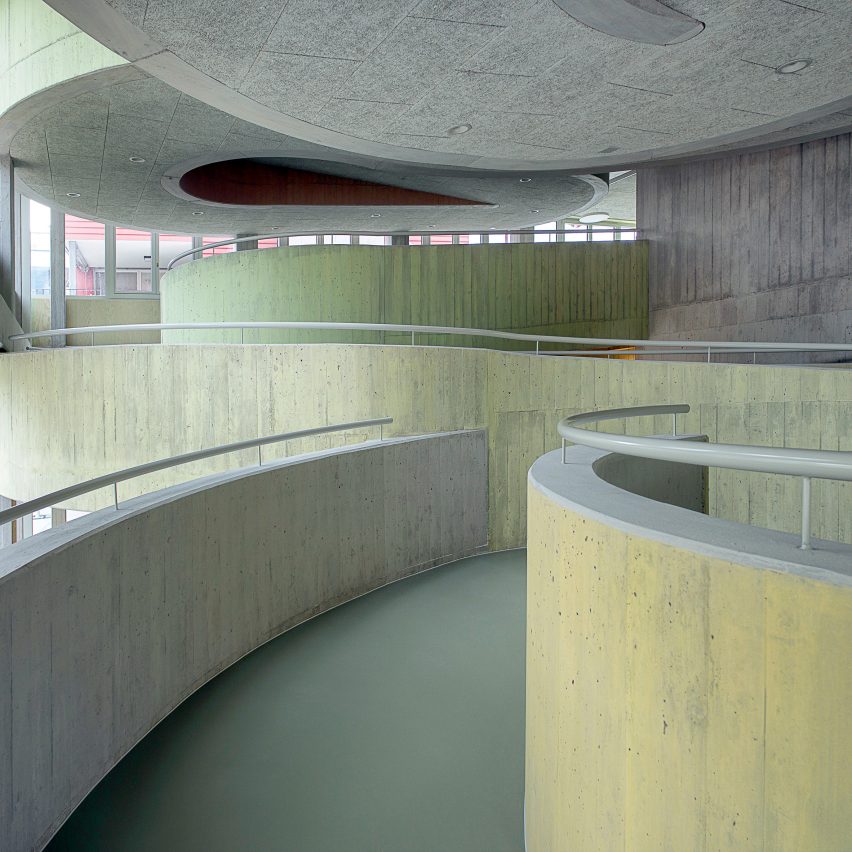
This extension to a day-care centre for disabled adults in the Swiss town of Stans has been kitted out with muted red awnings and spiralling pastel-tinged walkways. Read more

From the architect. Hermana República is a tasting place for Patito a beer made in a local brewery. Behind this tasting spot is the factory where the beer is made.
There are two conceptual axis that ruled this project; the first one was to create an environment that has a bound with the beer production, an industrial environment that is also a comfortable place to drink beer. The plan was to create a place that had an environment of a yucatecan cantina and a good restaurant where you can go and have a quality meal.
On the other hand, one of the strongest concepts of the craft beer served in Hermana República, is it’s ingrained with the sister republic of Yucatán, therefore its name. The formal and constructive concept of this point of sale has strong roots on the constructive systems and the formal space of construction in Yucatán.
The traditional “stone walls” of Yucatán, are represented by gabion walls in which they inserted some PVC tubes to allow the wind to pass through. This gabion walls hold a big metallic box that also evokes the big structures in which henequen and other products from our region where stored.
The interior is not presumptuous; it’s all about natural concrete floors, essential furniture designed by Oscar Hagerman, a very casual environment but at the same time with a human scale that provides us confidence and warmth.
The constructive system made by Joist structures that holds a concrete roof in which the constructors left the wood falsework apparent, an illumination based on hanging sources of light without any lamp to cover or decorate them.
The general volumetry of Hermana República is conceived as a big metallic box supported by this gabion walls that don’t meet with the box but they stand out of it accommodating the services and framing the beer garden that its used for private parties and on weekends its used as a parking lot for food trucks that get together and create this casual environment.

For architects seeking NCARB licensure, few things are more daunting than the dreaded structural exam. But now, thanks to a series of videos from structural engineer Dilip Khatri, even those of us who spent more time doodling than paying attention in college engineering classes can acquire the skills needed to pass the structural section of the ARE.
Khatri, principal of Khatri International Structural and Civil Engineers, has a PHD in Structural Engineering from the University of Southern California and over 30 years experience in the profession, including over 20 years of teaching structural engineering. In the videos, he covers everything you’ll need to know for the exam, from test-taking strategy to shear and moment diagramming to complex problem solving, illustrating with the help of a sharpie pen.
Check out the videos below, and find links to supplementary notes here:

Director Jonathan Chong used a combination of projection mapping, 3D printing, stop-motion and animation to create the video for Dan Sultan’s Magnetic track. Read more

Team Rambo, also known as Ramboland, is a project born from the need of Ron Rambo, born with Cerebral Palsy, for a home that can support his disability and increase his quality of life. However, Ramboland doesn’t just stop there. LEED Fellow Max Zahniser, has used his experience with Green Architecture to combine Ron’s social vision with an environmental one that can benefit the entire community. The meeting of these objectives has been defined by the goal “to design a project that will actually increase the vitality of life and life-support systems in every way possible,” using architecture to make a difference.
The building that will result from the Ramboland project aims to be not only energy grid independent, but also water grid independent and 50% food “grid” independent. As a result of the solar panelled roof, the house is estimated to generate about 40,000kWh/year – far more energy than it consumes. Any excess energy could be shared with neighbors, as well as support the surrounding common area. In addition to this, Ramboland hopes to generate funding for an accessible electrical car that could be shared with nearby residents in wheelchairs. The building’s backyard will be an edible Permaculture garden, with the only required maintenance being to harvest all the fruits, nuts, herbs and vegetables that will be growing there.
In order for Ron to access the agricultural space, the building will contain wheelchair accessible planter beds, in addition to adjustable height furniture and appliances, a suspension system between the bedroom and bathroom, automated mechanical and electrical systems and extra wide doors. At Ron’s request, the house is designed to accommodate anyone with any type of special needs that may inhabit the house in the future, greatly exceeding ADA (Americans with Disabilities Act) requirements. These elements and objectives embody the community-oriented foundation of the Ramboland project. As they put it themselves, “it’s not just about the building.”
When it comes to the technical aspects of the building, however, there is just as much attention to sustainability and health as with the rest of the project. Nearly no new materials are being used in the construction, as almost all of the project’s wood and steel elements will be sourced from reclaimed materials destined for landfills. Perhaps unexpectedly, the materials themselves will also contribute to building health; studies have shown that reclaimed materials often produce better indoor air quality, as any chemicals contained within them have been fully released over time. Obviously, this results in a far better environment for Ron’s health and comfort. By maximizing natural light and providing greenery indoors and views to the outdoors, the architecture also increases the physical, as well as the mental and emotional health of any inhabitants.
Clearly, Team Rambo is fulfilling their philosophy of extending the length and enhancing the quality of life, while reducing costs and improving sustainability. It’s no wonder that the project is so well received by the community; the architecture it looking to influence society far beyond the property line, improving the natural and social environment of the area.
You can find out more about the Ramboland project on the project website, here.

Located in New York’s Little Italy, Karma’s office was transformed by design studio FormNation into a modern space that combines Dutch and American design influences and provides transparency, communication and work-life balances for the employees.
Karma’s design brief was short, but clear: Design a space with 40 desks, ample break out areas, a war room, communal lunch space for 40, that fits the brand, and they had to move in there in 4 weeks.
Karma is a tech start up with strong Dutch influences, that brings a clear, simple, honest and powerful wifi product to the US. Without falling into the typical start up design trap of creating an industrial chic loft design with a slide, FormNation relied on its own Dutch background and design influences to create an aesthetic that focused on a mix of clean Dutch design with American design.
The L-shaped space boasts a 14’ tin ceiling in an industrial loft with an abundance of natural light from large windows along one wall that overlooks Little Italy and provides the perfect environment for collaboration and communication.
The space is divided into 3 main areas:
Work: A colorful pathway of blue and grey floor tiles welcomes employees and guests alike into the office. Employee desks are laid out in a clean grid, comfortable lounge seating exist in the center aisle for conversations and the windows are visible from all desks so everyone can enjoy the view and sunlight. The large, white Delta lights by Rich Brilliant Willing create a cozy work environment and the perfect working light. To top off the space is an oversized company logo, in iconic Dutch orange, resembling an all-American gas station.
Meet/private: FormNation built an extension to the existing conference rooms to create an open war room for meetings and brainstorming sessions in a central location. The conference rooms offer transparency through their glass walls and functionality as the walls are often used to write meeting notes. The conference rooms are a mix of Scandinavian design with American industrial chic.
Relax/break out: Adjacent to the meeting rooms is a lunch space big enough for the entire office with a long communal table and 40 modern handmade lamps that provide a mix of Brooklyn industrial design and European flair. Following Dutch tradition, Karma employees eat lunch together every day and then take a walk to get coffee. It’s become the norm for Karma now but it’s still strange for new employees to take an hour from their day to eat and not talk about work.
Employees often enjoy their coffee in the break out space featuring grey Moroso sofas and iconic Anglepoise lamps in white.

The wide range in which pieces of masonry can be arranged allows for multiple spatial configurations. Born in a furnace, the brick adorns and reinforces, protects and—to various degrees—brings natural light into spaces that need slight, natural illumination.
Throughout history, traditional brick-laying consisted of predetermined arrangement of parts, and lines of rope to guide the consistency and placement of each individual brick. But there are many other ways to exploit this multi-faceted, timeless material, so we’ve selected 16 projects that demonstrate the potential of the humble brick.
Below find 16 construction details from projects that use bricks in ingenious ways.