How much space do we really need to take up in order to have rich and rewarding lives?
In this short documentary for The Atlantic, filmmaker Sam Price-Waldman visits Arcosanti, the revolutionary experimental community and urban laboratory envisioned by architect Paolo Soleri. Since its founding by Soleri in the northern Arizona desert in 1970, the city has grown and evolved as it has demonstrated how to create a walkable, social city that could meet the needs of future societies.
The video is narrated by architect and Arcosanti co-president Jeff Stein, who explains how the city is able to maximize the potential of architecture for providing for communities, and features interviews with several Arcosanti community members.
“It’s not trying to drop out of mainstream society, it’s trying to say, ‘we understand mainstream society intimately and we’re gonna go one or two steps ahead to see where this is going’”
The short film, entitled “The City of the Future is Already Here” is a part of “To Live Deliverately,” a series of documentaries on alternative living strategies published by The Atlantic. Check out the entire series, here.
Design Week Mexico 2016: the contrasting halves of these perfume bottles can be repurposed separately, or in combinations as vases and incense holders (+ slideshow). (more…)
From the architect. The primary condition for the design of thenew headquarters of Congresso Nacional dos Municípios (CNM) is the creation of a metropolitan area in line with the urban context of the city of Brasilia. The action plan adopted for the design of the new building is based in some fundamental assumptions:
– The land use gives emphasis on integration of users with the built landscape;
– The organization / hierarchy of the ground floor should strengthen its function as the main local of convergence;
– Preference for a clear and rational structural system that will guarantee speed and economy in construction;
– A sustainable building;
The project is embodied along an axis in the form of a white metallic volume floating gently on a concrete basement. The transparency of the volume creates a special relation with their surroundings.
The arrangement of the built elements is a direct response to the distribution of the program in the site:
– The base contains all the public functions, spaces to house the external audience (the auditorium, foyer, support rooms) as well as living spaces (coffee and restaurant);
– The foil has the administrative areas;
– In the roof terrace there is the meeting rooms;
– Finally, in the basement, is the garage and an annex to the technical areas, service and maintenance areas.
Site Plan
Ground Floor Plan
3rd Floor Plan
The design of the ground floor was the guiding principle of the proposal. We have created a square, slightly sunken in relation to the midlevel of the terrain, which unfolds on two levels and results in a new topography for the lot. On the ground floor a reflecting pool guides the pedestrian towards the reception, giving access into the administrative areas. In a lower level, in the base, is the civic square from where you can access the auditorium. A staircase connects the two levels allowing the realization of events autonomously, without affecting the functioning of the administrative areas. The ground floor has two purposes: it is both support for the settlement of the new set and an interface with the city.
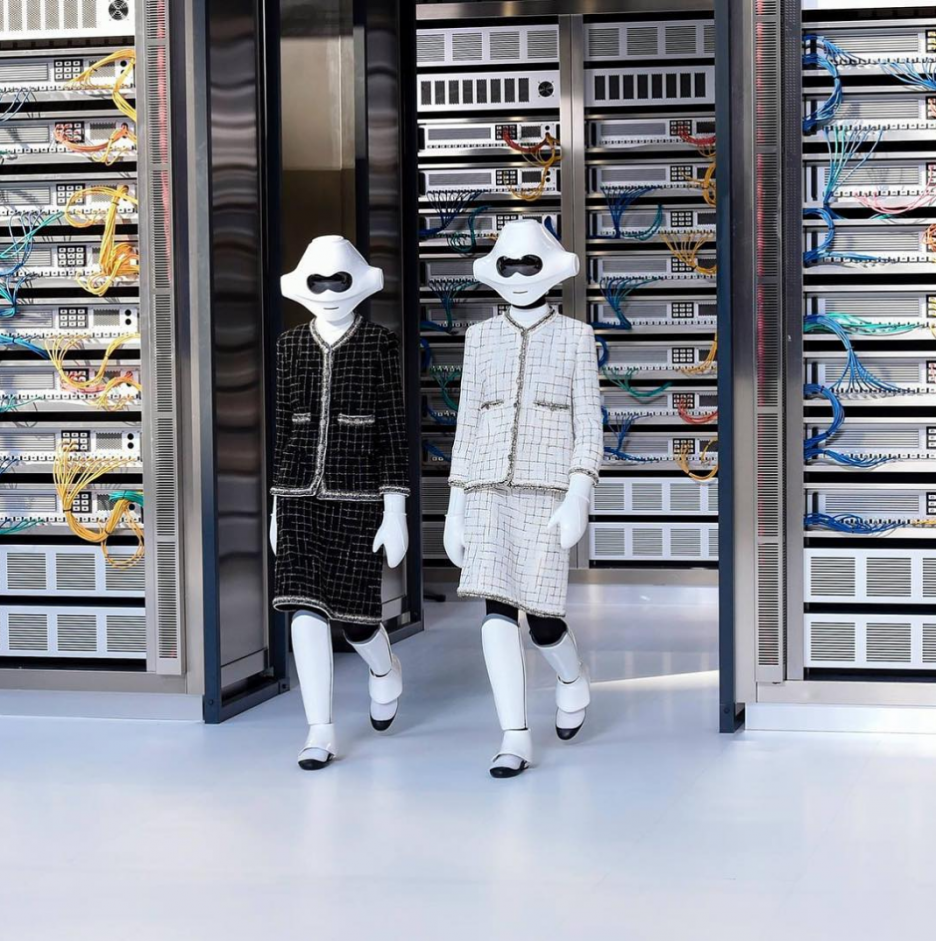
A “data centre” provided the backdrop for Chanel‘s spring summer 2017 show, which included models dressed as robots and bags with flashing LED displays (+ movie). (more…)
Currently, Penn Station is buried underground beneath Madison Square Garden. It accommodates over 600,000 passengers per day, more than twice as many as JFK, La Guardia and Newark airports combined, yet the station remains unsafe and unpleasant to visit. Cuomo’s plan for the new Penn Station centers upon the construction of the Moynihan Train Hall, which will be built where the Farley Post Office Building currently stands. The concerns that Chakrabarti has with this proposal are as follows: firstly, several platforms will have to be moved across from the central transit area beneath the Madison Square Garden, to be located underneath the new Moynihan Hall. Secondly, the vast majority of the traffic will still take place under the Garden, as that is where people are funneled through, especially with the expected construction of the Gateway project which will add new platforms to the South of the existing platforms. Hence, the logic that the new monumental hall should be built across the street from the busiest area of Penn Station is, indeed, somewhat flawed.
The Gateway project, a new program to build rail tunnels under the Hudson River, means that there will be changes in the city skyline on the South end of Penn Station and the Madison Square Garden. Chakrabati notes that this provides Madison Square Garden with the possibility of selling the airspace they have there for new building developments, providing the funding required to move the arena elsewhere; more specifically, to the West end of the Farley building, just 800 meters away. This would leave the building that is currently housing the Madison Square Garden, and placed directly on top of Penn Station, conveniently empty. In the spirit of a shared civil society that “asks us to do more with less,” Chakrabarti advocates for the recycling of the building’s superstructure and foundations, as well reusing the original station’s mezzanine levels and balustrades. The result: Chakrabati’s Penn Station palimpsest, maintaining and displaying the rich and complex history of the site for its commuters.
Courtesy of PAU
Chakrabati’s vision for the building strips the structure of all its unsightly cladding, replacing it with a double layer of blast proof glass that will let light, but not heat, into the building. The structure of the station will allow for passive heating and cooling, making it possible to build a 25-foot (7.6 meter) high open entrance along the entire perimeter of the cylinder that will also offer clear and unobstructed exits in the case of an emergency. The suggested oculus in the ceiling allows for smoke to be expelled effectively in the event of a fire, making the building not only beautiful and pleasant, but also efficient and safe.
Courtesy of PAU
Connecting the transit station with its context is powerfully achieved with the enormous glass façade, as well as with the reimagining of the Garden’s ceiling into a map of New York, soaring at 153 feet (46.6 meters) above the heads of passengers exiting the trains. The circular roof also reinforces the local connection by alluding to other specific iconic structures in New York, such as the New York State World’s Fair pavilion and Pan Am’s “Worldport” building at JFK. Chakrabarti’s glass portal is therefore more than just a new station, or a new building; it is working to bind the fabric of the entire neighborhood, reimagining a future that is collective and common.
Courtesy of PAU
The original, grand Penn Station was completed in 1910, designed by McKim, Mead and White, and destroyed in the 1960s, despite protests and futile attempts at salvaging the elaborate structure. In its place, Madison Square Garden was built. Retrieving the site to house its initial function, while respecting the history that has accumulated in the intervening decades, is undeniably the ultimate celebration of the significance of Penn Station for the society of New York. Chakrabarti and PAU’s philosophy of doing more with less and aiming to create a monumental structure without a titanic public cost adds to this building’s identity as belonging to the people. One can only hope that Governor Cuomo’s administration sees its enormous potential.
You can see The New York Times’ presentation of PAU’s proposal here.
A landscape of stone cliffs, wind bent pine trees, heather, and a forest floor of lichen and wild berries – this sparse yet rich site, coupled with a minimal budget, establishes the principles for this private residence at its origin.
The house is located on the island of Viggsö, in the Stockholm archipelago, and functions for a family of five. Both plan and section is ordered in three equal parts – Firstly, the entrance volume at the rear of the house containing the bathroom, bedroom, and kitchen; above, a loft for children and guests. Secondly, an airy, double height living room providing unobstructed views in three directions. Lastly, an open terrace facing the water, covered by a semi-transparent roof, concludes the house. Together, all three parts equate to a total area of approximately 80 square meters.
The design process largely focused on the development of a simple and economic structure in wood. The materiality of the house had to be efficiently transported and assembled on the island, yet able to withstand relatively large spans. The foundation, a series of posts, minimizes the houses touch on the ground condition, while elevating it to sit amongst the trees and vegetation. Simple planks connect the residence with the surrounding cliffs, following the aim to create an unassuming space within the landscape.
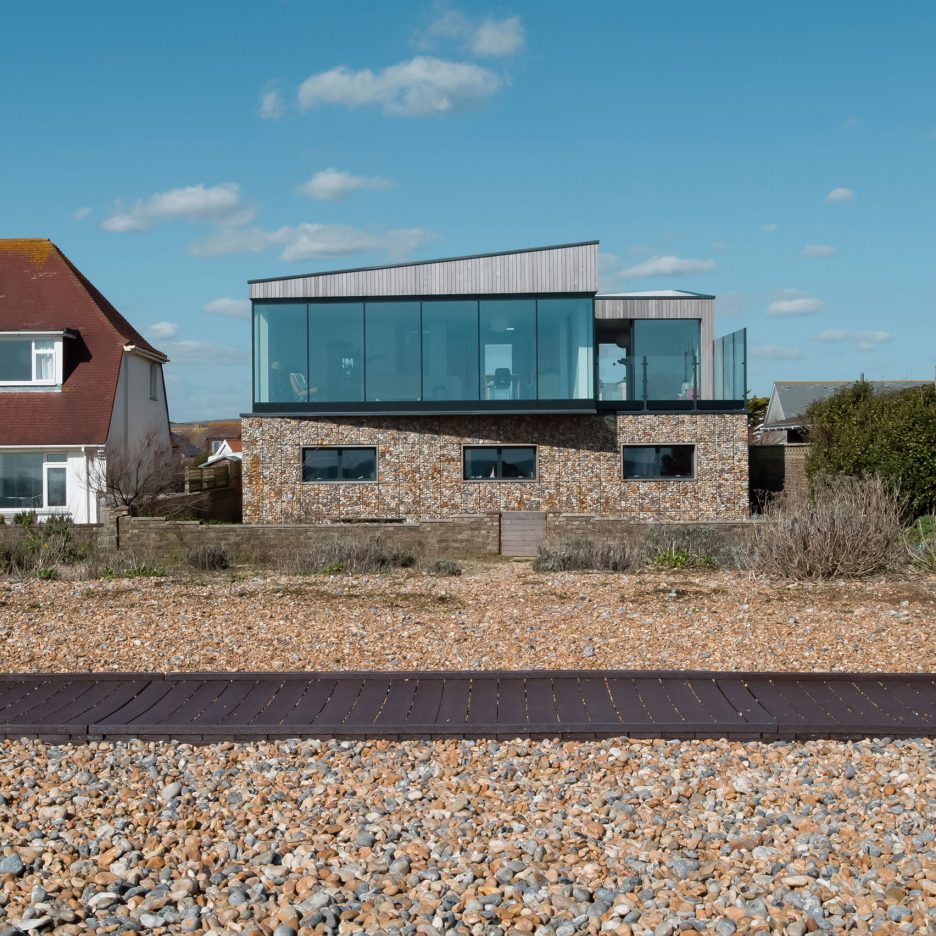
ABIR Architects used pebbles found on the beach to create the layered facade of this house in the English seaside town of Shoreham – which featured in last night’s episode of UK television show Homes By The Sea. (more…)








 Sig Nordal